You are currently viewing a new version of our website. To view the old version click .

Brain Sciences, Volume 15, Issue 3

March 2025 - 110 articles

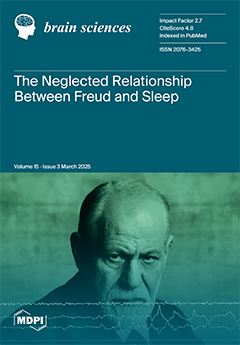
Cover Story: Sleep appears to have a central role in Freud’s original model, since dreaming is considered the guardian of sleep. The function of dreaming is to protect sleep from disruption, thereby preserving its biological integrity. Freud also recognized sleep as an active process, given that human beings voluntarily withdraw from the external world to sleep. The discovery of REM sleep in the 1950s led psychoanalysts to view sleep as the necessary backdrop against which dreaming occurs. Although Freud dismissed the clinical importance of sleep disturbances, authors have since suggested that sleep disturbances might have specific psychological significance. Thanks to Freud’s work, the desire to sleep assumes an important role as a psychological, active factor that contributes to the occurrence and function of sleep. View this paper
  • Issues are regarded as officially published after their release is announced to the table of contents alert mailing list .
  • You may sign up for email alerts to receive table of contents of newly released issues.
  • PDF is the official format for papers published in both, html and pdf forms. To view the papers in pdf format, click on the "PDF Full-text" link, and use the free Adobe Reader to open them.

Articles (110)

  • Article
  • Open Access
2 Citations
1,144 Views
14 Pages

Naringenin Exhibits Antiglioma Activity Related to Aryl Hydrocarbon Receptor Activity and IL-6, CCL2, and TNF-α Expression

  • Monique Reis de Santana,
  • Deivison Silva Argolo,
  • Irlã Santos Lima,
  • Cleonice Creusa dos Santos,
  • Maurício Moraes Victor,
  • Gabriel dos Santos Ramos,
  • Ravena Pereira do Nascimento,
  • Henning Ulrich and
  • Silvia Lima Costa

Background: Glioblastoma (GBM) is a highly aggressive brain tumor characterized by rapid cell proliferation, invasive behavior, and chemoresistance. The aryl hydrocarbon receptor (AhR) is implicated in chemoresistance and immune evasion, making it a...

  • Systematic Review
  • Open Access
1 Citations
6,047 Views
23 Pages

Mindfulness-Based Intervention Effects on EEG and Executive Functions: A Systematic Review

  • Gilberto Galindo-Aldana,
  • Luis Arturo Montoya-Rivera,
  • Jose Jaime Esqueda-Elizondo,
  • Everardo Inzunza-Gonzalez,
  • Enrique Efren Garcia-Guerrero,
  • Alfredo Padilla-Lopez,
  • Tara G. Bautista and
  • Cynthia Torres-González

Background. Mindfulness-based interventions (MBIs) have emerged as an alternative intervention for symptoms of psychological and psychiatric conditions, such as depression, anxiety, and emotional discomfort. Over the last ten years, MBIs have establi...

  • Article
  • Open Access
1 Citations
1,404 Views
13 Pages

Background: Predicting mortality in patients with acute ischemic stroke who need endovascular treatment (EVT) has previously been shown to be related to inflammation. In this study, we aimed to examine the effects of the neutrophil-to-lymphocyte rati...

  • Review
  • Open Access
1,346 Views
22 Pages

Murine Non-Transgenic Models of Alzheimer’s Disease Pathology: Focus on Risk Factors

  • Maricarmen Hernández-Rodríguez,
  • Juan Manuel Vega López,
  • Martín Martínez-Rosas,
  • María Inés Nicolás-Vázquez and
  • Elvia Mera Jiménez

Alzheimer’s disease (AD) represents a significant challenge among neurodegenerative disorders, as effective treatments and therapies remain largely undeveloped. Despite extensive research efforts employing various methodologies and diverse gene...

  • Perspective
  • Open Access
5 Citations
1,280 Views
11 Pages

The metaverse, an immersive virtual environment, is emerging as a transformative tool in rehabilitation, offering innovative modalities for motor and cognitive treatments. Virtual reality and augmented reality within the metaverse facilitate interact...

  • Review
  • Open Access
3 Citations
3,020 Views
19 Pages

Background: Parkinson’s disease has a significant impact on vocal characteristics and speech patterns, making them potential biomarkers for monitoring disease progression. To effectively utilise these biomarkers, it is essential to understand h...

  • Editorial
  • Open Access
1,283 Views
3 Pages

New Insights in Psychiatric Disorder Psychopharmacology

  • Mohammadreza Shalbafan and
  • Laura Orsolini

Psychopharmacological interventions are the treatment cornerstone of most psychiatric disorders such as depression, schizophrenia, obsessive–compulsive disorder, and bipolar disorders, with a huge number of studies including clinical trials and...

  • Article
  • Open Access
1,361 Views
18 Pages

Dual Assessment of Developmental Topographical Disorientation: Comparing Self-Reported Measures with Actual Navigational Performance

  • Alessia Bonavita,
  • Sofia Pepe,
  • Raffaella Nori,
  • Massimiliano Palmiero,
  • Cecilia Guariglia and
  • Laura Piccardi

Background/Objectives: This study aimed to (i) evaluate the effectiveness of the Familiarity and Spatial Cognitive Style Scale (FSCS) and the short Computerized Ecological Navigational Battery (LBS) in predicting navigational performance by comparing...

  • Article
  • Open Access
2 Citations
3,209 Views
17 Pages

Background: Modulating spontaneous neuronal activity is critical for understanding and potentially treating neurological disorders, yet the comparative effects of different non-invasive brain stimulation techniques remain underexplored. Objective: Th...

  • Article
  • Open Access
982 Views
15 Pages

Background/Objectives: First-generation antipsychotics (FGAs) and second-generation antipsychotics (SGAs) are frequently prescribed for the management of problem behaviours (PBs) in people with intellectual developmental disorders (IDDs) with or with...

of 11

Get Alerted

Add your email address to receive forthcoming issues of this journal.

XFacebookLinkedIn
Brain Sci. - ISSN 2076-3425