

You are currently viewing a new version of our website. To view the old version click .

Microorganisms, Volume 10, Issue 2

February 2022 - 288 articles

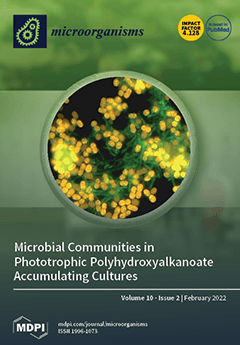
Cover Story: Phototrophic mixed cultures (PMC) are versatile systems which can be applied for waste streams valorisation and production of added-value compounds, such as polyhydroxyalkanoates (PHA). This work employed DNA sequencing, fluorescence in situ hybridization (FISH), Nile blue staining, and morphological observations to deepen our current knowledge of the bacterial communities present in PHA-producing PMC systems. Links between microbial communities and their PHA production performance were established and microbial groups with high PHA accumulation capacity were identified, namely, Chromatiaceae members. Knowledge of the operating conditions that maximize the presence of such groups and PHA storage will help to define improved operational strategies for PHA production with PMC systems. View this paper
  • Issues are regarded as officially published after their release is announced to the table of contents alert mailing list .
  • You may sign up for email alerts to receive table of contents of newly released issues.
  • PDF is the official format for papers published in both, html and pdf forms. To view the papers in pdf format, click on the "PDF Full-text" link, and use the free Adobe Reader to open them.

Articles (288)

  • Article
  • Open Access
13 Citations
4,647 Views
22 Pages

Cupriavidus metallidurans CH34 Possesses Aromatic Catabolic Versatility and Degrades Benzene in the Presence of Mercury and Cadmium

  • Pablo Alviz-Gazitua,
  • Roberto E. Durán,
  • Felipe A. Millacura,
  • Franco Cárdenas,
  • Luis A. Rojas and
  • Michael Seeger

Heavy metal co-contamination in crude oil-polluted environments may inhibit microbial bioremediation of hydrocarbons. The model heavy metal-resistant bacterium Cupriavidus metallidurans CH34 possesses cadmium and mercury resistance, as well as genes...

  • Review
  • Open Access
8 Citations
3,717 Views
13 Pages

Listeria monocytogenes is a foodborne pathogen that typically presents β-hemolytic activity. However, there are literature reports indicating that L. monocytogenes strains are sometimes nonhemolytic or their zones of hemolysis are perceivable on...

  • Article
  • Open Access
11 Citations
3,325 Views
13 Pages

Organic and Inorganic Amendments Shape Bacterial Indicator Communities That Can, In Turn, Promote Rice Yield

  • Chongwen Qiu,
  • Yuanyuan Bao,
  • Evangelos Petropoulos,
  • Yiming Wang,
  • Zhenfang Zhong,
  • Yaozhi Jiang,
  • Xuhong Ye,
  • Xiangui Lin and
  • Youzhi Feng

The dynamic patterns of the belowground microbial communities and their corresponding metabolic functions, when exposed to various environmental disturbances, are important for the understanding and development of sustainable agricultural systems. In...

  • Article
  • Open Access
8 Citations
3,532 Views
23 Pages

Metagenomic Assessment of DNA Viral Diversity in Freshwater Sponges, Baikalospongia bacillifera

  • Tatyana V. Butina,
  • Ivan S. Petrushin,
  • Igor V. Khanaev and
  • Yurij S. Bukin

Sponges (type Porifera) are multicellular organisms that give shelter to a variety of microorganisms: fungi, algae, archaea, bacteria, and viruses. The studies concerning the composition of viral communities in sponges have appeared rather recently,...

  • Article
  • Open Access
11 Citations
3,376 Views
15 Pages

Thermokarst lakes are important aquatic ecosystems in cold regions, experiencing several changes due to global warming. However, the fundamental assembly mechanisms of microeukaryotic communities in thermokarst lakes are unknown. In this study, we ex...

  • Article
  • Open Access
7 Citations
3,340 Views
14 Pages

Shallow-Water Hydrothermal Vents as Natural Accelerators of Bacterial Antibiotic Resistance in Marine Coastal Areas

  • Erika Arcadi,
  • Eugenio Rastelli,
  • Michael Tangherlini,
  • Carmen Rizzo,
  • Monique Mancuso,
  • Marilena Sanfilippo,
  • Valentina Esposito,
  • Franco Andaloro and
  • Teresa Romeo

Environmental contamination by heavy metals (HMs) poses several indirect risks to human health, including the co-spreading of genetic traits conferring resistance to both HMs and antibiotics among micro-organisms. Microbial antibiotic resistance (AR)...

  • Communication
  • Open Access
4 Citations
2,955 Views
8 Pages

Emergence of Novel Chlamydia trachomatis Sequence Types among Chlamydia Patients in the Republic of Belarus

  • Valentina A. Feodorova,
  • Yury V. Saltykov,
  • Anna A. Kolosova,
  • Liudmila V. Rubanik,
  • Nikolay N. Poleshchuk and
  • Vladimir L. Motin

Chlamydia trachomatis (CT) is a major cause of sexually transmitted diseases worldwide. The multilocus sequence typing (MLST) of clinical samples from random heterosexual chlamydia patients who were either asymptomatic or reported clinical manifestat...

  • Technical Note
  • Open Access
10 Citations
3,625 Views
8 Pages

Macroalgae-associated bacteria play an important role in their algal hosts’ biological processes. They are localized on surfaces of the host thalli, as well as between and even within algal cells. To examine the differences in community structu...

  • Article
  • Open Access
25 Citations
5,041 Views
16 Pages

Identification of a Novel Biosurfactant with Antimicrobial Activity Produced by Rhodococcus opacus R7

  • Jessica Zampolli,
  • Alessandra De Giani,
  • Alessandra Di Canito,
  • Guido Sello and
  • Patrizia Di Gennaro

Rhodococcus members excrete secondary metabolites, especially compounds which act as biosurfactants. In this work, we demonstrated the ability of Rhodococcus opacus R7 to produce a novel bioactive compound belonging to the class of biosurfactants wit...

of 29

Get Alerted

Add your email address to receive forthcoming issues of this journal.

XFacebookLinkedIn
Microorganisms - ISSN 2076-2607