You are currently viewing a new version of our website. To view the old version click .

Insects, Volume 14, Issue 9

September 2023 - 61 articles

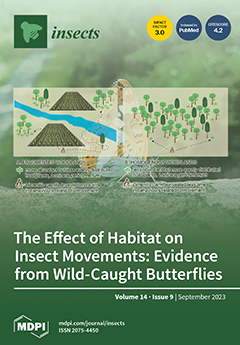
Cover Story: Habitat loss shapes animal behaviour, impacting the long-term survival of species. In our study, we explored the connection between the flight abilities of the woodland-specialist butterfly Limenitis camilla and the spatial–temporal connectivity of its primary habitat: broadleaved forests. We assessed shifts in forest functional connectivity in Wallonia, Belgium, over recent decades using land-cover data. Furthermore, we selectively captured L. camilla females in areas representing opposite ends of habitat connectivity and monitored their behaviours within outdoor arenas designed to replicate the species' natural habitat. Our findings reveal that butterflies from fragmented forests exhibit an increase in departure-related behaviour, potentially indicating an evolutionary adaptation for locating suitable egg-laying sites in shrinking, isolated habitats. View this paper
  • Issues are regarded as officially published after their release is announced to the table of contents alert mailing list .
  • You may sign up for email alerts to receive table of contents of newly released issues.
  • PDF is the official format for papers published in both, html and pdf forms. To view the papers in pdf format, click on the "PDF Full-text" link, and use the free Adobe Reader to open them.

Articles (61)

  • Article
  • Open Access
1 Citations
1,308 Views
12 Pages

11 September 2023

(1) Background: Leptocybe invasa (Hymenoptera: Eulophidae) is a global invasive pest that seriously damages eucalyptus plants and has caused serious harm to forestry production in many countries. Two genotypically distinct lineages of L. invasa have...

  • Article
  • Open Access
2 Citations
2,720 Views
21 Pages

11 September 2023

Candidatus Liberibacter asiaticus (CLas) is one of the putative causal agents of huanglongbing, which is a serious disease in citrus production. The pathogen is transmitted by Diaphorina citri Kuwayama (Hemiptera: Psyllidae). As an observational stud...

  • Article
  • Open Access
4 Citations
2,244 Views
20 Pages

9 September 2023

Parasitoids forage for hosts in dynamic ecosystems and generally have a short period of time to access hosts. The current study examined the optimal reproductive attributes of two egg parasitoids, Paratelenomus saccharalis Dodd (Hymenoptera: Platygas...

  • Article
  • Open Access
2,518 Views
24 Pages

9 September 2023

Anthropogenic land-cover change is modifying ecosystems at an accelerating rate. Changes to ecomorphologically variable taxa within those ecosystems serve as early-warning signs that resources on which humans and other animals depend are being altere...

  • Feature Paper
  • Article
  • Open Access
6 Citations
2,814 Views
16 Pages

8 September 2023

Chitin is the major component of the extracellular cuticle and plays multiple roles in insects. In butterflies, chitin builds wing scales for structural colors. Here, we show that intracellular chitin in live cells can be detected in vivo with fluore...

  • Article
  • Open Access
17 Citations
5,067 Views
14 Pages

8 September 2023

Temperature has been shown to have profound effects on mosquito population dynamics and life history. Understanding these effects can provide insight into how mosquito populations and the diseases they transmit may vary across space and time and unde...

  • Article
  • Open Access
10 Citations
4,592 Views
11 Pages

Honey vs. Mite—A Trade-Off Strategy by Applying Summer Brood Interruption for Varroa destructor Control in the Mediterranean Region

  • Marin Kovačić,
  • Aleksandar Uzunov,
  • Ivana Tlak Gajger,
  • Marco Pietropaoli,
  • Victoria Soroker,
  • Noureddine Adjlane,
  • Valerija Benko,
  • Leonidas Charistos,
  • Raffaele Dall’Olio and
  • Giovanni Formato
  • + 7 authors

7 September 2023

In this study, we investigated the effect of queen caging on honey bee colonies’ post-treatment development and the optimal timing of method application on honey production during the main summer nectar flow. We conducted the study in nine apia...

  • Article
  • Open Access
1 Citations
2,255 Views
16 Pages

6 September 2023

Hishimonus hamatus Kuoh is a leafhopper species native to China that feeds on Chinese jujube leaves. This leafhopper species has been verified to transmit jujube witches’ broom (JWB) disease, caused by phytoplasma, a fatal plant pathogen, which...

  • Article
  • Open Access
7 Citations
2,630 Views
61 Pages

The Morphological Diversity of Dragon Lacewing Larvae (Nevrorthidae, Neuroptera) Changed More over Geological Time Scales Than Anticipated

  • Laura Mengel,
  • Simon Linhart,
  • Gideon T. Haug,
  • Thomas Weiterschan,
  • Patrick Müller,
  • Christel Hoffeins,
  • Hans-Werner Hoffeins,
  • Viktor Baranov,
  • Carolin Haug and
  • Joachim T. Haug

6 September 2023

Nevrorthidae, the group of dragon lacewings, has often been considered a relic group. Today, dragon lacewings show a scattered distribution, with some species occurring in southern Europe, Japan, Australia, and one in China. The idea that this distri...

  • Article
  • Open Access
8 Citations
1,937 Views
12 Pages

6 September 2023

Researchers have previously investigated the role of Trichopria drosophilae as a pupal parasitoid in the biological control of Drosophila suzukii in China. Here, we investigated the ability of T. drosophilae to parasitize D. suzukii pupae at differen...

of 7

Get Alerted

Add your email address to receive forthcoming issues of this journal.

XFacebookLinkedIn
Insects - ISSN 2075-4450