


You are currently on the new version of our website. Access the old version .

Insects, Volume 14, Issue 10

October 2023 - 54 articles

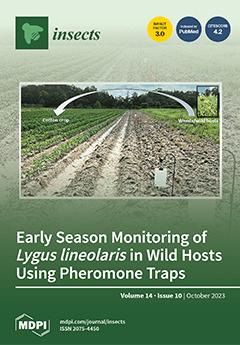
Cover Story: The tarnished plant bug, Lygus lineolaris, is a polyphagous pest that causes severe economic damage to cotton crops. Managing weedy field edges is important in preventing early season infestations of L. lineolaris in cotton. Scouting the fields for L. lineolaris is time- and labor-intensive, and individual variability can lead to inaccuracies. Insect traps combining visual cues and pheromones are more accurate, sustainable, and economically feasible. We investigated the application of red or white sticky cards baited with a female-produced sex pheromone to monitor overwintering L. lineolaris populations in early spring. The field experiments demonstrated that the red sticky cards baited with the pheromone are highly effective in trapping L. lineolaris adults in early spring before the row crops were planted and in monitoring their movement in cotton crops. View this paper
  • Issues are regarded as officially published after their release is announced to the table of contents alert mailing list .
  • You may sign up for email alerts to receive table of contents of newly released issues.
  • PDF is the official format for papers published in both, html and pdf forms. To view the papers in pdf format, click on the "PDF Full-text" link, and use the free Adobe Reader to open them.

Articles (54)

  • Article
  • Open Access
2 Citations
2,797 Views
14 Pages

23 October 2023

Two phenotypically similar but genetically distinct genotypes of Spissistilus festinus (Say, 1830) (Hemiptera: Membracidae), a pest of legume crops in Southern United States and a vector of grapevine red blotch virus (GRBV) in California vineyards, e...

  • Article
  • Open Access
5 Citations
4,368 Views
15 Pages

23 October 2023

Beekeeping faces several challenges, such as the Varroa mite. Few studies have measured the economic performance of farms in relation to the practices used for Varroa control. Our study analyzed various biotechniques (total brood removal, TBR; queen...

  • Article
  • Open Access
2 Citations
2,514 Views
13 Pages

21 October 2023

As a social organism, living in a communal structure is one of the most important physical barriers against environmental elements and natural enemies. Thaumetopoea pityocampa (Notodontidae, Thaumetopoeinae) caterpillars are conifer pests that spend...

  • Article
  • Open Access
4 Citations
3,073 Views
12 Pages

Optimization of Brewer’s Yeast Quantity in Liquid and Gel Larval Diets for the Mediterranean Fruit Fly

  • Paraschos N. Prekas,
  • Vasilis G. Rodovitis,
  • Evmorfia P. Bataka,
  • David Nestel,
  • Christos T. Nakas and
  • Nikos T. Papadopoulos

21 October 2023

Several artificial larval diets have been developed, evaluated and used for mass-rearing of the Mediterranean fruit fly (medfly), Ceratitis capitata (Wiedemann) (Diptera: Teprhitidae). There are several efforts to reduce the cost of rearing and optim...

  • Article
  • Open Access
2 Citations
2,823 Views
12 Pages

20 October 2023

Beekeeping in Ireland has been strongly impacted by the parasitic mite Varroa destructor, whose introduction caused alarming honeybee colony losses. If unmitigated, these losses could lead to the disappearance of the native honeybee subspecies, Apis...

  • Article
  • Open Access
4 Citations
2,324 Views
13 Pages

20 October 2023

The chalcid wasp Tetrastichus septentrionalis Yang (Hymenoptera: Eulophidae) is one of the dominant pupal parasitoids of Hyphantria cunea (Drury) (Lepidoptera: Erebidae). In this study, the photoperiod’s effect on diapause induction in T. septe...

  • Article
  • Open Access
1,786 Views
12 Pages

20 October 2023

MALDI-TOF is now considered a relevant tool for the identification of arthropods, including lice and fleas. However, the duration and conditions of storage, such as in ethanol, which is frequently used to preserve these ectoparasites, could impede th...

  • Article
  • Open Access
13 Citations
5,245 Views
13 Pages

Growth Performance, Diet Digestibility, and Chemical Composition of Mealworm (Tenebrio molitor L.) Fed Agricultural By-Products

  • Ana Montalbán,
  • Silvia Martínez-Miró,
  • Achille Schiavone,
  • Josefa Madrid and
  • Fuensanta Hernández

20 October 2023

Humanity’s growing demand for animal protein exceeds the capacity of traditional protein sources to support growing livestock production. Insects offer promising partial substitutes, converting low-nutritional quality materials into high-value...

  • Article
  • Open Access
1 Citations
2,114 Views
14 Pages

18 October 2023

It has long been disputed whether Tetranychus cinnabarinus and Tetranychus urticae belong to the same genus, with T. cinnabarinus regarded as a red form of T. urticae. However, it is unclear why T. urticae and T. cinnabarinus have different body colo...

  • Article
  • Open Access
8 Citations
2,563 Views
21 Pages

Vertical Distribution of Fruit Flies (Diptera: Drosophilidae) in Deciduous Forests in the Center of European Russia

  • Nikolai G. Gornostaev,
  • Alexander B. Ruchin,
  • Mikhail N. Esin,
  • Oleg E. Lazebny and
  • Alex M. Kulikov

18 October 2023

Research of Diptera in temperate forests has demonstrated uneven vertical distributions of insects. In this study, we examined the vertical distribution, seasonal fluctuations, and species diversity of Drosophilidae species in the Mordovia State Rese...

of 6

Get Alerted

Add your email address to receive forthcoming issues of this journal.

XFacebookLinkedIn
Insects - ISSN 2075-4450