



Next Issue
Volume 14, August
Previous Issue
Volume 14, June


Lubricants, Volume 14, Issue 7 (July 2026) – 35 articles
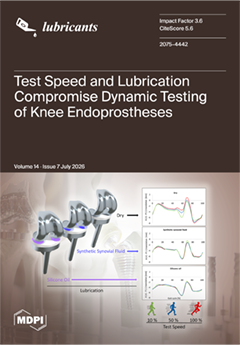
Cover Story (view full-size image): Preclinical testing of total knee endoprostheses is essential for ensuring implant safety and performance in situ. While loading and lubrication conditions are well defined for standard wear tests, their impact on dynamic implant testing by means of complex test setups, such as six-degree-of-freedom joint simulators, remains unclear. This study investigates the effect of different test speeds and lubrication conditions on the kinematics and kinetics of total knee endoprostheses. The results show that both parameters substantially influence the dynamic behavior of total knee endoprostheses. Targeted selection of test parameters and lubrication conditions is therefore essential for data interpretation and for obtaining reliable results in advanced testing of total knee implants. View this paper
  • Issues are regarded as officially published after their release is announced to the table of contents alert mailing list.
  • You may sign up for e-mail alerts to receive table of contents of newly released issues.
  • PDF is the official format for papers published in both, html and pdf forms. To view the papers in pdf format, click on the "PDF Full-text" link, and use the free Adobe Reader to open them.
Order results
Result details
Select all
Export citation of selected articles as:
23 pages, 14506 KB  
Article
Tribological Performance Evolution of Circular-Textured Surface Embedded with Paraffin Regulated by Texture Geometric Dimensions
by Qianzhi Wang, Haofeng Yin and Zhifeng Zhou
Lubricants 2026, 14(7), 282; https://doi.org/10.3390/lubricants14070282 - 21 Jul 2026
Viewed by 283
Abstract
The positive effect of paraffin on lowering the temperature, friction coefficient, and wear mass of a circular-textured surface has been proved. On this basis, this study is meant to reveal the influence of surface density and diameter of circular texture on the lubricating [...] Read more.
The positive effect of paraffin on lowering the temperature, friction coefficient, and wear mass of a circular-textured surface has been proved. On this basis, this study is meant to reveal the influence of surface density and diameter of circular texture on the lubricating effect. It was found that the friction coefficient and wear kept decreasing as surface density increased from 6.8% to 24.2% due to increasing dynamic pressure up to 285 Pa. However, as surface density further increased to 40.1%, the tribological properties were weakened due to high contact stress from a smaller contact area. On the basis of the optimized surface density of 24.2%, the friction coefficient and wear kept decreasing due to increasing dynamic pressure up to 326 Pa as the diameter of the circular texture increased from 400 μm to 550 μm. When the diameter of the circular texture increased to 650 μm, the tribological properties of the textured surface were weakened. Compared with a depth of 500 μm, a depth of 1000 μm could store more paraffin, providing better temperature-reducing and lubricating effects. Ultimately, the minimum temperature of 40.78 °C, minimum friction coefficient of 0.063 ± 0.003, and minimum wear loss of 0.70 ± 0.10 mg were obtained under the optimal texture surface density, diameter, and depth of 24.2%, 550 μm, and 1000 μm, respectively. Full article
(This article belongs to the Special Issue Phase-Change-Induced Improvements in Friction Interface Lubrication)
Show Figures

Figure 1

45 pages, 9585 KB  
Article
A Finite Volume-Based Unified Transient Deterministic Framework for Lubrication Modelling
by Filimonas Kaliafetis, Daniele Dini, James P. Ewen and Suhaib Ardah
Lubricants 2026, 14(7), 281; https://doi.org/10.3390/lubricants14070281 - 21 Jul 2026
Viewed by 300
Abstract
A unified transient deterministic lubrication model is developed for the analysis of rough, starved, and coated contacts within a single, fully-coupled numerical framework capable of resolving boundary, mixed, and full-film lubrication regimes. The model is formulated with the finite volume method on a [...] Read more.
A unified transient deterministic lubrication model is developed for the analysis of rough, starved, and coated contacts within a single, fully-coupled numerical framework capable of resolving boundary, mixed, and full-film lubrication regimes. The model is formulated with the finite volume method on a curvilinear grid and extends conventional full-film formulations through the introduction of a semi-system methodology, enabling robust treatment of complex multi-regime conditions. A key distinguishing feature of the framework is the direct resolution of thermal effects within both the lubricant and solid domains through solution of the energy equation. Unlike many existing mixed lubrication models that rely on analytical temperature approximations, the present approach captures transient, asperity-scale temperature evolution explicitly, allowing accurate representation of local thermo-mechanical interactions. Two case studies are presented to demonstrate the capabilities of the model. The first examines transient starvation in rough contacts with isotropic sinusoidal topographies of varying wavelength, as well as random machined surfaces, revealing a strong dependence of lubricant entrainment, asperity interaction, and localised heating on surface morphology. The second study investigates the role of coating thermal properties under transient starved conditions, demonstrating strong coupling between heat transport, viscosity variations, and frictional response. Overall, the proposed framework provides a robust and physically consistent platform for the simulation of transient lubrication phenomena under realistic operating conditions, enabling detailed insight into roughness, starvation, and thermal effects across regimes using a fully-coupled approach. Full article
(This article belongs to the Special Issue Modeling and Simulation of Elastohydrodynamic Lubrication)
Show Figures

Figure 1

20 pages, 18428 KB  
Article
Consolidation of Tantalum Powders by Spark Plasma Sintering: Densification, Wear and Corrosion Behavior
by Elena Mihalcea, Jorge Chávez, Omar Jiménez, Martín Flores, Francisco Alvarado-Hernández, Juan Pablo Camarillo-García, Horacio Flores-Zúñiga, Marco Aurelio González-Albarrán and Luis Olmos
Lubricants 2026, 14(7), 280; https://doi.org/10.3390/lubricants14070280 - 21 Jul 2026
Viewed by 307
Abstract
Tantalum (Ta) is an excellent alternative for structural orthopedic implants because of its high biocompatibility and chemical stability, but its melting point of 3020 °C severely complicates conventional casting. To address this, the study evaluates spark plasma sintering (SPS) to consolidate pure Ta [...] Read more.
Tantalum (Ta) is an excellent alternative for structural orthopedic implants because of its high biocompatibility and chemical stability, but its melting point of 3020 °C severely complicates conventional casting. To address this, the study evaluates spark plasma sintering (SPS) to consolidate pure Ta powders at 1450 °C and 50 MPa and analyzes the impact of heating rates (50–200 °C/min) on microstructural, mechanical, wear, and corrosion properties. Results indicate that heating rate dictates final densification: a 50 °C/min rate achieved 98.59% relative density, whereas 200 °C/min yielded only 82.28% due to reduced thermal exposure. Sintering involved dislocation creep and viscous flow mechanisms, with X-ray diffraction confirming a stable α-Ta matrix across all samples. Mechanically, the 50 °C/min samples achieved a maximum microhardness of 285 HV, whereas higher porosity at 200 °C/min reduced hardness by 27.8%. Wear testing showed a two-stage friction evolution: an initial Ta2O5 solid-lubricating effect, followed by predominant abrasion and adhesion, with stable wear rates (3.2 to 3.6 × 10⁻³ mm3/N·m) for dense specimens. Finally, tests in simulated body fluid confirmed spontaneous self-passivation. However, the corrosion rate increased with heating rates, indicating that the resulting porosity adversely affects the material’s surface response. Full article
Show Figures

Graphical abstract

27 pages, 6684 KB  
Article
Synergistic and Inhibitive Effects of Dissolved Air on Vapor Cavitation in Diesel Engine Bearing Oil Film
by Tianyi Yu, Zhenming Liu, Zhifei Dang, Guifeng Liu, Baiqi Huo, Mei Li and Jingbin Liu
Lubricants 2026, 14(7), 279; https://doi.org/10.3390/lubricants14070279 - 21 Jul 2026
Viewed by 247
Abstract
When predicting cavitation erosion risk in practical engineering bearings, traditional vapor cavitation models neglect the effect of dissolved air in the lubricant and fail to account for its precipitation and dynamic evolution in local low-pressure regions, leading to deviations in the prediction of [...] Read more.
When predicting cavitation erosion risk in practical engineering bearings, traditional vapor cavitation models neglect the effect of dissolved air in the lubricant and fail to account for its precipitation and dynamic evolution in local low-pressure regions, leading to deviations in the prediction of cavitation extent, intensity, and distribution. Taking the main bearing of a certain type of diesel engine as the research object, a coupled cavitation model combining the Schnerr–Sauer vapor cavitation model and a Henry’s law-based gas dissolution model is established. Together with large eddy simulation (LES), the accuracy of the numerical model is verified by constructing a visualization experimental platform. Numerical analysis is then carried out to investigate the effect of dissolved air in the lubricant on the cavitating flow field of the bearing oil film under initial conditions ranging from undersaturated to saturated states (air mass concentration of 0–0.4 g/L). The results show that as the mass concentration increases, the amount of air precipitation in the near-wall region gradually increases and extends downstream. When the mass concentration reaches 0.1 g/L, the precipitated air mass reaches 50% of the vapor cavitation mass, significantly expanding the cavitation range. In the critical mass concentration range of 0.24–0.28 g/L, intense air precipitation occurs inside the oil hole and covers the entire region. Through the synergistic effects of inhibiting high-speed jets, altering the local pressure field, and competing for cavitation nuclei, the precipitated air significantly suppresses the development of near-wall vapor cavitation, and the vapor cavitation mass decreases by 83.1% at saturation. In summary, within the practical mass concentration range, the presence of dissolved air significantly enhances the gas phase intensity near the bearing bush surface and expands the cavitation range, thereby exacerbating the risk of cavitation erosion damage in this region, while having little effect on the oil supply performance of the oil hole. Full article
(This article belongs to the Special Issue Advances in Hydrodynamic Bearings)
Show Figures

Figure 1

23 pages, 13829 KB  
Review
Application of Al–Si Alloys in Internal Combustion Engines
by Saša Milojević, Slavica Miladinović, Sandra Gajević, Stefan Čukić and Blaža Stojanović
Lubricants 2026, 14(7), 277; https://doi.org/10.3390/lubricants14070277 - 21 Jul 2026
Viewed by 634
Abstract
The use of aluminium alloys in internal combustion engines is an effective strategy for increasing energy efficiency, reducing component mass, and lowering harmful gas emissions. This paper analyses different types of Al–Si alloys (hypoeutectic, eutectic, and hypereutectic) in the context of their use [...] Read more.
The use of aluminium alloys in internal combustion engines is an effective strategy for increasing energy efficiency, reducing component mass, and lowering harmful gas emissions. This paper analyses different types of Al–Si alloys (hypoeutectic, eutectic, and hypereutectic) in the context of their use in the production of engine blocks, pistons, and cylinder liners. Special attention is given to the tribological challenges of using aluminium, such as increased wear and lower strength compared to traditional materials such as cast iron. Modern methods for improving wear resistance are discussed, including alloying, the application of solid lubricants and protective coatings (Ni–SiC, Al2O3, MoS2, etc.), and advanced surface engineering technologies such as PTWA, HVOF, and laser alloying techniques. This paper also presents practical examples of industrial applications, highlighting their essential role in the development of lightweight, high–performance internal combustion engines. This review highlights that the combination of optimized alloy composition and advanced surface engineering technologies represents the most effective approach for enhancing the durability and tribological performance of lightweight engine components. Full article
Show Figures

Figure 1

32 pages, 5772 KB  
Article
Method for Real-Time Monitoring of the Lubrication Regimes in Dynamically Loaded Radial Sliding Bearings Using Physics-Informed Neural Networks (PINNs)
by Ahmed Saleh, Georg Jacobs, Wenxi Chen, Mattheüs Lucassen and Benjamin Lehmann
Lubricants 2026, 14(7), 278; https://doi.org/10.3390/lubricants14070278 - 20 Jul 2026
Viewed by 386
Abstract
This study proposes a model-based method for real-time monitoring of the lubrication regimes in dynamically loaded radial sliding bearings using Physics-Informed Neural Networks (PINN). The proposed method replaces computationally intensive elastohydrodynamic lubrication (EHD) simulations with a PINN-based surrogate model. The model predicts hydrodynamic [...] Read more.
This study proposes a model-based method for real-time monitoring of the lubrication regimes in dynamically loaded radial sliding bearings using Physics-Informed Neural Networks (PINN). The proposed method replaces computationally intensive elastohydrodynamic lubrication (EHD) simulations with a PINN-based surrogate model. The model predicts hydrodynamic pressure and lubricant film-thickness distributions with comparable accuracy under dynamically varying operating conditions, enabling reliable assessment of lubrication regimes. The proposed model advances the state of the art in physics-informed modelling of mixed lubrication by extending existing approaches to simultaneously account for mixed-friction regimes through the Greenwood–Tripp contact model, transient operating conditions, and bearing surface deformation. Using only the bearing load and shaft rotational speed as inputs, the resulting hydrodynamic pressure field and corresponding lubricant film thickness can be monitored, enabling the direct assessment of the lubrication regime and potential wear risk. The proposed method is applied to a validated EHD model of a 30 mm sliding bearing test rig, where EHD simulation results are used to train, validate, and evaluate the model. The proposed framework achieved an average lubricant film-thickness prediction error of 2.34% and lubrication-regime classification errors of 7.8% and 8.2% for the static and dynamic validation cases, respectively. Furthermore, the computation time for the complete 18-time-step load case was reduced from approximately 35 h to 61.2 ms. Full article
(This article belongs to the Special Issue Intelligent Algorithms for Triboinformatics)
Show Figures

Figure 1

17 pages, 6996 KB  
Article
Effect of Oleic Acid Lubricating Performance on Yield Behavior of Magnetorheological Fluid
by Yanan Zhang, Baolin Jia, Hongjian Wu, Xinlong Wu, Yonggang Meng and Chuke Ouyang
Lubricants 2026, 14(7), 276; https://doi.org/10.3390/lubricants14070276 - 18 Jul 2026
Viewed by 284
Abstract
The effect of different concentrations of oleic acid additive on the yield behavior of a magnetorheological fluid (MRF) was investigated from the perspective of tribology. Different concentrations of oleic acid (OA) influence the magnetorheological effect by altering the lubricating properties of the base [...] Read more.
The effect of different concentrations of oleic acid additive on the yield behavior of a magnetorheological fluid (MRF) was investigated from the perspective of tribology. Different concentrations of oleic acid (OA) influence the magnetorheological effect by altering the lubricating properties of the base carrier liquid. Good lubricity of the carrier fluids led to lower shear stresses. The friction between the particles and that between the particles and plates were a part of the shear stress. The structural evolution was promoted by both lubrication and shearing. The shearing thinning of the MRF was delayed under good lubricity, and the particles were easier to roll. The friction forces, along with Brownian forces, Stokes forces, and magnetic attraction, affect the structural evolution of MRF. This study provides a new theory for the formulation design of magnetorheological fluids, reducing design costs and improving production efficiency. Full article
Show Figures

Figure 1

16 pages, 13513 KB  
Article
Investigation into Lubricating Oil Jet Injection and Tooth Surface Oil-Film Spreading Characteristics of Aero-Engine Accessory Gears
by Jianfeng Li, Meng He, Fei Wang and Ziang Ge
Lubricants 2026, 14(7), 275; https://doi.org/10.3390/lubricants14070275 - 17 Jul 2026
Viewed by 411
Abstract
The accessory gearbox of an aero-engine operates under high-speed and heavy-load conditions, where insufficient lubrication may lead to oil-film failure, increased frictional losses, and reduced transmission reliability. Therefore, understanding oil-jet injection and tooth surface oil-film spreading characteristics is essential for improving lubrication performance. [...] Read more.
The accessory gearbox of an aero-engine operates under high-speed and heavy-load conditions, where insufficient lubrication may lead to oil-film failure, increased frictional losses, and reduced transmission reliability. Therefore, understanding oil-jet injection and tooth surface oil-film spreading characteristics is essential for improving lubrication performance. In this study, a three-dimensional geometric model incorporating the meshing region and oil nozzles was established based on a typical accessory gear pair. The model employs the VOF multiphase flow approach and the standard k-ε turbulence model, coupled with dynamic mesh techniques to accurately capture the transient interactions between gear rotation and oil–air two-phase flow. Numerical simulations reveal the dynamic evolution of oil injection, impingement on the tooth surface, oil-film spreading, and transport into the meshing zone, while the effects of injection velocity and nozzle length on lubrication performance are quantitatively analyzed. Results indicate that an injection velocity of 45–55 m/s yields optimal oil-film coverage and uniformity, and a nozzle length of h = 30 mm minimizes jet energy decay and airflow interference, achieving uniform oil filling in the meshing zone. The optimal lubrication performance for accessory gears is obtained at an injection velocity of 45–55 m/s and a nozzle length of 30 mm. This study provides a reference for the design optimization of accessory gear lubrication systems. Full article
(This article belongs to the Special Issue Novel Tribology in Drivetrain Components)
Show Figures

Figure 1

21 pages, 3780 KB  
Article
Elastoplastic Multi-Physics Modeling of Sliding Electrical Contact in Slip Rings
by Yijin Sui, Pengfei Xing, Guobin Li and Hongpeng Zhang
Lubricants 2026, 14(7), 274; https://doi.org/10.3390/lubricants14070274 - 16 Jul 2026
Viewed by 249
Abstract
Electrical slip rings are key components for power and signal transmission in rotating equipment, and degradation of sliding electrical contact is a major factor limiting their reliability. To analyze the sliding electrical contact behavior of slip rings, an elastoplastic contact framework incorporating thermal–mechanical–electrical [...] Read more.
Electrical slip rings are key components for power and signal transmission in rotating equipment, and degradation of sliding electrical contact is a major factor limiting their reliability. To analyze the sliding electrical contact behavior of slip rings, an elastoplastic contact framework incorporating thermal–mechanical–electrical coupling is developed. The semi-analytical method combined with discrete convolution-fast Fourier transform is employed to efficiently solve the coupled contact problem, while J2 flow theory and radial return algorithm are adopted to determine plastic deformation. Based on the proposed model, the elastoplastic sliding electrical contact behaviors of smooth and sinusoidal surfaces are systematically investigated. The results show that plastic deformation increases the contact area, thereby reducing the electrical contact resistance, current density at the contact edge, and maximum temperature rise, although it may induce the residual stress. Reducing the asperity height of sinusoidal surfaces while maintaining multiple discrete micro contact spots can effectively lower the electrical contact resistance and interfacial temperature rise. The proposed model provides a useful theoretical tool for evaluating the thermal–mechanical–electrical performance of sliding electrical contact in slip rings. Full article
Show Figures

Graphical abstract

5 pages, 168 KB  
Editorial
High Performance Machining and Surface Tribology
by Lai Hu, Jun Wang and Chen Yin
Lubricants 2026, 14(7), 273; https://doi.org/10.3390/lubricants14070273 - 16 Jul 2026
Viewed by 306
Abstract
High-quality equipment in aerospace, energy, transportation, and advanced manufacturing sectors is increasingly required to operate with higher speeds, loads, precision, and autonomy [...] Full article
(This article belongs to the Special Issue High Performance Machining and Surface Tribology)
23 pages, 11965 KB  
Article
Electrochemical Response Characteristics During the Oxidative Degradation of Gear Oil in Wind Turbine Generators
by Min Wang, Guo-Jun Qin and Ming Liu
Lubricants 2026, 14(7), 272; https://doi.org/10.3390/lubricants14070272 - 16 Jul 2026
Viewed by 362
Abstract
Oxidative degradation stands as the principal cause of gear oil failure and transmission system malfunctions in wind turbines. Electrochemical impedance spectroscopy (EIS) offers a novel technical avenue for the condition monitoring of gear oil. This research centers on the evolution mechanism of electrochemical [...] Read more.
Oxidative degradation stands as the principal cause of gear oil failure and transmission system malfunctions in wind turbines. Electrochemical impedance spectroscopy (EIS) offers a novel technical avenue for the condition monitoring of gear oil. This research centers on the evolution mechanism of electrochemical properties during the oxidative degradation process, utilizing high-viscosity gear oil commonly employed in wind turbines as the research subject. Through a combination of accelerated oxidation tests, broadband EIS measurements, and equivalent circuit fitting, the study examines the variations in the electrochemical response of gear oil with respect to oxidation temperature and duration. The findings reveal that oxidative degradation does not modify the single-relaxation dielectric characteristics of the gear oil; however, various electrochemical parameters undergo systematic evolution. Following oxidation at temperatures ranging from 90 to 120 °C, the charge transfer resistance escalates by approximately 5.9-fold; the base resistance diminishes by 10% to 20%; both the admittance constant and dispersion index of the constant phase element (CPE) exhibit changes of less than 5%, indicating that the system retains its capacitive properties. During constant-temperature oxidation at 90 °C for durations spanning 50 to 175 h, the charge transfer resistance increases in an approximately linear fashion with oxidation time, while the base resistance continues to decline, and the CPE parameters remain largely stable. Various electrochemical parameters evolve monotonically with the extent of oxidation, with charge transfer resistance demonstrating the highest sensitivity to thermal oxidation and thus serving as a pivotal indicator for evaluating the degree of thermal oxidative degradation in gear oil. This study lays an experimental foundation for the application of EIS technology in the realm of online gear oil monitoring. Full article
(This article belongs to the Special Issue Condition Monitoring of Lubricating Oils)
Show Figures

Figure 1

27 pages, 13813 KB  
Article
Coupled Dynamics and Nonlinear Behavior of 5-DoF Heavy-Load Mechanical Press with Multi-Type Clearance Joints Considering Lubricated and Dry Contact Conditions
by Xuze Wu, Qingyun Ye, Guo Li, Chunyuan Shi, Wen Liu, Hang Wang and Yu Chen
Lubricants 2026, 14(7), 271; https://doi.org/10.3390/lubricants14070271 - 15 Jul 2026
Viewed by 233
Abstract
Joint clearances inevitably deteriorate kinematic accuracy and operational stability of heavy-load mechanical presses. Most existing studies focus on single-type clearances or uniform contact states, failing to reveal the coupled dynamic behavior of multi-type clearances with differentiated lubrication conditions. This work develops a five-degree-of-freedom [...] Read more.
Joint clearances inevitably deteriorate kinematic accuracy and operational stability of heavy-load mechanical presses. Most existing studies focus on single-type clearances or uniform contact states, failing to reveal the coupled dynamic behavior of multi-type clearances with differentiated lubrication conditions. This work develops a five-degree-of-freedom coupled dynamic model for a double-crank mechanical press, integrating hydrodynamic lubricated revolute joints and dry contact–impact translational joints. Nonlinear dynamic responses under varying clearances, driving speeds and contact regimes are systematically analyzed. Results show that moderately enlarged translational clearance improves positioning accuracy by suppressing oil film whirl-induced chaos; lubricated revolute joints effectively isolate high-frequency impact energy via squeeze-film damping, and the system exhibits non-monotonic dynamic characteristics with speed. This study provides a theoretical basis for clearance matching and operating optimization of mechanical presses. Full article
Show Figures

Figure 1

38 pages, 15122 KB  
Article
Quantitative Kinematics of Thermal Transients in Thin-Layer PEEK/CF30 Composite and Implications for Temperature Monitoring of Plain Bearings
by Nikolay Ovcharenko
Lubricants 2026, 14(7), 270; https://doi.org/10.3390/lubricants14070270 - 15 Jul 2026
Viewed by 296
Abstract
Thermal kinematics in two-layer systems, analogous to those employed in plain bearings, are investigated. The systems are based on a PEEK/CF30 composite, considered an established alternative to traditional babbitt alloys. Experimental modelling of transient and quasi-steady-state heat transfer regimes was performed on a [...] Read more.
Thermal kinematics in two-layer systems, analogous to those employed in plain bearings, are investigated. The systems are based on a PEEK/CF30 composite, considered an established alternative to traditional babbitt alloys. Experimental modelling of transient and quasi-steady-state heat transfer regimes was performed on a test bench implementing a one-dimensional heat conduction model within multi-layered media. Samples included babbitt alloy and polymer coatings with thicknesses of 0.40, 0.46, and 1.92 mm. A phenomenological model of heat transfer regimes is proposed, encompassing five sequential phases that represent a complete operating cycle of plain bearing temperature traces. The observed constants of temperature deviations and phase lags are discussed, including their application as instrumental invariants. It was established that reducing the antifriction layer thickness to 0.4 mm significantly lowers its thermal resistance and decreases the time lag by a factor of 5–8. This brings the system response time close to values characteristic of classical babbitt alloys. It is demonstrated that in steady-state hydrodynamic friction regimes, the temperature deviation for thin layers is less than 1 °C, obviating the necessity for algorithmic data compensation. The findings confirm the safety of using polymer materials as the working layer in plain bearings. Despite their lower thermal conductivity and increased time lag, the composites’ high thermal stability margin comfortably compensates for potential temperature deviations, ensuring equipment reliability and safety. Full article
Show Figures

Figure 1

23 pages, 3379 KB  
Article
Tool Wear Prediction in Complex Machining Processes: A Hybrid Residual-Compensated Deep Learning Framework
by Fucong Liu, Faqiang Wen, Baokaidi Tian, Lei Yu, Tianxiang Yu, Min Li, Yixin Geng and Sai Lou
Lubricants 2026, 14(7), 269; https://doi.org/10.3390/lubricants14070269 - 12 Jul 2026
Viewed by 380
Abstract
Accurate tool wear prediction is essential for predictive maintenance in complex machining processes, but non-stationary sensor signals make it difficult for a single model to capture both long-term degradation trends and local transient disturbances. This study introduces a residual-compensated Hybrid CNN-Informer + LightGBM [...] Read more.
Accurate tool wear prediction is essential for predictive maintenance in complex machining processes, but non-stationary sensor signals make it difficult for a single model to capture both long-term degradation trends and local transient disturbances. This study introduces a residual-compensated Hybrid CNN-Informer + LightGBM framework for tool wear prediction. The workflow first preprocesses multi-source sensor signals and selects wear-sensitive statistical descriptors to guide FiLM-based deep feature modulation. A CNN-Informer backbone then estimates the main wear trend by combining local feature extraction with long-range temporal modeling, and a LightGBM module performs secondary compensation on the remaining prediction residuals. On the PHM 2010 milling benchmark, the proposed framework achieved an RMSE of 4.0016, MAE of 2.8271, and R2 of 0.9870, reducing RMSE and MAE by 47.9% and 48.5% compared with a standard Transformer. Ablation results showed that both the CNN branch and residual compensation contributed to the final accuracy. External validation on the HMoTP dataset using an independent held-out tool further yielded an RMSE of 9.1111, MAE of 7.3522, and R2 of 0.9729. These results indicate that separating main-trend learning from residual correction provides a practical strategy for robust tool wear prediction under the tested machining conditions. Full article
Show Figures

Figure 1

18 pages, 7821 KB  
Article
Research on Magnetorheological Fluid Hydrostatic Bearing Device with Variable Stiffness
by Haopeng Li, Gege Liu, Shumeng Wang, Shaoyu Zhu, Yanzhe Bi and Shuyou Wang
Lubricants 2026, 14(7), 268; https://doi.org/10.3390/lubricants14070268 - 10 Jul 2026
Viewed by 299
Abstract
To address the limitations of conventional magnetorheological (MR) fluid hydrostatic bearings, a variable-stiffness bearing is proposed. These limitations include insufficient load capacity, low torque margin, and poor adaptability under complex operating conditions. Taking MR fluid as the lubricating medium, the device adopts permanent [...] Read more.
To address the limitations of conventional magnetorheological (MR) fluid hydrostatic bearings, a variable-stiffness bearing is proposed. These limitations include insufficient load capacity, low torque margin, and poor adaptability under complex operating conditions. Taking MR fluid as the lubricating medium, the device adopts permanent magnets to provide a basic stable magnetic field. A dual-excitation configuration, consisting of stiffness-adjustment coils integrated into the bearing and shaft-mounted coils attached to the rotor, enables dynamic magnetic field regulation. This mechanism modulates the rheological behavior of the MR fluid, realizing flexible stiffness tuning and dynamic torque enhancement of the bearing. The overall structure and working principle of the device are elaborated in detail. The mathematical models of bearing stiffness-current and output torque-current are derived, and the regulation law of current on the dynamic characteristics of the bearing is clarified. Ansys Maxwell 2022 R1 simulation results verify the feasibility of the dual excitation decoupling control scheme. The research results can provide theoretical support and technical reference for the intelligent regulation and engineering application of MR fluid hydrostatic bearings. Full article
(This article belongs to the Special Issue Multiphysics Modelling in Bearing Lubrication)
Show Figures

Figure 1

24 pages, 11360 KB  
Article
Influences of Pearlite Interlamellar Spacing on Wear and Rolling Contact Fatigue Behaviors of Pearlitic Rails on Field Tracks
by Junjie Fei, Hongfang Qi, Bei Yuan, Minbiao Wan and Linlang Zhang
Lubricants 2026, 14(7), 267; https://doi.org/10.3390/lubricants14070267 - 10 Jul 2026
Viewed by 433
Abstract
As a core load-bearing component for railway vehicles, rails are largely responsible for the safety and stability of train operation, and their service performance is inherently governed by material microstructure. In this study, rails with varied pearlite interlamellar spacing were prepared and laid [...] Read more.
As a core load-bearing component for railway vehicles, rails are largely responsible for the safety and stability of train operation, and their service performance is inherently governed by material microstructure. In this study, rails with varied pearlite interlamellar spacing were prepared and laid on field tracks for 8 months of service testing to investigate the influence of pearlite interlamellar spacing on rail wear and rolling contact fatigue (RCF). The results indicate that decreasing pearlite interlamellar spacing facilitated tread work hardening and reduced cumulative wear loss of rails. At the early service stage, rails with coarse pearlite lamellae exhibited earlier RCF crack initiation and longer crack morphologies, while rails featuring finer pearlite lamellae exhibited the latest-occurring crack initiation. With prolonged service duration, wear loss rose continuously, and the tread hardening rate first increased sharply and then tended to gradually become stable. Obvious differences in damage evolution were observed for rails with different pearlite interlamellar spacing. Coarse-lamellar rail suffered sparse short cracks dominated by wear; fine-lamellar rail developed dense fast-growing cracks controlled by RCF; and medium-lamellar rail achieved a relatively good balance between wear and RCF. A competitive relationship exists between wear and RCF during rail service. Reasonable regulation of pearlite interlamellar spacing facilitates a balanced evolution of wear and RCF, which provides a feasible microstructural optimization strategy for improving the service performance and service life of pearlitic rails. Full article
Show Figures

Figure 1

21 pages, 6089 KB  
Article
Enhanced Tribological Properties of Castor and Sesame Oil Mixture with Ascorbyl Palmitate for Boundary Lubrication
by Sandra Rojas-Osorio, Marco Ulises Negrete-Ríos, José E. Báez, María Teresa Hernández-Sierra and Karla J. Moreno
Lubricants 2026, 14(7), 266; https://doi.org/10.3390/lubricants14070266 - 9 Jul 2026
Viewed by 428
Abstract
Vegetable oil blends significantly improve friction and wear performance compared to individual oils. However, the oxidizing nature of these blends remains a consistent challenge. Currently, both natural and synthetic antioxidants are recommended to address this issue. This study investigated the use of ascorbyl [...] Read more.
Vegetable oil blends significantly improve friction and wear performance compared to individual oils. However, the oxidizing nature of these blends remains a consistent challenge. Currently, both natural and synthetic antioxidants are recommended to address this issue. This study investigated the use of ascorbyl palmitate as a natural additive in a previously evaluated mixture of castor and sesame oils, focusing on its tribological performance in an AISI 4140/AISI 52100 tribopair. The chemical composition of the biolubricants was analyzed using Fourier-transform infrared spectroscopy (FTIR), while the physical properties such as density and kinematic viscosity were measured at various temperatures. To evaluate their suitability for tribological applications, their friction and wear performance were assessed using a ball-on-disk tribometer. The friction coefficient, coefficient of lubrication efficiency (CLE), and wear behavior (volume loss, wear rate, and wear mechanism) were analyzed. This study demonstrates a notable enhancement in the tribological properties of the binary mixture with varying ascorbyl palmitate concentrations (0.25, 0.5, and 0.75 wt.%). The addition of ascorbyl palmitate reduces wear by forming protective interfacial layers, resulting in a low friction coefficient of 0.07 and a 46% reduction in volume loss. Some concentrations of ascorbyl palmitate also mitigated the severity of the wear mechanism. Full article
(This article belongs to the Special Issue Green Lubricants and Natural Additives: Tribology and Performance)
Show Figures

Graphical abstract

34 pages, 2262 KB  
Review
The Role of Machine Learning in Minimum Quantity Lubrication for Sustainable Machining: A Review
by Uma Maheshwera Reddy Paturi, Mohammed Muttahir, Satrio Herbirowo and Nagireddy Gari Subba Reddy
Lubricants 2026, 14(7), 265; https://doi.org/10.3390/lubricants14070265 - 6 Jul 2026
Viewed by 802
Abstract
Sustainable machining is gaining attention in modern manufacturing due to its cleaner operations, improved resource utilization, and reduced environmental impact. Among sustainable machining methods, minimum quantity lubrication (MQL) successfully minimizes cutting fluid consumption while maintaining adequate cooling and lubrication. This review examines recent [...] Read more.
Sustainable machining is gaining attention in modern manufacturing due to its cleaner operations, improved resource utilization, and reduced environmental impact. Among sustainable machining methods, minimum quantity lubrication (MQL) successfully minimizes cutting fluid consumption while maintaining adequate cooling and lubrication. This review examines recent developments and future directions in MQL-assisted machining, with particular emphasis on machine learning (ML)-based modeling and optimization techniques. A systematic review comprising literature identification, screening, scientometric analysis, and critical evaluation was employed to analyze 120 papers published mainly between 2010 and 2026. The reviewed studies employed ML models such as artificial neural networks, support vector machines, random forests, gradient boosting, and hybrid optimization approaches to predict machinability parameters, including surface roughness, tool wear, cutting force, cutting temperature, energy consumption, and chip morphology. The findings indicate that ML-assisted MQL processes improve prediction accuracy, machining efficiency, process monitoring, and sustainability performance by reducing energy consumption, minimizing cutting fluid usage, and improving machining quality. The analysis also identifies key research gaps and prospects for intelligent and sustainable machining. Full article
Show Figures

Figure 1

60 pages, 6463 KB  
Review
Surface Engineering Strategies for Enhancing the Tribological Performance of Components Fabricated by Additive Manufacturing Through Mechanisms Material Design and Future Perspectives
by Praveen Kumar Verma, N. Jeyaprakash, Hitesh Vasudev, Karthik V. Shankar and Jaspinder Singh
Lubricants 2026, 14(7), 264; https://doi.org/10.3390/lubricants14070264 - 2 Jul 2026
Viewed by 350
Abstract
Additive manufacturing (AM) has emerged as a transformative manufacturing technology for producing complex components with unprecedented design flexibility. However, the widespread application of AM parts in tribological environments is often limited by inherent defects such as high surface roughness, porosity, residual stresses, anisotropy, [...] Read more.
Additive manufacturing (AM) has emerged as a transformative manufacturing technology for producing complex components with unprecedented design flexibility. However, the widespread application of AM parts in tribological environments is often limited by inherent defects such as high surface roughness, porosity, residual stresses, anisotropy, and weak interlayer bonding, which adversely affect friction, wear resistance, and tribocorrosion performance. This review critically examines the tribological behavior of AM materials and components, emphasizing the influence of processing routes, material selection, secondary reinforcing phases, and microstructural evolution on tribological performance. Particular attention is given to surface engineering strategies, including thermal spray coatings, laser surface treatments, plasma electrolytic oxidation, vapor deposition technologies, and mechanical surface modification techniques for mitigating AM-induced defects and improving surface durability. Recent advances in machine learning (ML) and artificial intelligence (AI) for wear prediction, process optimization, and intelligent tribological monitoring are also discussed. The review highlights the relationships among manufacturing parameters, surface integrity, and wear mechanisms, while identifying key challenges associated with process variability, long-term reliability, and industrial implementation. Future research should focus on multifunctional surface systems, smart coatings, real-time condition monitoring, and data-driven design approaches to accelerate the deployment of tribologically optimized AM components in aerospace, biomedical, automotive, and energy applications. Full article
Show Figures

Figure 1

28 pages, 56507 KB  
Article
Machinability Assessment of Forged, SLM and Heat-Treated Inconel 718 Under Dry and MQL Conditions Using Machine Learning Models
by Fulya Cemaloğlu, Barış Özlü, Halil Demir and Fuat Kara
Lubricants 2026, 14(7), 263; https://doi.org/10.3390/lubricants14070263 - 1 Jul 2026
Viewed by 343
Abstract
In this study, the milling performance of Inconel 718 alloys produced by forging (WP1), Inconel 718 produced by Selective Laser Melting (SLM) (WP2), and Inconel 718 (WP3) subjected to heat treatment after SLM, under different cooling/lubrication conditions, was evaluated using experimental and artificial [...] Read more.
In this study, the milling performance of Inconel 718 alloys produced by forging (WP1), Inconel 718 produced by Selective Laser Melting (SLM) (WP2), and Inconel 718 (WP3) subjected to heat treatment after SLM, under different cooling/lubrication conditions, was evaluated using experimental and artificial intelligence-based approaches. Microstructural analysis showed a homogeneous fine-grained structure in WP1, while WP2 exhibited dendritic features and porosity. Heat treatment improved the microstructural homogeneity of WP3. The hardness values of WP1, WP2, and WP3 were 457 Hv, 303.33 Hv, and 391 Hv, respectively. Milling experiments yielded cutting forces of 336.5–1185.9 N, surface roughness values of 0.22–1.39 µm, and cutting temperatures of 168–658 °C. Compared with dry machining, MQL reduced average cutting force and cutting temperature by 15.5% and 18.65%, respectively, while improving tool wear and surface integrity. Machine learning models including LR, DTR, SVR, and GPR were developed to predict machining responses. GPR provided the highest prediction accuracy, achieving 98.72% for cutting force and 98.99% for cutting temperature. The results demonstrate that manufacturing route and cooling strategy significantly affect the machinability of Inconel 718 and that machine learning techniques can effectively support machining process optimization. Full article
Show Figures

Figure 1

11 pages, 2789 KB  
Article
A Designable Edge–Contact Architecture for Probing Edge Effects in Structural Superlubric Graphite Interfaces
by Yoga Palani, Hao Li, Deli Peng and Jingyi Zhang
Lubricants 2026, 14(7), 262; https://doi.org/10.3390/lubricants14070262 - 30 Jun 2026
Viewed by 341
Abstract
Structural superlubricity enables ultralow friction and wear–free sliding by cancellation of lateral forces at incommensurate, weakly interacting interfaces. However, edge–induced friction remains non–negligible. In this work, we systematically quantify edge–induced friction in atomically smooth single–crystal graphite/graphite interfaces using a controlled edge–contact architecture. By [...] Read more.
Structural superlubricity enables ultralow friction and wear–free sliding by cancellation of lateral forces at incommensurate, weakly interacting interfaces. However, edge–induced friction remains non–negligible. In this work, we systematically quantify edge–induced friction in atomically smooth single–crystal graphite/graphite interfaces using a controlled edge–contact architecture. By introducing holes with well–defined geometries and sizes, we systematically vary the total contact edge length while preserving the crystallinity and atomically smooth morphology of the interior graphite surface. The results reveal that friction enhancement in the patterned graphite/graphite interface is dominated by edge–mediated interactions at the hole boundary, demonstrating that total edge length, rather than real contact area, is the primary parameter governing interfacial friction. This outcome diverges from conventional contact–area–dependent friction theories, bringing to light the paramount importance of edge contributions in structurally superlubric interfaces. We show that engineering the hole perimeter provides a route to tuning friction in layered materials without changing material composition or external operating conditions. Full article
(This article belongs to the Special Issue Recent Advances in Superlubricity)
Show Figures

Figure 1

22 pages, 3780 KB  
Article
Coupled Model of Point-Contact Thermo-Elastohydrodynamic Lubrication and Dynamics with Double-Impact Mechanism for High-Precision Quantitative Diagnosis of Rolling Bearings
by Wei Jin, Chao Liu, Tongtong Liu, Jinfeng Huang, Chengshi Zhang, Feng Jin, Feibin Zhang and Chao Zhang
Lubricants 2026, 14(7), 261; https://doi.org/10.3390/lubricants14070261 - 30 Jun 2026
Viewed by 235
Abstract
Accurate quantitative diagnosis of spall sizes in rolling bearings is often hindered by the limitations of conventional dynamic models in characterizing temperature-dependent contact behavior. To address this issue, this paper presents a quantitative diagnosis method that incorporates point-contact thermo-elastohydrodynamic lubrication (TEHL) characteristics into [...] Read more.
Accurate quantitative diagnosis of spall sizes in rolling bearings is often hindered by the limitations of conventional dynamic models in characterizing temperature-dependent contact behavior. To address this issue, this paper presents a quantitative diagnosis method that incorporates point-contact thermo-elastohydrodynamic lubrication (TEHL) characteristics into a classical bearing dynamic framework. Specifically, rather than using prescribed or constant contact parameters, an improved equivalent stiffness–damping representation of the bearing contact interface is formulated based on TEHL-derived oil-film pressure, thickness, and temperature, while taking into account the inner–outer raceway thermal asymmetry. This localized lubricated contact representation is subsequently integrated into a classical five-degree-of-freedom (5-DOF) dynamic model to evaluate the double-impact response caused by outer-ring spalls. Comparative simulations using conventional 5-DOF, 4-DOF, and 2-DOF models, alongside experiments on a 6205-2-RS bearing with a 0.6 mm outer-ring defect, validate the proposed method. The results demonstrate that utilizing the TEHL-derived stiffness–damping representation significantly reduces spall-size estimation errors, improving both the accuracy and the physical interpretability of bearing fault quantification under thermally coupled conditions. Full article
Show Figures

Figure 1

25 pages, 1476 KB  
Systematic Review
From Waste to Lubrication Resource: A Systematic Review of Waste Cooking Oil-Based Greases and Liquid Lubricants
by Muhammad Auni Hairunnaja, Abdullah A. Alazemi and Mohd Aizudin Abd Aziz
Lubricants 2026, 14(7), 260; https://doi.org/10.3390/lubricants14070260 - 30 Jun 2026
Viewed by 317
Abstract
Waste cooking oil (WCO) is generated globally in large quantities, and improper disposal contributes to significant environmental problems. Recently, WCO has attracted increasing attention as a sustainable base fluid for lubricating grease due to its biodegradability, low cost, and favorable physicochemical properties after [...] Read more.
Waste cooking oil (WCO) is generated globally in large quantities, and improper disposal contributes to significant environmental problems. Recently, WCO has attracted increasing attention as a sustainable base fluid for lubricating grease due to its biodegradability, low cost, and favorable physicochemical properties after thermal degradation. This study presents a systematic review conducted with reference to the PRISMA 2020 guidelines of WCO-based grease and lubrication systems published between 2000 and 2025. Scopus was systematically searched, resulting in 22 peer-reviewed studies meeting the inclusion criteria. The review shows that thermal degradation increases WCO viscosity, polarity, and the relative proportion of saturated fatty acids, thereby enhancing boundary lubrication behavior. Tribological performance was found to depend more strongly on formulation strategy than feedstock variability, provided that appropriate pre-treatment is applied. Optimized WCO-based greases achieved coefficient of friction (COF) values as low as 0.0253 and wear scar diameters (WSD) of 467 µm, demonstrating performance comparable to conventional mineral oil greases. Non-soap thickeners exhibited thermal stability exceeding 350 °C, while additives such as molybdenum disulfide (MoS2) improved friction and wear performance. Overall, this review establishes a structure–property–performance framework linking thermal degradation chemistry, formulation design, and tribological behavior in WCO-based lubrication systems while highlighting challenges related to standardization, long-term stability, and industrial validation. Full article
Show Figures

Figure 1

13 pages, 3257 KB  
Article
Finite Element Analysis of Thermal Frictional Contact Characteristics of a Functionally Graded Coated Brake Disc
by Xiuli Liu, Changyao Zhang, Lingfeng Gao and Jing Liu
Lubricants 2026, 14(7), 259; https://doi.org/10.3390/lubricants14070259 - 30 Jun 2026
Viewed by 235
Abstract
To address the issues of local high temperatures, thermal stress concentration, and the susceptibility to spalling of homogeneous ceramic coatings in disc brakes under high-frequency thermal–mechanical cyclic loading, this paper proposes a surface design scheme incorporating a functionally graded material (FGM) coating along [...] Read more.
To address the issues of local high temperatures, thermal stress concentration, and the susceptibility to spalling of homogeneous ceramic coatings in disc brakes under high-frequency thermal–mechanical cyclic loading, this paper proposes a surface design scheme incorporating a functionally graded material (FGM) coating along the thickness direction. A three-dimensional thermal frictional contact model of a graded coated brake disc with continuously varying material properties (silicon carbide/gray cast iron) along the thickness direction is established by developing user subroutines on the Abaqus finite element platform. The effects of exponential, power-law, and trigonometric gradient distributions on the transient temperature and stress fields are systematically compared. The results indicate that the high thermal conductivity silicon carbide coating significantly reduces the disc surface temperature; however, a homogeneous coating induces interfacial thermal stress concentration due to a sudden stiffness mismatch. The graded design effectively mitigates the stress concentration through a smooth transition of material properties. Taking the power-law function (n = 1.5) as an example, this design not only significantly reduces the maximum disc surface temperature but also limits the residual equivalent stress at the end of braking to 245 MPa, which is approximately 24.8% lower than that of the homogeneous coating (325.8 MPa). The study demonstrates that the gradient function exerts a stronger regulatory effect on the stress field than on the temperature field, meaning the two cannot be simultaneously optimized. Nevertheless, exponential functions and power-law functions with small exponents can achieve a favorable balance of thermal–mechanical performance. This research reveals the mechanism by which thickness-direction gradient distributions regulate thermal–mechanical coupling behavior, providing a theoretical basis for the gradient design of thermal fatigue-resistant friction components. Full article
Show Figures

Figure 1

22 pages, 4449 KB  
Article
Effect of Friction Modifiers on Wheel–Rail Adhesion Behavior Under Curved Track Conditions
by Qun Li, Xufeng Song, He Zhang, Yuanke Wu, Liquan Yang, Erbo Liu and Rongrong Li
Lubricants 2026, 14(7), 258; https://doi.org/10.3390/lubricants14070258 - 30 Jun 2026
Viewed by 257
Abstract
To address the complex and highly variable wheel–rail adhesion behavior on high-speed railway curves, this study establishes a numerical wheel–rail rolling contact model based on starved elastohydrodynamic lubrication (EHL) theory and Herschel–Bulkley rheological characteristics. The model validation yielded RMSE = 0.0228, MAE = [...] Read more.
To address the complex and highly variable wheel–rail adhesion behavior on high-speed railway curves, this study establishes a numerical wheel–rail rolling contact model based on starved elastohydrodynamic lubrication (EHL) theory and Herschel–Bulkley rheological characteristics. The model validation yielded RMSE = 0.0228, MAE = 0.0217, MAPE = 11.80%, R2 = 0.828, and a 95% confidence interval of the mean residual of −0.0298 to −0.0136. The study focuses on the initial operational phase after application, systematically quantifying the fluid-dynamic regulation mechanisms of water-based friction modifiers once a thin, starved lubricating film has been formed on the rail surface under curving conditions. By analyzing rail profiles (CHN60 and CHN60N), operating parameters, and track geometry, this study shows how adhesion behavior on curved track sections is governed by the coupled effects of contact mechanics and lubrication. As the outer rail superelevation increases from 0 to 70 mm, the adhesion coefficient decreases by approximately 15–25%, mainly because the reduced normal force shifts the wheel–rail interface toward the Stribeck transition regime. Increasing axle load from 14 t to 30 t reduces the dimensionless film thickness, but the enlarged contact area contributes to a more stable adhesion level, with an increase of about 12%. Compared with the CHN60 profile, the CHN60N profile exhibits better geometric conformity, producing a lubricating film that is 10–15% thicker and leading to a lower and more stable adhesion coefficient, decreasing from approximately 0.35 to 0.1. The results also identify a critical lateral displacement of around −4 mm, beyond which the contact radius becomes stable and the adhesion coefficient reaches a minimum plateau. These findings clarify the competing effects of fluid entrainment and metallic asperity contact, and provide quantitative guidance for friction management and friction modifier application on curved track sections. Full article
Show Figures

Figure 1

21 pages, 2803 KB  
Article
Reliability Prediction Model for Ball Screws Considering Full-Life Fatigue Damage
by Changguang Zhou, Chao Luo, Bohao Meng, Jun Xu, Maocheng Jiang and Hutian Feng
Lubricants 2026, 14(7), 257; https://doi.org/10.3390/lubricants14070257 - 30 Jun 2026
Viewed by 239
Abstract
This paper addresses the challenges of life prediction and reliability assessment for ball screws under complex operating conditions by proposing a reliability prediction model that incorporates full-life fatigue damage. First, a full-life fatigue life prediction model encompassing the three stages of crack initiation, [...] Read more.
This paper addresses the challenges of life prediction and reliability assessment for ball screws under complex operating conditions by proposing a reliability prediction model that incorporates full-life fatigue damage. First, a full-life fatigue life prediction model encompassing the three stages of crack initiation, propagation, and fatigue cumulative spalling is developed. This model comprehensively considers the effects of material properties, geometric parameters, and loading history, enabling a systematic description of the fatigue process of ball screws from initial use to final failure. Based on this life prediction model, an enhanced adaptive Kriging–Monte Carlo simulation (E-AK-MCS) method is introduced to construct a surrogate model, which efficiently solves the high-dimensional nonlinear limit state function, thereby enabling accurate reliability assessment and parameter sensitivity analysis. Experimental results demonstrate that the proposed model achieves an average life prediction accuracy of 94.15% for the 8020 and 5005 specification ball screws, indicating its preliminary engineering applicability under the tested conditions. Reliability analysis indicates that ball diameter fracture toughness, and initial crack size are key factors influencing service reliability. This research provides systematic theoretical methods and technical support for the accurate life prediction, reliability design, and process optimization of ball screws. Full article
Show Figures

Figure 1

21 pages, 10557 KB  
Review
Current-Carrying Tribology of Pantograph–Catenary Systems Under Icing Conditions: Mechanisms, Challenges, and Protection Strategies
by Qingsong Wang, Guoqiang Gao, Jinhui Chen, Tianwei Lan, Pengyu Qian, Bo Tang, Zheng Li, Hong Wang, Guizao Huang, Jing Hao and Guangning Wu
Lubricants 2026, 14(7), 256; https://doi.org/10.3390/lubricants14070256 - 29 Jun 2026
Viewed by 289
Abstract
The pantograph–catenary system (PCS) is a critical component through which electrified railway trains obtain electrical energy, and the current-carrying friction and wear behavior at the pantograph–catenary interface directly affect current collection quality and operational safety. Water environments, particularly icing conditions, may induce contact [...] Read more.
The pantograph–catenary system (PCS) is a critical component through which electrified railway trains obtain electrical energy, and the current-carrying friction and wear behavior at the pantograph–catenary interface directly affect current collection quality and operational safety. Water environments, particularly icing conditions, may induce contact instability, arc ablation, and abnormal wear. Therefore, this paper provides a comprehensive review of research progress on the current-carrying friction and wear behavior of C/Cu contact pairs under water environments. It focuses on the interfacial evolution characteristics under three different phase states of water and analyzes their influence mechanisms on lubrication conditions, current transmission, and wear behavior. Typical protection strategies, including speed restriction, mechanical de-icing, thermal de-icing, and anti-icing measures, are summarized, and their applicability and current development status are discussed. Finally, it is suggested that future research should focus on the development of high-performance carbon strip materials, accurate monitoring of ice morphology and types, and efficient hybrid anti-/de-icing technologies, thereby ensuring the reliable operation of high-speed railways under icing conditions. Full article
Show Figures

Figure 1

20 pages, 3032 KB  
Article
Nonlinear Wear Modelling in Lubricated Pin-on-Disc Contacts Using the Archard–Bayer Law with FEM Validation for Sheet Metal Forming
by Tobias B. Humpf, Maximilian A. Oppold, Anjali K. M. DeSilva, Muditha Kulatunga and Wolfgang Rimkus
Lubricants 2026, 14(7), 255; https://doi.org/10.3390/lubricants14070255 - 29 Jun 2026
Viewed by 335
Abstract
Accurate prediction of wear in lubricated metal-to-metal contacts remains a critical challenge, as calibration parameters derived from laboratory tests often lack transferability to finite element method (FEM) simulations. While classical linear Archard models are widely applied, they fail to capture the nonlinear load-dependent [...] Read more.
Accurate prediction of wear in lubricated metal-to-metal contacts remains a critical challenge, as calibration parameters derived from laboratory tests often lack transferability to finite element method (FEM) simulations. While classical linear Archard models are widely applied, they fail to capture the nonlinear load-dependent wear behavior observed under varying operating conditions. This study addresses this limitation by developing and validating a nonlinear wear formulation based on the Archard–Bayer law within a coupled experimental–numerical framework. A comprehensive Pin-on-Disc test matrix was conducted under lubricated conditions using carbide–steel contacts across varying loads and cycle counts. Wear progression was quantified and analysed using outlier-corrected weighted regression, yielding a force exponent mexp=1.58±0.34 and cycle exponent nexp= 0.41 ± 0.17. The calibrated nonlinear model was implemented in a FEM environment and systematically evaluated across multiple loading scenarios. The nonlinear formulation demonstrates improved predictive capability compared to the classical linear Archard model, particularly under higher load conditions (15 N–20 N), where deviations between simulation and experiment remain below 11%. The FEM-calibrated exponent (m = 1.35) lies within the 95% confidence interval of the experimental value, indicating that numerical adjustments required for stability are statistically non-significant. The results show that nonlinear wear models provide a more accurate representation of load-dependent wear behavior but require constrained calibration ranges for reliable application. The proposed methodology enables robust transfer of experimentally derived wear parameters into FEM simulations and provides a practical basis for tool-life prediction, parameter tuning, and model deployment in sheet metal forming processes. Full article
Show Figures

Figure 1

31 pages, 4480 KB  
Article
A Mechanism-Informed Gaussian Process Surrogate Model for Solid-Particle Erosion Prediction in Gas–Solid Bent Pipe Flows
by Junyan Ma, Jiafu Yang, Wenwen Yang, Yonggang Song, Adilanmu Sitahong, Duoming Pan and Yong Huang
Lubricants 2026, 14(7), 254; https://doi.org/10.3390/lubricants14070254 - 27 Jun 2026
Viewed by 281
Abstract
In cold hydrogenation processes, bent pipes are highly susceptible to severe localized erosion under hydrogen–silica powder gas–solid two-phase flow. However, high-fidelity numerical simulations are computationally expensive and thus inadequate for rapid assessment under multiple operating conditions. To overcome this limitation, an MI-UK-GPR-based method [...] Read more.
In cold hydrogenation processes, bent pipes are highly susceptible to severe localized erosion under hydrogen–silica powder gas–solid two-phase flow. However, high-fidelity numerical simulations are computationally expensive and thus inadequate for rapid assessment under multiple operating conditions. To overcome this limitation, an MI-UK-GPR-based method is proposed for predicting the erosion rate of cold hydrogenation bent pipes. Based on a validated CFD model, six input variables, namely pipe inner diameter, curvature ratio, bend angle, particle mass flow rate, particle size, and particle velocity, were selected. Latin hypercube sampling was employed to generate parameter combinations, and the corresponding maximum erosion rates were obtained through high-fidelity CFD simulations to construct an LHS-CFD sample database. The input variables were then normalized, and the maximum erosion rates were log-transformed. On this basis, an MI-UK-GPR model integrating a mechanistic trend term with a Gaussian process residual term was developed to capture both the global trend of erosion peaks and local nonlinear deviations. Model performance was assessed using leave-one-out cross-validation with MAE, RMSE, MAPE, R2, and PICP as evaluation metrics. The results show that, under leave-one-out cross-validation, the proposed MI-UK-GPR model achieved an MAE of 7.10 × 10⁻⁵, an RMSE of 1.29 × 10⁻⁴, a MAPE of 14.53%, an R2 of 0.9573, and a PICP of 88.33%, outperforming RSM, SVR, and ordinary GPR in terms of overall prediction performance. In addition, for 50 independent operating conditions, the total computational time of parameterized CFD batch simulations was 5083.51 s, whereas the trained MI-UK-GPR model required only 0.004860 s, corresponding to a speedup of approximately 1.05 × 10⁶. Overall, the proposed method provides a physically consistent, uncertainty-aware, and computationally efficient framework for rapid erosion assessment of cold hydrogenation elbows under multiple operating conditions. Full article
Show Figures

Figure 1

18 pages, 4132 KB  
Article
Impact of Test Speed and Lubrication Conditions on Dynamic Testing of Total Knee Endoprostheses
by Paul Henke, Daniel Thiele, Leo Ruehrmund, Annett Klinder, Sven Krueger, Philipp Damm, Maeruan Kebbach and Rainer Bader
Lubricants 2026, 14(7), 253; https://doi.org/10.3390/lubricants14070253 - 27 Jun 2026
Cited by 1 | Viewed by 646
Abstract
Preclinical testing is essential for evaluating new implant designs and materials for total knee replacement (TKR). Standardized wear tests, such as ISO 14243, are widely accepted but only partially represent physiological kinematics and kinetics, as they do not account for all six degrees [...] Read more.
Preclinical testing is essential for evaluating new implant designs and materials for total knee replacement (TKR). Standardized wear tests, such as ISO 14243, are widely accepted but only partially represent physiological kinematics and kinetics, as they do not account for all six degrees of freedom of the knee joint. More advanced setups, including robotic systems and joint simulators, enable complex load cases; however, the influence of lubrication conditions and testing speeds remains insufficiently standardized. This study investigated the kinematic and kinetic effects of different lubrication conditions (dry, synthetic synovial fluid, silicone oil) and speeds (static, 10%, 50%, 100% of normal gait) in a joint simulator setup using a posterior cruciate ligament-retaining TKR during level walking. Complementary pin-on-disk measurements revealed significant dependencies on both lubrication and speed. During joint simulator tests, omitting lubrication resulted in more than double the maximum flexion–extension moment, while the range of anterior–posterior femoral translation increased by approximately 73%. At 50% and 100% speed, silicone lubrication yielded results comparable to static tests, in contrast to the dry and synthetic synovial fluid conditions. These findings demonstrate that physiologically relevant lubrication and appropriate test speeds are essential for obtaining reliable results in experimental studies of TKR dynamics. Full article
(This article belongs to the Special Issue Experimental Modelling of Tribosystems)
Show Figures

Figure 1

Previous Issue
Next Issue
Back to TopTop
