



Next Issue
Volume 14, September
Previous Issue
Volume 14, July


Lubricants, Volume 14, Issue 8 (August 2026) – 46 articles
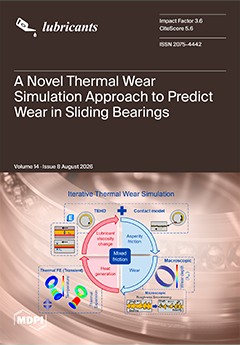
Cover Story (view full-size image): Sliding bearings in heavy-duty applications can operate under mixed friction, causing wear. Wear simulations have been developed to predict this wear evolution. Realistic wear prediction requires considering surface changes and thermal effects. However, existing simulations do not accurately model thermal effects like bearing clearance change under temperature rise. This paper extends wear simulations to include local, transient modelling of bearing temperature and thermal expansion. The novelty is combining these thermal effects with surface topography changes to predict wear more realistically, supporting wear safety evaluation in bearing design. The simulation is validated against friction torque, temperature, and wear volume measured on a radial sliding bearing test bench. View this paper
  • Issues are regarded as officially published after their release is announced to the table of contents alert mailing list.
  • You may sign up for e-mail alerts to receive table of contents of newly released issues.
  • PDF is the official format for papers published in both, html and pdf forms. To view the papers in pdf format, click on the "PDF Full-text" link, and use the free Adobe Reader to open them.
Order results
Result details
Select all
Export citation of selected articles as:
28 pages, 3482 KB  
Article
Wear Prediction of Cylindrical Gears Based on Deep Neural Networks
by Jiachun Lin, Xudong Zhao, Huijun Yue, Yunjin Xiang, Peng Wang, Minghui Tu and Ulf Olofsson
Lubricants 2026, 14(8), 328; https://doi.org/10.3390/lubricants14080328 - 21 Aug 2026
Viewed by 213
Abstract
Gears serve as core transmission components, and their wear evolution directly affects equipment stability and service life under long-duration complex loading. Especially under complex loading and long-term service conditions, the tooth surface topography undergoes continuous evolution. However, traditional wear prediction methods based on [...] Read more.
Gears serve as core transmission components, and their wear evolution directly affects equipment stability and service life under long-duration complex loading. Especially under complex loading and long-term service conditions, the tooth surface topography undergoes continuous evolution. However, traditional wear prediction methods based on physical models or empirical formulas have significant limitations in addressing nonlinear problems involving multiple coupled variables. This study proposes a deep neural network (DNN)-based method for gear wear prediction. Geometric parameters, loading conditions, and surface topography characteristics are integrated as model inputs to enable point-by-point prediction of tooth-profile wear. Experimental results demonstrate that the proposed model achieves excellent predictive performance in the mild-wear regime, with a mean absolute error (MAE) below 2.5 × 10⁻⁴ mm, a root mean square error (RMSE) below 5.0 × 10⁻⁴ mm, and R2 values ranging from 0.92 to 0.99. The model also achieves satisfactory prediction accuracy at previously unseen measurement positions and for previously unseen superfinished gear samples. The proposed DNN effectively learns implicit wear-evolution patterns from experimental data and exhibits strong generalization capability, providing a practical approach for gear health monitoring and predictive maintenance. Full article
(This article belongs to the Special Issue Advanced Gear Tribology)
Show Figures

Figure 1

58 pages, 6331 KB  
Review
Eco-Friendly Production of Sustainable Bio-Based Lubricants with Green-Synthesized Nanoparticles
by Raj Shah, Brandon Juran and Stefanos Nitodas
Lubricants 2026, 14(8), 327; https://doi.org/10.3390/lubricants14080327 - 21 Aug 2026
Viewed by 463
Abstract
Eco-friendly lubricant manufacturing focuses on using biodegradable, renewable base oils, such as waste oil, and green-synthesized nanomaterials, such as agricultural residue-based nanoparticles, in order to replace conventional toxic lubricants with biodegradable alternatives and reduce environmental impact. These nanolubricants are produced through low-energy methods [...] Read more.
Eco-friendly lubricant manufacturing focuses on using biodegradable, renewable base oils, such as waste oil, and green-synthesized nanomaterials, such as agricultural residue-based nanoparticles, in order to replace conventional toxic lubricants with biodegradable alternatives and reduce environmental impact. These nanolubricants are produced through low-energy methods like mechanical, microwave, or chemical-free synthesis that can result in improvement in their performance. The produced lubricants exhibit enhanced tribological properties, including reduced friction and wear. Several formulations also raise the thermal degradation onset above that of their mineral benchmarks, although oxidative stability remains the weakest property of bio-based systems. This approach addresses industrial demands for sustainable, cost-effective, and environmentally compliant lubrication technologies. Our study reviews sustainable, eco-friendly synthesis methods for producing high-performance nanolubricants from different waste oils, including cooking and mineral oils. In addition to the incorporation of residue-based nanoparticles (e.g., eggshell) in waste oils, the performance and properties of bio-based lubricants with engineered nanoparticles, such as metal nano-oxides and carbon-based nanomaterials, are also reviewed for comparison purposes. Within bio-based fluids at moderate contact severity, residue-derived additives are found to match their engineered counterparts in terms of friction and wear, while engineered two-dimensional lamellar additives retain an advantage under extreme-pressure conditions where residue-derived particles have not yet been evaluated. Neither class has been assessed by life cycle or biodegradation testing as a finished formulation. Full article
Show Figures

Figure 1

26 pages, 8865 KB  
Article
Research on RFID Detection Method for Lubricating Oil Moisture-Based on Phase-RSSI Orthogonal Fusion
by Na Wu and Qian Song
Lubricants 2026, 14(8), 326; https://doi.org/10.3390/lubricants14080326 - 21 Aug 2026
Viewed by 208
Abstract
Moisture significantly reduces the load-carrying capacity of lubricating oil films, accelerates oxidative degradation, and induces equipment corrosion, making it a critical hazard factor affecting lubrication reliability. To overcome the limitations of existing methods for determining water content—such as complex operation, poor real-time performance, [...] Read more.
Moisture significantly reduces the load-carrying capacity of lubricating oil films, accelerates oxidative degradation, and induces equipment corrosion, making it a critical hazard factor affecting lubrication reliability. To overcome the limitations of existing methods for determining water content—such as complex operation, poor real-time performance, and high cost—this paper proposes a radio frequency identification (RFID)-based method for lubricating oil water content detection via the orthogonal fusion of phase and received signal strength indicator (RSSI) as an off-line analytical tool. The method exploits the signal variation characteristics when RF signals penetrate media with different dielectric properties; by analyzing the phase and RSSI of backscattered RFID signals, non-contact moisture sensing is achieved. First, a theoretical model integrating phase and RSSI for water content detection is established to reveal the differential response mechanisms of the two parameters to water content. Second, a detection method based on phase-RSSI orthogonal fusion is proposed, and performance evaluation metrics are constructed. Finally, comparative experiments with different detection approaches are conducted. It is found that as water content increases, the mean phase continuously rises with significantly increased fluctuation, while RSSI exhibits a linear decreasing trend, demonstrating clear complementary response characteristics. Compared with single-phase or single-RSSI methods, the proposed fusion method achieves a coefficient of determination (R2) of 0.95 over the 0–2.0% water content range, with reliable detection verified at concentrations as low as 0.1%, and exhibits superior detection sensitivity in the low-water-content range. Furthermore, it possesses a type-discrimination capability absent in single-parameter methods—that is, it can effectively distinguish whether response variations originate from moisture contamination or non-moisture interference. The method offers stable response and high detection efficiency, providing a new approach for accurate determination of water content in lubricating oil. Full article
Show Figures

Figure 1

18 pages, 16431 KB  
Article
Film Thickness Prediction from Dichromatic Interference Images Based on Dual-Wavelength Physics-Guided Graph Neural Network
by Peng Yue, Jiaqing Wang, Zhimin Shi, Chen He, Xiaoran Zhu and Yujuan Zhang
Lubricants 2026, 14(8), 325; https://doi.org/10.3390/lubricants14080325 - 21 Aug 2026
Viewed by 239
Abstract
Dichromatic optical interferometry provides rich optical information for lubricant film-thickness measurement. However, experimental data are typically limited to a small number of discrete operating conditions, making it difficult to learn the nonlinear relationship among entrainment speed, dichromatic interference images, and lubricant film thickness. [...] Read more.
Dichromatic optical interferometry provides rich optical information for lubricant film-thickness measurement. However, experimental data are typically limited to a small number of discrete operating conditions, making it difficult to learn the nonlinear relationship among entrainment speed, dichromatic interference images, and lubricant film thickness. To address this limitation, a Dual-Wavelength Physics-Guided Graph Neural Network (DW-PG-GNN) is proposed for intermediate lubrication-state characterization from sparse experimental observations. Rather than directly regressing film thickness from interference images, the proposed framework learns the nonlinear relationship among entrainment speed, dichromatic interference images, and lubricant film thickness through a unified physics-guided learning framework. Specifically, graph representations capture the structural continuity and cross-wavelength coupling characteristics of dichromatic interference fringes, while a physics-guided residual learning strategy embeds analytical film-thickness priors from classical elastohydrodynamic lubrication (EHL) theory into an implicit neural representation for intermediate state prediction. A differentiable interference renderer further constrains the consistency between predicted film thickness and reconstructed dichromatic interference images, ensuring optical and physical consistency throughout the learning process. Validation based on sparse experimental datasets acquired from a ball-on-disc EHL rig demonstrates reliable average film-thickness prediction and interference-image reconstruction under the investigated operating conditions. The prediction errors remain within 2.2% for trained conditions and 8.67% for unseen entrainment-speed interpolation conditions. Full article
Show Figures

Figure 1

17 pages, 3107 KB  
Article
Friction–Adhesion Coupling Behavior of SBS-Modified Asphalt Pavement with Discontinuous Surface Texture
by Gang Li, Jiangang Li, Zhane Li, Xin Lu, Yingling Li, Yun Lin, Xingnan Hu and Wei Kang
Lubricants 2026, 14(8), 324; https://doi.org/10.3390/lubricants14080324 - 21 Aug 2026
Viewed by 217
Abstract
Pitting distress introduces discontinuous surface texture, thereby modifying the friction–adhesion coupling at the rubber–asphalt interface. This study systematically investigates the interfacial friction response of SBS-modified asphalt pavements with three pitting distribution patterns (sparse, medium, and dense) under varying sliding rates, temperatures, and cyclic [...] Read more.
Pitting distress introduces discontinuous surface texture, thereby modifying the friction–adhesion coupling at the rubber–asphalt interface. This study systematically investigates the interfacial friction response of SBS-modified asphalt pavements with three pitting distribution patterns (sparse, medium, and dense) under varying sliding rates, temperatures, and cyclic loading using a custom-developed friction testing apparatus. The results reveal that adhesion-dominated friction is strongly dependent on both texture distribution and operating conditions. With increasing temperature, the dense pattern exhibits the most pronounced adhesion enhancement, with an average friction increase of 55.0%. The sparse pattern shows a continuous decreasing trend in the low-to-medium speed range, but exhibits a strengthening rebound at high speeds, demonstrating the most complex rate sensitivity. Under cyclic loading, among the three pitting patterns tested, the dense pattern exhibits the best friction retention, with an average friction reduction of only 6.2% after 30 cycles, compared to 9.5% for the sparse pattern and 10.8% for the medium pattern. Three-dimensional topography indicates that the medium pattern exhibits a continuous and relatively uniform wavy roughness, while the dense pattern transforms into a high-frequency serrated morphology. However, the wear in both patterns is dominated by homogenized micro-grooves, without the formation of local deep pits or sharp undulations, which favors the maintenance of stable skid resistance under the laboratory cyclic loading conditions tested in this study. Furthermore, a unified regression model with distribution dummy variables and interaction terms (R2 = 0.826; cross-validated Q2 = 0.646) quantifies the synergistic effect of pitting density and temperature, with the temperature sensitivity increasing six-fold from the sparse to the dense pattern (0.011 to 0.071 N/°C). Full article
(This article belongs to the Special Issue Tire/Road Interface and Road Surface Textures, 2nd Edition)
Show Figures

Figure 1

16 pages, 3467 KB  
Article
A Method for Predicting Motion Error of Internal Feedback Hydrostatic Turntable Under Eccentric Load
by Honglie Ma, Qingkai Shen, Xiaolei Deng, Qiang Cheng and Mingyue Zhang
Lubricants 2026, 14(8), 323; https://doi.org/10.3390/lubricants14080323 - 21 Aug 2026
Viewed by 201
Abstract
This paper proposes a method to analyze motion errors in a five-degree-of-freedom hydrostatic turntable with internal feedback under eccentric load. The motion error models of thrust and journal bearings are derived separately, revealing the mechanism of the influence of manufacturing errors of thrust [...] Read more.
This paper proposes a method to analyze motion errors in a five-degree-of-freedom hydrostatic turntable with internal feedback under eccentric load. The motion error models of thrust and journal bearings are derived separately, revealing the mechanism of the influence of manufacturing errors of thrust plate and shaft on motion errors. The results demonstrate that the hydrostatic oil film exhibits an error averaging effect. When the amplitude of the mating surface error reaches 15 μm, the corresponding linear deviation of the turntable remains below 0.3 μm, indicating that the oil film can effectively suppress the transmission of manufacturing errors. However, the pressure oil film cannot completely balance the errors on the film binding surface, especially when the amplitude of the binding surface error is larger, resulting in a weaker ability of the oil film to balance. Full article
Show Figures

Figure 1

18 pages, 31834 KB  
Article
Wear Partition of PWR Control Rod Cladding Under Impact–Sliding Loading
by Changzheng Li, Guoliang Zhang, Weichao Liu, Changyi Chen, Change Wu, Jia Xiao, Rui Shu, Feng Wang, Shaohong Zhang and Xiang Liu
Lubricants 2026, 14(8), 322; https://doi.org/10.3390/lubricants14080322 - 20 Aug 2026
Viewed by 180
Abstract
This study investigates the wear behavior of PWR control rod cladding under three representative loading modes: pure impact, circumferential sliding, and impact–sliding coupling, in high-temperature (300 °C) and high-pressure (15.5 MPa) water. Pre-oxidized and non-oxidized specimens were compared using white-light interferometry, net mass [...] Read more.
This study investigates the wear behavior of PWR control rod cladding under three representative loading modes: pure impact, circumferential sliding, and impact–sliding coupling, in high-temperature (300 °C) and high-pressure (15.5 MPa) water. Pre-oxidized and non-oxidized specimens were compared using white-light interferometry, net mass change, SEM, and EDS. Maximum wear depth and wear volume were used as the primary quantitative indicators of wear because net mass change may also reflect oxidation, transferred material, and retained debris. The results show that pre-oxidation does not uniformly reduce wear but changes its distribution between the contacting bodies. Under circumferential sliding, for example, pre-oxidation increased the cladding wear depth from 12.85 to 20.05 μm while reducing the guide-card depth from 24.99 to 11.93 μm. Impact–sliding coupling produced a distinct edge-localized wear morphology, although it did not yield the largest value for every wear metric. Surface observations revealed oxide-layer cracking and spallation in pre-oxidized specimens and stronger adhesion-related transfer features in non-oxidized specimens. The results show that control-rod wear assessment should consider not only the total wear magnitude but also its distribution between the cladding and guide card. Full article
Show Figures

Figure 1

18 pages, 3266 KB  
Article
Analysis of Deformation, Blow-Out Mechanism, and Leakage Behavior of Brush Seals Under Distributed Pressure Loading
by Syed Muntazir Mehdi, Jae-Hyung Kim and Young Cheol Kim
Lubricants 2026, 14(8), 321; https://doi.org/10.3390/lubricants14080321 - 20 Aug 2026
Viewed by 197
Abstract
Brush seals using compliant bristle packs can reduce turbomachinery leakage more effectively than conventional labyrinth seals, but their coupled structural and flow behavior makes design difficult. Under large pressure loading, bristles can deflect, lose contact with the rotor, and generate clearance, causing the [...] Read more.
Brush seals using compliant bristle packs can reduce turbomachinery leakage more effectively than conventional labyrinth seals, but their coupled structural and flow behavior makes design difficult. Under large pressure loading, bristles can deflect, lose contact with the rotor, and generate clearance, causing the sharp leakage increase known as blow-out. This study develops a model linking nonlinear bristle deflection, rotor–bristle contact loss, and leakage response. The bristle is treated as an inextensible nonlinear elastic member subjected to distributed pressure loading, backing-plate support, and frictional rotor contact. Contact and separated states are solved iteratively using boundary-value and initial-value solvers. Leakage through the bristle pack is calculated using a random bristle-bed formulation, and leakage through generated clearance is evaluated with an orifice-flow model. The model agrees well with published bristle-deflection predictions. Increasing pressure load reduces normal contact force until lift-off occurs, producing clearance and a sharp rise in leakage. Increasing front-plate free height shifted lift-off from pressure ratio ≈4 to ≈2, while clearance flow contributed up to 36.5% after lift-off. Brush-seal blowout is therefore governed by the transition from rotor–bristle contact to separation. Lower back-plate height can delay blow-out, but hysteresis and durability tradeoffs must be considered. Full article
(This article belongs to the Special Issue Mechanical Tribology and Surface Technology, 3rd Edition)
Show Figures

Figure 1

18 pages, 3779 KB  
Article
Equivalent Fractal Parameter Inversion for Mechanically Consistent Surface Characterization of Metallic Seals
by Bo Yang, Chaojun Deng, Linyuan Kuang, Zeyuan Yu and Ying Luo
Lubricants 2026, 14(8), 320; https://doi.org/10.3390/lubricants14080320 - 20 Aug 2026
Viewed by 180
Abstract
The first step in the analysis of the contact mechanics and leakage prediction of metallic seals applied to nuclear reactor pressure vessels is the proper characterization of the surface topography. At present, two approaches are used for this characterization. On the one hand, [...] Read more.
The first step in the analysis of the contact mechanics and leakage prediction of metallic seals applied to nuclear reactor pressure vessels is the proper characterization of the surface topography. At present, two approaches are used for this characterization. On the one hand, there are non-parametric techniques such as HPD and PSD, which retain all the characteristics of the surfaces that have been measured, but the results are high dimensional; hence, they cannot be analyzed analytically. The other type is parametric fractal methods, where the parameters used are fractal dimension D and characteristic scale G, where the analytical derivations can be made; however, this leads to systematic deviations in the mechanical response due to some idealized assumptions, like isotropy, Gaussian distribution, and infinite self-similarity. In this article, we propose an equivalent fractal parameter inversion model (EFPIM) that does not rely on geometric fitting; instead, it fits the mechanical contact behavior of a physical surface. This inversion procedure reduces three errors simultaneously. Thus, the EFPIM does not use D and G as the geometrical fitting variables but rather redefines them as mechanically equivalent ones, the purpose of which is to minimize the difference between the W-M fractal surface and the real measured surface. To address the problem of constrained inversion, we adopt a genetic algorithm with BFGS. To prove its effectiveness, we carried out experiments on C-ring seal surfaces and found that the deviation in the contact area was reduced by an order of magnitude in comparison to traditional structure-function extraction, and the deviation in the approach and the maximum pressure were less than 2%. Moreover, the equivalent parameters shift systematically away from their geometric counterparts in the direction that compensates for the dominant non-ideal deficit of the W-M surface; when both parameters are free, the equivalent fractal dimension decreases, while the equivalent characteristic scale increases, compensating for the absent non-Gaussian deep valleys of ideal W-M surfaces. Existing models of analytical contact and leakage may be directly implemented using equivalent parameters and with accuracy comparable to that of FFT-based simulations, with the modest cost of the offline computations. Full article
Show Figures

Figure 1

34 pages, 33546 KB  
Article
Transient Evolution of the Piston–Cylinder Oil Film and Thermo–Fluid–Solid Coupling Response in an Axial Piston Pump Under Complex Operating Conditions
by Sibo Liu, Hongwang Zhao, Jiabao Li, Dandan Wu, Hao Li and Zhong Liu
Lubricants 2026, 14(8), 319; https://doi.org/10.3390/lubricants14080319 - 18 Aug 2026
Viewed by 270
Abstract
Existing piston–cylinder lubrication studies often simplify the pressure boundary as a constant load or a single field, making it difficult to capture pump-level pressure excitation, local oil-film response, and non-concentric posture under variable loading. This paper establishes a thermo–fluid–solid coupling framework integrating an [...] Read more.
Existing piston–cylinder lubrication studies often simplify the pressure boundary as a constant load or a single field, making it difficult to capture pump-level pressure excitation, local oil-film response, and non-concentric posture under variable loading. This paper establishes a thermo–fluid–solid coupling framework integrating an AMESim full-pump model, a Fluent transient oil-film model, and a Transient Structural model; UDF transfer of periodic pressure, dynamic meshes, and a calibrated Roelands law were used to analyze parallel-offset and center-tilted postures. As the load pressure increased from 10 to 30 MPa, the maximum discharge–half-cycle temperature rose from 28.39 to 36.95 °C, and the average positive leakage during the third-cycle high-pressure stage increased from 0.0201 to 0.1026 L/min; increasing speed from 1000 to 3000 r/min reduced cycle-averaged leakage by 8.93%. At 500 r/min and 30 MPa, the parallel-offset case reached 46.34 °C, 41 kPa, and 0.0990 L/min in maximum temperature, maximum shear stress, and average leakage, whereas the center-tilted case produced a peak resultant force of 3537.12 N, a cylinder inner-wall high-stress band of 76.96 MPa, and a maximum piston deformation and equivalent stress of 4.31 μm and 83.16 MPa. These results clarify the distinct lubrication behavior and potential uneven-wear risk associated with the two representative non-concentric postures, and provide a basis for clearance design and posture-sensitive condition assessment of axial piston pumps. Full article
Show Figures

Figure 1

20 pages, 4109 KB  
Article
Investigation of the Influence of Hydraulic Parameters on a Hydraulic Pump
by Ján Kosiba, Zdenko Tkáč, Daniel Skladaný, Martin Nagy, Ladislav Tóth, Siniša Bikić, Samuel Danis and Martin Olejár
Lubricants 2026, 14(8), 318; https://doi.org/10.3390/lubricants14080318 - 18 Aug 2026
Viewed by 289
Abstract
This paper presents an experimental investigation into the flow characteristics and volumetric efficiency (ηvol) of a fixed-displacement external gear pump (GHD 17R) operating under coupled hydraulic parameters using an eco-friendly synthetic ester-based hydraulic fluid (48 mm2·s−1 at 40 [...] Read more.
This paper presents an experimental investigation into the flow characteristics and volumetric efficiency (ηvol) of a fixed-displacement external gear pump (GHD 17R) operating under coupled hydraulic parameters using an eco-friendly synthetic ester-based hydraulic fluid (48 mm2·s−1 at 40 °C). Measurements were performed on a laboratory single-circuit hydraulic test rig across a rotational speed range of 500–2500 min−1, operating pressure range of 2–10 MPa, and fluid temperature range of 30–60 °C. To eliminate flow fluctuations caused by structural vibrations at 1250 and 1750 min−1, a 15% trimmed mean statistical filter was successfully implemented. A comparative sensitivity analysis—evaluating absolute, normalized, and relative significance—was developed and compared against a three-way analysis of variance (ANOVA) effect size model (η2 and partial η2). The relative sensitivity approach identified rotational speed as the dominant parameter for direct hydraulic flow, accounting for 95.80% of total variation. Conversely, when evaluating volumetric efficiency, the proportional impact of speed was removed, revealing a balanced distribution of internal losses: rotational speed contributed 54.73%, fluid temperature 26.08%, and pressure 19.19%. The three-way ANOVA confirmed that all primary parameters and their cross-interactions had a statistically significant effect (p < 0.05). The findings scientifically demonstrate that temperature-induced viscosity collapse exhibits a stronger relative dynamic sensitivity on volumetric losses than pressure fluctuations within standard operating envelopes. The constructed multi-dimensional flow and efficiency maps provide practical input for advanced diagnostic tools, real-time thermal condition monitoring, predictive maintenance, and energy-optimized control schemes in modern fluid power systems using eco-friendly lubricants. Full article
(This article belongs to the Special Issue Tribological Study in Hydraulic Systems)
Show Figures

Figure 1

15 pages, 6443 KB  
Article
Surface Mechanical Behavior and Surface Lubrication Properties of Bionic Foot
by Xuan Yin, Qiang Hao, Haosheng Pang and Dameng Liu
Lubricants 2026, 14(8), 317; https://doi.org/10.3390/lubricants14080317 - 18 Aug 2026
Viewed by 202
Abstract
The surface mechanical behavior of metallic bionic foot exerts a decisive influence on their service life. A face-to-face friction test system was employed to simulate the surface tribological behavior of bionic foot during actuation. Cellulose coatings were in situ formed on the contact [...] Read more.
The surface mechanical behavior of metallic bionic foot exerts a decisive influence on their service life. A face-to-face friction test system was employed to simulate the surface tribological behavior of bionic foot during actuation. Cellulose coatings were in situ formed on the contact surfaces of three types of bionic foot to replicate practical operating conditions, followed by tribological testing and characterization analysis. This study investigated the effect of cellulose coating in retarding the wear of the three bionic feet and elucidated their surface lubrication properties. The results demonstrate that surface deformation of the bionic foot is primarily concentrated at the toe tips, as well as the edges and corners of the feet. Tribological test results indicate that after modification with cellulose coatings, the friction coefficient first decreases and then increases with increasing load; when the load reaches 20 N, the friction coefficient of the bionic foot surface drops to as low as 0.043, and the wear scar depth also reaches its minimum value. The underlying mechanism lies in the fact that friction-induced effects promote the formation of adsorbed tribofilms of cellulose on the surface of the bionic foot. These tribofilms effectively isolate the direct contact between the upper and lower friction pairs, thereby enhancing lubrication efficiency while significantly mitigating adhesive wear and abrasive wear. This study establishes mechanical models of the bionic foot to provide experimental validation and design guidelines aimed at enhancing its service life. Full article
(This article belongs to the Special Issue Wear-Resistant Coatings and Film Materials, 2nd Edition)
Show Figures

Figure 1

22 pages, 4707 KB  
Article
Wear Response of Carbide-Reinforced 1.75 mol% Y2O3-Stabilized ZrO2 Composites Under Dry Sliding Conditions
by Dávid Medveď, Jana Andrejovská, Viktor Puchý, Róbert Džunda and Ondrej Petruš
Lubricants 2026, 14(8), 316; https://doi.org/10.3390/lubricants14080316 - 18 Aug 2026
Viewed by 209
Abstract
This study investigates the mechanical and tribological behavior of three composites with a ZrO2 matrix stabilized with 1.75 mol% Y2O3 and containing 1 wt.% Al2O3, reinforced with TiC (A), TiC + ZrC (B), and TiC [...] Read more.
This study investigates the mechanical and tribological behavior of three composites with a ZrO2 matrix stabilized with 1.75 mol% Y2O3 and containing 1 wt.% Al2O3, reinforced with TiC (A), TiC + ZrC (B), and TiC + WC + Mo2C (C). The matrix powder was synthesized by chemical coprecipitation, and the composites were consolidated by spark plasma sintering at 1350 °C. Dry reciprocating sliding tests against 100Cr6 steel were performed at 10 and 25 N. Composite A exhibited the highest HV10 hardness (1268), while the indentation fracture toughness values were similar (6.41–6.57 MPa·m1/2). Wear resistance did not follow the hardness ranking. At 25 N, composite A exhibited surface fragmentation and a specific wear rate of 2.52 × 10⁻⁶ mm3·N−1·m−1, while composite B showed extensive and heterogeneous transfer of steel-derived material. Composite C exhibited the lowest coefficient of friction and specific wear rate, reaching 0.392 and 7.04 × 10⁻⁸ mm3·N−1·m−1, respectively, at 25 N. EDS mapping revealed an area-integrated Fe content of 0.7 at.% for C, compared with 7.2 at.% for A and B. The superior wear resistance of C was associated with substantially lower steel-derived material transfer and a relatively smooth wear-track surface rather than with the highest bulk hardness. Full article
Show Figures

Figure 1

22 pages, 5491 KB  
Article
Influence of PMA on Rheological, Viscosity–Temperature and Lubrication Properties of Base Oils
by Yanan Zhang, Xinlong Wu, Jinyu Liu, Hongjian Wu, Yonggang Meng and Chuke Ouyang
Lubricants 2026, 14(8), 315; https://doi.org/10.3390/lubricants14080315 - 16 Aug 2026
Viewed by 252
Abstract
To investigate the regulation mechanism of poly (alkyl methacrylate) (PMA) additives on the viscosity–temperature characteristics and tribological performance of different types of base oils, Group III mineral base oils and Group IV PAO synthetic base oils were selected as the research objects. Rheological [...] Read more.
To investigate the regulation mechanism of poly (alkyl methacrylate) (PMA) additives on the viscosity–temperature characteristics and tribological performance of different types of base oils, Group III mineral base oils and Group IV PAO synthetic base oils were selected as the research objects. Rheological and boundary-lubrication tests were systematically conducted at different PMA addition levels, with emphasis on comparatively analyzing the polymer conformational evolution, interfacial adsorption behavior, and lubrication-performance response induced by differences in the solvent polarity of the base oils. The results showed that the modification effect of PMA on base oils exhibited pronounced matrix dependence and non-monotonic concentration characteristics, and its lubrication-regulating behavior was dominated by the coupled trade-off among polymer solubility, molecular conformational stability, and interfacial competitive adsorption ability. In the mineral-oil system, where the base oil acts as a good solvent, the solubility parameters of PMA and the base oil are well matched, allowing the polymer molecular chains to sufficiently swell and extend and providing excellent adsorption and film-forming ability. With increasing PMA concentration, the viscous-flow activation energy of the oil continuously decreased, while the viscosity–temperature performance and boundary-lubrication stability were simultaneously improved, resulting in stable and reliable modification effects. In contrast, in the PAO synthetic-oil system, where the base oil acts as a poor solvent, the PMA molecular chains tend to adopt coiled conformations, with their conformations being highly sensitive to temperature and shear rate, while their interfacial adsorption ability is weaker than that of the base-oil molecules. An optimum critical PMA concentration of 1.0 wt% was observed in this system. Above this concentration, intramolecular friction increased, resulting in deterioration of both viscosity–temperature characteristics and friction performance. This study clarifies the differentiated modification mechanisms of PMA in base oils with different polarities and reveals the dominant role of solvent effects in polymer rheological and tribological behaviors, thereby addressing the insufficient understanding in existing studies of the non-monotonic modification behavior of PMA and its multi-factor coupled mechanism. The findings provide a theoretical basis for PMA structural selection and precise concentration formulation in lubricating oils under different operating conditions and have important engineering application value for optimizing viscosity–temperature performance over a wide temperature range, improving service stability under boundary lubrication, and balancing lubrication reliability with formulation economy. Full article
Show Figures

Figure 1

23 pages, 5664 KB  
Article
Comparison of Nonlinear Dynamics for Rotor Supported by Aerostatic Journal Bearings with Small-Hole and Micro-Hole Restrictors
by Hanqian Zhang, Mingjin Lan, Qun Lei, Zhentao Cheng and Jianjun Du
Lubricants 2026, 14(8), 314; https://doi.org/10.3390/lubricants14080314 - 14 Aug 2026
Viewed by 196
Abstract
Aerostatic journal bearings with small-hole restrictors are widely adopted due to their superior stiffness, making them effective solutions to meet the growing demands for improved stability and higher rotational speeds in precision machinery. In this study, the nonlinear dynamic behaviors of a rigid [...] Read more.
Aerostatic journal bearings with small-hole restrictors are widely adopted due to their superior stiffness, making them effective solutions to meet the growing demands for improved stability and higher rotational speeds in precision machinery. In this study, the nonlinear dynamic behaviors of a rigid rotor supported by aerostatic bearings with micro-hole and small-hole restrictors were systematically investigated and numerically compared. Experimental results indicate that aerostatic journal bearings with integrated micro-holes exhibit superior dynamic stability to their small-hole counterparts, with the threshold speed of half-frequency whirl increased by 10.5%. This research provides critical insights for optimizing the performance of aerostatic journal bearings in high-speed applications. Full article
Show Figures

Figure 1

33 pages, 42884 KB  
Article
Vibration Characteristics of Biomimetic Textured Rolling Bearings Inspired by Monstera deliciosa Under Starved Lubrication
by Risheng Long, Xiaoqing Wang, Siwei Wang, Fangfeng Gao, Peilin Song, Yonglin Wang and Lin Zong
Lubricants 2026, 14(8), 313; https://doi.org/10.3390/lubricants14080313 - 14 Aug 2026
Viewed by 231
Abstract
Biomimetic surface texturing provides a promising strategy for regulating the vibration behavior of rolling bearings under starved lubrication. In this study, vein-like, elliptical, semi-elliptical, and composite textures inspired by Monstera deliciosa leaves were fabricated on the shaft-washer raceways of thrust cylindrical roller bearings [...] Read more.
Biomimetic surface texturing provides a promising strategy for regulating the vibration behavior of rolling bearings under starved lubrication. In this study, vein-like, elliptical, semi-elliptical, and composite textures inspired by Monstera deliciosa leaves were fabricated on the shaft-washer raceways of thrust cylindrical roller bearings at depths of 4 μm, 8 μm, and 12 μm. Tangential and normal vibration signals were analyzed using time-domain parameters, frequency spectra, power spectral density, and time–frequency maps. The results showed that both texture morphology and depth strongly affected vibration stability. Most textured bearings exhibited lower vibration responses than the smooth bearing after prolonged operation. Among the tested depths, 8 μm produced the most stable response, characterized by lower peak values, smoother root mean square curves, reduced power spectral density levels, and more uniform time–frequency energy distributions. The 8 μm semi-elliptical texture exhibited the best overall performance by suppressing transient impacts and high-frequency energy concentration. These findings indicate that vibration regulation in textured rolling bearings depends primarily on the synergistic matching between texture morphology and depth rather than texture complexity alone. Full article
(This article belongs to the Special Issue Surface Textures and Tribology in Mechanical Components)
Show Figures

Figure 1

28 pages, 2166 KB  
Article
Machine-Learning-Based Screening of Relative Eccentric-Wear Severity in Shield TBM Disc Cutters Using 3D-Scan Morphology Labels
by Junyou Zhang, Yu Zhang, Jian Zhang and Jinghui Xia
Lubricants 2026, 14(8), 312; https://doi.org/10.3390/lubricants14080312 - 13 Aug 2026
Viewed by 291
Abstract
Disc-cutter wear in abrasive strata is spatially non-uniform, yet mean wear depth cannot indicate where it concentrates. This retrospective feasibility study develops a machine-learning-based condition-monitoring framework that predicts the relative severity of eccentric wear from engineering data available before inspection, supervised by 3D-scan [...] Read more.
Disc-cutter wear in abrasive strata is spatially non-uniform, yet mean wear depth cannot indicate where it concentrates. This retrospective feasibility study develops a machine-learning-based condition-monitoring framework that predicts the relative severity of eccentric wear from engineering data available before inspection, supervised by 3D-scan morphology labels. An Eccentric-Wear Morphology Index (EWI) is constructed from post-replacement 3D morphology and used solely as a relative-severity label; its tertile-based grades are cohort-relative rather than universal engineering thresholds. The analysis cohort comprised 244 quality-controlled 19-inch cutter rings, and an engineering-prioritized redundancy review condensed 58 candidate variables into a frozen 22-variable set. In five-fold out-of-fold evaluation, the Random Forest achieved 0.779 accuracy, 0.775 macro F1, and 0.939 high-severity recall. With nested threshold selection, in which the operating threshold was chosen only within the training folds, the pooled held-out screening result reached 0.988 recall and 0.946 F2 while including 41.0% of the samples in the review pool, and this operating point was insensitive to false-negative-to-false-positive cost ratios between 5:1 and 15:1. Grouping both rings of each twin cutter into the same fold left the screening operating points essentially unchanged. The framework shows potential to support within-project inspection prioritization; external validation and calibration remain necessary because the screening signal is strongly associated with service exposure and the project-specific cutter-change schedule. Full article
Show Figures

Figure 1

23 pages, 4480 KB  
Article
Dual-Range Ilmenite Reinforcement for Thermally Stable and Wear-Resistant LM30 Aluminum Brake Drum Composites
by Varun Singhal, Daksh Shelly, Gurpreet Singh Matharou and Anil Prakash Singh
Lubricants 2026, 14(8), 311; https://doi.org/10.3390/lubricants14080311 - 13 Aug 2026
Viewed by 261
Abstract
Aluminum matrix composites (AMCs) reinforced with natural mineral ilmenite offer a cost-effective and thermally stable alternative to conventional cast iron brake drum materials. This study investigates the synergistic effect of fine (32–50 µm) and coarse (75–106 µm) ilmenite particles at four fine-to-coarse weight [...] Read more.
Aluminum matrix composites (AMCs) reinforced with natural mineral ilmenite offer a cost-effective and thermally stable alternative to conventional cast iron brake drum materials. This study investigates the synergistic effect of fine (32–50 µm) and coarse (75–106 µm) ilmenite particles at four fine-to-coarse weight ratios (1:4, 2:3, 3:2, and 4:1) and three reinforcement contents (5, 10, and 15 wt.%) on the thermal stability and dry sliding wear behavior of stir-cast LM30 Al composites. Ilmenite reinforcement progressively reduces the coefficient of thermal expansion of the LM30 matrix, with the 15 wt.% 4:1 fine-to-coarse ratio composite (15DRP41) exhibiting the lowest coefficient of thermal expansion of ~16.54 × 10⁻⁶/°C, a ~33.3% reduction relative to the unreinforced alloy (~24.8 × 10⁻⁶/°C). The 15DRP41 composite demonstrates the lowest wear rate of all the fabricated composites, 1.82 × 10⁻³ mm3/m at 9.81 N and 9.56 × 10⁻³ mm3/m at 68.67 N at 200 °C. Under the most severe load condition (68.67 N, 200 °C), the coefficient of friction of 15DRP41 is reduced by up to 44% compared with the LM30 alloy. A comparative test against commercial grey cast iron shows that 15DRP41 has a similar wear rate up to 200 °C, while its density (~2.9 g/cm3) is significantly lower and it has excellent dimensional stability. Scanning electron microscopy and energy-dispersive X-ray spectroscopy of worn surfaces and debris confirm a progressive change from oxidative and mild abrasive wear at low loads and temperatures to severe wear by delamination at 68.67 N and 300 °C, as evidenced by the presence of a multi-component mechanically mixed layer. The results have confirmed that the optimum fine-to-coarse ratio for the reinforcement was 4:1, which led to the maximum wear resistance and thermal stability in ilmenite-reinforced LM30 composites for lightweight automotive brake drum applications, and that the optimum weight percentage for the reinforcement was 15 wt.%. Full article
Show Figures

Figure 1

19 pages, 3053 KB  
Article
Prediction of Iron Wear Metal Concentration in Used Engine Oils from FT-IR Spectra Using Partial Least Squares Regression
by Adam Agocs, Georg Vorlaufer, Marcella Frauscher and Charlotte Besser
Lubricants 2026, 14(8), 310; https://doi.org/10.3390/lubricants14080310 - 13 Aug 2026
Viewed by 306
Abstract
Wear metal monitoring is an important component of lubricant condition monitoring but commonly relies on elemental techniques such as inductively coupled plasma optical emission spectroscopy (ICP-OES), which require dedicated laboratory infrastructure and sample preparation. This study evaluates whether Fourier-transform infrared (FT-IR) spectra of [...] Read more.
Wear metal monitoring is an important component of lubricant condition monitoring but commonly relies on elemental techniques such as inductively coupled plasma optical emission spectroscopy (ICP-OES), which require dedicated laboratory infrastructure and sample preparation. This study evaluates whether Fourier-transform infrared (FT-IR) spectra of used engine oils can be combined with partial least squares (PLS) regression to provide a rapid screening estimate of iron (Fe) concentration. Used petrol and diesel engine oil samples were analyzed by FT-IR spectroscopy and ICP-OES. PLS models were developed using processed FT-IR spectra as predictor variables and ICP-OES-derived Fe concentrations as response variables. For petrol used oil samples, the optimized model employing 18 latent variables achieved a root mean squared error of 5.02 ppm and a coefficient of determination of 0.97 between measured and predicted Fe concentrations. Model loadings indicated contributions from spectral features associated with soot, oxidation, nitration, antioxidant (AO) depletion, and zinc dialkyldithiophosphate depletion. Combining petrol and diesel samples in a single model reduced predictive performance and increased uncertainty, indicating that their differing degradation pathways cannot be adequately represented by one common latent variable model. The approach does not directly measure Fe and is not intended to replace elemental analysis. Instead, it provides a rapid, low-cost screening tool for identifying samples with potentially elevated wear metal concentrations and prioritizing them for confirmatory analysis. Full article
(This article belongs to the Special Issue Recent Advances in Automotive Powertrain Lubrication, 2nd Edition)
Show Figures

Figure 1

18 pages, 5810 KB  
Article
Impact of Mixed Convection and Lubricated Surface on Ellis Fluid Flow in a Periciliary Layer
by Abdul Majeed Siddiqui, Mehwish Ahmed, Muhammad Israr Siddiqui and Khadija Maqbool
Lubricants 2026, 14(8), 309; https://doi.org/10.3390/lubricants14080309 - 12 Aug 2026
Viewed by 213
Abstract
Ciliary-driven flow refers to the movement of fluid by the rhythmic and coordinated beating cilia and finds applications in the respiratory tract, fallopian tube, embryonic node, brain ventricles, paranasal sinuses, and understanding flows in the auditory tube. Previous research on cilia-driven flow has [...] Read more.
Ciliary-driven flow refers to the movement of fluid by the rhythmic and coordinated beating cilia and finds applications in the respiratory tract, fallopian tube, embryonic node, brain ventricles, paranasal sinuses, and understanding flows in the auditory tube. Previous research on cilia-driven flow has demonstrated forced convective flow with no-slip boundary conditions, which is crucial in mucus clearance and is not firmly stuck to the periciliary layer. This paper develops the mixed convective flow of Ellis fluid near the periciliary layer with a lubricated surface. The partial slip boundary condition provides reduced friction near the periciliary layer for the Ellis fluid flow. The momentum and energy equations are simplified by the lubrication approach, and the resulting problem is solved analytically. This research achieves the exact solutions for the temperature and velocity profiles for the consistency index 3. The findings show that the mucus flow along the lubricated surface is enhanced by the slip parameter and viscosity (shear-thinning fluid) parameter beta, but the flow across the trachea decays due to the slip and viscosity parameters. The mucus temperature rises due to the radiation and Prandtl number, which also help to reduce the frictional forces near the periciliary layer and facilitate faster mucociliary clearance. Full article
Show Figures

Figure 1

14 pages, 2921 KB  
Article
Improvement in Surface Quality of Ironing Product Using Differential Lubrication
by Kazuhito Asai, Kazuhiko Kitamura and Takumi Nishi
Lubricants 2026, 14(8), 308; https://doi.org/10.3390/lubricants14080308 - 10 Aug 2026
Viewed by 255
Abstract
Ironing is an effective process for precisely finishing a formed product at the final stage of a series of forming processes. Generally, a high-performance lubricant oil with high viscosity is used to prevent galling under severe forming conditions, but high-viscosity oil is difficult [...] Read more.
Ironing is an effective process for precisely finishing a formed product at the final stage of a series of forming processes. Generally, a high-performance lubricant oil with high viscosity is used to prevent galling under severe forming conditions, but high-viscosity oil is difficult to remove from the workpiece after the forming process. Residual oil can interfere with subsequent processes such as welding, heat treatment, and painting. Therefore, low-viscosity oils with excellent cleanability are desirable under severe ironing conditions. In this study, differential lubrication was applied to ironing to enable the use of low-viscosity lubricant oil. The results showed that severe galling occurred on the inner surface of the workpiece when a low-viscosity oil was used. However, no galling was observed when low- and high-viscosity oils were applied to the inner and outer surfaces of the workpiece, respectively. These results indicate that differential lubrication enables the use of a low-viscosity lubricant oil without galling while maintaining high surface quality. Full article
(This article belongs to the Special Issue Tribology in Forging)
Show Figures

Figure 1

27 pages, 18116 KB  
Article
Preparation and Comprehensive Properties of CeO2-Doped Composite Copper Foils
by Yanghuan Li, Haonan Zhang, Xiang Li, Dongzhou Jia and Yongqiang Fu
Lubricants 2026, 14(8), 307; https://doi.org/10.3390/lubricants14080307 - 10 Aug 2026
Viewed by 209
Abstract
In the field of flexible electronics, traditional composite copper foils generally suffer from weak interfacial adhesion between the copper layer and polymer substrate, poor corrosion resistance, insufficient surface uniformity, and limited functional adaptability. To address these issues, Cu/Cu-CeO2 composite coatings were deposited [...] Read more.
In the field of flexible electronics, traditional composite copper foils generally suffer from weak interfacial adhesion between the copper layer and polymer substrate, poor corrosion resistance, insufficient surface uniformity, and limited functional adaptability. To address these issues, Cu/Cu-CeO2 composite coatings were deposited on polyimide (PI) substrates via PVD magnetron sputtering using argon as the working gas, aiming to enhance the comprehensive properties of composite copper foils, including interfacial bonding strength and corrosion resistance. Initially, pure Cu coatings were deposited on polyimide (PI), polyethylene terephthalate (PET), and polypropylene (PP) substrates. The deposition parameters were optimized through orthogonal and single-factor experiments, and the optimal process combination was determined as follows: PI substrate, sputtering time of 20 min, sputtering power of 60 W, and argon flow rate of 90 sccm, which achieved a balance between mechanical and electrical properties. Subsequently, comparative studies of Ar plasma treatment (100 s, 200 s, 300 s, and 400 s) and NaOH chemical etching (0 mol/L, 1 mol/L, 2 mol/L, and 3 mol/L) were conducted on the three polymer substrates. Comprehensive analyses of water contact angle, surface energy, bonding strength, and surface roughness demonstrated that the PI substrate treated with Ar plasma for 300 s exhibited superior overall performance, with a water contact angle of 48.5°, surface energy of 61.78 × 10⁻³ J/m2, bonding strength of 4.56 N, and surface roughness of 0.89 μm. On this basis, the performance of pure Cu coatings and Cu/Cu-CeO2 composite coatings prepared under different CeO2 sputtering powers (20 W, 30 W, 40 W, and 50 W) was further investigated. Combined analyses of SEM, EDS, and XPS characterizations, together with bonding strength, resistivity, electrochemical impedance spectroscopy, polarization curves, and corrosion morphology tests, revealed that the Cu/Cu-CeO2 composite coating prepared at a sputtering power of 50 W exhibited superior overall performance in terms of interfacial bonding strength and corrosion resistance. Full article
Show Figures

Figure 1

20 pages, 72306 KB  
Article
Investigation on Tribological and Electrochemical Corrosion Properties of TiAl4822 Alloy Fabricated via Selective Laser Melting
by Junjie Yuan, Zhichao Wang, Gang Zou, Rui Sun, Donghui Li and Guoliang Liu
Lubricants 2026, 14(8), 306; https://doi.org/10.3390/lubricants14080306 - 9 Aug 2026
Viewed by 249
Abstract
TiAl alloy exhibits excellent strength, oxidation resistance and creep resistance, making it a preferred candidate material to replace high-temperature alloys. Currently, TiAl alloy has been widely applied in aerospace, the marine industry and other fields involving high-stress contact or highly corrosive environments. Selective [...] Read more.
TiAl alloy exhibits excellent strength, oxidation resistance and creep resistance, making it a preferred candidate material to replace high-temperature alloys. Currently, TiAl alloy has been widely applied in aerospace, the marine industry and other fields involving high-stress contact or highly corrosive environments. Selective laser melting (SLM) technology provides a brand-new approach for the fabrication of TiAl alloys, which enables direct forming of workpieces with complex structures and significantly reduces manufacturing cycles. However, the quality and performance of SLM fabricated TiAl alloys are highly dependent on laser energy input. Therefore, this study fabricated TiAl4822 alloy under different SLM process parameters, and systematically conducted investigations on its tribological properties and electrochemical corrosion behavior. The experimental results show that the SLM process did not alter the basic phase composition of TiAl4822 alloy, with Ti0.6Al0.4 as the dominant phase. TiAl4822 alloys fabricated under the parameter combinations of 1000 mm/s + 140 W exhibited outstanding wear resistance, and the wear mechanism transformed from severe adhesion and abrasive wear to mild oxidative wear. When the laser power was 100 W and the scanning speed was 1200 mm/s, the alloy achieved the highest corrosion resistance, with the corrosion potential reaching the maximum value of −390.065 mV and the corrosion current density decreasing to the minimum value of 8.73 × 10⁻⁶ A/cm2. Thus, different parameter combinations can realize the optimization of tribological properties and electrochemical corrosion performance respectively. This study lays a theoretical foundation for promoting the high-performance engineering application of this alloy in harsh wear-resistant and corrosion-resistant environments. Full article
(This article belongs to the Special Issue Laser Surface Engineering for Advanced Tribological Performance)
Show Figures

Figure 1

18 pages, 5814 KB  
Article
Vibration Evolution Causal Correlation Analysis of Bearing Raceway Failure Process Under Dynamic Excitation
by Ning Li, Jingyu Zhai, Jingqi Zhang and Shihai Cui
Lubricants 2026, 14(8), 305; https://doi.org/10.3390/lubricants14080305 - 7 Aug 2026
Viewed by 250
Abstract
To address the challenges in understanding the raceway failure mechanisms of bearings under dynamic radial excitations, this study proposes a vibration evolution analysis method based on multi-source data fusion and a Granger causality test. Firstly, a vertical bearing vibration test bench that can [...] Read more.
To address the challenges in understanding the raceway failure mechanisms of bearings under dynamic radial excitations, this study proposes a vibration evolution analysis method based on multi-source data fusion and a Granger causality test. Firstly, a vertical bearing vibration test bench that can simulate the dynamic excitation in engineering practice is built, and the bearing acceleration, inner ring displacement and cage data are collected at the same time. Subsequently, the evolution law and correlation relationship of bearing vibration signals during the expansion process of bearing raceway damage were studied. Based on this, a multi-source vibration data fusion method was proposed, and the effectiveness of different data fusion schemes in characterizing raceway damage expansion was compared. Finally, the Granger causality test was applied to analyze the causal relationship between the evolution of various vibration behaviors during the damage propagation process. Research results demonstrate that under complex loading conditions during sustained operation, the “False Brinelling” indentation gradually develops into raceway surface damage. The vibration behavior of bearings exhibits distinct stage-specific characteristics under dynamic radial excitations. Notably, variations in vibration behavior amplitude and transition timing between different operational phases demonstrate significant discrepancies. Significant alterations in causal relationships between vibration behaviors were observed throughout different degradation phases. The combined approach proposed in this paper, encompassing complex load simulation, multi-source data fusion, and causal analysis, offers a new understanding of the raceway failure mechanism of bearings under real-world operating conditions. Full article
Show Figures

Figure 1

18 pages, 17117 KB  
Article
Impact Load Effects on Dynamic Behavior of High-Precision Mechanism with Clearance Joint
by Rui Qiu, Yang Guo, Runqi Yu, Siyi Dong and Yu Chen
Lubricants 2026, 14(8), 304; https://doi.org/10.3390/lubricants14080304 - 6 Aug 2026
Viewed by 242
Abstract
Generally, a clearance joint can cause contact–impact characteristics and nonlinear dynamic behavior of a mechanism, and the introduction of an external load would improve motion instability. The main concern in mechanism design is to obtain the dynamic response of a mechanism with clearance [...] Read more.
Generally, a clearance joint can cause contact–impact characteristics and nonlinear dynamic behavior of a mechanism, and the introduction of an external load would improve motion instability. The main concern in mechanism design is to obtain the dynamic response of a mechanism with clearance joints. In this study, a dynamic model of a high-precision mechanism is established. The contact characteristics of the clearance joints are described using the dissipative contact model and the Coulomb friction law. Meanwhile, an experiment platform for impact load and dynamic behavior for this mechanism is designed. And the impact load value is introduced into the dynamic model. Eventually, the influence of clearance characteristics and design parameters on the nonlinear response of the high-precision mechanism is analyzed using a case study. Full article
Show Figures

Figure 1

19 pages, 5194 KB  
Article
Study on Heat Partition in Sliding Contact Pairs Considering Conduction Heat Flux
by Xiangyu Du, Shaowei Liu, Xiaoquan Lu and Tianyou Zheng
Lubricants 2026, 14(8), 303; https://doi.org/10.3390/lubricants14080303 - 5 Aug 2026
Viewed by 285
Abstract
Regarding heat conduction in sliding contact pairs, this paper investigates the interfacial heat partition problem with conduction heat flux taken into account to address the issue of the heat partition coefficient falling outside its physically reasonable range. The main contributions of this study [...] Read more.
Regarding heat conduction in sliding contact pairs, this paper investigates the interfacial heat partition problem with conduction heat flux taken into account to address the issue of the heat partition coefficient falling outside its physically reasonable range. The main contributions of this study are as follows. First, conduction heat flux is explicitly introduced, and the governing equation for the heat partition coefficient incorporating conduction heat flux is derived via Green’s function method. Subsequently, to tackle the nonlinearity caused by the time-varying velocity and heat source of the contact pair, least-squares estimation is adopted to solve for the heat partition coefficient and conduction heat flux. The results indicate that under extreme operating conditions with drastic variations in heat source and velocity, traditional heat partition models yield unphysical results where the heat partition coefficient is less than 0 or greater than 1, whereas the modified model effectively resolves this issue. Furthermore, this paper analyzes the effects of material parameters, motion characteristics, and thermal loads on heat partition. The findings of this work provide a reference for interfacial thermal design and thermal management of various sliding contact pairs. Full article
Show Figures

Figure 1

22 pages, 22188 KB  
Article
Multiple Lubrication Mechanisms and Performance Prediction in WC-cBN-MoS2 Self-Lubricating Ceramics
by Yongquan Gan, Lanlan Pan, Hanbing Zhang, Haixuan Sun, Chunliang Niu and Jiakun Wu
Lubricants 2026, 14(8), 302; https://doi.org/10.3390/lubricants14080302 - 5 Aug 2026
Viewed by 278
Abstract
Lubrication performance is a critical index determining the service performance of self-lubricating ceramic cutting tools, but the coupling between mechanical properties, lubrication, and wear makes the lubrication effect challenging to predict. In this paper, WC-cBN-MoS2 self-lubricating ceramics with 15 vol% MoS2 [...] Read more.
Lubrication performance is a critical index determining the service performance of self-lubricating ceramic cutting tools, but the coupling between mechanical properties, lubrication, and wear makes the lubrication effect challenging to predict. In this paper, WC-cBN-MoS2 self-lubricating ceramics with 15 vol% MoS2 and a range of mechanical properties (Vickers hardness: 10.33–20.22 GPa; fracture toughness: 1.8–5.95 MPa·m1/2) were fabricated by high-pressure sintering. A lubricating particle release model is established to analyze the contributions of matrix deformation and surface wear to lubricant release. It is found that matrix deformation alone cannot extrude lubricating particles to the surface; instead, wear is the primary mechanism supplying particles to the friction interface. The lubricating film, containing both ceramic matrix debris and lubricating particles, exhibits characteristics of multi-media powder lubrication, with film thickness increasing linearly with applied load and sliding speed. The friction coefficient shows a non-monotonic relationship with load and speed, attributed to the coexistence of powder lubrication within the film and quasi-boundary lubrication at the upper interface. A predictive model is established based on the superposition of these two mechanisms, and its predictions agree well with experimental measurements. This work clarifies the multiple lubrication mechanisms of self-lubricating ceramics and provides a quantitative framework for predicting their tribological performance. Full article
Show Figures

Figure 1

30 pages, 39090 KB  
Article
Dynamic Performance of Asymmetric Herringbone-Groove Journal Bearings Lubricated with Gallium-Based Liquid Metal
by Yubin Zhang, Junan Qian, Fengtao Wang, Chunlan Yu, Bolan Kong and Xiaoyun Zhao
Lubricants 2026, 14(8), 301; https://doi.org/10.3390/lubricants14080301 - 4 Aug 2026
Viewed by 333
Abstract
To address lubricant film oscillation and rotor whirl instability caused by unreasonable bearing configurations in X-ray tubes, this study systematically investigated the dynamic performance of asymmetrically distributed herringbone-groove journal bearings lubricated with gallium-based liquid metal. On the basis of hydrodynamic lubrication theory and [...] Read more.
To address lubricant film oscillation and rotor whirl instability caused by unreasonable bearing configurations in X-ray tubes, this study systematically investigated the dynamic performance of asymmetrically distributed herringbone-groove journal bearings lubricated with gallium-based liquid metal. On the basis of hydrodynamic lubrication theory and turbulence effects, an unsteady dynamic Reynolds equation and a perturbation pressure differential equation are established. The physical definitions and coordinate transformation relationships of the lubricant film stiffness and damping coefficients are clarified. Comparative analyses of symmetric and asymmetric bearing structures are conducted on the COMSOL Multiphysics platform under varying eccentricities, rotational speeds, bearing clearances, and groove depths. Compared with the symmetric design, the asymmetric structure generates a significantly higher damping peak in the medium-to-high eccentricity range, achieving an optimal combination of high stiffness and moderate damping. A stable, directional, high-pressure zone can form at zero eccentricity, which actively guides the lubricant to establish a steady hydrodynamic film under misaligned operating conditions. This study provides theoretical support for the optimal design of high-speed bearing systems. Full article
(This article belongs to the Special Issue Advances in Hydrodynamic Bearings)
Show Figures

Figure 1

30 pages, 2329 KB  
Review
Cutting Tool Wear Minimization in Machining Operations: A Review
by Mohsen Soori
Lubricants 2026, 14(8), 300; https://doi.org/10.3390/lubricants14080300 - 1 Aug 2026
Viewed by 810
Abstract
Cutting tool wear significantly influences machining performance, surface quality, and manufacturing cost. Proper minimization of cutting tool wear will result in enhanced life of the cutting tool, surface integrity, precision, and sustainability of the machining process. There are various methods for minimizing cutting [...] Read more.
Cutting tool wear significantly influences machining performance, surface quality, and manufacturing cost. Proper minimization of cutting tool wear will result in enhanced life of the cutting tool, surface integrity, precision, and sustainability of the machining process. There are various methods for minimizing cutting tool wear in machining operations. These include the optimization of parameters such as reducing the feed and speed, use of proper coating such as TiN and Al2O3, lubrication/cooling, and proper material for the cutting tool like carbide and ceramic materials. The application of chip breakers and high machine rigidity can minimize wear by lowering heat and friction, which are the major causes of wear. Reduction in wear will ensure a better surface finish, enhanced tool life, and economic efficiency of the machining process. The main objective of this research paper is to conduct an extensive study on wear of cutting tools in machining operations. As a result, the study discusses several advanced methods of tool wear detection in cutting tools, including sensor-based methods, machine vision, and AI/ML-assisted predictive maintenance. Additionally, a critical assessment in tool wear minimization is conducted to apply new material to the cutting tool, the coating process, cutting parameter and path optimization, cooling and lubrication systems such as minimum amount lubrication and cryogenic cooling. Moreover, various challenges with intelligent and autonomous manufacturing systems that arise in tool wear prediction with regard to availability of data and reliability of prediction models are discussed in the study. Finally, potential future research directions are provided, with an emphasis on the importance of using digital twin technologies and sustainable manufacturing approaches in tool wear management. Full article
Show Figures

Figure 1

16 pages, 12554 KB  
Article
Optimization of Tribological Properties of 20CrMnTi Alloy with a Composite Bionic Texture and Graphene Coating for Gear Applications
by Lexia Wei, Haowen Qin, Xuan Chen, Chenxi Wu, Shiyu Liu, Chaohua Wu and Xiaoliang Shi
Lubricants 2026, 14(8), 299; https://doi.org/10.3390/lubricants14080299 - 31 Jul 2026
Viewed by 246
Abstract
Surface-dominated failures such as micropitting, scuffing, and rolling contact fatigue remain critical challenges for 20CrMnTi gear steel under high-stress and poor lubrication conditions. Inspired by the composite bionic “checkerboard + dot-matrix dimple” architecture found in natural surfaces, this study aims to develop an [...] Read more.
Surface-dominated failures such as micropitting, scuffing, and rolling contact fatigue remain critical challenges for 20CrMnTi gear steel under high-stress and poor lubrication conditions. Inspired by the composite bionic “checkerboard + dot-matrix dimple” architecture found in natural surfaces, this study aims to develop an optimized biomimetic texture combined with a graphene solid lubricant coating to enhance the tribological performance of 20CrMnTi alloy. Laser surface texturing was employed to fabricate the bionic pattern on 20CrMnTi substrates, followed by deposition of an oxysilane-graphene coating. Reciprocating ball-on-disc tribological tests were conducted under both dry friction and oil-lubricated conditions. The results showed that under dry friction, the optimized textured and coated specimen achieved an average friction coefficient of ~0.18, representing a ~62% reduction compared to the untextured surface (~0.47). Under oil lubrication, the friction coefficient was further reduced to ~0.10–0.11, demonstrating a synergistic effect among the texture, graphene coating, and lubricant. Wear volume decreased by over 70% under dry conditions. The dominant wear mechanism shifted from severe adhesive–abrasive–oxidative wear to mild adhesive and abrasive wear. These findings suggest that the proposed composite bionic texture combined with a graphene coating offers an effective strategy for improving the tribological durability of 20CrMnTi gear. Full article
Show Figures

Figure 1

Previous Issue
Back to TopTop
