


You are currently viewing a new version of our website. To view the old version click .

Agronomy, Volume 8, Issue 8

August 2018 - 29 articles

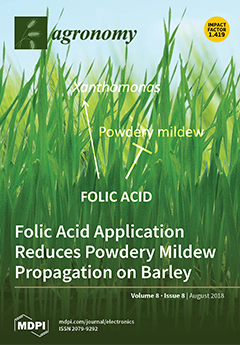
Cover Story: Application of Arabidopsis thaliana resistance-inducing compounds, including salicylic acid and folic acid to barley, systemically reduces propagation of the fungal pathogen Blumeria graminis (Bgh; powdery mildew). Although the data suggest that adverse effects on the growth of bacterial pathogens, such as Xanthomonas translucens, should be anticipated, folic acid application could be considered as an alternative method to enhance the resistance of barley against powdery mildew. View this paper
  • Issues are regarded as officially published after their release is announced to the table of contents alert mailing list .
  • You may sign up for email alerts to receive table of contents of newly released issues.
  • PDF is the official format for papers published in both, html and pdf forms. To view the papers in pdf format, click on the "PDF Full-text" link, and use the free Adobe Reader to open them.

Articles (29)

  • Article
  • Open Access
53 Citations
6,783 Views
16 Pages

Salinity and Low Phosphorus Differentially Affect Shoot and Root Traits in Two Wheat Cultivars with Contrasting Tolerance to Salt

  • Ghulam Abbas,
  • Yinglong Chen,
  • Faisal Younus Khan,
  • Yupeng Feng,
  • Jairo A. Palta and
  • Kadambot H. M. Siddique

20 August 2018

Soil salinity and phosphorus (P) deficiency both have adverse effects on crop growth and productivity, but the interaction of soil salinity and P deficiency is not well known. Two P-inefficient wheat cultivars, Janz (salinity-tolerant) and Jandaroi (...

  • Article
  • Open Access
19 Citations
5,264 Views
14 Pages

20 August 2018

The high adaptive potential of modern wheat to a wide range of environmental conditions is determined by genetic changes during domestication. Genetic diversity in VRN1 genes is a key contributor to this adaptability. Previously, the association betw...

  • Article
  • Open Access
13 Citations
5,621 Views
12 Pages

First Case of Conyza canadensis from Hungary with Multiple Resistance to Glyphosate and Flazasulfuron

  • Candelario Palma-Bautista,
  • Behroz Khalil Tahmasebi,
  • Pablo Tomás Fernández-Moreno,
  • Antonia M. Rojano-Delgado,
  • Ricardo Alcántara de la Cruz and
  • Rafael De Prado

20 August 2018

Conyza canadensis is a species invading large areas throughout the world, mainly due to its ability to evolve herbicide resistance. In Hungary, extensive areas have been infested by this species due to the difficulty in controlling it with glyphosate...

  • Article
  • Open Access
27 Citations
8,776 Views
15 Pages

19 August 2018

Eloquent information about the genetic basis of inheritance is important for any breeding program. Therefore, a diallel study was conducted under the influence of tomato leaf curl virus (TLCV) disease, using the eleven advanced lines of tomato. First...

  • Article
  • Open Access
6 Citations
4,750 Views
12 Pages

Nitrogen Recovery Efficiency from Urea Treated with NSN Co-Polymer Applied to No-Till Corn

  • Pablo Andrés Barbieri,
  • Hernán René Sainz Rozas and
  • Hernán Eduardo Echeverría

19 August 2018

Nitrogen (N) rate increases used by many farmers produce a reduced or null effect on N recovery efficiency (RE) by crops. Therefore, management practices to reduce N losses and increase RE are necessary. Co-polymer maleic itaconic acid (NSN) have bec...

  • Article
  • Open Access
17 Citations
5,993 Views
9 Pages

Water Stress Influence on The Vegetative Period Yield Components of Different Maize Genotypes

  • Cassyo De Araujo Rufino,
  • Jucilayne Fernandes-Vieira,
  • Jesús Martín-Gil,
  • José De Souza Abreu Júnior,
  • Lizandro Ciciliano Tavares,
  • Marciabela Fernandes-Correa and
  • Pablo Martín-Ramos

17 August 2018

Maize is an important food staple in many countries, and is useful in animal feed and many industrial applications. Its productivity is highly sensitive to drought stress, which may occur at any period during its growth cycle. The objective of this w...

  • Review
  • Open Access
51 Citations
12,056 Views
21 Pages

Climate Change, Carbon Dioxide, and Pest Biology, Managing the Future: Coffee as a Case Study

  • Lewis H. Ziska,
  • Bethany A. Bradley,
  • Rebekah D. Wallace,
  • Charles T. Bargeron,
  • Joseph H. LaForest,
  • Robin A. Choudhury,
  • Karen A. Garrett and
  • Fernando E. Vega

17 August 2018

The challenge of maintaining sufficient food, feed, fiber, and forests, for a projected end of century population of between 9–10 billion in the context of a climate averaging 2–4 °C warmer, is a global imperative. However, climate ch...

  • Article
  • Open Access
47 Citations
7,518 Views
16 Pages

Effect of Sulphur Application on Photosynthesis and Biomass Accumulation of Sesame Varieties under Rainfed Conditions

  • Muhammad Ali Raza,
  • Ling Yang Feng,
  • Nasir Iqbal,
  • Abdul Manaf,
  • Muhammad Hayder Bin Khalid,
  • Sana Ur Rehman,
  • Allah Wasaya,
  • Muhammad Ansar,
  • Masum Billah and
  • Feng Yang
  • + 1 author

16 August 2018

Oilseeds yield response to sulphur (S) has been well investigated but the dynamics of total biomass accumulation (TBA) and partitioning by sesame plants in response to S are not well understood. This study was initiated to investigate the effects of...

  • Feature Paper
  • Article
  • Open Access
43 Citations
6,865 Views
10 Pages

16 August 2018

Apricot fruits provide important health, economic, and nutritional benefits. Weeds damage apricot production directly and host the pests that cause damages to apricot trees. However, very few studies are available on weed control in apricot orchards....

  • Review
  • Open Access
19 Citations
7,656 Views
16 Pages

Similarities and Differences in the Acquisition of Fe and P by Dicot Plants

  • Carlos Lucena,
  • Rafael Porras,
  • Francisco Javier Romera,
  • Esteban Alcántara,
  • María José García and
  • Rafael Pérez-Vicente

15 August 2018

This review deals with two essential plant mineral nutrients, iron (Fe) and phosphorus (P); the acquisition of both has important environmental and economic implications. Both elements are abundant in soils but are scarcely available to plants. To pr...

of 3

Get Alerted

Add your email address to receive forthcoming issues of this journal.

XFacebookLinkedIn
Agronomy - ISSN 2073-4395