


You are currently viewing a new version of our website. To view the old version click .

Cancers, Volume 14, Issue 1

January-1 2022 - 262 articles

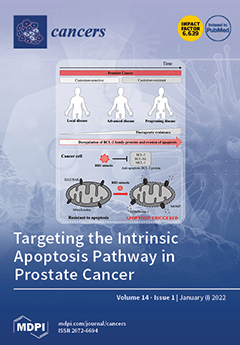
Cover Story: The management of prostate cancer has improved over the last 20 years; despite this, advanced disease remains invariably fatal. Evasion of apoptosis is a hallmark of cancer, and thus, triggering apoptotic cancer cell death is an attractive therapeutic strategy. Targeting the intrinsic apoptosis pathway with BH3 mimetics has been successful for hematological malignancies. Utilizing these agents for solid malignancies has been more challenging, though efforts are ongoing. Molecular characterization and the development of predictive biomarkers is likely to be critical for patient selection. Here, we provide an up-to-date overview of cell death, specifically focusing on the intrinsic apoptosis pathway. We summarize the latest approaches for targeting the intrinsic apoptosis pathway with BH3 mimetics and discuss how these strategies may be leveraged to treat prostate cancer. View this paper
  • Issues are regarded as officially published after their release is announced to the table of contents alert mailing list .
  • You may sign up for email alerts to receive table of contents of newly released issues.
  • PDF is the official format for papers published in both, html and pdf forms. To view the papers in pdf format, click on the "PDF Full-text" link, and use the free Adobe Reader to open them.

Articles (262)

  • Article
  • Open Access
18 Citations
3,199 Views
13 Pages

Genetic Analysis Reveals the Prognostic Significance of the DNA Mismatch Repair Gene MSH2 in Advanced Prostate Cancer

  • Hao-Han Chang,
  • Cheng-Hsueh Lee,
  • Yei-Tsung Chen,
  • Chao-Yuan Huang,
  • Chia-Cheng Yu,
  • Victor C. Lin,
  • Jiun-Hung Geng,
  • Te-Ling Lu,
  • Shu-Pin Huang and
  • Bo-Ying Bao

4 January 2022

DNA damage repair is frequently dysregulated in advanced prostate cancer and has been linked to cancer susceptibility and survival outcomes. The aim of this study is to assess the influence of genetic variants in DNA damage repair pathways on the pro...

  • Article
  • Open Access
3 Citations
2,688 Views
10 Pages

Utility of 3T MRI in Women with IB1 Cervical Cancer in Determining the Necessity of Less Invasive Surgery

  • Soo Young Jeong,
  • Byung Kwan Park,
  • Chel Hun Choi,
  • Yoo-Young Lee,
  • Tae-Joong Kim,
  • Jeong-Won Lee and
  • Byoungi-Gie Kim

4 January 2022

Purpose: Cervical cancer that is invisible on magnetic resonance imaging (MRI) may suggest lower tumor burden than physical examination. Recently, 3 tesla (3T) MRI has been widely used prior to surgery because of its higher resolution than 1.5T MRI....

  • Article
  • Open Access
20 Citations
4,239 Views
10 Pages

Post-Irradiation Sinus Mucosa Disease in Nasopharyngeal Carcinoma Patients Treated with Intensity-Modulated Proton Therapy

  • Pei-Wen Wu,
  • Chien-Chia Huang,
  • Yun-Shien Lee,
  • Yung-Chih Chou,
  • Kang-Hsing Fan,
  • Chien-Yu Lin,
  • Bing-Shen Huang,
  • Shih-Wei Yang,
  • Chi-Che Huang and
  • Po-Hung Chang
  • + 2 authors

4 January 2022

In the past decade, patients with nasopharyngeal cancer (NPC) have been deemed candidates for proton radiotherapy, due to the large and comprehensive target volumes and the necessity for the retention of the surrounding healthy tissues. In this study...

  • Review
  • Open Access
100 Citations
8,396 Views
22 Pages

Tumor-Associated Macrophages in Hepatocellular Carcinoma Pathogenesis, Prognosis and Therapy

  • Konstantinos Arvanitakis,
  • Triantafyllia Koletsa,
  • Ioannis Mitroulis and
  • Georgios Germanidis

4 January 2022

Hepatocellular carcinoma (HCC) constitutes a major health burden globally, and it is caused by intrinsic genetic mutations acting in concert with a multitude of epigenetic and extrinsic risk factors. Cancer induces myelopoiesis in the bone marrow, as...

  • Review
  • Open Access
23 Citations
5,339 Views
13 Pages

Implication of Ceramide Kinase/C1P in Cancer Development and Progression

  • Laura Camacho,
  • Alberto Ouro,
  • Ana Gomez-Larrauri,
  • Arkaitz Carracedo and
  • Antonio Gomez-Muñoz

4 January 2022

Cancer cells rewire their metabolic programs to favor biological processes that promote cell survival, proliferation, and dissemination. Among this relevant reprogramming, sphingolipid metabolism provides metabolites that can favor or oppose these ha...

  • Article
  • Open Access
26 Citations
4,610 Views
18 Pages

Auger Emitter Conjugated PARP Inhibitor for Therapy in Triple Negative Breast Cancers: A Comparative In-Vitro Study

  • Ramya Ambur Sankaranarayanan,
  • Jennifer Peil,
  • Andreas T. J. Vogg,
  • Carsten Bolm,
  • Steven Terhorst,
  • Arno Classen,
  • Matthias Bauwens,
  • Jochen Maurer,
  • Felix Mottaghy and
  • Agnieszka Morgenroth

4 January 2022

PARP1 inhibitors (PARPi) are currently approved for BRCAmut metastatic breast cancer, but they have shown limited response in triple negative breast cancer (TNBC) patients. Combination of an Auger emitter with PARPis enables PARP inhibition and DNA s...

  • Article
  • Open Access
10 Citations
3,233 Views
17 Pages

Metabolic Reprogramming and Risk Stratification of Hepatocellular Carcinoma Studied by Using Gas Chromatography–Mass Spectrometry-Based Metabolomics

  • Chengnan Fang,
  • Hui Wang,
  • Zhikun Lin,
  • Xinyu Liu,
  • Liwei Dong,
  • Tianyi Jiang,
  • Yexiong Tan,
  • Zhen Ning,
  • Yaorui Ye and
  • Guang Tan
  • + 1 author

4 January 2022

Hepatocellular carcinoma (HCC) displays a high degree of metabolic and phenotypic heterogeneity and has dismal prognosis in most patients. Here, a gas chromatography–mass spectrometry (GC-MS)-based nontargeted metabolomics method was applied to...

  • Review
  • Open Access
25 Citations
6,000 Views
16 Pages

Lipid Metabolism in Cancer: The Role of Acylglycerolphosphate Acyltransferases (AGPATs)

  • Angeliki Karagiota,
  • Georgia Chachami and
  • Efrosyni Paraskeva

4 January 2022

Altered lipid metabolism is an emerging hallmark of aggressive tumors, as rapidly proliferating cancer cells reprogram fatty acid (FA) uptake, synthesis, storage, and usage to meet their increased energy demands. Central to these adaptive changes, is...

  • Review
  • Open Access
11 Citations
5,912 Views
18 Pages

Secretory Autophagy Forges a Therapy Resistant Microenvironment in Melanoma

  • Silvina Odete Bustos,
  • Nathalia Leal Santos,
  • Roger Chammas and
  • Luciana Nogueira de Sousa Andrade

4 January 2022

Melanoma is the most aggressive skin cancer characterized by high mutational burden and large heterogeneity. Cancer cells are surrounded by a complex environment, critical to tumor establishment and progression. Thus, tumor-associated stromal compone...

  • Article
  • Open Access
27 Citations
3,879 Views
13 Pages

Circulating Cell-Free DNA-Based Comprehensive Molecular Analysis of Biliary Tract Cancers Using Next-Generation Sequencing

  • Szilvia Lilla Csoma,
  • Judit Bedekovics,
  • Gergő Veres,
  • Anita Árokszállási,
  • Csilla András,
  • Gábor Méhes and
  • Attila Mokánszki

4 January 2022

Biliary tract cancer (BTC) is a rare malignancy with a long disease course and an overall poor prognosis. Despite multiple chemotherapy agents, there is no defined second-line treatment opportunity for advanced BTCs. In the era of precision oncology,...

of 27

Get Alerted

Add your email address to receive forthcoming issues of this journal.

XFacebookLinkedIn
Cancers - ISSN 2072-6694