

You are currently on the new version of our website. Access the old version .

Toxins, Volume 13, Issue 7

2021 July - 74 articles

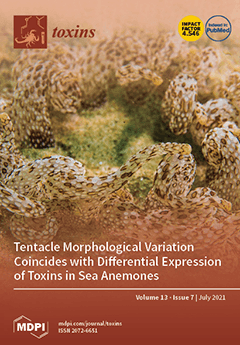
Cover Story: In phylum Cnidaria, venom apparatus is distributed across the entire animal, supporting the regionalisation of venom production and the tissue-specific expression of toxins. Transcriptomic analysis was used to characterise the toxin profiles of specialised tentacular structures and investigate their functional significance within order Actiniaria. Results showed that the differential expression of toxin genes is associated with morphological variation of tentacular structures in a tissue-specific manner. Furthermore, hosting photosynthetic symbionts may account for the tentacle-specific toxin expression profiles in select sea anemone families. Thus, specialised tentacular structures serve unique ecological roles, and, in order to fulfil their functions, they possess distinct venom cocktails. View this paper
  • Issues are regarded as officially published after their release is announced to the table of contents alert mailing list .
  • You may sign up for email alerts to receive table of contents of newly released issues.
  • PDF is the official format for papers published in both, html and pdf forms. To view the papers in pdf format, click on the "PDF Full-text" link, and use the free Adobe Reader to open them.

Articles (74)

  • Article
  • Open Access
1 Citations
3,306 Views
15 Pages

20 July 2021

This paper assesses the effects of exposure to toxic concentrations (1200 to 6000 cells/mL) of the dinoflagellates Prorocentrum lima, Prorocentrum minimum, and Prorocentrum rhathymum and several concentrations of aqueous and organic extracts obtained...

  • Article
  • Open Access
18 Citations
6,864 Views
37 Pages

20 July 2021

Parkinson’s patients often suffer from depression and anxiety, for which there are no optimal treatments. Hemiparkinsonian (hemi-PD) rats were used to test whether intrastriatal Botulinum neurotoxin-A (BoNT-A) application could also have antidepressa...

  • Article
  • Open Access
12 Citations
4,453 Views
23 Pages

Cell Death and Metabolic Stress in Gymnodinium catenatum Induced by Allelopathy

  • Leyberth José Fernández-Herrera,
  • Christine Johanna Band-Schmidt,
  • Tania Zenteno-Savín,
  • Ignacio Leyva-Valencia,
  • Claudia Judith Hernández-Guerrero and
  • Mauricio Muñoz-Ochoa

20 July 2021

Allelopathy between phytoplankton species can promote cellular stress and programmed cell death (PCD). The raphidophyte Chattonella marina var. marina, and the dinoflagellates Margalefidinium polykrikoides and Gymnodinium impudicum have allelopathic...

  • Article
  • Open Access
13 Citations
4,181 Views
13 Pages

The Protein-Independent Role of Phosphate in the Progression of Chronic Kidney Disease

  • Irene Faria Duayer,
  • Eduardo Jorge Duque,
  • Clarice Kazue Fujihara,
  • Ivone Braga de Oliveira,
  • Luciene Machado dos Reis,
  • Flavia Gomes Machado,
  • Fabiana Giorgetti Graciolli,
  • Vanda Jorgetti,
  • Roberto Zatz and
  • Rosa Maria Affonso Moysés
  • + 1 author

19 July 2021

Several factors contribute to renal-function decline in CKD patients, and the role of phosphate content in the diet is still a matter of debate. This study aims to analyze the mechanism by which phosphate, independent of protein, is associated with t...

  • Article
  • Open Access
9 Citations
5,229 Views
36 Pages

Proteo-Trancriptomic Analyses Reveal a Large Expansion of Metalloprotease-Like Proteins in Atypical Venom Vesicles of the Wasp Meteorus pulchricornis (Braconidae)

  • Jean-Luc Gatti,
  • Maya Belghazi,
  • Fabrice Legeai,
  • Marc Ravallec,
  • Marie Frayssinet,
  • Stéphanie Robin,
  • Djibril Aboubakar-Souna,
  • Ramasamy Srinivasan,
  • Manuele Tamò and
  • Anne-Nathalie Volkoff
  • + 1 author

19 July 2021

Meteorus pulchricornis (Ichneumonoidea, Braconidae) is an endoparasitoid wasp of lepidopteran caterpillars. Its parasitic success relies on vesicles (named M. pulchricornis Virus-Like Particles or MpVLPs) that are synthesized in the venom gland and i...

  • Article
  • Open Access
26 Citations
3,996 Views
17 Pages

18 July 2021

A novel porous carbon adsorbent for the removal of deoxynivalenol was prepared from soybean dreg (SD). The new material was characterized by scanning electron microscopy equipped with energy dispersive X-ray spectroscopy (SEM-EDS), transmission elect...

  • Article
  • Open Access
4 Citations
6,601 Views
21 Pages

Identification and Characterization of Novel Proteins from Arizona Bark Scorpion Venom That Inhibit Nav1.8, a Voltage-Gated Sodium Channel Regulator of Pain Signaling

  • Tarek Mohamed Abd El-Aziz,
  • Yucheng Xiao,
  • Jake Kline,
  • Harold Gridley,
  • Alyse Heaston,
  • Klaus D. Linse,
  • Micaiah J. Ward,
  • Darin R. Rokyta,
  • James D. Stockand and
  • Ashlee H. Rowe
  • + 2 authors

18 July 2021

The voltage-gated sodium channel Nav1.8 is linked to neuropathic and inflammatory pain, highlighting the potential to serve as a drug target. However, the biophysical mechanisms that regulate Nav1.8 activation and inactivation gating are not complete...

  • Communication
  • Open Access
20 Citations
8,819 Views
6 Pages

Dietary Supplements Based on Red Yeast Rice—A Source of Citrinin?

  • Magdalena Twarużek,
  • Iwona Ałtyn and
  • Robert Kosicki

17 July 2021

Citrinin (CIT) is secondary metabolite of filamentous molds. This mycotoxin has nephrotoxic, hepatotoxic, embryocidal, and fetotoxic properties. It is also produced by several species of the three genera Penicillium spp., Aspergillus spp., and Monasc...

  • Article
  • Open Access
14 Citations
4,732 Views
20 Pages

Study of Anti-Inflammatory and Analgesic Activity of Scorpion Toxins DKK-SP1/2 from Scorpion Buthus martensii Karsch (BmK)

  • Yunxia Liu,
  • Yan Li,
  • Yuchen Zhu,
  • Liping Zhang,
  • Junyu Ji,
  • Mingze Gui,
  • Chunli Li and
  • Yongbo Song

17 July 2021

Buthus martensii Karsch (BmK), is a kind of traditional Chinese medicine, which has been used for a long history for the treatment of many diseases, such as inflammation, pain and cancer. In this study, DKK-SP1/2/3 genes were screened and extracted f...

  • Review
  • Open Access
24 Citations
5,517 Views
17 Pages

Biosensors for Deoxynivalenol and Zearalenone Determination in Feed Quality Control

  • Krisztina Majer-Baranyi,
  • Nóra Adányi and
  • András Székács

17 July 2021

Mycotoxin contamination of cereals used for feed can cause intoxication, especially in farm animals; therefore, efficient analytical tools for the qualitative and quantitative analysis of toxic fungal metabolites in feed are required. Current trends...

of 8

Get Alerted

Add your email address to receive forthcoming issues of this journal.

XFacebookLinkedIn
Toxins - ISSN 2072-6651