

You are currently viewing a new version of our website. To view the old version click .

Pharmaceutics, Volume 17, Issue 12

December 2025 - 125 articles

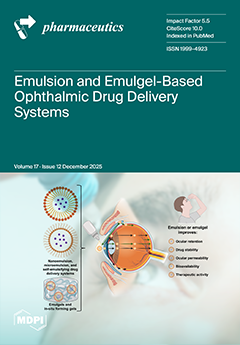
Cover Story: Ophthalmic drug delivery faces major anatomical and physiological barriers, necessitating the development of novel drug delivery systems. This review highlights nanoemulsions, microemulsions, self-emulsifying drug delivery systems including self-nano emulsifying drug delivery systems and self-micro emulsifying drug delivery systems, emulgels, and in situ-forming emulgels as emerging platforms that improve ocular retention, stability, permeability, bioavailability, and ultimately therapeutic activity. It covers ocular diseases, limitations of conventional formulations, mechanisms of enhanced permeation by emulsion systems, formulation and optimization strategies, characterization, recent patents, clinical trials, marketed products, and future prospects of these systems for ocular diseases. View this paper
  • Issues are regarded as officially published after their release is announced to the table of contents alert mailing list .
  • You may sign up for email alerts to receive table of contents of newly released issues.
  • PDF is the official format for papers published in both, html and pdf forms. To view the papers in pdf format, click on the "PDF Full-text" link, and use the free Adobe Reader to open them.

Articles (125)

  • Review
  • Open Access
435 Views
38 Pages

The Application of Nanomaterials in Breast Cancer

  • Kexin Guo,
  • Yue Sun and
  • Huihua Xiong

Breast cancer is one of the most prevalent malignant tumors worldwide, with the highest incidence and mortality among women. Early precise diagnosis and the development of efficient treatment regimens remain major clinical challenges. Harnessing the...

  • Article
  • Open Access
471 Views
29 Pages

Background/Objectives: Wound healing requires simultaneous pain control, inflammation management, infection prevention, and tissue regeneration. This study aimed to develop and evaluate in vitro a non-contact thermosensitive spray hydrogel combining...

  • Article
  • Open Access
519 Views
19 Pages

Background: The compaction of formulation blends is a critical stage in pharmaceutical tablet manufacturing, particularly when drug substances or functional excipients exhibit limited flowability and tabletability. Objectives: This study systematical...

  • Review
  • Open Access
1,049 Views
48 Pages

Recent Developments in Pharmaceutical Spray Drying: Modeling, Process Optimization, and Emerging Trends with Machine Learning

  • Waasif Wahab,
  • Raya Alshamsi,
  • Bouta Alharsousi,
  • Manar Alnuaimi,
  • Zaina Alhammadi and
  • Belal Al-Zaitone

Spray drying techniques are widely used in the pharmaceutical industry to produce fine drug powders with different properties depending on the route of administration. Process parameters play a vital role in the critical quality attributes of the fin...

  • Review
  • Open Access
734 Views
33 Pages

Sodium–glucose cotransporter 2 (SGLT2) inhibitors are widely used in type 2 diabetes and cardiometabolic diseases, and their pharmacokinetic characteristics generally confer a low risk of clinically relevant drug–drug interactions (DDIs)....

  • Article
  • Open Access
581 Views
30 Pages

Flavonifractor plautii as a Next-Generation Probiotic Enhancing the NGP F/P Index in a Simulated Human Gut Microbiome Ecosystem

  • Md Sarower Hossen Shuvo,
  • Sukyung Kim,
  • Sujin Jo,
  • Md Abdur Rahim,
  • Indrajeet Barman,
  • Mohammed Solayman Hossain,
  • Youjin Yoon,
  • Hanieh Tajdozian,
  • Izaz Ahmed and
  • Ali Atashi
  • + 7 authors

Background/Objectives: Traditionally consumed fermented foods and lactic acid bacteria (LAB)-based products have primarily been investigated for their nutritional and health-promoting benefits as dietary supplements. More recently, research has advan...

  • Review
  • Open Access
1 Citations
667 Views
40 Pages

Mesoporous silica nanoparticles (MSNs) are among the most adaptable nanocarriers in modern pharmaceutics, characterized by a high surface area, tunable pore size, controllable morphology, and excellent biocompatibility. These qualities enable effecti...

  • Correction
  • Open Access
263 Views
2 Pages

Correction: Sennato et al. Optimization of Lipoplexes Functionalized with a Sialic Acid Mimetic (F9-PEG) to Target the C1858T PTPN22 Variant for Preclinical Assessment of a Novel Immunotherapy in Endocrine Autoimmunity. Pharmaceutics 2025, 17, 710

  • Simona Sennato,
  • Giorgia Paldino,
  • Cecilia Bombelli,
  • Irene Mezzani,
  • Stefania Petrini,
  • Eugenia Belcastro,
  • Domenico Vittorio Delfino,
  • Francesco Fiorentino,
  • Carlotta Marianecci and
  • Alessia Ciogli
  • + 3 authors

Eugenia Belcastro was not included as an author in the original publication [...]

  • Review
  • Open Access
474 Views
17 Pages

Sulfated Hyaluronan in Dermatology: What’s New? Overview of Evidence in Specific Dermatological Diseases

  • Giovanni Pellacani,
  • Simone Michelini,
  • Federica Trovato,
  • Alessandra Rallo,
  • Giuseppe Gemma,
  • Camilla Chello,
  • Mauro Pavan,
  • Cristian Guarise and
  • Alberto Giuseppe Passi

Background/Objectives: Sulfated hyaluronic acid (sHA) is a chemically modified derivative of native hyaluronic acid (HA), characterized by enhanced physicochemical stability and increased biological activity. Glycosaminoglycans (GAGs), including HA,...

  • Article
  • Open Access
406 Views
19 Pages

Therapeutic Delivery of Phloretin by Mixed Emulsifier-Stabilized Nanoemulsion Alleviated Cerebral Ischemia/Reperfusion Injury

  • Tingting Huang,
  • Changjing Wu,
  • Wenchai Lu,
  • Houbo Lv,
  • Ronghui Jin,
  • Jingyao Gan and
  • Yuandong Zhang

Background: Cerebral ischemia/reperfusion injury (CIRI) is a major challenge in ischemic stroke treatment. Phloretin (PHL), despite its potent antioxidant and anti-inflammatory properties, has limited clinical application due to poor oral bioavailabi...

of 13

Get Alerted

Add your email address to receive forthcoming issues of this journal.

XFacebookLinkedIn
Pharmaceutics - ISSN 1999-4923