
- Article

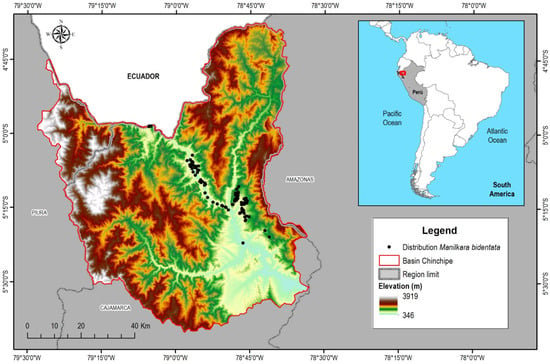
Manilkara bidentata is a tropical tree of high economic and ecological value. In Peru, it is listed as Vulnerable and is under pressure from timber extraction. In the Chinchipe River basin, it survives only as isolated trees and in relict forest patches, and it is unknown how climate change will affect its distribution there. We modelled its current and future habitat suitability with MaxEnt. Of 96 presence records, 95 were retained, and 10 bioclimatic, topographic, and edaphic variables were selected from 41 candidates using correlation clustering and an integrated importance index. Future conditions came from five global climate models (ACCESS-CM2, CNRM-CM6-1, IPSL-CM6A-LR, MIROC6, and MPI-ESM1-2-HR) under four scenarios (SSP1-2.6, SSP2-4.5, SSP3-7.0, and SSP5-8.5) for four periods between 2021 and 2100, giving 80 projections. The model discriminated occurrences from background points well (training AUC = 0.9905; mean test AUC in five-fold cross-validation = 0.988). Using the maximum sensitivity-plus-specificity threshold (0.055), suitable habitat currently covers 699.6 km2 of the 14,632 km2 modelling window that encloses the basin, 586.7 km2 of them inside the basin. Where at least half of the climate models agreed, suitable habitat decreased in every scenario, by 3.3% to 37.1%, and between 268.7 and 518.0 km2 remained stable. The individual models, however, ranged from an almost complete loss to a gain of 126.1%. Modeling the spatial distribution of M. bidentata under climate change scenarios will help us understand the species’ climatic and ecological sensitivity so that we can propose appropriate conservation and restoration strategies.
25 November 2026