Review

Black Locust (Robinia pseudoacacia L.) Wood: A Review of Material Properties, Characterization, and Industrial Potential in Europe

by
Mihaela Porojan
and
Emilia-Adela Manea Salca
*
Faculty of Furniture Design and Wood Engineering, Transilvania University of Brasov, 500036 Brasov, Romania
*
Author to whom correspondence should be addressed.
Forests 2026, 17(7), 841; https://doi.org/10.3390/f17070841
Submission received: 28 May 2026 / Revised: 6 July 2026 / Accepted: 13 July 2026 / Published: 16 July 2026
(This article belongs to the Special Issue Wood Quality and Mechanical Properties: 3rd Edition)

Abstract

Black locust (Robinia pseudoacacia L.) has become an increasingly important tree species in Europe due to its rapid growth, adaptability and potential to provide durable timber under changing climatic conditions. This paper presents a review of the European specialty literature concerning the silviculture, utilization, anatomical structure, chemical composition, main physical properties, mechanical properties and technological processing of black locust wood. Particular attention is given to the relationship between wood characteristics and possible industrial applications. The literature survey indicates that black locust trees perform well on drought-prone and sandy sites and produce timber with favourable mechanical properties. Together with its durability, relatively low shrinkage, good dimensional stability, and satisfactory machinability, these attributes support its use in both indoor and outdoor products. In addition, thermal modification and appropriate drying techniques can further enhance the wood’s appearance and service performance, increasing its competitiveness as a sustainable alternative to tropical hardwood species. The synthesis of existing research highlights the significant yet still underexploited potential of black locust for the European wood industry and emphasizes the need for continued research and wider industrial promotion of the species.

1. Introduction

The transition toward a sustainable bioeconomy and the intensifying impacts of climate change have heightened the search for tree species that can provide renewable raw materials while maintaining high productivity under increasingly challenging environmental conditions.
In Europe, prolonged droughts, rising temperatures, and the growing need to reduce dependence on imported tropical hardwoods have spurred interest in alternative timber species that combine ecological adaptability with desirable technological properties. Among these, black locust (Robinia pseudoacacia L.) has attracted considerable attention for its rapid growth, tolerance of poor soils and water deficits, high-quality timber and exceptional natural durability [1,2,3].
Originally native to North America, black locust has been cultivated throughout Europe for more than three centuries and is now widely distributed across temperate regions. The species has become an important component of forestry, agroforestry, land restoration, and biomass production systems, particularly on marginal and degraded sites where many native species show limited productivity. At the same time, black locust represents a complex management issue because, while it provides significant economic and environmental benefits, it is also recognized as an invasive alien species in several European regions, where uncontrolled expansion may threaten native ecosystems and biodiversity [1,4]. Consequently, its sustainable management requires balancing its economic value with ecological considerations.
From the perspective of wood utilization, black locust is distinguished by a unique combination of anatomical, chemical, physical and mechanical characteristics. Its high density, excellent strength, good dimensional stability and remarkable natural durability make it one of the most valuable temperate hardwoods for outdoor and structural applications [3]. These intrinsic properties also influence its technological behaviour during drying, machining, bonding, finishing, and thermal modification, ultimately determining its suitability for different industrial products. Understanding the relationships between wood formation, structure, properties, processing behaviour and end-use performance is therefore essential for maximizing the efficient utilization of this resource.
Although numerous studies have investigated individual aspects of black locust biology, wood quality, and technological processing, the available information remains fragmented across different scientific disciplines.
Most publications address specific topics such as wood anatomy, mechanical performance, drying behaviour, machining or industrial applications independently, making it difficult to obtain an integrated understanding of the species. Moreover, no recent review has comprehensively synthesized the European-scientific literature while explicitly linking the biological characteristics of black locust with its technological performance and industrial potential.
The present review addresses this gap by critically synthesizing the European literature concerning the silviculture, anatomical structure, chemical composition, physical and mechanical properties, technological processing, durability and utilization of black locust wood. Particular emphasis is placed on the relationships between wood characteristics and processing behaviour, illustrating how the inherent properties of the material determine its industrial performance and potential applications. The review also considers the dual role of black locust as both a valuable timber resource and a potentially invasive species, highlighting the implications for its sustainable management within the European context.
The review is structured according to a conceptual framework that links tree growth and wood formation to anatomical and chemical characteristics, the resulting physical and mechanical properties, technological processing, and ultimately industrial utilization. By integrating these interconnected aspects, the review aims to provide a comprehensive reference on black locust wood in Europe, identify current knowledge gaps and research priorities and support the wider and more sustainable utilization of this valuable hardwood species.

2. Methodology

This review synthesizes 142 international studies on the black locust (Robinia pseudoacacia L.) grown in Europe. Relevant literature was retrieved from Google Scholar and ResearchGate using specific keywords, including black locust, durability, physical properties, mechanical properties, structure, technological properties and uses.
The analysis incorporates original research articles, review papers, conference proceedings, PhD theses and rare historical publications of local and international significance. The core of the paper is deliberately divided into thematic sections, such as silviculture, structure, chemical composition, physical and mechanical properties, technological processing and utilization of black locust wood. This thematic structuring allows for direct comparison, contrast and synthesis of results across multiple papers. To give the study a logical progression, a conceptual framework illustrating the relationship between the sections was compiled (Figure 1).

3. Silvicultural Aspects of Black Locust Wood Species

Robinia pseudoacacia L. belongs to the order Rosales, the family Leguminosae, the subfamily Papilionatae, and the genus Robinia. An exotic species, black locust is native to southeastern North America, where it is found in a relatively small territory. The genus Robinia includes about 20 species of trees and shrubs [1,2,3].
Black locust has a distinct history in each region where it was introduced and cultivated [1,2,3]. In its homeland, it forms mixed stands with other species. It is found in meadows but not in floodplains, at elevations up to about 1500 m. Black locust has been widely planted outside their native range, covering 3 million hectares, out of which over 2.3 million hectares are spread in Europe [4]. It follows Eucalyptus as a planted species [5] and is the second hardwood species introduced in Europe for wood production after Quercus rubra [6]. Its cultivation has spread to Europe and Asia—to India, Burma, Japan, China, the Middle and Near East, and South Africa. In Europe, it covers 400,000 ha in Hungary, 423,000 ha in Ukraine, 250,000 ha in Romania, 200,000 ha in France and 230,000 ha in Italy [7]. The species has a high ecological and economic value; it is known as a pioneer, ornamental and feed species. However, in other regions, such as Britain, Germany, France, and Japan, it poses serious problems as an invasive species [8,9]. It reduces biodiversity by limiting light access and changes the microclimate and soil conditions [10]. On the contrary, in areas heavily impacted by human activity, its ability to spread is a positive feature [11]. Black locust tree can grow in mixed stands of fast-growing species, such as Betula pendula, Populus tremula, Pinus sylvestris or Prunus spinosa shrubs [11]. Fossil fragments of black locust wood from the Tertiary geologic period have been found in Europe [12]. Black locust tree grows well in regions with a mild climate, with a lot of summer heat and a long growing season, which allows the lignification of the shoots. The ecological optimum of the species is located in regions with an average annual precipitation above 1000 mm and a temperature of 9–11 °C, but drier conditions are also tolerated. In cold climates, with frequent early frosts and cold winds, it is often damaged and shows a poor capacity for bioaccumulation and survival. Frost and soft snow cause the shoots and branches to break, the forked stems to split and the shoots to become unkempt [3,9]. Of great importance for its development are the soil’s physical and chemical properties, in addition to thermal and humidity conditions. Thus, coarse-textured, sandy, aerated, permeable, neutral or slightly acidic soils are favourable for it [3,9]. Clayey, compact, carbonate-rich soils are not recommended for cultivation [12]. The high calcium content is much more unfavourable in dry conditions in the soil. It tolerates, without achieving special performances, relatively saline soils. Although it can also develop on relatively poor, oligobasic soils, these are not favourable for it, because black locust tree consumes very large quantities of mineral elements, a fact proven by foliar and ash composition analyses resulting from combustion. Therefore, repeated cultivation on soils deficient in exchange base supply depletes the soil and growth performance is considerably reduced [1,7,12].
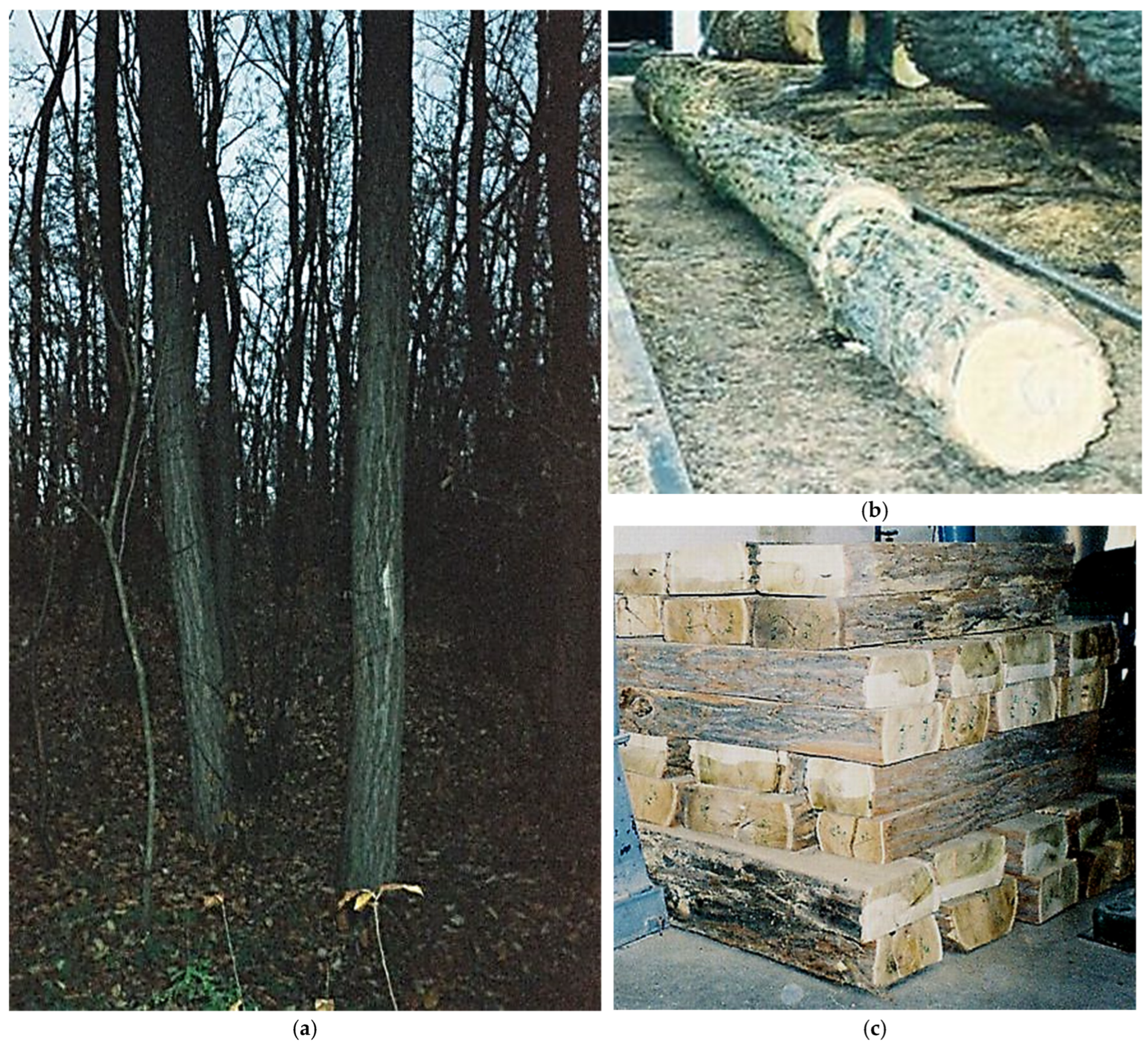
The black locust tree is a light-demanding species and it tolerates a slight lateral shading [3,7]. Therefore, old tree stands are often thinned out, modifying the indoor climate very little. However, very few woody species can survive in stands made up of black locust, due to the strong competition that it exerts in the soil through its very-well-developed root system, both in depth and laterally, consuming large quantities of mineral substances [3,7,12]. The expansion in cultivation depends largely on the attack of the species Megacyllena robiniae and the infestation with Phellinus rimosus, which causes rot, the wood being unfit for commercial use [3]. Black locust seedlings, leaves, shoots and wood are affected by cryptogamic diseases. In most plantations, the fungi Fomes cytisinus, Grifola sulphurea, Ganoderma applanatum and Paria sp. are of certain importance, which cause rot of the heartwood or sapwood (Figure 2). Some damage is caused by game animals that eat the seedlings, leaves and young shoots and by beetle larvae that attack the roots, while the stands are sometimes subjected to wildfires [13,14].
Black locust trees mature early, fruiting annually and abundantly at 5–7 years. Two regeneration methods are applied, such as vegetative regeneration of harvested stands using mechanical stimulation of root sprouting and also an artificial one by planting nursery seedlings in non-forest lands [15,16]. Nicolescu et al. [15] showed that a density of root suckers around 50,000 plants/ha can be obtained after clear-cutting and stump removal. The maturation is annual, around September when the dissemination begins, which continues until February–March. It is recommended to harvest the seeds directly from the trees or by separation from litter; seedlings are ready for transplantation after one growth season. The seeds must meet the standard requirement for purity, germination and mass [14]. The longevity of the black locust tree exceeds 100 years, but rot often forms before this age. But coppicing with 20-year rotation lengths does not allow the tree to reach old age [17]. The specimens from shoots, which have the powerful root system of the stump at their disposal, grow very quickly when young. Under optimal conditions, the shoots can reach a few metres in the first year and at 5 years old, they exceed 10 m in height. The growth of specimens from shoots and suckers is very active, but suckers are preferable, being longer-lived. The tree can reach heights of over 25 m at 30 years of age [3,12]. Specimens from seeds also show considerable growth speed, which, after 15–20 years, exceeds that obtained vegetatively. At 20 years, the average productivity of the best black locust stands in plantations reaches 15–17 m3/year/ha, while the productivity of stands from shoots of the same age is 13.4 m3/ha [3]. The intensity of thinning operations is a key factor for further activities in each stand, considering the growth and wood quality. The maximum growth in diameter and volume in black locust trees occurs between 12 and 20 years of age. Thus, in favourable locations, it produces, at relatively young ages, much larger quantities of wood mass than most of the basic species in the country’s forests (Figure 2).
However, black locust trees may present forked and curved stems, which negatively influence wood production [3]. Genetic breeding programmes are highly effective in producing black locust trunks of suitable shape for higher wood quality and many countries have invested in such programmes to improve their industrial timber value [5]. From the coppice and plantation stand structures of black locust, a yield of production class III at 20 years old of about 185 m3/ha and 195 m3/ha, respectively, was obtained [3].
Black locust is one of the widely used species in forest land reclamation. Black locust is a multi-purpose tree species; its afforestation on degraded lands improves the land potential and contributes to the local communities, rather than being a dangerous neophyte [18]. Several programmes to develop clonal materials could be implemented to solve the limitations of black locust and enhance its wood quality [19,20,21,22]. The black locust tree has exceptional silvicultural and protective value due to its ability to fix mobile, “flying” sands. However, some black locust forests with this function have been illegally cleared [23]. On the other hand, the use of black locust trees on degraded lands other than sandy ones has yielded very good results in the absence of limiting factors [24]. The trees have an environmental utility for carbon sequestration that increases with age. However, plantations have a negative influence on soil moisture recharge at depth [25]. Black locust tree is widely used as an ornamental species in forest belts, blooms abundantly, and its honey value is indisputable; black locust groves are among the most valued, along with lime trees, for beekeeping [3,26]. In addition to its silvicultural importance, black locust also holds industrial potential. It has better strength and elastic properties than other native species in Europe, although it is not widely used for furniture manufacturing [2]. Due to its durability and dimensional stability, black locust is now an important resource for diverse applications [3].
Silvicultural practices and site conditions play a fundamental role in determining the formation and quality of black locust wood. Growth rate, stand density, soil characteristics, water availability and climate influence cambial activity and wood formation, affecting annual ring width, the proportion of earlywood and latewood, vessel distribution, fibre development and the accumulation of heartwood extractives. These anatomical characteristics are established during tree growth and ultimately determine the intrinsic structure of the wood. Therefore, understanding the silvicultural and ecological factors influencing wood formation provides the necessary basis for interpreting the anatomical and chemical features that govern the technological behaviour of black locust wood.

4. Structure of Black Locust Wood

4.1. Macroscopic Structure

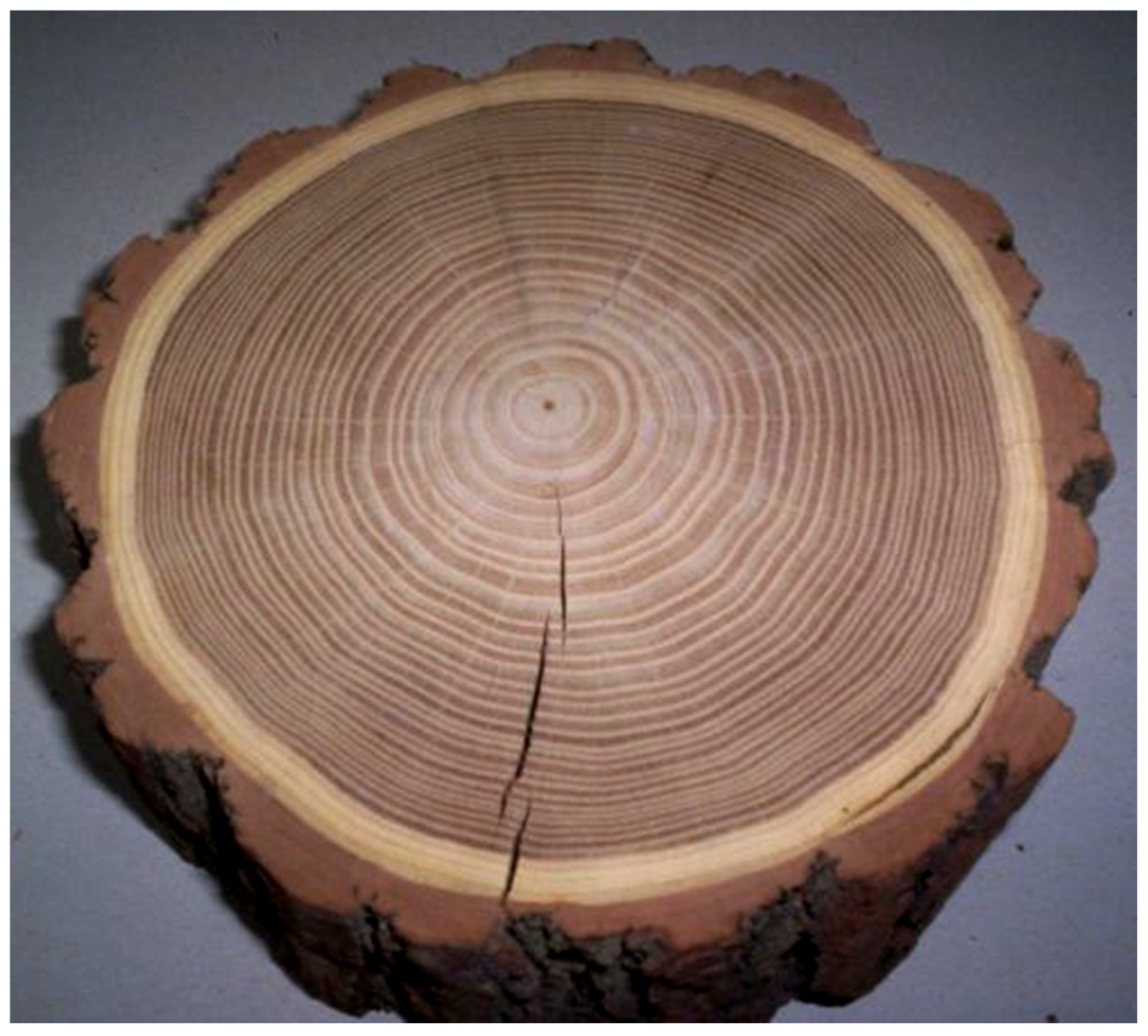
The black locust wood species is classified among ring-porous deciduous species with heartwood, characterized by a complex, uneven structure, with annual rings clearly visible to the naked eye and pores filled with tyloses, fine, invisible rays and approximately 6% wood parenchyma [27,28]. In the cross-section of a black locust log, except for the bark, three characteristic zones can be distinguished: an outer zone consisting of 2–5 annual rings that form the sapwood, the second central zone, extended, which includes most of the annual rings forming the heartwood, and the third zone—the wood pith, very slightly extended (Figure 3). The bark is greyish-brown [3,26].
The sapwood, when fresh, is light yellowish-white with a slight greenish tint; when exposed to air, it darkens slightly due to oxidation. This colour change occurs shortly after the tree is felled, and the colour reopens upon drying. The vessels in the sapwood, for the most part, lack tyloses and are permeable to water. The sapwood of a living or freshly felled tree has a higher water content; it is the physiologically active area, serving the upward circulation of raw sap and the storage of reserve substances [3].
The heartwood is wide and clearly distinct from the sapwood; it ranges in hue from yellowish-brown or greyish-brown to greenish-brown in young trees. The formation of heartwood, called duramenification, is a complex biochemical and physiological process during which most cells die. During this process, parenchymal cells secrete various secondary chemical substances—dyes, tannins, phenolics—which partially diffuse through the wood and are localized in the prosenchyma cells, in the intermicellar and interfibrillar spaces, in the intercellular spaces and in their lumen. The duramenification process begins at the age of 2–3 years, the heartwood representing up to 93% of the cross-sectional area, frequently 75%–85% [28,29,30]. Other authors mention the ages of 4–6 for heartwood generation, mostly linked to the ageing of the sapwood living cells [31,32]. The regulation of vascular cells is a process connected to heartwood formation [32].
The share of heartwood across the circumferential black locust tree presents differences depending on the tree age, site fertility, light facing, crown structure and trunk shape [28,33]. The proportion of heartwood can be determined based on the number of annual rings and the area occupied by the heartwood. In her study, Porojan [28] used black locust trees from two regions of Romania, North and South, with diameters at breast height from 22.3 to 27.2 cm. It was found that the non-uniformity of the annual ring width produced small differences among the results of the two methods. However, the high heartwood percentage (>80%) shows that black locust wood presents high bulk density and good mechanical properties that will be further discussed.
The heartwood presents fewer vessels with a smaller diameter and filled with tyloses, making it difficult for water to penetrate, as it contains less water than the sapwood. The colour difference between the heartwood and the sapwood is clearly visible immediately after felling and is accentuated after drying. The pith area comprises the anatomical centre of the cross-section and appears as a darker, circular or oval spot, surrounded by 1–2 annual rings of primary wood, with different properties from the rest of the wood [3].
The annual rings of black locust generally have a regular outline, with a difference between earlywood and latewood, both in colour and compactness, the width of the annual rings ranging between 3.8 and 6.5 mm. Latewood is pronounced and accounts for 76%–83% of the annual ring width [28]. When comparing the black locust trees from the North and South of Romania, Porojan [28] found that the average width of the latewood zone in the case of black locust (2.77 for trees in North and 3.20 mm South) represented around 2/3 of the average width of the annual rings (3.93 mm North and 4.32 mm South), in all the trees regardless of the geographical area. Trees from the North presented 9% lower widths of annual rings than those in the South. These findings are in accordance with the specialty literature. Usually, the cells in the latewood present a small radius, thick walls and small lumens, which makes the wood tissue very dense [34].
Porojan [28] found an average latewood percentage of about 70.46% for the trees in the North, while a higher percentage of about 75.28% was determined for the trees in the South of Romania. The wider the annual ring, the wider the latewood width is [3]. Klisz et al. [35] studied 31–46-year-old black locust trees in three stands of Poland having 24.7–26.0 cm DBH. Findings showed that wider rings of about 2.26 and 2.17 mm laid down in the directions of the south and east, respectively, while the narrowest one (1.97 mm) was noticed in the northerly direction. However, there is no validation in the case when a layer of spruce trees limits the black locust trees from reaching the light. The tree diameter does not influence the latewood range and anisotropy [6]. Klasnja et al. [36] noticed a significant slowdown of the annual ring width in black locust wood in the older trees: at 6 years old, the average ranged from 5.52 mm to 8.33 mm, while at 13 years old, they ranged from 3.22 mm to 5.85 mm. In general, under the same growth conditions, the annual rings are wider in the central area of the section and decrease in width towards the outside of the cross-section [3]. It was shown that the width of the first 5–9 growth rings from the central part of the black locust is larger and it declined gradually [3].
The cambial activity in black locust is influenced by the site conditions, day length and temperature. These conditions could vary along a growing season and determine the formation of large vessels in early wood and fibres in latewood, with effects on the annual ring width [3,37]. Therefore, wider growth rings are a reflection of the optimal conditions for cell division in a specific side of the trunk [37]. A significant effect of the air temperature and precipitation level on the width of the annual ring (average of about 3.4 mm, ranging from 1.6 to 5.6 mm) of the ornamental black locust trees in Wroclaw, Poland, during the period 1971–2013, was also shown by Kalbarczyk et al. [38]. The temperatures in late winter to early spring, as well as low precipitation in summer, could generate the inhibition of radial growth of black locust wood [38]. Moreover, there is a combined influence of moisture, heat and temperature on the radial growth [6,39].

4.2. Organoleptic Characteristics

The organoleptic characteristics of any wood (appearance: colour, gloss, drawing, texture and smell and taste) contribute to wood identification and influence its perception in practical applications. The golden yellow or yellowish-brown colour is the basic colouration characteristic of black locust wood. Its colour is highly inhomogeneous between trees and within a tree trunk. The a*-b* colour space contains many sample colour dots; the redness coordinate ranges in the interval of 1–7 units and the yellow coordinate covers the interval of 24–35 units. This colour inhomogeneity can be diminished by steaming in wet conditions and by dry heat treatment [40]. In Hungary, Nemeth evaluated the influence of the growing site conditions on the chromatic coordinates of black locust heartwood. Total colour differences from 3.94 to 6.31 were found for good conditions of stands from seedlings and poor conditions of stands from sprouts, respectively [40]. The remarkable gloss is given by the reflection of light by the anatomical components, being most pronounced on the radial section. The semi-fine texture (coarse and uneven) is determined by the diversity of anatomical elements, their size and distribution, by the contrast between vessels (pores), fibre areas and areas of wood parenchyma. The pattern is characterized as “ruled” or “regularly striped”, expressive in the radial and tangential direction. The smell is unpleasant in the green state, due to the volatility of substances encrusted in the cell walls or stored in their lumen (gums, tanning substances), but it is attenuated by drying the wood [3,41].

4.3. Microscopic Structure

Fibres are anatomical elements specific to deciduous trees, with a role in resistance. In black locust wood, they represent 58% of the wood structure [3,41]. They determine the physical, mechanical and technological properties of the species. They are very elongated with thin cells, closed at the ends, with a sharp tip, with thick cell membrane walls and a narrow lumen, with small, simple pits and with linear-oblique openings, more abundant on the radial walls. Almost all fibres in the outer part of the annual ring are living wood fibres that function as large starch storage with a “single-use” [42]. It has been found that the fibres in the heartwood are 7%–9% shorter than those in the sapwood [43]. In another view, the fibre length increases radially from the pith to the cambium [44,45]. On the contrary, Erkan and Bektas [46], who studied a 21-year-old black locust tree of about 6.75 m in length and 20 cm in trunk diameter, found that fibres in the heartwood are longer than those in the sapwood, as presented in Table 1. The so-called gelatinous fibres appear hereditary in healthy black locust wood, which are fibres with very thick walls which appear in most woody species only in tension wood [41]. Older trees have the longest, widest fibres and the thickest fibre walls, while the youngest have the thinnest fibres [36,47,48]. Klasnja et al. [36] noticed that 6-year-old trees presented fibres with a length ranging from 720 to 826 μm and 13-year-old trees had fibres with a higher length, from 817 to 960 μm. The climatic conditions influence the fibre dimensions, especially during the juvenile growth phase. Juvenile and mature wood could give a clear evaluation of wood quality [36,45].
The vessel elements are cells characteristic of deciduous species, with transverse walls totally or partially resorbed. By their end-to-end association, in the longitudinal direction, they form the vessels of the wood and serve to conduct the raw sap from the root to the leaves. They are cells with a large lumen and relatively thin walls, varied in shape, size, thickenings, wall thickenings, pits, perforations of the transverse walls and inclusions. In black locust wood, the vessels in the earlywood have a larger diameter than those in the late wood and are grouped in 2–3 tangential rows. Those in the latewood are scattered in the mass of fibres. The vessels have simple perforations, with round, oval or polygonal pits. They have helical thickenings in the latewood, which increase their resistance. The proportion of vessels in black locust wood is only 15% and influences the properties of this species [41].
After the cessation of the conduction function, the lumen of the vessel elements, in black locust wood, as in other wood species, is totally or partially clogged with tyloses [3]. These are cellulose-like outgrowths of the radial parenchyma or longitudinal parenchyma cells around the vessels. They reach their interior by passing through the pits, due to the osmotic depression in the vessels. The presence of tyloses is also reflected in the water content of black locust logs, which have low moisture content when felled. Within the annual ring width, earlywood contains the highest rate of tyloses [49].
Rays are anatomical elements made up of radial parenchyma cells that conduct and store nutrients received from the leaves and conduct water from the wood to the bark. In black locust, rays, in proportion of 21%, are pluriseriate, made up of 1–3 rows, and in the tangential section they are arranged 9–22/mm2 [3,41]. The lumen of the radial parenchyma cells is blocked by various crystalline chemical substances.
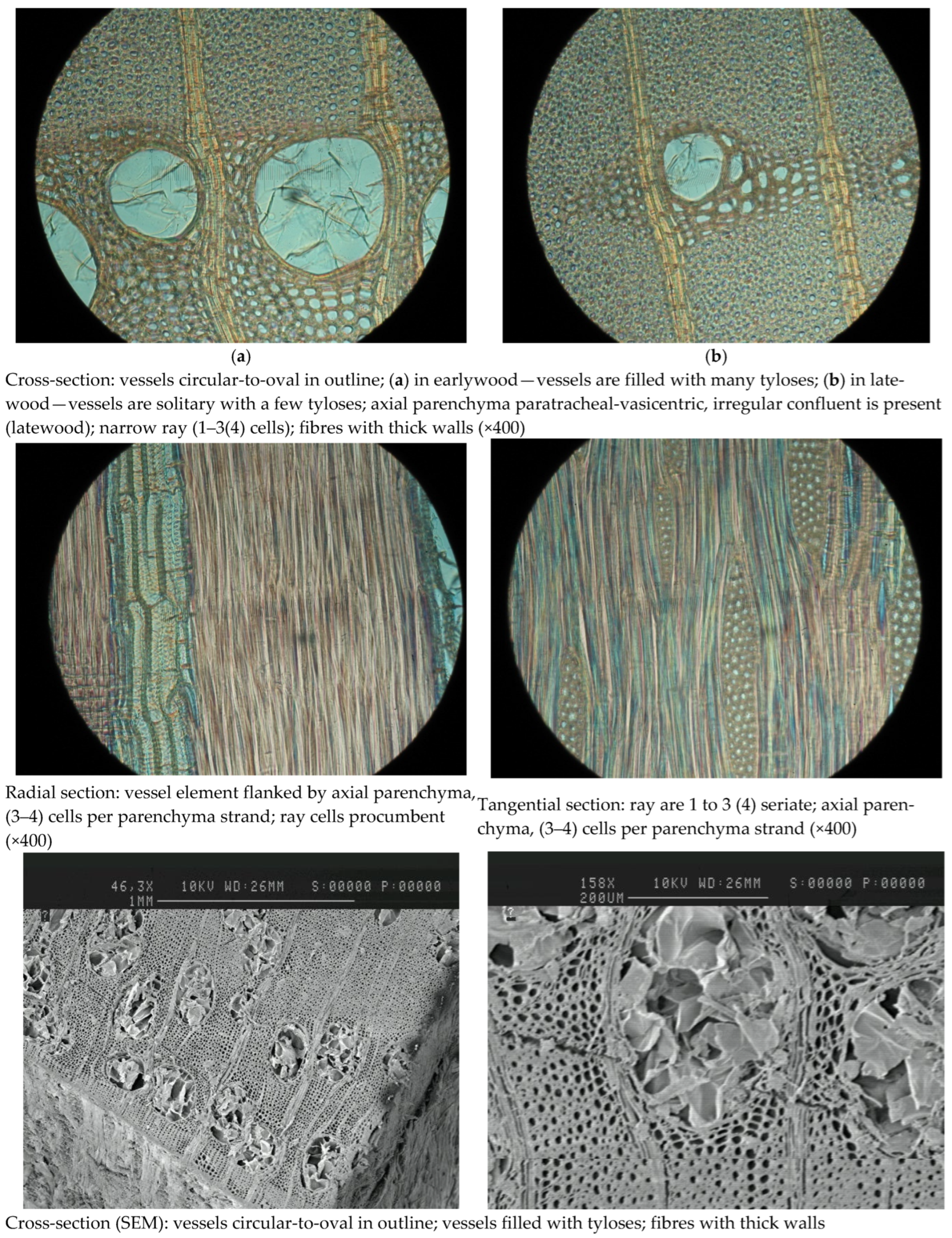
The woody parenchyma in black locust, in proportion of 6%, is made up of longitudinal parenchyma cells, generally short and thin, arranged in groups, abundantly, at the limit of the annual ring. These are of the confluent and terminal paratracheal type [3]. Black locust wood presents all the anatomical elements specific to hardwoods, with a shape, size, proportion and arrangement specific to this species. The main anatomical elements of the black locust structure are presented in Figure 4 and Table 1.
Table 1. Main anatomical elements of black locust wood.
Main ElementsLength, [μm]Width,
[μm]
Lumen Diameter, [μm]Double Wall Thickness [μm]Rate
[%]
Source
EW
LW
Fibres700–1000–130011.7–15.3–31.03–5–82.5–4–758[41]
590–1000–1350-3–5–8.22.5–3.9–5.158[27]
SW 1263
HW 1290
SW 15.44
HW14.88
SW 8.36
HW 9.40
SW 6.52
HW 6.04
-[46]
770–1040----[50]
680–108013.05–16.076.52–10.63--[51]
884–198619–366–177–11-[47]
Vessels130–180–310-130–180–2201.5–315
[41]
70–95–140
--130–190–220-15[27]
70–95–140
--EW 105
LW 90
--[49]
160–180 24 [50]
Raysheight, [μm]13–40–60
-

-

21

[41]
150–300–400
150–330–69013–40–75--21[27]
Parenchyma
Cells
20–160--2–4.56[41]
---- 6[27]
Where: SW—sapwood, HW—heartwood, EW—early wood, LW—late wood; three values represent minimum, average and maximum reported values.

4.4. Chemical Composition and Durability

Knowledge of the elementary chemical composition of wood is of particular interest from both a theoretical and practical point of view, as it determines the profitability of its use in industrial chemical or mechanical processing. The main chemical components of wood are cellulose, hemicelluloses, and lignin. Along with them, wood contains, in much smaller quantities, other chemical components secreted by parenchymal cells, called secondary chemical components (5%–10% in hardwoods) or extractives (vegetable resins, waxes, fats, dyes, glycosides, proteins, alkaloids, phytosterols). They can be extracted from wood with various solvents (alcohol, ether, water), without causing any particular change in the wood structure [41].
Black locust wood contains about 90% of the main chemical substances, with a cellulose and lignin content towards the upper limit of deciduous species, which has a positive effect on wood properties. The consistent content of extractives (of which tannin is 3%–4%) particularly influences the natural durability of this species [3,46].
In black locust wood, there are differences between the chemical composition of the wood in sapwood and heartwood [46]. Thus, the content of lignin and extractives is higher in heartwood, with a positive effect on mechanical properties, natural durability and calorific value of black locust wood [3,6,46]. Extractives from heartwood increased vertically and lignin decreased from the bottom to the top [52]. The content of holocellulose (cellulose + hemicellulose) and ash is higher in sapwood [29]. The origin of black locust wood influences the extractives content, as shown by Brische et al. [49].
Southern black locust wood in Romania contains 4.2% higher amounts of secondary chemicals than that in the North. Such a difference is mainly due to the chemical composition of the soil. Moreover, the pH of the aqueous extract has a weakly acidic character (4.5 ÷ 6.5) regardless of the wood origin—from North or South—and the method used [53]. Consequences on the glueing and finishing processes of black locust wood, certainly leading to shorter drying and hardening times of the applied film-forming substances, could occur. The low ash content is a favourable factor in the mechanical processing operations of this species, as it will not lead to pronounced tool wear, as in the case of species with a high ash content [53]. The resistance to decay of black locust wood is also given by the presence of tyloses that block the lumen of the vessels, along with the high extractive content. Therefore, they block the penetration of fungal hyphae. Also, the lumen of the radial parenchyma cells is blocked by various crystalline chemical substances, with a positive effect on the use of black locust wood in the manufacture of barrels.
Natural durability is one of the principal competitive advantages of black locust wood. Heartwood exhibits high resistance to decay fungi, particularly brown-rot and white-rot fungi, owing primarily to its high concentration of phenolic extractives, flavonoids and other bioactive compounds that inhibit fungal growth. The presence of tyloses further limits fungal colonization by reducing water transport within vessels. Black locust wood also shows good resistance to many wood-boring insects compared with most temperate hardwoods, although susceptibility may vary depending on local environmental conditions and the biological agent involved. In terms of durability, black locust wood is generally considered comparable with or superior to many naturally durable European hardwoods such as oak, making it particularly attractive for outdoor applications where preservative treatment is undesirable [3].
According to EN 350, there are five durability classes of biological durability against fungi, from 1 to 5, very durable to non-durable [54]. Due to the content of specific secondary chemical substances and the presence of tyloses, black locust wood is classified as a very durable wood. It has been assigned to class 1–2 [55]. However, black locust wood from the USA is included in class 1, while the wood from Calw in Germany and Sibiu in Romania belongs to classes 2–3. Such differences are attributed to the wood origin and the extractive content variation [49]. The content of secondary chemicals leads to a decrease in wood swelling and shrinkage, because they are located in the intermicellar and interfibrillar spaces, limiting the penetration of water [3,41]. The natural durability of black locust wood is also given by the content of robinetin and dihydro-robinetin (DHR), secondary chemical substances with a toxic role for fungi [31,56]. Eichhorn et al. reported similar chemical compounds for oak and sweet chestnut [57]. DHR represents 75%–85% of the phenolics in heartwood [56]. Extracts from black locust hardwood provided a high level of resistance against decay to aspen and beech wood [58,59].
The amount of heartwood extractives decreases from the outermost heartwood to the pith [31,60]. These extracts present an axial variability in the stemwood [52]. The phenolic compounds and flavonoids are abundant in mature wood. Their lack in the juvenile heartwood causes reduced durability [30,56]. Phenolic extractives play a protective role against wood decay [61]; they are natural antioxidants and not such fungal inhibitors [62,63]. Younis [64] associated the chemical extractives and colour parameters of black locust wood from five locations in Hungary. It was found that the methanol–water extract (from 5.04 to 11.8%) and the phenol content (from 15.1 to 36%) were linked to the lightness, while the cyclohexane ethanol (from 1.57%–3.42%) was related to all colour parameters (lightness ranged from 56.2 to 62, redness from 2.64 to 4.24 and yellowness from 26.3 to 30.2).
Two stilbenes, such as resveratrol (271 mg/kg) and piceatannol (650 mg/kg), that are present in a limited number of other trees, were found in mature black locust wood [49,56]. They have antifungal properties and are also beneficial for human health [56]. Useful information on surface degradation and related chemical changes after weathering is provided by Kubovsky et al. [65], to increase the potential use of black locust wood in various outdoor applications, based on its lowest discolorations, low roughness changes and the absence of mould and fungi.
Old literature classifies the durability of black locust wood as follows: 10–20 years partially buried, intact after 14 years totally buried, 60–80 years outdoors, 100–1000 years under sheds and 300–500 years submerged in water [66,67,68]. Data on the chemical composition of black locust wood based on oven-dry mass, according to various literature sources, are presented in Table 2.
The anatomical structure and chemical composition of black locust wood largely determine its physical and mechanical performance. Features such as the ring-porous arrangement, thick-walled fibres, vessel occlusion by tyloses and the presence of extractives directly influence density, dimensional stability, moisture movement, mechanical strength and natural durability. Consequently, the technological value of black locust wood cannot be understood solely from its anatomical description; rather, these structural characteristics should be interpreted in terms of the properties they generate. The following sections, therefore, examine the principal physical and mechanical properties resulting from this distinctive wood structure.

5. Properties of Black Locust Wood

5.1. Physical Properties

The main physical properties frequently reported in the European literature that are directly relevant to the technological processing and utilization of black locust wood are: moisture content, density, swelling and shrinkage.

5.1.1. Wood Moisture Content

The moisture content of wood changes constantly, both during the tree’s growth, depending on climatic conditions, and after it has been felled, depending on environmental parameters during transport and storage. Knowing the moisture content of green wood is important both for the logs’ preservation and for the timber-drying process. The specialized literature indicates values between 35% and 40% for green moisture in black locust wood [66], explained by the presence of tyloses in the vessels that limit the penetration of water. Within the tree, the moisture content varies both in height, the cross-section, respectively in the radius [3,66]. In height, a slight increase is generally observed from the base to 2/3 of the tree height, after which the moisture content decreases towards the top. In the cross-section, the central area, the heartwood, always has lower moisture than the outer area, the sapwood [66]. The fibre saturation moisture content for black locust wood is in the range of 20%–24% [66]. Kopitovic et al. [43] established the fibre saturation point for black locust wood in the range of 20.19–29.62, with an average of 23.9%.

5.1.2. Wood Density

Due to the particular structure of wood, its density is given by the density of the dry wood substance and the density of the other components within the cell wall, including water. In addition to moisture content, the density of wood is influenced by the wood species, vegetation conditions and wood structure. The highest density is generally recorded in trees grown in optimal vegetation conditions.
The origin of black locust wood influences the density; the wood from trees grown from shoots has a higher bulk density than that from seeds [3,36,71].
In ring-porous wood species, with increasing annual ring width, the width of the late wood zone increases and, implicitly, the density [66]. According to reference data, this correlation is not always respected for black locust wood, due to the irregularity of the annual rings [43]. The density increases with the increase in the proportion of fibres, and it is influenced by the annual ring width and the rate of latewood. For black locust wood, there is a difference between the density established for early wood (490 kg/m3) and late wood (680 kg/m3) [72].
In general, in ring-porous hardwood species, the density is maximal at the base and decreases up to a certain height, then remains almost constant over a fairly tall height, and increases slightly under the crown. In the radial direction, it decreases from the pith to the bark. Also, heartwood has a higher mass volume than sapwood. This applies to black locust wood as well [73]. The density of black locust wood is considerably affected by the tree age and size, and the rate of late wood in the cross-section at breast height [36,74]. The highest densities (788.8–927.3 kg/m3) were determined for the thinnest trees at 38 years old, while the lowest (643.8–815.4 kg/m3) for the thickest ones at 71 years old [74].
The average density of black locust wood is about 722.5 kg/m3 at 12% MC [66]. According to Pollet et al. [75], the average density at the same MC ranges between 529 and 857 kg/m3.

5.1.3. Shrinkage and Swelling

The literature characterizes black locust wood as a species with high bulk density and small dimensional changes, with variations in relative air humidity; water absorption is blocked by the presence of tiles in the vessels’ lumen.
Black locust wood presents good dimensional stability and a low anisotropy coefficient [43,71,76]. According to several studies, the dimensional variations of black locust wood fall within certain ranges. Strong or average volumetric shrinkage for black locust, such as 7.9%–23.5%, with an average of 15.9%, has been reported [75]. Such shrinkage values may have implications for processing: a working allowance must be provided during sawing to accommodate dimensional changes during drying; before processing, it is requested to keep the wood at the service MC; specific drying schedules must also be used [75]. High density positively affects mechanical resistance and the low anisotropy coefficient favourably influences the physical properties of black locust wood [43,71].
The low value of the fibre saturation point has a positive effect on durability and other properties of black locust wood. The content of secondary chemical substances leads to a decrease in the swelling and shrinkage of the wood, because they are localized in the intermicellar and interfibrillar spaces, limiting the penetration of water [3,66].
Among the frequent treatments applied to wood, steaming is notable, generally applied to beech wood, but also to other species, including black locust wood. After steaming, the amount of pentosans is significantly reduced, which has a high swelling capacity. As a result, steamed wood swells and contracts less than non-steamed wood from the same species. In addition, steamed wood has a lower dynamic sorption and desorption phenomena and, as such, is more stable to variations in environmental parameters [77]. Depending on the parameters of the steaming process, the physical properties of black locust wood are influenced to a greater or lesser extent [66].
Research conducted by Babiak and Nemeth [78] has established that the origin of the material—untreated/steamed—did not significantly influence the density and dimensional variations. The reaction of black wood to changes in moisture content is much lower than in other species. The permeability to liquids and gases for untreated and steamed wood is extremely low [78]. Table 3 displays the average and range intervals of the physical properties of black locust wood based on the specialty literature.

5.2. Mechanical Properties

Due to its chemical composition and specific structure, the mechanical properties of wood are different from those of other materials and are influenced by a series of factors, such as the structure and density, moisture content and temperature at the stress moment, the type of stress, the direction of the force in relation to the fibres and annual rings of the wood [3,66]. The anatomical structure of wood influences the wood’s strength. At the microscopic level, the thickness of the cell wall, the mode of association and the rate of anatomical elements in the wood structure influence the wood strength. In hardwood, the higher the proportion of fibres, the higher the strength. At the macroscopic level, these are favourably influenced by the width of the annual ring and the rate of late wood [3].
The density positively influences wood strength. Thus, with the increase in density, mechanical strength increases linearly or parabolically [3]. The lower the moisture content of wood, the higher the mechanical strength; the maximum values are considered to be in the dry state of the wood. The literature on black locust wood shows that age significantly influences density, shrinkage, and some mechanical strength, such as compression strength parallel to the grain and static bending [36].
Molnar highlighted the dependence between the structure of annual rings and the density and also the dependence between the density and the strength of black locust wood, especially the bending strength [79,80]. Research has been conducted on both the influence of wood origin and the applied heat treatment on the main mechanical properties of black locust wood. Table 4 presents such results for black locust wood from shoots and seeds. There are insignificant differences in strength values for wood from shoots and seeds [80].
It was noticed that the mechanical strength decreases by 20%–30% for steamed wood, the shear strength being the most affected. Regardless of origin or treatment, the strength values obtained for black locust wood are superior to those of the high-density deciduous species growing in Europe. Pollet et al. [75] evaluated the black locust wood in Belgium as having moderate to high mechanical properties but poor dimensional stability.
Most of its mechanical properties were found to be higher than those of oak, as shown in Table 4 above. Studies performed on black locust wood, native to Greece and Hungary, showed similar mechanical properties to beech wood [6].
Due to the different density between early wood (490 kg/m3) and late wood (680 kg/m3), black locust wood can be characterized as a natural lamellar composite, which implies different mechanical properties for the two areas [72].
Differences in basic properties of black locust wood within a tree and between sites have been evaluated by Niklas 1997 and Klisz et al. [81,82]. The lower part of the tree presents the highest hardness, while no significant variation in radial and tangential MOE was found [83]. The orientation of annual rings, respectively the direction of stress—radial or tangential—does not affect wood elasticity [84].
Juvenile black locust wood in Greece presented lower bending strength compared to mature wood, except for the axial compression strength. Such low strength results are attributed to the anatomical and chemical properties rather than to differences in the density of specimens of 21- to 37-year-old black locust trees. The rate of juvenile wood can be reduced by increasing the rotation age, as a forest management method [2]. Table 5 synthesizes the literature values of the main mechanical properties of black locust wood, determined at 12%–15% MC. Generally, the density positively influences the values of wood strength. Such an influence was also found for black locust wood. Anomalies that appeared can be attributed to the inhomogeneous structure of the wood, especially the irregularity of the annual rings, the presence of fibre areas, agglomerations of vessels, and parenchyma areas [3].
Based on its MOR and MOE, compression and shear strength, black locust wood can be used for structural purposes, in which the wood rigidity and the structural cohesive cellular joint are required.

5.3. Technological Properties

The technological performance of black locust wood is closely determined by its anatomical structure and intrinsic material properties. Its relatively high density and ring-porous structure provide excellent mechanical strength and wear resistance but simultaneously increase cutting forces during machining and may accelerate tool wear compared with lower-density hardwoods [3]. The presence of tyloses effectively blocks vessel lumina, improving natural durability and reducing permeability, although this may limit adhesive penetration and complicate preservative impregnation. Similarly, the high content of extractives contributes to biological resistance but may influence adhesive curing and coating adhesion if surface preparation is inadequate. The weakly acidic pH leads to shorter times in the glueing and finishing processes of this species; good behaviour in glueing and finishing allows the creation of solid wood panels or glued laminated wood (beams) used in various interior or exterior applications (decorative panels, furniture, resistance structures for various applications) [3]. The following section discusses the technological processing of black locust wood in relation to its intrinsic material properties.
Black locust wood presents good properties, but with limited use due to defects, uneven colour, the appearance of deformations and cracks upon drying due to the presence of twisted fibre in the late wood. Wear strength and shear bond strength are two main technological properties of black locust wood. Knowing the technological properties of black locust wood can give us important information regarding the use of efficient cutting schedules. When compared to other hardwood species and based on its high density and hardness, black locust wood appears to be difficult to machine. It produces a light blunting effect on cutting edges and presents a proper response to turning, steaming, bending, glueing and finishing. Merhar et al. [91] highlighted that such knowledge on machinability properties and schedule parameters is crucial for its further applications under the European subsidizing program of tree cultivation.

5.3.1. Wear Resistance of Black Locust Wood

Wear is the effect of the destructive action by crushing, detaching and grinding the surface of the wood, due to its friction with harder bodies with abrasive properties. The ability of wood to resist this action is called wear resistance. In current uses, black locust wood is subject to wear, especially in floors and parquet, but also in the construction of the roadway parts of wooden bridges, stairs, and thresholds. Research conducted in this regard [92], under laboratory conditions, has established that the wear resistance of wood species is mainly influenced by the density, so that there is no direct proportionality between the amount of wood removed by abrasion and the mass loss. Also, wood wear is influenced by the anatomical section of the surface and increases with the increase in the angle of inclination of the annual rings. If the abrasion occurs in a direction parallel to the fibres, the average value of wear is lower than in the case of abrasion in a direction perpendicular to the fibres. Black locust wood has been found to have very good wear resistance, expressed by mass loss and thickness loss (um ~ 0.06 g; ug ~ 0.7 mm for α = 0–50° and um = 0.085 ÷ 0.10 g; ug = 0.95 ÷ 1.73 mm for α = 85–90°) compared to other species (ash and oak).
In order to determine the wear behaviour of black locust wood from the two geographical areas, experiments were carried out using the mass loss method and thickness reduction in the specimen by sanding with 24-grit sandpaper [92]. Porojan [3,92] concluded that for all the studied specimens, the wear increases with the increase in the orientation angle of the annual rings. For the tangential section (α = 0°) the wear is minimum, and for the radial section (α = 90°) the wear is maximum. The lower values recorded for the wear test, expressed both by the mass loss and thickness loss, for the samples from the north, are explained on the basis of their higher density compared to samples from the south. The wear resistance decreases with the increase in wood density, as it is presented in Table 6. Based on the hardness and abrasion resistance, black locust wood, along with other wood species, such as hornbeam and turkey oak, is suitable for parquet strips [77]. Nemeth et al. [77] investigated the possibility of replacing oak top layers with black locust (light/dark steamed) in parquet applications in a service test of 5 years. The results of their study on wear resistance are presented in Table 6.

5.3.2. Bonding of Black Locust Wood

The bonding properties of black locust wood offer indications of its potential use in wood structures and furniture frame construction. Satisfactory shear bond strength values are to be obtained to enable the utilization of the species competing with those traditionally used. The shear bond strength depends on the wood density, correlated to the wood mechanical properties [93]. Determining the strength of adhesive joints consists of determining the shear bond strength in order to establish the quality of adhesives used in the wood industry. Due to the small diameter of the logs and structural defects, quality timber from the black locust tree is obtained in small quantities, while larger-sized assortments are achieved through glueing. Experimental tests were carried out using a series of adhesives (Resorcinol, PVAc, melamine and polyurethane-PUR) with high resistance for outdoor conditions (D4), both for untreated and steamed black locust wood [3,94,95,96]. As a result of these tests, good shear bond strengths were obtained for these adhesives [3,95]. The literature mentioned that black locust wood bonds better with one-component polyurethane adhesive than phenol–resorcinol–formaldehyde adhesives [94,95,97]. No negative influences of the secondary chemical composition of black locust wood during bonding were reported, while in the case of steamed wood, the results were lower [98]. Other authors mentioned that the adhesion quality of the species may be enhanced by using various technologies that could reduce the extractives’ influence (like steaming, priming, plasma treatment) before or simultaneously with the glueing process [95,96,99]. It was also noticed that when producing panels from small-sized slats, glued in teeth, problems were caused not by the adhesive used, but by the teeth geometry and the species, because residual stresses appeared in black locust wood after drying [3].
High values of the shear strength (10.5 MPa) of the black locust wood specimens bonded with PUR have been reported by Jauernig [100]. Voulgaridis et al. [101] found that PVAc produced better bonds than PUR, while the best results were recorded for epoxy adhesive. When increasing the pressing time and curing time, a bonding improvement was noticed. Kamperidou and Barboutis [95] reported that 22% higher shear bond strength of black locust wood bonded with PVAc was recorded for low pressure when compared to high-pressure results. However, when compared to beech, black locust wood bonded with PVAc recorded lower strength values. Such behaviour is attributed to the high extractive content, which affects the process of adhesive polymerisation. The high extractive content keeps the lumen of the surface line full and affects the wood pH value [95,96].
A cold-water extract (4.56%) and pH value (4.65), along with the parallel roughness (Ra = 5.8) did not influence the strength of bonded black locust wood in the dry state (11.69 MPa). But a greater influence was induced by the density (726 kg/m3), perpendicular roughness (Ra = 9.6) and low contact angle [96]. The modified PUR adhesive produced better bonding when applied to sanded surfaces [97]. However, in his study, Kariz et al. showed that black locust wood (678 kg/m3), among other wood species, presented a low adhesive penetration [97]. In dry conditions, the PVAc adhesive produced higher bonding strength when compared to PUR adhesive, which is explained by the larger vessels of black locust wood [95]. In wet conditions, a low decrease in bonding strength was noticed for the PUR adhesive of about 2.1 MPa. Table 7 displays average values of the shear bond strength of black locust wood specimens based on the literature results.

6. Workability of Black Locust Wood

The physical and mechanical properties of black locust wood largely determine its behaviour during industrial processing. High density and mechanical strength provide excellent performance in structural applications but also influence machining forces and tool wear. However, the low ash content is a favourable factor in the mechanical processing operations of this species, as it will not lead to pronounced tool wear, as in the case of species with a high ash content.
The anatomical structure (high proportion of fibres, presence of tyloses in the lumen of the vessels, high proportion of heartwood, high proportion of latewood) correlated with a cellulose and lignin content located at the upper limit of deciduous species and an appreciable content of secondary chemical substances positively influences the density, dimensional stability, natural durability, mechanical resistance, resistance to glueing and the quality of the processed surfaces (milling, sanding) [3]. An understanding of these relationships enables the selection of appropriate processing technologies that maximize product quality while minimizing manufacturing challenges.
Successful processing of black locust wood requires technological parameters adapted to its specific anatomical and chemical characteristics, demonstrating the strong relationship between wood structure, material properties and industrial performance.
The wood surface condition is influenced by the woodworking steps. There is a specific operational process to be considered, which usually includes sawing, planing, milling and sanding before the final finishing step.

6.1. Sawing

When it comes to sawing, maximizing the value of wood as a renewable but still limited resource is based on the assumption that the relationship between log defects and yield is known [3,102]. In their study, Cataldo et al. [102] found that the defect (taper and ovality) rate increased as the log diameter increased, influencing the sawing yield. However, black locust logs were identified to have little sensitivity to defect variability, with stable yield, when compared to other species [102]. Live sawing parallel to the trunk is recommended; it leads to a better sawing yield of sawn boards [102,103].

6.2. Milling

The scope of milling is vast and aims to obtain surfaces and parts of the most varied shapes. Cylindrical milling is the most widespread in the finished products industry. Thus, milling can process simple flat surfaces, as well as surfaces with a complex contour and profile. Several machine types can be used, such as routers, machines for planning, tenoning and vertical milling machines.
The wood species influences the milling process through: wood density and hardness, structure, structural anisotropy, and moisture content. The milled surfaces are smoother the higher the density and the more uniform the structure of the wood is. For the manufacture of finished wooden products, the moisture content must range between 8 and 12%; therefore, it is not a variable parameter, and it presents little influence on the quality of the milled surfaces. The surface quality, cutting dynamics, acoustic pressure, and cost are the key factors for an optimal cutting process. Little attention has been paid to the processing of black locust wood, as stated by Porankiewicz [104].
As it concerns the machining by planing, an increase in the number of cutters along with the decrease in feed speed resulted in smoother surfaces of black locust wood [105]. Usta et al. [106] found that perfect quality of radial black locust wood surfaces, with an arithmetic mean surface roughness (Ra) of about 4.58 μm, can be produced by planing with a four-knife cutter, at a low feed speed of about 5 m/min and applying a light cutting depth of about 1 mm. Considerations on the roughness of black locust wood machined surfaces have also been formulated by Pinkowski [107]. The surface quality is affected by several factors, such as the tool angle, wood density and feed speed. A sharpness angle of about 40° was found to be ideal for achieving optimal surface quality (Ra of about 1.8 μm) at a milling feed speed of about 3.2 m/min [107].
Recent studies evaluated the machinability of this species in terms of planing, routing and turning [91]. An average grade of the planing surface quality of black locust wood samples of 3.65 (fair to poor surface quality) at the highest feed speed of 18 m/min and 1.6 mm cutting depth was found. The planing quality was less affected when low feed speeds were applied. A milling head of two knives at a 1.6 mm cutting depth was shown to produce excellent to good wood surface quality (1.43/1.42) at side and end grain routing, respectively. It appears that for smooth planed surfaces, low feed, shallow cut, more knives and sharp cutters are needed [91,105,106].

6.3. Sanding

Sanding technology represents the processing operations by which the surfaces processed by chipping are given their final roughness. Sanding aims to eliminate protrusions and irregularities on the surfaces of wooden pieces produced by previous processing and to improve the wood surface quality. The quality of sanded wood surfaces is influenced by several factors, including wood species, density, moisture content and the cutting parameters, cutting tools, cutting force and power consumption.
The wood species, through its structure and density, has a decisive influence on the quality of sanding. Thus, the anatomical structure of the wood determines the processing position and piece feed in relation to the fibres’ orientation, and the surface quality increases with the wood’s hardness. Black locust wood is classified as a species with high hardness and good sanding quality [3]. The parameters of the wood sanding schedule are determined by the quality of the processed surface, the sanding productivity and the tool durability. The optimal sanding speed is 20–25 m/s, the optimal sanding pressure is 0.3–0.6 N/m2, and the feed rate is 5–20 m/min, established depending on the machine type [3].
Due to its high density and ring-porous structure, black locust wood exhibits specific sanding behaviour and surface roughness characteristics that strongly influence finishing quality and industrial processing. In their study, Magoss et al. [108] investigated the effect of wetting on the surface properties of black locust wood sanded with two grit sizes, P100 and P180 sandpapers (10 and 8 m/s belt speed, 7 m/min constant feed rate, 0.2 and 0.1 mm cutting thickness, respectively). Sanded wood surfaces are not stable when wet; however, the results showed that black locust wood surfaces were stable when compared to spruce. An average surface roughness of about 7 μm was recorded for black locust wood-sanded samples.

7. Drying and Heat Treatment Applied to Black Locust Wood

7.1. Drying

In industrial practice, black locust wood is known as a species that is difficult to dry, due to the irregular fibre that frequently appears in late wood, causing deformations and drying defects, namely cracks and fissures. The priority for high-yield use of black locust timber is its drying. Through the conventional drying process, the drying quality was reported to be good [109], with black locust wood showing less deformation than beech dried under the same conditions, while the colour was not greatly influenced.
Lee and Kim [110] investigated the behaviour of check formation over the kiln drying process of black locust wood at temperatures of 60, 45 and 35 °C. The study revealed that end-checks occurred at the beginning stage on thick tree discs, maximum checks were produced at 40%–45% MC and their number decreased progressively with the drying process when V-type cracks appeared at 15% MC. To prevent the development of V-crack formations, the temperature should be lowered to 35 C. Black locust wood needs slow drying. Plavcak et al. [109] found low-bound water diffusion coefficients between 2.84 and 0.39 × 10⁻⁹ m2/s at a 20 °C drying temperature level and from 2.73 to 0.43 × 10⁻⁹ m2/s at a 40 °C drying temperature level. The bound water diffusion means higher resistance, with an effect on the diffusion coefficient. Black locust wood is denser than other species and as a result, it presents a low value of diffusivity. Moreover, in thick black locust boards, lower drying rates have been determined, about 0.34%/day at a 20 °C drying temperature level, and 0.54%/day at a 40 °C drying temperature level.
Vacuum-drying with convection heating as well as drying with superheated steam led to promising results, with black locust wood behaving similarly to beech and much better than oak [111]. A proper drying schedule can lead to a desirable surface colour resembling that of exotic species [112].

7.2. Steaming

Black locust wood presents a less appealing non-homogeneous colour, which causes marketing problems for products such as flooring and furniture fronts. This unfavourable property can be corrected by steaming, a non-toxic modification process [80,113,114].
For solid wood, steaming is generally applied to reduce growth stresses, increase permeability and change the wood colour [80]. Steaming also produces a decrease in equilibrium moisture content (EMC) for low relative humidity values and an increase at high relative humidity values (RH = 98%) [78]. Steaming at atmospheric pressure, below or above its value, is a very good technique for modifying and uniforming the colour of black locust wood, more or less affecting the mechanical properties.
Using a proper combination of steaming parameters, many shades of brown can be achieved, ranging from golden yellow, light brown to dark brown, increasing the esthetic value of this species [78,99,113,114,115]. Tolvaj and Molnar [116] applied a steam treatment to black locust wood at 100% RH with temperatures ranging from 80 to 130 °C for 1–6 days. Reddish hues were noticed after a few hours of treatment and the colour variation decreased day by day during the steaming. The colour homogenisation was faster at higher temperatures.
In his study, Nemeth [77] applied steaming on black locust parquet face layers at atmospheric pressure and temperatures of about 85 °C and 95 °C for 48 h to prove the potential of the species for high-traffic flooring. The steaming presented a combined effect on the abrasion resistance.
The structure and components of wood, along with physical and chemical changes, are affected by steaming. Extractives are the most sensitive wood chemical components during steaming. Steam carries extractable robinetin and a thin yellow layer is created on the wood surface; steam easily penetrates the dry black locust wood [115]. Such yellow extractives carried by steam above 100 °C in the chamber were found to transfer into the poplar samples treated in the same unit [115].

7.3. Heat Treatment

Heat treatment is an old and inexpensive, eco-friendly modification of wood that has been popularly used for decades. Heat treatment can be applied to wood at temperature levels from 120 to 250 °C for 15 min to 24 h. During the treatment, specific positive and negative changes are produced in wood: mass loss, decomposition of chemical compounds, decrease in the EMC, crack formation, increase in dimensional stability, improvement of durability, degradation of mechanical properties, colour changes, decrease in surface roughness, decrease in finishing properties and reduced bondability.
Thermal treatment is imposed to species that have an unattractive natural colour or present an inhomogeneous appearance, like black locust wood. Extractives, found in large quantities in black locust, play an important role in the darkening effect of the wood under heat treatment [117,118]. But hemicelluloses are found the most vulnerable component during heat treatment of the species [118]. It appeared that the colour saturation of treated black locust wood varied more than the hue and both reduced as the treatment temperature increased [118]. Heat-treated black locust wood can easily replace exotic species in the wood industry [90,112,118]. However, because of the strength deterioration after treatment, treated wood is not used for load-bearing and structural elements in construction.
Black locust hybrid wood samples under heat treatment in a nitrogen environment at 210–230 °C were investigated by Tuong and Li [119]. The study revealed that the number of hydroxyl groups and the hygroscopic properties were reduced after treatment and as a result, the dimensional stability improved. Heat treatment applied to wood flour of black locust wood at 120 °C for 24 h showed a severe darkening under oxygen exposure compared to a nitrogen medium [112]. Yellowish behaviour was gradually observed. During the heat treatment, red and yellow component colours, quinone-like substances, are formed by chemical reactions [112]. Wood was intensely coloured due to the phenolic groups oxidized to quinone structures under oxygen exposure (at 1672 cm−1 absorbance peak) [112].
Pre-treated black locust wood samples at 160 and 200 °C for 2–6 h were monitored under 36 h UV irradiation by Tolvaj et al. [120]. The study highlighted that treated specimens at 200 °C reduced the changes in the red component produced by photodegradation, while the yellow component was less affected. Another study monitored the colour change of oil-heat-treated specimens during UV exposure. It was found that the treatment in oil did not protect the lignin against photodegradation [117].
There is a decrease in wood mechanical properties caused by the chemical components and their changes during the heat treatment. Sikora et al. [90] studied the changes in mechanical properties under heat treatment at 160–210 °C for 3 h. By increasing the process temperature, the bending strength properties decreased because of cellulose degradation. The highest reduction was found for MOR at 210 °C. While the amorphous part of polysaccharides in wood is reduced, the rot resistance is improved and the dimensional stability as well [90]. The behaviour of black locust wood under thermal treatment is to be further explored to increase its potential for efficient use.

8. Coatings Applied to Black Locust Wood

The finishing is the final step in a production line meant to protect the wood surface and improve its overall properties, including its appearance, through an extended service life of the product. To study the behaviour of wood when stained, aqueous solutions were applied by different methods on samples prepared by sanding. Depending on the process used for staining, black locust wood behaved well [121] and the specific spread rate of stain was much lower than that used for other fast-growing species (alder, poplar).
In general, uniform, warm, beautiful colours were obtained; the texture of the wood was emphasized and the surfaces were much more expressive. In terms of colour stability, Panek and Reinprecht [122] showed that black locust wood samples reacted better to transparent paints compared to spruce surfaces. Strips of parquet made of black locust wood, under steaming before oiling, have been proven to reach an increased utilization potential. However, the oily treatment did not present significantly higher performance compared to natural wood [77]. In their study, Panek and Reinprecht [123] investigated the influence of several coating systems applied to black locust painted wood surfaces on colour changes and other esthetic features after weathering for 36 months. Top-coating layers with acrylate resin modified with oils, nano-sized polyvalent metal for UV protection, pigments, additives and a water repellent layer have been used. It appeared that black locust wood substrate maintained the original colour of painted specimens during weathering. Using more layers of coating, fewer defects in painted wood occurred and the water-repellent layer improved the colour stability of painted wood samples.
The behaviour of planed black locust wood surfaces when wet, correlated to the deformation of a coated wood surface, has been described by Molnar et al. [124]. It is considered a swelling and shrinkage process with deformation residues, which increase the surface roughness. The anatomical structure and the moisture dynamics in the surface layer produced such a roughness increase. Black locust wood presented high stability during wetting.
In their study, Pavlic et al. [125] applied three types of coatings to black locust wood samples, such as: one-component waterborne on an acrylate–polyurethane basis (WPU), one-component solventborne on a polyurethane basis (SPU) and tung oil (TO). As a high-density wood, black locust wood samples presented a lower oil/coating uptake, which produced a higher thickness of the coating layer (91 μm for WPU, 75 μm for SPU). A yellowing of the coating film was also noticed, caused by the migration of the extractives. Tung oil needed a longer drying time, while no other issues were raised during coating.

9. Traditional and Industrial Uses of Black Locust Wood

The successful industrial utilization of black locust wood depends not only on its inherent wood properties but also on the effectiveness of the processing technologies applied. Appropriate drying schedules, optimized machining conditions, suitable adhesive systems, surface finishing and wood modification techniques enhance product quality, service life, and esthetic appearance, thereby expanding the range of possible applications. These technological improvements allow the natural advantages of black locust wood, including its high strength and exceptional durability, to be fully exploited in both traditional and innovative products. Consequently, the final performance and market potential of black locust wood are determined by the combined effects of its biological characteristics and the technologies used to transform the raw material into finished products.
The significant wood production it offers at young ages, as well as the numerous uses to which black locust wood can be put, represent socio-economic benefits that increase the value of this species. Black locust wood has a well-developed heartwood that is heavy, hard and highly resistant. It has the most diverse uses, from fence posts, mine wood, tool handles, vine trellises, barrel staves, railway sleepers, timber, and parquet [3,9,26,126]. The wood is less commonly used in furniture construction. However, it was shown to have potential for upholstered furniture frames since the configured joints presented satisfying performance and strength levels [127]. Black locust staves have different properties compared to oak staves. In black locust wood, the medullary rays are small and filled with secondary chemical substances that do not allow the absorption of liquid, and cracks next to the rays are very rare. Thus, it is not necessary to manufacture staves with radial faces. The technological process of stave manufacturing complements the manufacture of parquet strips [3]. Research on this topic has shown that, from 23 m3 of black locust logs (50% class I and 50% class II), 6.5 m3 of staves and 1.2 m3 of parquet strips can be manufactured [26]. However, it cracks easily, which limits the feasibility of large-scale industrial use. Wood is preferred for outdoor use because it is resistant to soft-rot fungi and bacteria due to its high phenolic content [3]. It is also beneficial for fire, owing to its calorific value [7,128,129,130]. There are European sawmills specialized in log processing that capitalize on the potential of black locust waste for pellet production; a mixture with conifer sawdust could reduce emissions and meet the EU standard [128]. At an early age, it provides non-wood products, among which the most valuable byproduct is honey [131,132].
Extracts derived from the leaves of the black locust tree present antibacterial and anticancer properties [133,134], while resveratrol and piceatannol from the mature black locust heartwood are used in cosmetic and pharmaceutical industries [56]. The flowers present medicinal properties for the digestive, pulmonary and nervous system with positive effects [135]. Also, a traditional jam could be obtained from them and a compote [135], while the seeds and bark are toxic to humans. For many herbivorous animals, the foliage is the primary food source [136].
Lamellar structures obtained by glueing are used in various applications. This is a way to compensate for the defects of the trunk, such as knots and fibre deviations, and transform small components into high-quality engineering products [137]. In terms of durability and density, black locust wood is suitable for producing laminated veneer lumber [138,139]. Although black locust wood exhibits favourable mechanical properties for structural applications, its integration into standardized engineering design systems remains limited. A detailed evaluation of structural design standards is beyond the scope of this review; however, the available evidence suggests that further harmonization of mechanical datasets could support future inclusion in standardized frameworks.
Wood is used in the manufacture of furniture, chipboards, fibreboards, and also in the production of veneers [3,26]. Black locust wood and branches could also be used in the production of WPC, with significant technological properties and biological durability [140]. Recent studies showed that the tree bark could be used in lime-based composite reinforcement; a bark content of about 10%–20% generated favourable results in terms of mechanical and physical properties [141].
Steaming of black locust wood is a common practice, with positive effects on the wood’s colour and its suitability for furniture manufacture. Modification technologies, such as thermal and chemical ones, could be used to enhance black locust wood properties for value-added products [117,142]. Black locust wood has a potential for the pulp and paper industry. Due to its fibres (short in length, with narrow lumen and thick wall), black locust wood is suitable for pulp production [47].
Altogether, these diverse uses highlight the species’ versatility and its important contribution to sustainable resource utilization. Its combined ecological, economic and social benefits make it a highly valuable and widely utilized species.
The industrial applications of black locust wood demonstrate how its intrinsic characteristics can contribute to more sustainable resource utilization. Its combination of high mechanical performance, exceptional natural durability and long service life makes black locust wood a suitable material for replacing less durable temperate species and, in many applications, reducing the demand for tropical hardwoods. The efficient use of this renewable resource, together with advances in processing technologies and value-added wood products, supports the principles of the circular bioeconomy by extending product lifespan, promoting the use of sustainably sourced materials, and increasing carbon storage in long-lived wood products. However, the expansion of black locust wood utilization should be accompanied by responsible forest management that considers both its economic value and its potential ecological impacts in regions where the species exhibits invasive behaviour. Within this context, sustainable utilization requires balancing technological innovation, industrial development and biodiversity conservation to maximize the benefits of black locust wood in Europe.
Table 8 displays the main advantages and limitations of black locust wood, along with implications for its industrial utilization.

10. Conclusions

This study reviewed the European specialty literature concerning the silviculture, anatomical structure, physical and mechanical properties, machinability and utilization of black locust wood within the scope of its great potential. Despite the extensive body of research on black locust wood, several knowledge gaps remain. Many studies are based on local populations or limited sample sizes, making direct comparison difficult because of differences in growth conditions, tree age and testing methodology. Future research should focus on the development of standardized European databases describing wood quality, the influence of silvicultural management on structure, technological properties, optimization of machining and adhesive technologies, advanced wood modification processes, and the long-term performance of engineered black locust products. Increased attention should also be given to life-cycle assessment, carbon storage potential and the role of black locust wood within the circular bioeconomy.
Black locust is a fast-growing species that is widely distributed throughout Europe. It demonstrates a high tolerance to drought conditions and sandy soils, although optimal growth is achieved on productive sites with adequate precipitation. Black locust represents one of the most debated tree species in Europe because it combines significant economic value with ecological concerns. On one hand, it is highly appreciated for its rapid growth, high-quality timber, exceptional natural durability, nitrogen-fixing ability and adaptability to poor or degraded soils, making it an important resource for timber production, land restoration and climate-change adaptation. On the other hand, black locust is recognized as an invasive alien species in several European regions, where its vigorous vegetative regeneration and efficient seed dispersal may alter native plant communities, reduce biodiversity and modify soil nutrient dynamics. But sustainable management can maximize economic benefits and habitat protection by focusing cultivation on degraded lands and suitable forests.
The high proportion of heartwood gives the wood a high density, with positive effects on all the wood’s properties. In addition, black locust wood exhibits relatively low shrinkage and good dimensional stability after drying. To ensure uniform coloration, steaming treatment is recommended, while kiln drying should be conducted under mild conditions. Heat-treated black locust wood has significant potential as a sustainable alternative to exotic timber species in the wood industry, although its use is not advised for structural applications.
The technological behaviour of black locust wood is largely governed by its anatomical and chemical characteristics. The thick fibre walls and relatively high proportion of latewood contribute to its high density and excellent mechanical properties, making it suitable for demanding structural and outdoor applications. Vessel occlusion by tyloses substantially improves natural durability by reducing moisture movement and limiting fungal penetration, although it also decreases permeability during impregnation processes. Furthermore, the relatively high content of phenolic extractives and flavonoids contributes to resistance against biological degradation while potentially influencing bonding performance and coating adhesion. Therefore, understanding the relationship between wood structure, chemistry and processing behaviour is essential for optimizing manufacturing technologies and expanding industrial applications. In general, the wood demonstrates good machinability and finishing characteristics. Overall, black locust wood species represents a valuable renewable resource with considerable opportunities for the wood industry sector.
Increased attention from local communities, researchers and industry stakeholders could further support the promotion and sustainable utilization of this species. Black locust wood has considerable potential to contribute to the European bioeconomy owing to its high mechanical performance, exceptional natural durability, and adaptability to changing environmental conditions.
Future utilization is expected to expand beyond traditional applications towards engineered wood products, modified wood, bio-based composites and other high-value products. Realizing this potential will require further advances in processing technologies, optimized grading systems and standardized characterization of wood quality. At the same time, wider cultivation and utilization of black locust should be supported by responsible forest management that balances its economic benefits with the need to minimize ecological risks associated with its invasive potential in sensitive European ecosystems.

Author Contributions

Conceptualization, M.P. and E.-A.M.S.; methodology, M.P.; software, M.P.; validation, E.-A.M.S.; formal analysis, M.P., investigation, M.P., resources, E.-A.M.S.; data curation, M.P.; writing—original draft preparation, M.P. and E.-A.M.S.; writing—review and editing, E.-A.M.S.; visualization, M.P.; supervision, M.P. All authors have read and agreed to the published version of the manuscript.

Funding

This research received no external funding.

Data Availability Statement

The original contributions presented in this study are included in the article. Further inquiries can be directed to the corresponding author.

Conflicts of Interest

The authors declare no conflicts of interest.

References

  1. Nicolescu, V.N.; Hernea, C.; Bakti, B.; Keserű, Z.; Antal, B.; Rédei, K. Black locust (Robinia pseudorevised L.) as a multi-purpose tree species in Hungary and Romania: A review. J. For. Res. 2018, 29, 1449–1463. [Google Scholar] [CrossRef] [Scilit]
  2. Adamopoulos, S.; Passialis, C.; Voulgaridis, E. Strength properties of juvenile and mature wood in black locust (Robinia pseudoacacia L.). Wood Fiber Sci. 2007, 39, 241–249. [Google Scholar]
  3. Porojan, M. Contribution to the Study of Physical, Mechanical and Technological Properties of Black Locust Wood. Ph.D. Thesis, Transilvania University of Brașov, Brașov, Romania, 2007. [Google Scholar]
  4. Brus, R.; Pötzelsberger, E.; Lapin, K.; Brundu, G.; Orazio, C.; Straigyte, L.; Hasenauer, H. Extent, distribution and origin of non-native forest tree species in Europe. Scand. J. For. Res. 2019, 34, 533–544. [Google Scholar] [CrossRef] [Scilit]
  5. Ábri, T.; Cseke, K.; Keserű, Z.; Porcsin, A.; Szabó, F.M.; Rédei, K. Breeding and improvement of black locust (Robinia pseudoacacia L.) with a special focus on Hungary: A review. iForest 2023, 16, 290–298. [Google Scholar] [CrossRef] [Scilit]
  6. Younis, F.A.A.A.; Govina, J.K.; Seidu, H.; Németh, R. Basic characteristics of black locust (Robinia pseudoacacia L.) wood grown under different site conditions: A review. Acta Silv. Lign. Hung. 2023, 19, 21–35. [Google Scholar] [CrossRef] [Scilit]
  7. Sitzia, T.; Cierjacks, A.; de Rigo, D.; Caudullo, G. Robinia pseudoacacia in Europe: Distribution, habitat, usage and threats. In European Atlas of Forest Tree Species; San-Miguel-Ayanz, J., de Rigo, D., Caudullo, G., Houston Durrant, T., Mauri, A., Eds.; Publications Office of the European Union: Luxembourg, 2016; pp. 166–167. [Google Scholar]
  8. Li, G.; Xu, G.; Guo, K.; Du, S. Mapping the global potential geographical distribution of black locust (Robinia pseudoacacia L.) using herbarium data and a maximum entropy model. Forests 2014, 5, 2773–2792. [Google Scholar] [CrossRef] [Scilit]
  9. Enescu, C.M.; Danascu, A. Black locust (Robinia pseudoacacia L.)—An invasive neophyte in the conventional land reclamation flora in Romania. Bull. Transilv. Univ. Bras. Ser. II 2013, 6, 55. [Google Scholar]
  10. Vítková, M.; Sádlo, J.; Roleček, J.; Petřík, P.; Sitzia, T.; Müllerová, J.; Pyšek, P. Robinia pseudoacacia-dominated vegetation types of Southern Europe: Species composition, history, distribution and management. Sci. Total Environ. 2020, 707, 134857. [Google Scholar] [CrossRef] [Scilit] [PubMed]
  11. Kunakh, O.M.; Ivanko, I.A.; Holoborodko, K.K.; Voljova, A.M.; Zhukov, O.V. Age estimation of black locust (Robinia pseudoacacia) based on morphometric traits. Biosyst. Divers. 2023, 31, 222–228. [Google Scholar] [CrossRef] [Scilit]
  12. Ciuvat, L.; Abrudan, I.; Blujdea, V.; Marcu, C.; Dinu, C.; Enescu, C.; Nuță, I. Distribution and peculiarities of black locust in Romania. Rev. Silvic. Cineget. 2013, 18, 76–85. [Google Scholar]
  13. Ianculescu, M.; Ionescu, M.; Lucaci, D.; Neagu, Ș.; Macarescu, C.M. Dynamics of pollutants concentration in the forest stands from Copșa Mică industrial area. Ann. For. Res. 2009, 52, 207–226. [Google Scholar] [CrossRef] [Scilit]
  14. Cântar, I.C.; Ciontu, C.I.; Dinca, L.; Borlea, G.F.; Crisan, V.E. Damage and tolerability thresholds for remaining trees after timber harvesting: A case study from Southwest Romania. Diversity 2022, 14, 193. [Google Scholar] [CrossRef] [Scilit]
  15. Nicolescu, V.N.; Buzatugoanță, C.; Bartlett, D.; Iacob, N. Regeneration and early tending of black locust (Robinia pseudoacacia L.) stands in the North-West of Romania. South-East Eur. For. 2019, 10, 97–105. [Google Scholar] [CrossRef] [Scilit]
  16. Dinca, L.; Timiș-Gânsac, V.; Breaban, I.G. Forest stands from direct accumulation and natural lakes slopes from the Southern Carpathians. Present Environ. Sustain. Dev. 2020, 14, 211–218. [Google Scholar]
  17. Mușat, I. Principles for the establishment of transport network windbreaks and their practical implementation. Rev. Silvic. Cineget. 2012, 17, 30–33. [Google Scholar]
  18. Blujdea, V.; Abrudan, I.V.; Pahonțu, C. Afforestation of degraded and low productive lands by flexible instruments under Kyoto Protocol. An. ICAS 2003, 46, 399. [Google Scholar]
  19. Rédei, K.M.; Csiha, I.; Keserű, Z.; Gál, J. Influence of regeneration method on the yield and stem quality of black locust (Robinia pseudoacacia L.) stands: A case study. Acta Silv. Lign. Hung. 2012, 8, 103–111. [Google Scholar] [CrossRef] [Scilit]
  20. Rédei, K.M.; Keserű, Z.; Bach, I.; Rásó, J.; Ábri, T.; Gál, J. Management of Robinia pseudoacacia cv. ‘Üllői’—‘Üllői’ locust. Acta Silv. Lign. Hung. 2020, 16, 9–18. [Google Scholar] [CrossRef] [Scilit]
  21. Ábri, T.; Keserű, Z.; Rásó, J.; Rédei, K. Stand structure and growth of Robinia pseudoacacia ‘Jászkiséri’—‘Jászkiséri’ black locust. J. For. Sci. 2021, 67, 489–497. [Google Scholar] [CrossRef] [Scilit]
  22. Ábri, T.; Csajbók, J.; Keserű, Z.; Szabó, G.; Szabó, L. Growth and multispectral analysis of new black locust (Robinia pseudoacacia L.) clones. Forests 2026, 17, 208. [Google Scholar] [CrossRef] [Scilit]
  23. Rédei, K.; Osváth-Bujtás, Z.; Veperdi, I. Black locust (Robinia pseudoacacia L.) improvement in Hungary: A review. Acta Silv. Lign. Hung. 2008, 4, 127–132. [Google Scholar] [CrossRef] [Scilit]
  24. Kraszkiewicz, A. Productivity of black locust (Robinia pseudoacacia L.) grown on varying habitats in Southeastern Poland. Forests 2021, 12, 470. [Google Scholar] [CrossRef] [Scilit]
  25. Liang, H.; Meng, Z.; Li, Z.; Liu, G. The effect of Robinia pseudoacacia plantation on soil desiccation across different precipitation zones of the Loess Plateau, China. Forests 2022, 13, 321. [Google Scholar] [CrossRef] [Scilit]
  26. Molnár, S. Wood properties and utilization of black locust in Hungary. Drev. Výsk. 1995, 40, 27–33. [Google Scholar]
  27. Wagenführ, R.; Scheiber, C. Holzatlas, 6th ed.; Fachbuchverlag: Leipzig, Germany, 2000. [Google Scholar]
  28. Porojan, M. Experimental study concerning the indices of macroscopic structure for acacia wood (Robinia pseudoacacia L.). Pro Ligno 2008, 4, 31–38. [Google Scholar]
  29. Rosu, C. Salcamul intre legenda si realitate. Rev. Padur. 1996, 111, 4. [Google Scholar]
  30. Latorraca, J.V.; Dünisch, O.; Koch, G. Chemical composition and natural durability of juvenile and mature heartwood of Robinia pseudoacacia L. An. Acad. Bras. Ciênc. 2011, 83, 1059–1068. [Google Scholar] [CrossRef] [Scilit] [PubMed]
  31. Magel, E.; Jay-Allemand, C.; Ziegler, H. Formation of heartwood substances in the stemwood of Robinia pseudoacacia L. II. Distribution of nonstructural carbohydrates and wood extractives across the trunk. Trees 1994, 8, 165–171. [Google Scholar] [CrossRef] [Scilit]
  32. Ziegler, H. Biological aspects of heartwood formation. Holz Roh Werkst. 1968, 26, 61–68. [Google Scholar] [CrossRef] [Scilit]
  33. Klisz, M.; Wojda, T.; Jastrzębowski, S.; Ukalska, J. Circumferential variation in heartwood in stands of black locust (Robinia pseudoacacia L.). Drewno 2015, 58, 31–44. [Google Scholar] [CrossRef] [Scilit]
  34. Shmulsky, R.; Jones, P.D. Forest Products and Wood Science: An Introduction, 6th ed.; John Wiley & Sons: Hoboken, NJ, USA, 2011. [Google Scholar]
  35. Klisz, M.; Ukalska, J.; Wojda, T.; Jastrzębowski, S.; Mionskowski, M.; Szyp-Borowska, I. Radial growth of selected stands of black locust in Poland. Ann. Wars. Univ. Life Sci. SGGW For. Wood Technol. 2014, 85, 123–130. [Google Scholar]
  36. Klašnja, B.; Kopitović, Š.; Orlović, S.; Galić, Z. Variability of some structural and physical properties of black locust (Robinia pseudoacacia L.) wood. Genetika 2000, 32, 9–17. [Google Scholar]
  37. Waisel, Y.; Fahn, A. The effects of environment on wood formation and cambial activity in Robinia pseudoacacia L. J. Plant Growth Regul. 1965, 64, 436–442. [Google Scholar] [CrossRef] [Scilit]
  38. Kalbarczyk, R.; Ziemiańska, M.; Machowska, A. Effect of climatic conditions on tree-ring widths in black locust (Robinia pseudoacacia L.) in the city of Wrocław. Drv. Ind. 2016, 67, 33–41. [Google Scholar] [CrossRef] [Scilit]
  39. He, Y.; Yu, Q.; Wang, G.; Hao, M.; Fan, S.; Hu, D.; Li, Z.; Gao, P. Tree ring width responses of Pinus densiflora and Robinia pseudoacacia to climate variation in the Mount Tai area of Northern China. Forests 2023, 14, 2087. [Google Scholar] [CrossRef] [Scilit]
  40. Németh, R.; Tolvaj, L.; Govina, J.K.; Seidu, H.; Younis, F.A.A.A.; Báder, M. Effects of growing sites on the color variations in black locust (Robinia pseudoacacia L.) wood. Forests 2026, 17, 471. [Google Scholar] [CrossRef] [Scilit]
  41. Pescăruș, P. Studiul Lemnului; Universitatea din Brașov: Brașov, Romania, 1982; Volume I. [Google Scholar]
  42. Yamada, Y.; Awano, T.; Fujita, M.; Takabe, K. Living wood fibers act as large-capacity “single-use” starch storage in black locust (Robinia pseudoacacia). Trees 2011, 25, 607–616. [Google Scholar] [CrossRef] [Scilit]
  43. Kopitović, S.; Klašnja, B.; Guzina, V. Importance of structural, physical and chemical properties of robinia wood for its mechanical characteristics. Drev. Výsk. 1989, 122, 13–27. [Google Scholar]
  44. Panshin, A.J.; de Zeeuw, C. Variability of wood within a species. In Textbook of Wood Technology, 4th ed.; McGraw-Hill: New York, NY, USA, 1980. [Google Scholar]
  45. Adamopoulos, S.; Chavenetidou, M.; Passialis, C.; Voulgaridis, E. Effect of cambium age and ring width on density and fibre length of black locust and chestnut wood. Wood Res. 2010, 55, 25–36. [Google Scholar]
  46. Erkan, S.; Bektaş, İ. Investigation of chemical and morphological properties of the sapwood and heartwoods of stone pine and black locust. Kastamonu Univ. J. For. Fac. 2021, 21, 183–195. [Google Scholar] [CrossRef] [Scilit]
  47. Lachowicz, H.; Bijak, S. Tree age and size affect selected fiber parameters in black locust (Robinia pseudoacacia L.) wood. Forests 2025, 16, 111. [Google Scholar] [CrossRef] [Scilit]
  48. Tomovic, Z.; Orlovic, S.; Guzina, V.; Ivanisevic, P. Comprataive inversigation of growth rate and length of thorns of black locust (Robinia pseudoacacia L.). Genetika 1997, 29, 23–30. [Google Scholar]
  49. Brischke, C.; Stolze, H.; Koddenberg, T.; Vek, V.; Caesar, C.M.C.; Steffen, B.; Taylor, A.M.; Humar, M. Origin-specific differences in the durability of black locust (Robinia pseudoacacia) wood against wood-destroying basidiomycetes. Wood Sci. Technol. 2024, 58, 1427–1449. [Google Scholar] [CrossRef] [Scilit]
  50. Adamopoulos, S.; Voulgaridis, E. Within-tree variation in growth rate and cell dimensions in the wood of black locust (Robinia pseudoacacia). IAWA J. 2002, 23, 191–199. [Google Scholar] [CrossRef] [Scilit]
  51. Younis, F.A.A.A.; Báder, M.; Bak, M.; Németh, R. Relationships of fiber length and ring width with precipitation and temperature on wood of Robinia pseudoacacia. In Proceedings of Wood 4 Sustainability; Soproni Egyetem Kiadó: Sopron, Hungary, 2024; pp. 104–112. [Google Scholar]
  52. Adamopoulos, S.; Voulgaridis, E.; Passialis, C. Variation of certain chemical properties within the stem wood of black locust (Robinia pseudoacacia L.). Holz Roh Werkst. 2005, 63, 327–333. [Google Scholar] [CrossRef] [Scilit]
  53. Porojan, M.; Urdea, S. Experimental study concerning the contents of water soluble extractives and ash at black locust wood harvested from two geographic regions from Romania. Pro Ligno 2010, 6, 43–49. [Google Scholar]
  54. EN 350; Durability of Wood and Wood-Based Products—Testing and Classification of the Durability to Biological Agents of Wood and Wood-Based Materials. European Committee for Standardization: Brussels, Belgium, 2016.
  55. Pollet, C.; Jourez, B.; Hebert, J. Natural durability of black locust (Robinia pseudoacacia L.) wood grown in Wallonia, Belgium. Can. J. For. Res. 2008, 38, 1366–1372. [Google Scholar] [CrossRef] [Scilit]
  56. Sergent, T.; Kohnen, S.; Jourez, B.; Beauve, C.; Schneider, Y.J.; Vincke, C. Characterization of black locust (Robinia pseudoacacia L.) heartwood extractives: Identification of resveratrol and piceatannol. Wood Sci. Technol. 2014, 48, 1005–1017. [Google Scholar] [CrossRef] [Scilit]
  57. Eichhorn, S.; Erfurt, S.; Hofmann, T.; Seegmüller, S.; Németh, R.; Hapla, F. Determination of the phenolic extractive content in sweet chestnut (Castanea sativa Mill.) wood. Wood Res. 2017, 62, 181–196. [Google Scholar]
  58. Smith, A.L.; Campbell, C.L.; Walker, D.B.; Hanover, J.W. Extracts from black locust as wood preservatives: Extraction of decay resistance from black locust heartwood. Holzforschung 1989, 43, 293–296. [Google Scholar] [CrossRef] [Scilit]
  59. Sablík, P.; Giagli, K.; Pařil, P.; Baar, J.; Rademacher, P. Impact of extractive chemical compounds from durable wood species on fungal decay after impregnation of nondurable wood species. Eur. J. Wood Prod. 2016, 74, 231–236. [Google Scholar] [CrossRef] [Scilit]
  60. Dünisch, O.; Richter, H.G.; Koch, G. Wood properties of juvenile and mature heartwood in Robinia pseudoacacia L. Wood Sci. Technol. 2010, 44, 301–313. [Google Scholar] [CrossRef] [Scilit]
  61. Schultz, T.P.; Nicholas, D.D. Development of environmentally-benign wood preservatives based on the combination of organic biocides with antioxidants and metal chelators. Phytochemistry 2002, 61, 555–560. [Google Scholar] [CrossRef] [Scilit] [PubMed]
  62. Vek, V.; Balzano, A.; Poljanšek, I.; Humar, M.; Oven, P. Improving fungal decay resistance of less durable sapwood by impregnation with Scots pine knotwood and black locust heartwood hydrophilic extractives with antifungal or antioxidant properties. Forests 2020, 11, 1024. [Google Scholar] [CrossRef] [Scilit]
  63. Vek, V.; Poljanšek, I.; Oven, P. Variability in content of hydrophilic extractives and individual phenolic compounds in black locust stem. Eur. J. Wood Prod. 2020, 78, 501–511. [Google Scholar] [CrossRef] [Scilit]
  64. Younis, F.A.A.A.; Hofmann, T.; Németh, R. Site variability in chemical compositions and color parameters of black locust (Robinia pseudoacacia L.) wood. Eur. J. Wood Prod. 2026, 84, 24. [Google Scholar] [CrossRef] [Scilit]
  65. Kubovský, I.; Oberhofnerová, E.; Kačík, F.; Pánek, M. Surface changes of selected hardwoods due to weather conditions. Forests 2018, 9, 557. [Google Scholar] [CrossRef] [Scilit]
  66. Filipovici, J. Studiul Lemnului; Editura Didactică și Pedagogică: București, Romania, 1965; Volume II. [Google Scholar]
  67. Simionescu, C. Chimia Lemnului și a Celulozei; Institutul Politehnic Iași: Iași, Romania, 1972; Volume I. [Google Scholar]
  68. Pescăruș, P.; Cismaru, M. Studiul Lemnului: Îndrumar Pentru Lucrări Practice; Universitatea din Brașov: Brașov, Romania, 1979. [Google Scholar]
  69. Passialis, C.; Voulgaridis, E.; Adamopoulos, S.; Matsouka, M. Extractives, acidity, buffering capacity, ash and inorganic elements of black locust wood and bark of different clones and origin. Holz Roh Werkst. 2008, 66, 395–400. [Google Scholar] [CrossRef] [Scilit]
  70. Panayotov, P.; Valchev, I.; Kalmukov, K.; Panayotov, M.; Petrin, S.; Yavorov, N. Black locust wood—Perspective raw material for production of chemical pulp and glucose. For. Ideas 2015, 21, 307–316. [Google Scholar]
  71. Porojan, M. Experimental study concerning the physical properties of black locust wood (Robinia pseudoacacia L.). Pro Ligno 2009, 5, 47–56. [Google Scholar]
  72. Tsoumis, G. Science and Technology of Wood: Structure, Properties, Utilization; Chapman and Hall: New York, NY, USA, 1991. [Google Scholar]
  73. Stringer, J.W.; Olson, J.R. Radial and vertical variation in stem properties of juvenile black locust (Robinia pseudoacacia). Wood Fiber Sci. 1987, 19, 59–67. [Google Scholar] [CrossRef] [Scilit]
  74. Bijak, S.; Lachowicz, H. Impact of tree age and size on selected properties of black locust (Robinia pseudoacacia L.) wood. Forests 2021, 12, 634. [Google Scholar] [CrossRef] [Scilit]
  75. Pollet, C.; Verheyen, C.; Hebert, J.; Jourez, B. Physical and mechanical properties of black locust (Robinia pseudoacacia) wood grown in Belgium. Can. J. For. Res. 2012, 42, 831–840. [Google Scholar] [CrossRef] [Scilit]
  76. Adamopoulos, S.; Voulgaridis, E. Dimensional changes of extracted and non-extracted small wood specimens of black locust (Robinia pseudoacacia L.). Holz Roh Werkst. 2003, 60, 264–268. [Google Scholar] [CrossRef] [Scilit]
  77. Németh, R.; Molnárné Posch, P.; Molnár, S.; Bak, M. Performance evaluation of strip parquet flooring panels after long-term, in-service exposure. Drewno 2014, 57, 119–134. [Google Scholar] [CrossRef] [Scilit]
  78. Babiac, M.; Németh, R. Effect of steaming on the sorption isotherms of black locust wood. Acta Fac. Ligniensis 1998, 64–68. [Google Scholar]
  79. Molnár, S.; Bariska, M. Industrial Trees of Hungary—Wood Species in Hungary; Szaktudás Kiadó Ház: Budapest, Hungary, 2002. [Google Scholar]
  80. Molnár, S.; Peszlen, I.; Richter, H.G.; Tolvaj, L.; Varga, F. Influence of steaming on selected wood properties of black locust. In Proceedings of Environment and Wood Science; University Sopron: Sopron, Hungary, 1998; pp. 38–45. [Google Scholar]
  81. Niklas, K.J. Mechanical properties of black locust (Robinia pseudoacacia L.) wood: Size- and age-dependent variations in sap- and heartwood. Ann. Bot. 1997, 79, 265–272. [Google Scholar] [CrossRef] [Scilit]
  82. Klisz, M.; Jastrzębowski, S.; Wojda, T.; Ukalska, J.; Noskowiak, A. Variability of black locust hardness in relation to different measurement direction and location along the stem. Wood Res. 2017, 62, 211–222. [Google Scholar]
  83. Adamopoulos, S. Flexural properties of black locust (Robinia pseudoacacia L.) small clear wood specimens in relation to the direction of load application. Holz Roh Werkst. 2002, 60, 325–327. [Google Scholar] [CrossRef] [Scilit]
  84. Passialis, C.; Adamopoulos, S. A comparison of three NDT methods for determining the modulus of elasticity in flexure of fir and black locust small clear wood specimens. Holz Roh Werkst. 2002, 60, 323–324. [Google Scholar] [CrossRef] [Scilit]
  85. Kollmann, F.F.P. Principles of Wood Science and Technology: Solid Wood; Springer: Berlin, Germany, 1968. [Google Scholar]
  86. Filipovici, J. Studiul Lemnului; Editura Didactică și Pedagogică: București, Romania, 1964; Volume I. [Google Scholar]
  87. Sell, J.; Kropf, F. Proprietés et Caractéristiques des Essences de Bois; Lignum: Le Mont, Switzerland, 1990. [Google Scholar]
  88. Porojan, M.; Salca, E.A. Research concerning the shearing strength of black locust wood. Pro Ligno 2011, 7, 30–38. [Google Scholar]
  89. Kamperidou, V.; Barboutis, I.; Vassiliou, V. Prospects for the utilization of black locust wood (Robinia pseudoacacia L.) coming from plantations in furniture manufacturing. In Proceedings of the 27th International Conference on Wood Modification and Technology, Zagreb, Croatia, 13–14 October 2016; pp. 123–128. [Google Scholar]
  90. Sikora, A.; Hájková, K.; Jurczyková, T. Degradation of chemical components of thermally modified Robinia pseudoacacia L. wood and its effect on the change in mechanical properties. Int. J. Mol. Sci. 2022, 23, 15652. [Google Scholar] [CrossRef] [Scilit] [PubMed]
  91. Merhar, M.; Gornik Bučar, D.; Merela, M. Machinability research of the most common invasive tree species in Slovenia. Forests 2020, 11, 752. [Google Scholar] [CrossRef] [Scilit]
  92. Porojan, M.; Salca, E.A.; Cismaru, M. Experimental study concerning the behaviour of black locust wood to wear test. In Proceedings of DAAAM; DAAAM International: Vienna, Austria, 2010; p. 1035. [Google Scholar]
  93. Baş, S.; Dénes, L.; Csiha, C. Advancements in sustainable wood furniture: A comprehensive review of bonding techniques and adhesives. In Az Alkalmazott Művészet Létmódjai és a Kreatív Ipar Kihívásai Napjainkban; Soproni Egyetem Kiadó: Sopron, Hungary, 2023; pp. 302–348. [Google Scholar]
  94. Konnerth, J.; Kluge, M.; Schweizer, G.; Miljković, M.; Gindl-Altmutter, W. Survey of selected adhesive bonding properties of nine European softwood and hardwood species. Eur. J. Wood Prod. 2016, 74, 809–819. [Google Scholar] [CrossRef] [Scilit]
  95. Kamperidou, V.; Barboutis, I. Bondability of black locust (Robinia pseudoacacia) and beech wood (Fagus sylvatica) with polyvinyl acetate and polyurethane adhesives. Maderas Cienc. Tecnol. 2017, 19, 87–94. [Google Scholar] [CrossRef] [Scilit]
  96. Iždinský, J.; Reinprecht, L.; Sedliačik, J.; Kúdela, J.; Kučerová, V. Bonding of selected hardwoods with PVAc adhesive. Appl. Sci. 2021, 11, 67. [Google Scholar] [CrossRef] [Scilit]
  97. Kariž, M.; Šega, B.; Šernek, M.; Žigon, J.; Merela, M. Bonding properties of selected alien invasive wood species. BioResources 2024, 19, 3078–3094. [Google Scholar] [CrossRef] [Scilit]
  98. Nemeth, R.; Hill, C.A.S.; Takats, P.; Tolvaj, L. Chemical changes of wood during steaming measured by IR spectroscopy. Wood Mater. Sci. Eng. 2016, 11, 95–101. [Google Scholar] [CrossRef] [Scilit]
  99. Varga, D.; Van Der Zee, M.E. Influence of steaming on selected wood properties of four hardwood species. Eur. J. Wood Prod. 2008, 66, 11–18. [Google Scholar]
  100. Jauernig, H. Research on the Adhesion of Black Locust Wood at Higher Moisture Contents. Master’s Thesis, University of Hamburg, Hamburg, Germany, 1997. [Google Scholar]
  101. Voulgaridis, E.; Passialis, C.; Negri, M.; Adamopoulos, S. Shear bond strength of black locust wood glued with three adhesive systems. Wood Res. 2012, 57, 489–496. [Google Scholar]
  102. Cataldo, M.F.; Mammoliti, A.; Papandrea, S.F.; Proto, A.R. Sawing yield estimation of defective logs in Olea europaea L., Robinia pseudoacacia L., and Castanea sativa Mill. species growing in Southern Italy. Ann. For. Sci. 2025, 82, 36. [Google Scholar] [CrossRef] [Scilit]
  103. Klement, I.; Igaz, R.; Gergeľ, T.; Vilkovska, T.; Drugdova, J. Effect of laser cutting of oak wood on the drying process. Cent. Eur. For. J. 2023, 69, 98–105. [Google Scholar] [CrossRef] [Scilit]
  104. Porankiewicz, B.; Dolata, A.; Wieloch, G. Cutting force during the turning of wood from black locust. BioResources 2008, 3, 745–757. [Google Scholar] [CrossRef] [Scilit]
  105. Gurleyen, L. Comparison of Surface Smoothness in the Materials of Solid Wood Using in Furniture Industry. Master’s Thesis, Gazi University, Ankara, Turkey, 1998. [Google Scholar]
  106. Usta, I.; Demirci, S.; Kilic, Y. Comparison of surface roughness of locust acacia (Robinia pseudoacacia L.) and European oak (Quercus petraea) in terms of the preparative process by planing. Build. Environ. 2007, 42, 2988–2992. [Google Scholar] [CrossRef] [Scilit]
  107. Pinkowski, G.; Szymański, W.; Krauss, A.; Stefanowski, S. Effect of sharpness angle and feeding speed on the surface roughness during milling of various wood species. BioResources 2018, 13, 6952–6962. [Google Scholar] [CrossRef] [Scilit]
  108. Magoss, E.; Molnár, Z.; Suri, V. Evaluating wetting-induced effects on the surface stability of sanded wood. Wood Res. 2019, 64, 401–410. [Google Scholar]
  109. Plavcak, D.; Gorišek, Z.; Straže, A.; Merela, M. Drying characteristics of wood of invasive tree species growing in an urban environment. Les/Wood 2019, 68, 31–43. [Google Scholar] [CrossRef] [Scilit]
  110. Lee, H.W.; Kim, B.N. Monitoring the wood drying process with an image processing system (I): Drying characteristics of tree disk of black locust. Mokchae Konghak 2001, 29, 21–26. [Google Scholar]
  111. Trebula, P. Vakuumtrocknung von Robinienholz. Holzindustrie 1983, 4, 115–116. [Google Scholar]
  112. Chen, Y.; Fan, Y.; Gao, J.; Stark, N.M. The effect of heat treatment on the chemical and color change of black locust (Robinia pseudoacacia) wood flour. BioResources 2012, 7, 1157–1170. [Google Scholar] [CrossRef] [Scilit]
  113. Tolvaj, L.; Faix, O. Modification of wood colour by steaming. In Proceedings of the ICWSF’96 Conference, Sopron, Hungary, 10–12 April 1996; pp. 10–19. [Google Scholar]
  114. Tolvaj, L.; Horváth-Szováti, E.; Safar, C. Colour modification of black locust by steaming. Wood Res. 2000, 45, 25–32. [Google Scholar]
  115. Banadics, E.A.; Tolvaj, L.; Varga, D. Steaming of poplar, black locust and beech timbers simultaneously to investigate colour modification effect of extractive transport. Drewno 2022, 65, 209. [Google Scholar] [CrossRef] [Scilit]
  116. Tolvaj, L.; Molnar, S. Colour homogenization of hardwood species by steaming. Acta Silv. Lign. Hung. 2006, 2, 39–47. [Google Scholar] [CrossRef] [Scilit]
  117. Németh, R.; Tolvaj, L.; Bak, M.; Alpar, T. Colour stability of oil-heat treated black locust and poplar wood during short-term UV radiation. J. Photochem. Photobiol. A 2016, 329, 287–292. [Google Scholar] [CrossRef] [Scilit]
  118. Kačík, F.; Kubovský, I.; Bouček, J.; Hrčka, R.; Gaff, M.; Kačíková, D. Colour and chemical changes of black locust wood during heat treatment. Forests 2023, 14, 73. [Google Scholar] [CrossRef] [Scilit]
  119. Tuong, V.M.; Li, J. Effect of heat treatment on the change in color and dimensional stability of acacia hybrid wood. BioResources 2010, 5, 1257–1267. [Google Scholar] [CrossRef] [Scilit]
  120. Tolvaj, L.; Nemeth, R.; Pasztory, Z.; Bejo, L.; Takats, P. Colour stability of thermally modified wood during short-term photodegradation. BioResources 2014, 9, 6644–6651. [Google Scholar] [CrossRef] [Scilit]
  121. Popa, E. Contribuţii la Studiul Comportării Speciilor de Anin, Plop şi Salcâm în Procesul de Colorare. Ph.D. Thesis, Transilvania University of Brașov, Brașov, Romania, 2003. [Google Scholar]
  122. Pánek, M.; Reinprecht, L. Colour stability and surface defects of naturally aged wood treated with transparent paints for exterior constructions. Wood Res. 2014, 59, 421–430. [Google Scholar]
  123. Pánek, M.; Reinprecht, L. Effect of the number of UV-protective coats on the color stability and surface defects of painted black locust and Norway spruce woods subjected to natural weathering. BioResources 2016, 11, 4663–4676. [Google Scholar] [CrossRef] [Scilit]
  124. Molnar, Z.; Fuchs, I.; Tatai, S.; Magoss, E. Stability of planed and precision planed solid wood surfaces due to wetting. Maderas Cienc. Tecnol. 2019, 21, 123–132. [Google Scholar] [CrossRef] [Scilit]
  125. Pavlič, M.; Žigon, J.; Petrič, M. Wood surface finishing of selected invasive tree species. Drv. Ind. 2020, 71, 271–280. [Google Scholar] [CrossRef] [Scilit]
  126. Comsa, G.N. Contributii la Studiul Fabricarii si Asamblarii Parchetului Stratificat. Ph.D. Thesis, Transilvania University of Brasov, Brasov, Romania, 2001. [Google Scholar]
  127. Vassiliou, V.; Barboutis, I.; Kamperidou, V. Strength of corner and middle joints of upholstered furniture frames constructed with black locust and beech wood. Wood Res. 2016, 61, 495–504. [Google Scholar]
  128. Paczkowski, S.; Sauer, C.; Anetzberger, A.; Jaeger, D.; Pelz, S. Utilization of black locust (Robinia pseudoacacia) sawdust as an alternative pelletization raw material. Biomass Conv. Bioref. 2024, 14, 25583–25597. [Google Scholar] [CrossRef] [Scilit]
  129. Mudryk, K. Quality assessment for briquettes made of biomass from maple (Acer negundo L.) and black locust (Robinia pseudoacacia L.). Agric. Eng. 2011, 7, 115–121. [Google Scholar]
  130. Stolarski, M.J.; Gil, Ł.; Krzyżaniak, M.; Olba-Zięty, E.; Wu, A.-M. Willow, poplar, and black locust debarked wood as feedstock for energy and other purposes. Energies 2024, 17, 1535. [Google Scholar] [CrossRef] [Scilit]
  131. Ciuvat, A.L.; Abrudan, I.V.; Ciuvat, C.G.; Marcu, C.; Lorent, A.; Dinca, L.; Szilard, B. Black locust (Robinia pseudoacacia L.) in Romanian forestry. Diversity 2022, 14, 780. [Google Scholar] [CrossRef] [Scilit]
  132. Vítková, M.; Müllerová, J.; Sádlo, J.; Pergl, J.; Pyšek, P. Black locust (Robinia pseudoacacia) beloved and despised: A story of an invasive tree in Central Europe. For. Ecol. Manag. 2017, 384, 287–302. [Google Scholar] [CrossRef] [Scilit] [PubMed]
  133. Tkachenko, H.; Lukash, O.; Kurhaluk, N. Antibacterial properties of extracts derived from the leaves of black locust (Robinia pseudoacacia L.). Agrobiodivers. Improv. Nutr. Health Life Qual. 2025, 9, 85–92. [Google Scholar] [CrossRef] [Scilit]
  134. Uzelac, M.; Sladonja, B.; Šola, I.; Dudaš, S.; Bilic, J.; Famuyide, I.M.; McGaw, L.J.; Eloff, J.N.; Mikulic-Petkovsek, M.; Poljuha, D. Invasive alien species as a potential source of phytopharmaceuticals: Phenolic composition and antimicrobial and cytotoxic activity of Robinia pseudoacacia L. leaf and flower extracts. Plants 2023, 12, 2715. [Google Scholar] [CrossRef] [Scilit] [PubMed]
  135. Lukash, O.; Morskyi, V.; Kurhaluk, N.; Tkaczenko, H. Black locust (Robinia pseudoacacia L.) as a medicinal plant with antibacterial activities. MOJ Food Process. Technol. 2024, 12, 152–154. [Google Scholar] [CrossRef] [Scilit]
  136. Ayers, A.C.; Barrett, R.P.; Cheeke, P.R. Feeding value of tree leaves (hybrid poplar and black locust) evaluated with sheep, goats and rabbits. Anim. Feed Sci. Technol. 1996, 57, 51–62. [Google Scholar] [CrossRef] [Scilit]
  137. Dill-Langer, G.; Nieberle, R.; Hänsel, A. Glued laminated Robinia hardwood timber for structural use. BioResources 2025, 20, 3848–3865. [Google Scholar] [CrossRef] [Scilit]
  138. Nzokou, P.; Zyskowski, J.; Boury, S.; Kamdem, D.T. Natural decay resistance of LVL made of veneers from durable and nondurable wood species. Holz Roh Werkst. 2005, 63, 173–178. [Google Scholar] [CrossRef] [Scilit]
  139. Hirschmüller, S.; Blumer, S. Some elasto-mechanical properties of black locust laminated veneer lumber under dry and wet conditions. Eur. J. Wood Prod. 2025, 83, 151. [Google Scholar] [CrossRef] [Scilit]
  140. Hosseinihashemi, S.K.; Karimi, S.; Latibari, A.J.; Tamjidi, A.; Ayrilmiş, N. Use of black locust/poplar wood as filler in thermoplastic composites. Turk. J. Agric. For. 2016, 40, 327–334. [Google Scholar] [CrossRef] [Scilit]
  141. Kamperidou, V.; Paschalidou, G.; Barboutis, I. Valorization of invasive tree species (black locust, tree-of-heaven) bark in commercial lime mortars: Effects on composites’ physical, hygroscopic and mechanical performance. Appl. Sci. 2026, 16, 861. [Google Scholar] [CrossRef] [Scilit]
  142. Stanciu, M.D.; Sova, D.; Savin, A.; Ilias, N.; Gorbacheva, G.A. Physical and mechanical properties of ammonia-treated black locust wood. Polymers 2020, 12, 377. [Google Scholar] [CrossRef] [Scilit] [PubMed]
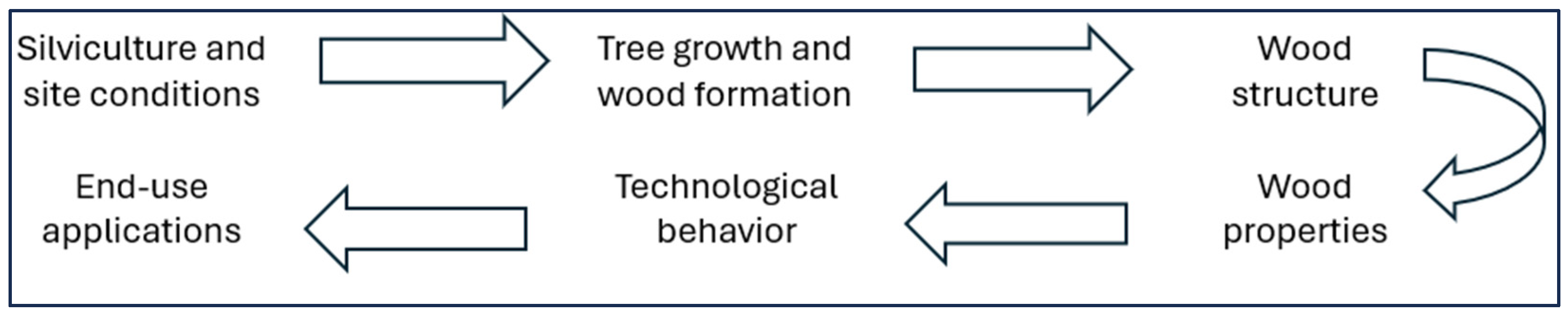
Figure 1. Conceptual framework of the study.
Forests 17 00841 g001
Figure 2. Black locust tree (a), log (b) and heart planks (c) [3].
Forests 17 00841 g002
Figure 3. Cross-section of a black locust log [3].
Forests 17 00841 g003
Figure 4. Anatomical details of black locust wood [3].
Forests 17 00841 g004
Table 2. Chemical composition of black locust wood.
Chemical Components, [%] Source
[67][27][43][26][52][53]
North/
South
[69][70][46][64]
Cellulose46.23–48.7239.1–50.166.12–67.86
40–50---44.4–49.1HW 78.4
SW 80.7
-
Pentosans14.52–17.8020.8–23.7 ---17.5–22.9-
Lignin24.39–27.1320.6–29.124.05–24.50
Klason
25–30HW 22.03
SW 19.77
--21.1–27.5HW 24.6
SW 23.9
-
Extractives--7.70- --- 7.37–13.4
Cold Water Solubility7.221.9–8.3-- 2.362/
2.414
--HW 10.67
SW 10.13
-
Hot Water Solubility8.203.9–11--JW 9.25
HW 5.1
4.244/
4.469
JW 8.52
SW 4.36
B 13.1
3.7–9.8HW 11.56
SW 10.36
-
1% NaOH Solubility20.27–23.94-------HW 22.68
SW 20.3
-
Ether Solubility1.07–1.920.7–1.7------HW 11.57
SW 9.25
-
Ash0.36–0.430.1–0.60.23–0.24HW 0.26
SW 0.98
B 4.76
HW 0.56
SW 0.7
0.417/
0.435
HW 0.8
SW 1.24
B 8.54
0.2–0.7HW 0.21
SW 0.41
0.29–0.47
Tannin-3–4-3–6------
Nitrogen, g/100 g----------
pH Value-4.1–5.3---4.5–6.5----
Where: HW—heartwood, SW—sapwood, JW—juvenile wood, B—bark.
Table 3. Average and range interval values of physical properties of black locust wood.
Property Source
D[27][36][79][71]
North
South
[75] [74]
Fresh-felled MC, % --35–4535.11
36.42
--
Oven-Dry Density, kg/m3 540–740–870617–712540–870613–719
584–698
529–857595–762
Basic Density, kg/m3 ---551–670--
Air-Dry Density, kg/m3 580–770–900520–614580–870658–780
633–772
-668–824
Green Density, kg/m3 800–900–950-800–950801–884
796–885
--
Shrinkage, %L0.1-0.10.04–0.67
0.04–0.54
0.290.3
R3.2–4.6- 4.06–6.52
4.07–6.62
5.55.1
T5.4–7.2-5.4–7.26.08–9.24
5.96–9.68
8.766.8
V11.4–12.2-11.4–12.210.66–14.81
10.09–14.70
1611.7
Swelling, %L---0.10–0.28
0.10–0.48
--
R---3.38–6.56
3.83–7.19
--
T---6.28–8.88
5.58–9.03
--
V---10.48–14.58
10.69–15.76
--
Shrinkage/
Swelling for 1% Variation in MC
L---0.01/0.01--
R---0.22/0.21--
T---0.31/0.30--
V0.4--0.52/0.53--
Coefficient of Anisotropy 1.46--1.40–1.551.6-
Where: D—direction, L—longitudinal, R—radial, T—tangential, V—volumetric.
Table 4. Main mechanical properties of natural and steamed black locust wood.
Mechanical
Property, MPa
Natural WoodSteamed WoodOak
Source
[80][68]
SeedShootSeedShoot
Parallel Shear Strength18.018.513.814.511.0
Parallel Compression Strength93.379.589.665.761.0
Parallel Tensile Strength131.1195.7133.0141.090.0
Bending Strength, MOR145.6155.2133.1130.388.0
Modulus of Elasticity, MOE13,34812,63112,46413,32211,700
Impact Bending Strength, J/mm20.1780.1720.1520.1480.06
Brinell–Morath Hardness84.884.688.486.966.0
Krippel–Pallay Hardness87.689.484.784.8-
Table 5. Mechanical properties of black locust wood.
Mechanical Property, MPa Source
[27][85][86][87][43][26][3,88]
North
South
[2][75][89][74] [90]
Parallel Tensile strength88–136–169-136120–148104.5–207.8166.8------
Perpendicular Tensile Strength4.3-4.3---------
Modulus of Elasticity in Tensile10,900
17,800
------------
Parallel Compression Strength62–72–81-71.958–7246.2–71.762–8170.76
68.21
JW 63.5
MW 67.7
63.3-75-
Perpendicular Compression Strength-----18.5-- ---
Bending Strength, MOR103–136–169133.5104.5118–14581.2–143.6103–169164.92
162.50
JW 90.9
MW 150
138173.02155.5150.8
Modulus of Elasticity in Bending, MOE9000–11,130–13,60011,08511,27011,000–15,70013,732–20,9979000–13,00017,490
17,328
JW 14,461
MW 14,846
15,700-14,28813,269
Parallel Shear strength
Radial/Tangential
11–13–16-12.812.5–16-11–16
14.76
/16.05 15.40
/16.74
-----
Perpendicular Shear Strength
Radial/Tangential
------4.92/
6.43
4.98/
5.23
-----
Transverse Shear Strength
Radial/Tangential
------91.72/
98.85
96.44/
97.73
-----
Splitting Strength
Radial/Tangential
0.6–1.1-----0.64/
0.86
0.58/
0.84
-----
Impact Bending Strength, [J/mm2]0.12–0.14–0.180.1350.0670.112–0.1350.093–0.2470.12–0.180.135
0.138
-0.1720.034-0.108
Brinell Parallel Hardness67–78–88 78.264–7834.1–62.467–8854.81
48.88
-----
Brinell Perpendicular Hardness28–34–4730–6035.540–5729.8–42.92838.31
33.71
-----
Janka Parallel
Hardness
-65–10087---90.03
72.54
-----
Janka Perpendicular Hardness--77----86.65
68.23
-----
Monnin Hardness
[mm−1]

-

4–9

-

9.5

-
-4.94
4.74
-5.227.48–8.09--
Where: JW—juvenile wood, MW—mature wood.
Table 6. Wear resistance of black locust wood.
Wood Density, kg/m3Wood Section
or Wood Category
Um, gUg, mmSource
719/702Natural Radial North/South0.074/0.1001.234/1.322[92]
Natural Tangential
North/South
0.064/0.0891.097/1.223
770Natural wood0.5650.149[77]
Light Steamed0.6410.143
Dark Steamed0.5750.154
Table 7. Average values of the shear bond strength of black locust wood.
Shear Bond Strength, MPa
Source[95][101][94][96][97]
Pressure17.85 kPa27.26 kPa8 bar-1.2 MPa0.8 MPa
AdhesivePVAcPURPVAcPURPURPVAcPURPVAcPVAcPUR
Wood state

14.57


7.4


11.92


6.39


13.3


9.58


11.7
Dry 11.69Dry 11.19.2
Wet 1.58Wet 2.92.1
Rec 12.62Rec 12.73.7
Table 8. Main advantages and limitations of black locust wood and their implications for industrial utilization.
CharacteristicAdvantageLimitationsImplications for Industrial Utilization
Growth and AdaptabilityFast growth, suitable for marginal and drought conditionsSometimes present invasive
behaviour
Sustainable resource under appropriate management
Trunk Diameter and ShapeResults in high timber value when not curved or forkedWhen forked and curved harms wood productionInfluence timber production
Twisted FibresSmall-sized wood for high-quality engineered productsLimit the size of wood typesSolid wood panels;
Structural use Glulam
Anatomy (tyloses)Provide durabilityReduce adhesive penetrationBonding and impregnation need optimization
Chemical CompositionHigh extractive content, durabilityMay influence coating performanceSurface preparation necessary
DensityHigh strength and wear resistanceHigher machining forces and tool wearSuitable for structural and
outdoor products
Dimensional StabilityLow shrinkageDrying requires a proper scheduleFlooring, joinery, exterior uses
Natural DurabilityResistance to fungi, insects, and
weathering
Limited permeabilityLong service life without
protection
Thermal TreatmentImproves colour and dimensional
stability
Slight reduction in mechanical propertiesValue-added products
MachiningGood processing with proper toolsDense wood may increase cutting resistanceOptimization of parameters
improve quality
Disclaimer/Publisher’s Note: The statements, opinions and data contained in all publications are solely those of the individual author(s) and contributor(s) and not of MDPI and/or the editor(s). MDPI and/or the editor(s) disclaim responsibility for any injury to people or property resulting from any ideas, methods, instructions or products referred to in the content.