You are currently viewing a new version of our website. To view the old version click .
  • 28 daysTime to First Decision

Biosphere

Biosphere is an international, peer-reviewed, open access journal on ecosystems published quarterly online by MDPI.

All Articles (7)

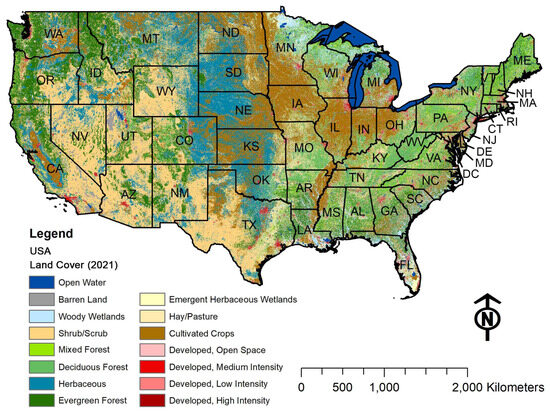
Economic connectedness has been recently found to lower income inequality by rising intergenerational mobility, yet its environmental impacts are less well known. More well-known is the fact that the non-carbon footprint is easier to reach via regulations because its production is domestic. These two problems of income inequality and environmental pollution have echoed in public opinion polls as one of the major current problems in developed countries. We thereby look at the United States on the state level during the last two decades (2010–2020) with a Hausman–Taylor estimator for panel data. The choice of the estimator stems from its appropriateness for panel datasets with constant variables. We find that in the United States, economic connectedness between friends, whereby friendships were formed within the same group, may be blamed for the rising environmental (non-carbon) footprint. The non-carbon footprint is, therefore, explained by the bonding of social capital, which may restrict innovation. We document the case where social capital in the form of economic connectedness may be harmful to the public good, such as the environment, our main contribution. The negative effect of bonding social capital on environmental outcomes due to rigid social networks and particular network technology use is a novel addition to the prior research. The policy implications are discussed in more detail, and a call is made to distinguish social capital types and promote bridging social capital where bonding social capital is relatively strong.

18 December 2025

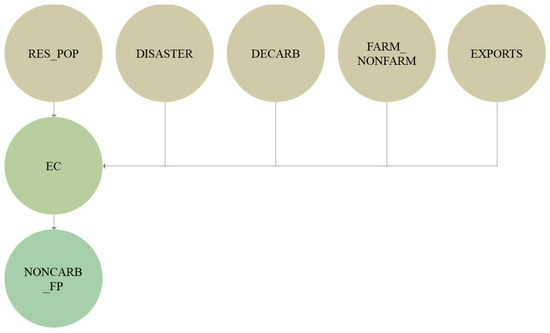
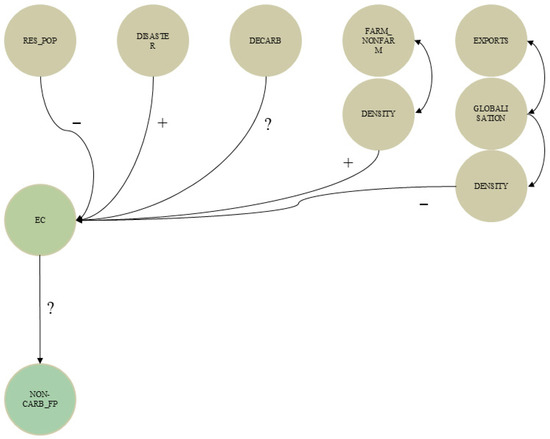
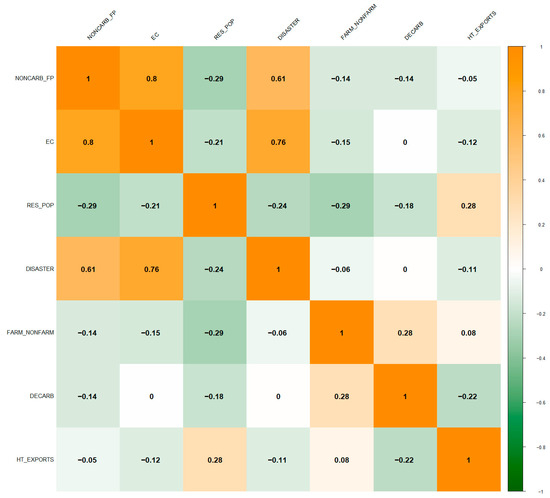
Instrumental variable model of non-carbon footprint. Note: RES_POP denotes resident population; DISASTER denotes disaster resiliency; DECARB denotes decarbonisation; FARM_NONFARM denotes farm-to-nonfarm production ratio; EXPORTS denotes high-technology exports; EC denotes economic connectedness; and NONCARB_FP denotes non-carbon footprint.

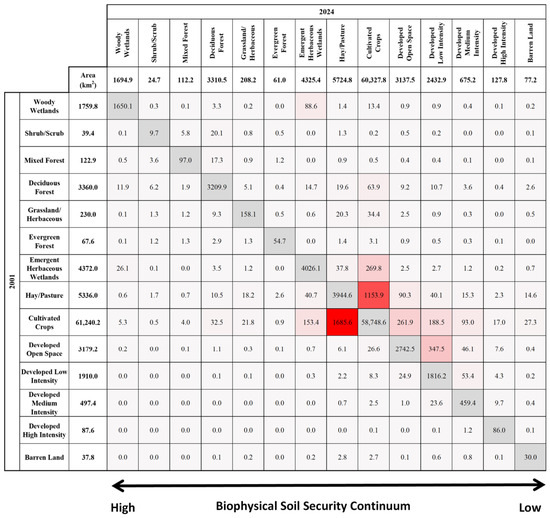
Analysis of historical and future land use/land cover (LULC) dynamics using spatiotemporal data is crucial for better management of natural resources and environmental monitoring. This study investigated LULC transformations over a span of 60 years (1984–2044) for the Giba basin in northern Ethiopia. ArcGIS and the Cellular Automata and Artificial Neural Network (CA-ANN) model were used to develop the historical (1984, 2004, 2014, and 2024) and projected future (2034 and 2044) LULC maps of the basin, respectively. The results show that LULC categories experienced shifts from one class to another by 35%, 33%, and 40% in 2004–2014, 2014–2024, and 2004–2024, respectively. During 1984–2024, the largest and smallest percentage of positive changes were observed in settlement (7700%) and shrubs and bushes (25%), which increased from negligible to 78 km2 and from 1668 km2 to 2082 km2, respectively. Furthermore, barren land and forestland showed the largest (−80%) and smallest (−37%) declines, which decreased from 956 km2 to 187 km2 and from 164 km2 to 103 km2 during the same period, respectively. Overall, the last 40 years witnessed considerable changes to LULC dynamics in the Giba basin. Cropland, water bodies, and settlements showed a continuously increasing trend throughout the historical study period, while grassland exhibited a continuous decreasing trend. Results of the CA-ANN model showed that the majority of the LULC categories (including water body, forest, bushes and shrubs, grassland, and barren land) will decrease, except for a slight increase of cropland (+6%) and settlements (+16%), which is projected to increase from 2570 km2 to 2733 km2 and from 78 km2 to 91 km2, respectively, in the next two decades, from 2024 to 2044. In general, high population increase, changes in government policies, and armed conflicts were found to be the most influential driving factors of LULC changes in the basin.

11 November 2025

Geographical location of the study area.

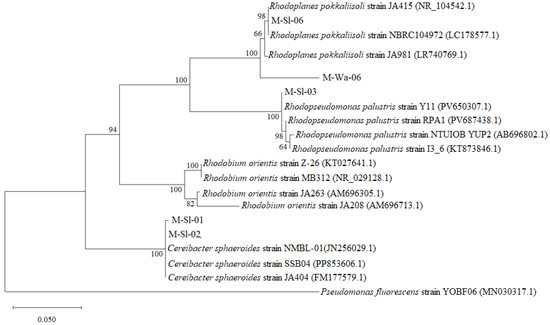
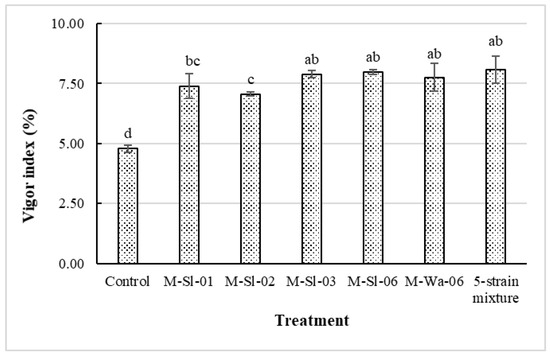
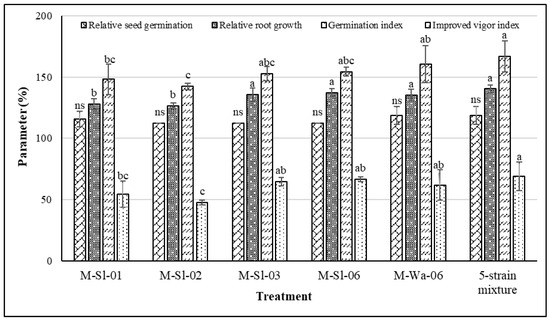
Potassium (K) is present in soils mainly in minerals, including feldspar. However, most of it is unavailable to plants. In the in-dyked alluvial soils of the Mekong Delta, available K is typically low despite the abundance of K-bearing feldspar, leading to nutrient imbalances and yield constraints. This study aimed to (i) select potential feldspar-potassium-solubilizing purple nonsulfur bacteria (K-PNSB), (ii) determine their ability to enhance hybrid maize seed vigor (Zea mays L.), and (iii) evaluate their effects on the growth of maize seedlings. Fifty-eight K-PNSB strains were isolated from maize-cultivated in-dyked alluvial soils, with soluble K concentrations ranging from 0.108 to 15.0 mg L−1. Among these, strain M-Sl-03 released the highest K concentration under microaerobic light conditions, whereas strains M-Sl-01 and M-Sl-06 produced best under aerobic dark conditions. In addition, two more strains, M-Sl-02 and M-Wa-06, were also selected for their K solubilization ability. The selected strains were identified as Cereibacter sphaeroides strains M-Sl-01 and M-Sl-02, Rhodopseudomonas palustris strain M-Sl-03, and Rhodoplanes pokkaliisoli strains M-Sl-03 and M-Wa-06, according to their 16S rDNA region. None of them exhibited toxicity to germinating maize seeds. Both individual strains and the five-strain mixture significantly improved seed vigor. At a 1:1000 dilution, individual and mixed inoculants increased the vigor index of maize seeds by 47.5–68.8%. In addition, the selected PNSB strains contributed to improving the growth of maize seedlings, particularly plant height and root dry biomass. These promising strains have potential for application as biofertilizers to support hybrid maize cultivation.

7 November 2025

Neighbor-joining phylogenetic tree constructed from 16S rDNA sequences of five selected feldspar-potassium-solubilizing purple nonsulfur bacterial strains and their closely related strains retrieved from the GenBank database. Bootstrap values (based on 1000 replicates) are shown at the branching points. The scale bar represents 0.05 nucleotide substitutions per site, and GenBank accession numbers are provided in parentheses.

Ammonia Losses, Wheat Biomass, and N Dynamics as Influenced by Organo-Mineral Fertilizer

  • Helen Carla Santana Amorim,
  • Francielle Roberta Dias de Lima and
  • Mariene Helena Duarte
  • + 4 authors

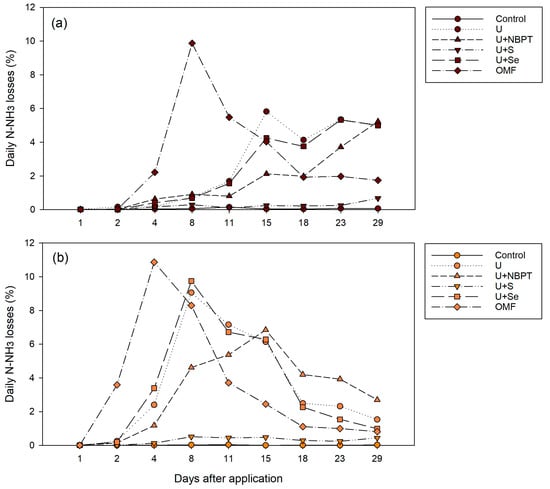
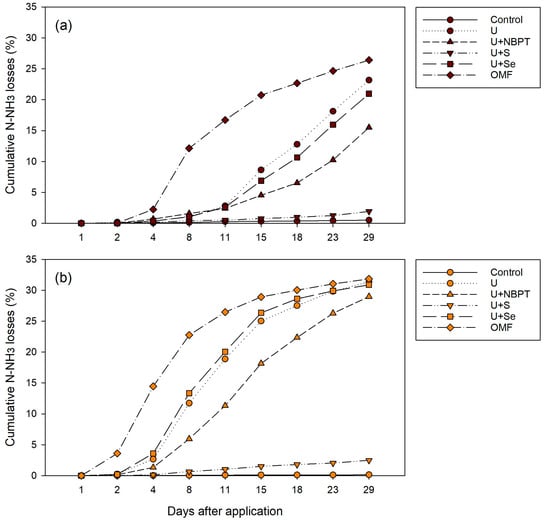
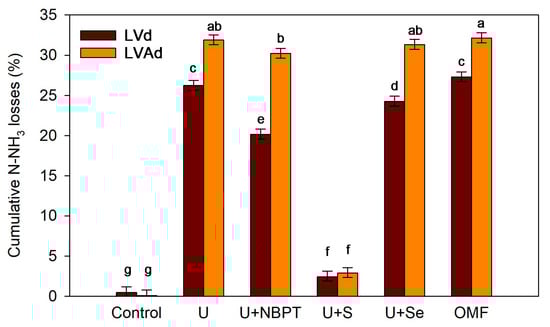
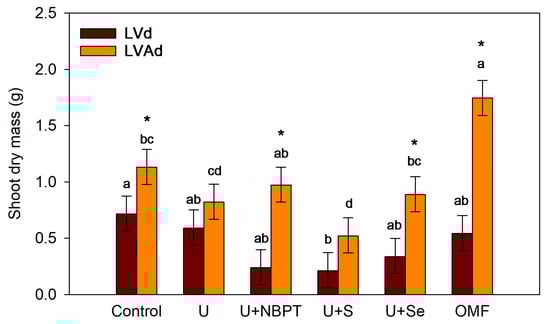
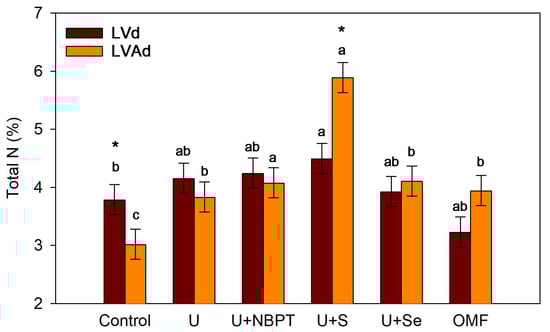
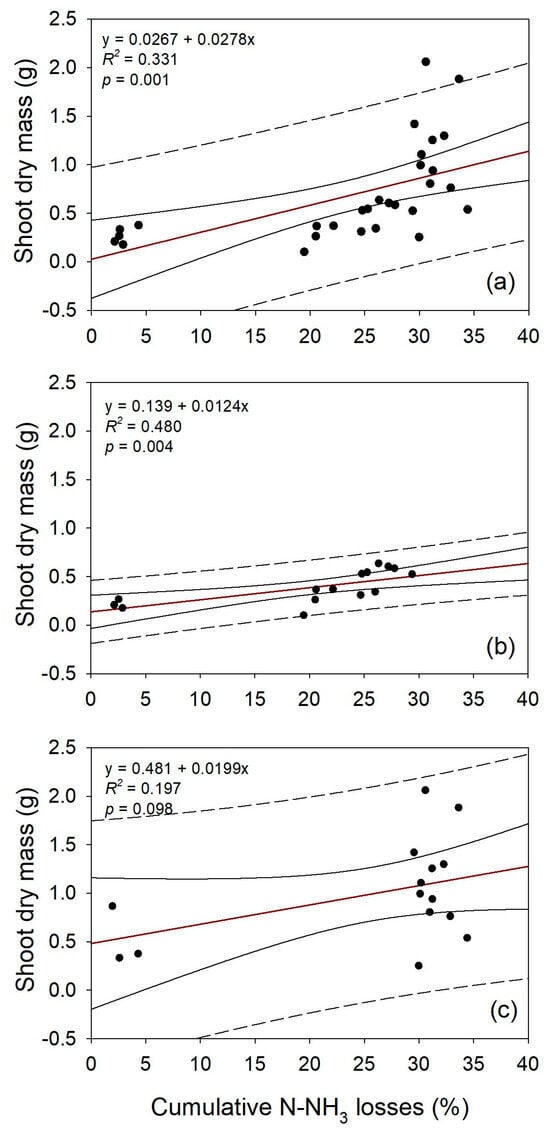
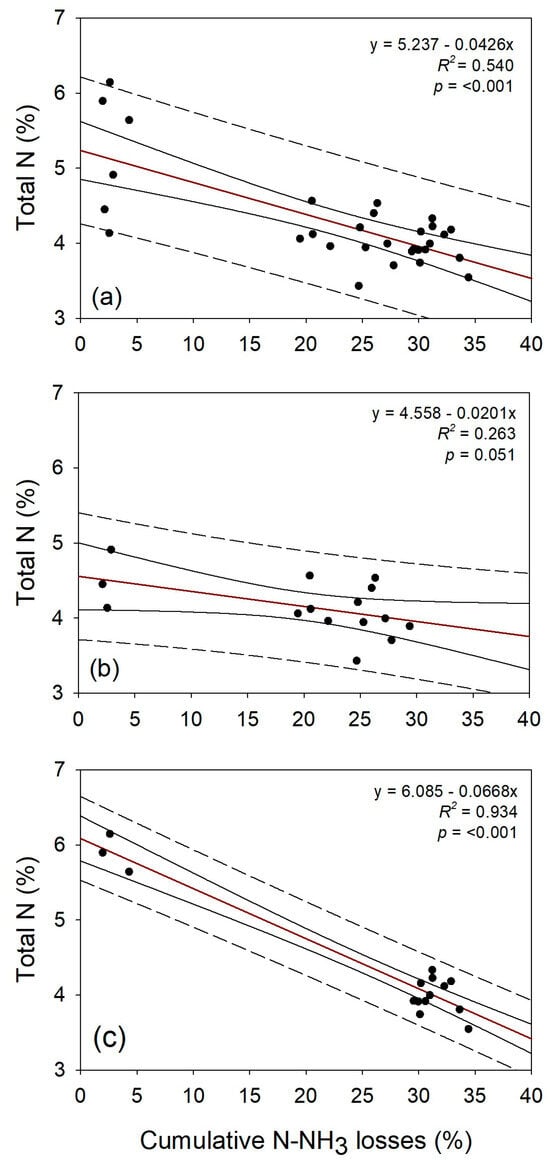
Organo-mineral fertilizers can slow N release to plants, reducing N losses to the environment and enhancing N use efficiency (NUE). Yet, this greater NUE is not always coupled to greater crop yields, which warrants further investigation. Here, we assessed the relationship between N-NH3 losses from volatilization and wheat (Triticum aestivum L.) biomass and N status. The following treatments were tested: conventional urea (U, 45% N), urea treated with NBPT (N-(n-butyl) thiophosphoric triamide) (U + NBPT, 45.6% N), S-coated urea (U + S; 37% N), Se-coated urea (U + Se; 45% N), organo-mineral fertilizer Azoslow 29 (OMF, 29% N + 50% Azogel®). The above treatments and non-fertilized control were tested in two soils (LVd and LVAd, 71 and 25% clay, respectively). Semi-open static collectors were used to determine N-NH3 volatilization 1, 2, 4, 8, 11, 15, 18, 23, 29, and 36 days after application of treatments. Wheat was cultivated for 35 days, and shoot dry mass and total leaf N were determined after harvest. Cumulative N-NH3 losses from OMF (27 and 32% of N applied in the LVd and LVAd soils, respectively) did not differ from U and (26–32%) and U + Se (24–31%), likely due to organic matter inputs enhancing urease activity in soils. Nevertheless, OMF resulted in 2–4 times greater wheat dry matter than U, U + Se, and U + S, with similar dry mass of U + NBPT for LVAd soils. OMF application enhanced total N removal in wheat leaves relative to the unfertilized control and most N sources. N-NH3 losses did not reduce biomass yield, but were negatively linked to N accumulation in wheat. The OMF enhanced wheat biomass and nutrition while sustaining environmental quality and promoting circularity in agroecosystems.

1 July 2025
Daily N-NH3 losses (% of N applied) after the application of N-fertilizers: control (without fertilizer application); conventional urea (U; 45% N); NBPT-coated urea (U + NBPT; 45% N); S-coated urea (U + S; 37% N); Se-coated urea (U + Se; 45% N), and the organo-mineral fertilizer (OMF; 29% N) in a typical dystrophic Red Latosol (LVd) (a) and typical dystrophic Red Yellow Latosol (LVAd) (b).

News & Conferences

Issues

Open for Submission

Editor's Choice

Get Alerted

Add your email address to receive forthcoming issues of this journal.

XFacebookLinkedIn
Biosphere - ISSN 3042-6111