

You are currently viewing a new version of our website. To view the old version click .

Marine Drugs, Volume 19, Issue 6

June 2021 - 69 articles

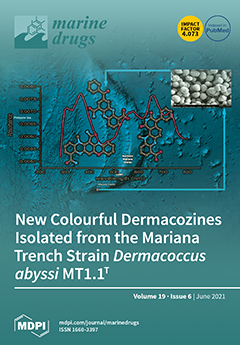
Cover Story: The Mariana Trench sediment strain Dermacoccus abyssi MT1.1T is known to produce novel phenazines called dermacozines. In our recent article alongside the compound isolation of the unprecedented dermacozine N and the new dermacozines O and P, we describe their challenging structure elucidation arising from their polycyclic nature being supported with various statistical and computational chemistry methods. The example of the dermacozines shows, that despite the mesmerizing depth of the hadal zone a vividly coloured life is thriving there. The vast majority of natural products—with potential applications from opto-electronics through biosensing chemistry up to medicinal chemistry—so far have not yet been explored. View this paper
  • Issues are regarded as officially published after their release is announced to the table of contents alert mailing list .
  • You may sign up for email alerts to receive table of contents of newly released issues.
  • PDF is the official format for papers published in both, html and pdf forms. To view the papers in pdf format, click on the "PDF Full-text" link, and use the free Adobe Reader to open them.

Articles (69)

  • Communication
  • Open Access
10 Citations
4,172 Views
7 Pages

8 June 2021

Mangroves are intertidal extreme environments with rich microbial communities. Actinobacteria are well known for producing antibiotics. The search for biosynthetic potential of Actinobacteria from mangrove environments could provide more possibilitie...

  • Article
  • Open Access
23 Citations
6,091 Views
21 Pages

Genome Mining for Antimicrobial Compounds in Wild Marine Animals-Associated Enterococci

  • Janira Prichula,
  • Muriel Primon-Barros,
  • Romeu C. Z. Luz,
  • Ícaro M. S. Castro,
  • Thiago G. S. Paim,
  • Maurício Tavares,
  • Rodrigo Ligabue-Braun,
  • Pedro A. d’Azevedo,
  • Jeverson Frazzon and
  • Ana P. G. Frazzon
  • + 2 authors

6 June 2021

New ecosystems are being actively mined for new bioactive compounds. Because of the large amount of unexplored biodiversity, bacteria from marine environments are especially promising. Further, host-associated microbes are of special interest because...

  • Article
  • Open Access
5 Citations
4,160 Views
16 Pages

Spray Drying of Chitosan Acid Salts: Process Development, Scaling Up and Physicochemical Material Characterization

  • Nilia de la Paz,
  • Mirna Fernández,
  • Orestes López,
  • Caridad Garcia,
  • Antonio Nogueira,
  • Leonid Torres,
  • Wilfredo Turiño and
  • Jyrki Heinämäki

6 June 2021

We investigated a spray drying process for preparing water-soluble salts of high molecular weight chitosan (CH) intended for pharmaceutical excipient applications. CH was derived from chitin of marine lobster origin (Panulirus argus). The effects of...

  • Review
  • Open Access
23 Citations
5,204 Views
40 Pages

5 June 2021

In this review, we discuss structural diversity, taxonomic distribution, biological activities, biogenesis, and synthesis of a rare group of terpenoids, the so-called malabaricane and isomalabaricane triterpenoids, as well as some compounds derived f...

  • Article
  • Open Access
8 Citations
4,081 Views
20 Pages

In Vitro and In Silico Characterization of G-Protein Coupled Receptor (GPCR) Targets of Phlorofucofuroeckol-A and Dieckol

  • Pradeep Paudel,
  • Su Hui Seong,
  • Se Eun Park,
  • Jong Hoon Ryu,
  • Hyun Ah Jung and
  • Jae Sue Choi

4 June 2021

Phlorotannins are polyphenolic compounds in marine alga, especially the brown algae. Among numerous phlorotannins, dieckol and phlorofucofuroeckol-A (PFF-A) are the major ones and despite a wider biological activity profile, knowledge of the G protei...

  • Article
  • Open Access
30 Citations
5,463 Views
21 Pages

3 June 2021

The pressurized liquid extraction (PLE) technique was used to obtain protein extracts with antioxidant capacity from salmon muscle remains, heads, viscera, skin, and tailfins. A protein recovery percentage ≈28% was obtained for all samples except for...

  • Feature Paper
  • Review
  • Open Access
12 Citations
6,425 Views
75 Pages

Antitumor Profile of Carbon-Bridged Steroids (CBS) and Triterpenoids

  • Valery M. Dembitsky,
  • Tatyana A. Gloriozova and
  • Vladimir V. Poroikov

3 June 2021

This review focuses on the rare group of carbon-bridged steroids (CBS) and triterpenoids found in various natural sources such as green, yellow-green, and red algae, marine sponges, soft corals, ascidians, starfish, and other marine invertebrates. In...

  • Article
  • Open Access
6 Citations
5,449 Views
22 Pages

3 June 2021

Three dermacozines, dermacozines N–P (1–3), were isolated from the piezotolerant Actinomycete strain Dermacoccus abyssi MT 1.1T, which was isolated from a Mariana Trench sediment in 2006. Herein, we report the elucidation of their structures using a...

  • Article
  • Open Access
13 Citations
5,093 Views
19 Pages

Okadaic Acid Exposure Induced Neural Tube Defects in Chicken (Gallus gallus) Embryos

  • Yuhu Jiao,
  • Guang Wang,
  • Dawei Li,
  • Hongye Li,
  • Jiesheng Liu,
  • Xuesong Yang and
  • Weidong Yang

2 June 2021

Okadaic acid (OA) is an important liposoluble shellfish toxin distributed worldwide, and is mainly responsible for diarrheic shellfish poisoning in human beings. It has a variety of toxicities, including cytotoxicity, embryonic toxicity, neurotoxicit...

of 7

Get Alerted

Add your email address to receive forthcoming issues of this journal.

XFacebookLinkedIn
Mar. Drugs - ISSN 1660-3397