You are currently viewing a new version of our website. To view the old version click .

Marine Drugs, Volume 19, Issue 6

June 2021 - 69 articles

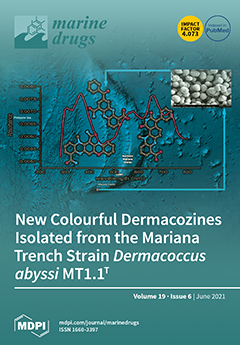
Cover Story: The Mariana Trench sediment strain Dermacoccus abyssi MT1.1T is known to produce novel phenazines called dermacozines. In our recent article alongside the compound isolation of the unprecedented dermacozine N and the new dermacozines O and P, we describe their challenging structure elucidation arising from their polycyclic nature being supported with various statistical and computational chemistry methods. The example of the dermacozines shows, that despite the mesmerizing depth of the hadal zone a vividly coloured life is thriving there. The vast majority of natural products—with potential applications from opto-electronics through biosensing chemistry up to medicinal chemistry—so far have not yet been explored. View this paper
  • Issues are regarded as officially published after their release is announced to the table of contents alert mailing list .
  • You may sign up for email alerts to receive table of contents of newly released issues.
  • PDF is the official format for papers published in both, html and pdf forms. To view the papers in pdf format, click on the "PDF Full-text" link, and use the free Adobe Reader to open them.

Articles (69)

  • Review
  • Open Access
51 Citations
6,998 Views
26 Pages

15 June 2021

Cancer has always been a threat to human health with its high morbidity and mortality rates. Traditional therapy, including surgery, chemotherapy and radiotherapy, plays a key role in cancer treatment. However, it is not able to prevent tumor recurre...

  • Article
  • Open Access
12 Citations
5,418 Views
10 Pages

15 June 2021

The aim of this study was to evaluate the effects of ingesting fucoidan derived from Okinawa mozuku (Cladosiphon okamuranus) on natural killer (NK) cell activity and to assess its safety in healthy adults via a randomized, double-blind, parallel-grou...

  • Article
  • Open Access
10 Citations
3,346 Views
11 Pages

Six New Diterpene Glycosides from the Soft Coral Lemnaliabournei

  • Xia Yan,
  • Han Ouyang,
  • Te Li,
  • Yutong Shi,
  • Bin Wu,
  • Xiaojun Yan and
  • Shan He

14 June 2021

A chemical study on the extracts of soft coral Lemnalia bournei resulted in the isolation and identification of six new bicyclic diterpene glycosides including three new lemnaboursides E–G (1–3), and three new lemnadiolboursides A–C (4–6), along with...

  • Article
  • Open Access
16 Citations
4,379 Views
8 Pages

NaCl Promotes the Efficient Formation of Haematococcus pluvialis Nonmotile Cells under Phosphorus Deficiency

  • Feng Li,
  • Ning Zhang,
  • Yulei Zhang,
  • Qingsheng Lian,
  • Caiying Qin,
  • Zuyuan Qian,
  • Yanqi Wu,
  • Zhiyuan Yang,
  • Changling Li and
  • Xianghu Huang
  • + 1 author

13 June 2021

Natural astaxanthin helps reduce the negative effects caused by oxidative stress and other related factors, thereby minimizing oxidative damage. Therefore, it has considerable potential and broad application prospects in human health and animal nutri...

  • Article
  • Open Access
61 Citations
7,464 Views
19 Pages

Characterization of Protein Hydrolysates from Fish Discards and By-Products from the North-West Spain Fishing Fleet as Potential Sources of Bioactive Peptides

  • Andreia Henriques,
  • José A. Vázquez,
  • Jesus Valcarcel,
  • Rogério Mendes,
  • Narcisa M. Bandarra and
  • Carla Pires

13 June 2021

Fish discards and by-products can be transformed into high value-added products such as fish protein hydrolysates (FPH) containing bioactive peptides. Protein hydrolysates were prepared from different parts (whole fish, skin and head) of several disc...

  • Article
  • Open Access
13 Citations
3,862 Views
24 Pages

Hemolytic Activity in Relation to the Photosynthetic System in Chattonella marina and Chattonella ovata

  • Ni Wu,
  • Mengmeng Tong,
  • Siyu Gou,
  • Weiji Zeng,
  • Zhuoyun Xu and
  • Tianjiu Jiang

12 June 2021

Chattonella species, C. marina and C. ovata, are harmful raphidophycean flagellates known to have hemolytic effects on many marine organisms and resulting in massive ecological damage worldwide. However, knowledge of the toxigenic mechanism of these...

  • Article
  • Open Access
24 Citations
4,179 Views
14 Pages

A Comparative In Vitro Evaluation of the Anti-Inflammatory Effects of a Tisochrysis lutea Extract and Fucoxanthin

  • Elisabetta Bigagli,
  • Mario D’Ambrosio,
  • Lorenzo Cinci,
  • Alberto Niccolai,
  • Natascia Biondi,
  • Liliana Rodolfi,
  • Luana Beatriz Dos Santos Nascimiento,
  • Mario R. Tredici and
  • Cristina Luceri

11 June 2021

In this study, we compared the effects of a Tisochrysis lutea (T. lutea) F&M-M36 methanolic extract with those of fucoxanthin (FX) at equivalent concentration, on lipopolysaccharide (LPS)-stimulated RAW 264.7 macrophages. The T. lutea F&...

  • Review
  • Open Access
54 Citations
5,269 Views
25 Pages

11 June 2021

Sinularia is one of the conspicuous soft coral species widely distributed in the world’s oceans at a depth of about 12 m. Secondary metabolites from the genus Sinularia show great chemical diversity. More than 700 secondary metabolites have been repo...

  • Article
  • Open Access
9 Citations
3,908 Views
9 Pages

Antiproliferative Illudalane Sesquiterpenes from the Marine Sediment Ascomycete Aspergillus oryzae

  • Raha Orfali,
  • Shagufta Perveen,
  • Muhammad Farooq Khan,
  • Atallah F. Ahmed,
  • Mohammad A. Wadaan,
  • Areej Mohammad Al-Taweel,
  • Ali S. Alqahtani,
  • Fahd A. Nasr,
  • Sobia Tabassum and
  • Paolo Luciano
  • + 3 authors

10 June 2021

The new asperorlactone (1), along with the known illudalane sesquiterpene echinolactone D (2), two known pyrones, 4-(hydroxymethyl)-5-hydroxy-2H-pyran-2-one (3) and its acetate 4, and 4-hydroxybenzaldehyde (5), were isolated from a culture of Aspergi...

  • Review
  • Open Access
19 Citations
5,408 Views
31 Pages

Sphingolipids of Asteroidea and Holothuroidea: Structures and Biological Activities

  • Timofey V. Malyarenko,
  • Alla A. Kicha,
  • Valentin A. Stonik and
  • Natalia V. Ivanchina

8 June 2021

Sphingolipids are complex lipids widespread in nature as structural components of biomembranes. Commonly, the sphingolipids of marine organisms differ from those of terrestrial animals and plants. The gangliosides are the most complex sphingolipids c...

of 7

Get Alerted

Add your email address to receive forthcoming issues of this journal.

XFacebookLinkedIn
Mar. Drugs - ISSN 1660-3397