

You are currently viewing a new version of our website. To view the old version click .

Pharmaceuticals, Volume 10, Issue 1

March 2017 - 32 articles

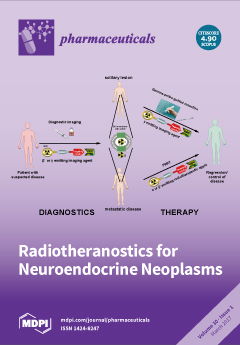
Cover Story: Radiotheranostics combining diagnostic imaging and radiotherapeutic treatment fulfil the criteria of personalized medicine on molecular level. In particular, peptide receptor targeting mechanism has demonstrated strong potential in the clinical management of neuroendocrine neoplasms (NENs) wherein radiolabeled somatostatin analogs targeting somatostatin receptors (SSTR) has entered clinical practice. Other receptors expressed in various NENs such as Glucagon-Like Peptide-1 Receptor and Cholecystokinin-2 receptor approached clinical research, and Glucose-Dependent Insulinotropic Polypeptide (GIP) receptor has the potential for SSTR-negative and GLP-1R-negative NENs. The current status of radiotheranostics in NENs proves that peptide-receptor targeting nuclear imaging and therapy is an indispensable clinical tool in oncology. View this paper
  • Issues are regarded as officially published after their release is announced to the table of contents alert mailing list .
  • You may sign up for email alerts to receive table of contents of newly released issues.
  • PDF is the official format for papers published in both, html and pdf forms. To view the papers in pdf format, click on the "PDF Full-text" link, and use the free Adobe Reader to open them.

Articles (32)

  • Editorial
  • Open Access
9 Citations
6,706 Views
3 Pages

Aptamers: Biomedical Interest and Applications

  • Cristina Romero-López and
  • Alfredo Berzal-Herranz

Aptamers are short DNA or RNA oligonucleotides specialized in the specific and efficient binding to a target molecule. They are obtained by in vitro selection or evolution processes. It was in 1990 that two independent research groups described the b...

  • Article
  • Open Access
86 Citations
12,797 Views
10 Pages

Anacardic Acid Constituents from Cashew Nut Shell Liquid: NMR Characterization and the Effect of Unsaturation on Its Biological Activities

  • Selene M. Morais,
  • Katherine A. Silva,
  • Halisson Araujo,
  • Icaro G.P. Vieira,
  • Daniela R. Alves,
  • Raquel O.S. Fontenelle and
  • Artur M.S. Silva

Anacardic acids are the main constituents of natural cashew nut shell liquid (CNSL), obtained via the extraction of cashew shells with hexane at room temperature. This raw material presents high technological potential due to its various biological p...

  • Review
  • Open Access
47 Citations
12,942 Views
22 Pages

Abstract: Nuclear medicine plays a pivotal role in the management of patients affected by neuroendocrine neoplasms (NENs). Radiolabeled somatostatin receptor analogs are by far the most advanced radiopharmaceuticals for diagnosis and therapy (radioth...

  • Review
  • Open Access
24 Citations
5,120 Views
11 Pages

The treatment landscape for mantle cell lymphoma (MCL) is rapidly evolving toward the incorporation of novel and biologically targeted pharmaceuticals with improved disease activity and gentler toxicity profiles compared with conventional chemotherap...

  • Article
  • Open Access
17 Citations
6,612 Views
15 Pages

Theranostic Value of Multimers: Lessons Learned from Trimerization of Neurotensin Receptor Ligands and Other Targeting Vectors

  • Simone Maschauer,
  • Jürgen Einsiedel,
  • Dominik Reich,
  • Harald Hübner,
  • Peter Gmeiner,
  • Hans-Jürgen Wester,
  • Olaf Prante and
  • Johannes Notni

Neurotensin receptor 1 (NTS1) is overexpressed on a variety of cancer entities; for example, prostate cancer, ductal pancreatic adenocarcinoma, and breast cancer. Therefore, it represents an interesting target for the diagnosis of these cancers types...

  • Review
  • Open Access
82 Citations
9,846 Views
19 Pages

Protein Kinase CK2: Intricate Relationships within Regulatory Cellular Networks

  • Teresa Nuñez de Villavicencio-Diaz,
  • Adam J. Rabalski and
  • David W. Litchfield

Protein kinase CK2 is a small family of protein kinases that has been implicated in an expanding array of biological processes. While it is widely accepted that CK2 is a regulatory participant in a multitude of fundamental cellular processes, CK2 is...

  • Review
  • Open Access
13 Citations
6,867 Views
13 Pages

CK2 Molecular Targeting—Tumor Cell-Specific Delivery of RNAi in Various Models of Cancer

  • Janeen H. Trembley,
  • Betsy T. Kren,
  • Md. Joynal Abedin,
  • Rachel I. Vogel,
  • Claire M. Cannon,
  • Gretchen M. Unger and
  • Khalil Ahmed

21 February 2017

Protein kinase CK2 demonstrates increased protein expression relative to non-transformed cells in the majority of cancers that have been examined. The elevated levels of CK2 are involved in promoting not only continued proliferation of cancer cells b...

  • Review
  • Open Access
56 Citations
14,086 Views
23 Pages

20 February 2017

Casein kinase II (CK2) is an ubiquitous and pleiotropic serine/threonine protein kinase able to phosphorylate hundreds of substrates. Being implicated in several human diseases, from neurodegeneration to cancer, the biological roles of CK2 have been...

  • Article
  • Open Access
37 Citations
8,063 Views
18 Pages

Targeting Protein Kinase CK2: Evaluating CX-4945 Potential for GL261 Glioblastoma Therapy in Immunocompetent Mice

  • Laura Ferrer-Font,
  • Lucia Villamañan,
  • Nuria Arias-Ramos,
  • Jordi Vilardell,
  • Maria Plana,
  • Maria Ruzzene,
  • Lorenzo A. Pinna,
  • Emilio Itarte,
  • Carles Arús and
  • Ana Paula Candiota

12 February 2017

Glioblastoma (GBM) causes poor survival in patients even with aggressive treatment. Temozolomide (TMZ) is the standard chemotherapeutic choice for GBM treatment but resistance always ensues. Protein kinase CK2 (CK2) contributes to tumour development...

  • Article
  • Open Access
9 Citations
6,660 Views
20 Pages

RNA-Eluting Surfaces for the Modulation of Gene Expression as A Novel Stent Concept

  • Olivia Koenig,
  • Diane Zengerle,
  • Nadja Perle,
  • Susanne Hossfeld,
  • Bernd Neumann,
  • Andreas Behring,
  • Meltem Avci-Adali,
  • Tobias Walker,
  • Christian Schlensak and
  • Hans Peter Wendel
  • + 1 author

10 February 2017

Presently, a new era of drug-eluting stents is continuing to improve late adverse effects such as thrombosis after coronary stent implantation in atherosclerotic vessels. The application of gene expression–modulating stents releasing specific small i...

of 4

Get Alerted

Add your email address to receive forthcoming issues of this journal.

XFacebookLinkedIn
Pharmaceuticals - ISSN 1424-8247