You are currently viewing a new version of our website. To view the old version click .

International Journal of Molecular Sciences, Volume 19, Issue 1

January 2018 - 316 articles

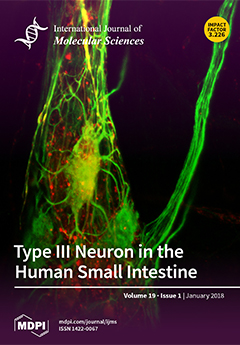
Cover Story: The enteric nervous system consists of more neurons than the spinal cord. These neurons generate different reflex arcs located completely within the gut wall. Our basic knowledge on different neuron types is derived from studies in the guinea pig gut. To identify the equivalent human enteric neuron populations, morpho–chemical analysis is a powerful method. Type III neurons have long, slender, branched dendrites. Beyond their immunoreactivity for neurofilaments (green) and calbindin (red), their unique chemical code needs to be deciphered. View this paper
  • Issues are regarded as officially published after their release is announced to the table of contents alert mailing list .
  • You may sign up for email alerts to receive table of contents of newly released issues.
  • PDF is the official format for papers published in both, html and pdf forms. To view the papers in pdf format, click on the "PDF Full-text" link, and use the free Adobe Reader to open them.

Articles (316)

  • Article
  • Open Access
23 Citations
8,316 Views
17 Pages

Comparative Genomics of the Balsaminaceae Sister Genera Hydrocera triflora and Impatiens pinfanensis

  • Zhi-Zhong Li,
  • Josphat K. Saina,
  • Andrew W. Gichira,
  • Cornelius M. Kyalo,
  • Qing-Feng Wang and
  • Jin-Ming Chen

The family Balsaminaceae, which consists of the economically important genus Impatiens and the monotypic genus Hydrocera, lacks a reported or published complete chloroplast genome sequence. Therefore, chloroplast genome sequences of the two sister ge...

  • Review
  • Open Access
214 Citations
22,656 Views
27 Pages

Microglia and Aging: The Role of the TREM2–DAP12 and CX3CL1-CX3CR1 Axes

  • Carmen Mecca,
  • Ileana Giambanco,
  • Rosario Donato and
  • Cataldo Arcuri

Depending on the species, microglial cells represent 5–20% of glial cells in the adult brain. As the innate immune effector of the brain, microglia are involved in several functions: regulation of inflammation, synaptic connectivity, programmed cell...

  • Review
  • Open Access
12 Citations
7,015 Views
10 Pages

Hereditary Fibrinogen Aα-Chain Amyloidosis in Asia: Clinical and Molecular Characteristics

  • Masahide Yazaki,
  • Tsuneaki Yoshinaga,
  • Yoshiki Sekijima,
  • Fuyuki Kametani and
  • Nobuo Okumura

Hereditary fibrinogen Aα-chain amyloidosis (Aα-chain amyloidosis) is a type of autosomal dominant systemic amyloidosis caused by mutations in fibrinogen Aα-chain gene (FGA). Patients with Aα-chain amyloidosis have been mainly reported in Western coun...

  • Article
  • Open Access
15 Citations
7,158 Views
15 Pages

Affinity Purification and Comparative Biosensor Analysis of Citrulline-Peptide-Specific Antibodies in Rheumatoid Arthritis

  • Eszter Szarka,
  • Petra Aradi,
  • Krisztina Huber,
  • Judit Pozsgay,
  • Lili Végh,
  • Anna Magyar,
  • Gergő Gyulai,
  • György Nagy,
  • Bernadette Rojkovich and
  • Éva Kiss
  • + 2 authors

Background: In rheumatoid arthritis (RA), anti-citrullinated protein/peptide antibodies (ACPAs) are responsible for disease onset and progression, however, our knowledge is limited on ligand binding affinities of autoantibodies with different citrull...

  • Communication
  • Open Access
4 Citations
6,075 Views
10 Pages

Micro-RNAs (miRNAs) have emerged as novel gene expression regulators. Recent evidence strongly suggests a role for miRNAs in a large variety of cancer-related pathways. Different studies have shown that 18.7 to 37% of all human miRNA genes are cluste...

  • Review
  • Open Access
41 Citations
15,918 Views
17 Pages

Acute fatty liver of pregnancy (AFLP), a catastrophic illness for both the mother and the unborn offspring, develops in the last trimester of pregnancy with significant maternal and perinatal mortality. AFLP is also recognized as an obstetric and med...

  • Review
  • Open Access
91 Citations
17,041 Views
40 Pages

Heat Shock Proteins and Autophagy Pathways in Neuroprotection: From Molecular Bases to Pharmacological Interventions

  • Botond Penke,
  • Ferenc Bogár,
  • Tim Crul,
  • Miklós Sántha,
  • Melinda E. Tóth and
  • László Vígh

Neurodegenerative diseases (NDDs) such as Alzheimer’s disease, Parkinson’s disease and Huntington’s disease (HD), amyotrophic lateral sclerosis, and prion diseases are all characterized by the accumulation of protein aggregates (amyloids) into inclus...

  • Article
  • Open Access
28 Citations
6,215 Views
11 Pages

Overall Survival of Ovarian Cancer Patients Is Determined by Expression of Galectins-8 and -9

  • Heiko Schulz,
  • Christina Kuhn,
  • Simone Hofmann,
  • Doris Mayr,
  • Sven Mahner,
  • Udo Jeschke and
  • Elisa Schmoeckel

The evaluation of new prognostic factors that can be targeted in ovarian cancer diagnosis and therapy is of the utmost importance. Galectins are a family of carbohydrate binding proteins with various implications in cancer biology. In this study, the...

  • Review
  • Open Access
59 Citations
12,064 Views
26 Pages

Unlike other malignant bone tumors including osteosarcomas and Ewing sarcomas with a peak incidence in adolescents and young adults, conventional and dedifferentiated chondrosarcomas mainly affect people in the 4th to 7th decade of life. To date, the...

  • Review
  • Open Access
22 Citations
9,430 Views
15 Pages

Deregulation of Frizzled Receptors in Hepatocellular Carcinoma

  • Kristy Kwan-Shuen Chan and
  • Regina Cheuk-Lam Lo

G protein-coupled receptors (GPCRs) have a substantial role in tumorigenesis and are described as a “cancer driver”. Aberrant expression or activation of GPCRs leads to the deregulation of downstream signaling pathways, thereby promoting cancer progr...

of 32

Get Alerted

Add your email address to receive forthcoming issues of this journal.

XFacebookLinkedIn
Int. J. Mol. Sci. - ISSN 1422-0067