


Abstract
Terminological diversity in community-based participatory health can obscure the meaning of community knowledge and social participation, generate conceptual ambiguity, and hinder cross-study comparisons. This scoping review mapped the use of three selected expressions—‘community health knowledge’, ‘popular health education’, and ‘empowerment-based health education’—and explored their relationships with community knowledge and social participation. PubMed was searched for publications from 2000 to 2025. Eligible publications included English-language empirical studies and reviews using the selected expressions either as named approaches/constructs or in descriptive/incidental contexts. Two reviewers independently selected sources and charted data, which were summarized through descriptive mapping and a non-comparative narrative overview. The included corpus comprised 167 publications: 91 on empowerment-based health education, 44 on popular health education, and 32 on community health knowledge. Overall, 103 publications (61.7%) used the expressions as named approaches/constructs, whereas 64 (38.3%) used them descriptively/incidentally. Within this subset, empowerment-based health education encompassed self-management and autonomy alongside community-oriented applications; popular health education emphasized dialogue, local knowledge, and collective educational processes; and community health knowledge addressed Indigenous, local, and experiential knowledge. In conclusion, these patterns reveal conceptual similarities and differences in emphasis of the three terms, without establishing a hierarchy of participatory alignment. Restriction to PubMed and English-language publications limited coverage and may have influenced the representation of the expressions. Distinguishing between conceptual use and incidental mentions allows for a more accurate interpretation of how terminology reflects participation in public health.
1. Introduction
Public health interventions are grounded in social, cultural, and economic contexts. Addressing persistent health inequities and structural vulnerabilities requires not only scientific and professional expertise but also knowledge and experience of local communities. Community participation is important because it concerns whose knowledge and priorities guide health initiatives and how communities influence decision-making [1].
Community-based participatory health (CBPH) emphasizes collaboration between communities and health professionals, bringing different forms of knowledge into health initiatives [1,2,3,4,5]. Participation can occur in research, service planning, educational activities, and policy development [6,7]. Its meaning depends on the role assigned to communities, which may range from consultation to shared decision-making [8,9].
This range of participatory arrangements is accompanied by considerable variations in terminology. The literature frequently uses multiple overlapping terms to describe approaches involving communities, including community knowledge, participation, education, and empowerment [10,11]. These terms may refer to related but distinct processes, ranging from knowledge transmission to collective decision-making. This terminological ambiguity can obscure how interventions are conceptualized and operationalized, complicate cross-study comparisons, and hinder the synthesis and translation of evidence into effective public health practices [11,12,13,14].
Three specific terms illustrate this conceptual heterogeneity: ‘community health knowledge’, ‘popular health education’, and ‘empowerment-based health education’. These expressions address knowledge and education in health, but their meanings and implications for participation require examination within each source. Community health knowledge raises questions about whose knowledge is recognized and how it informs health action. Popular health education is associated with Freirean critical pedagogy, dialogue, and emancipatory educational practices [15,16]. Empowerment-based health education includes applications informed by patient empowerment frameworks in clinical care [17,18,19,20,21]. These associations provide context for this review, which examines how these expressions are differentiated within the selected literature.
An additional distinction concerns how an expression functions within a publication. It may identify an explicitly described approach or construct, or it may appear as a general description of knowledge, education, services, or the popularity of an educational tool. Both uses are relevant to terminology mapping, but they do not provide equivalent evidence for conceptual interpretation. Exact-phrase retrieval alone cannot distinguish these uses, because identical wording may serve different functions across publications. Examining the surrounding context helps establish whether an expression names an educational approach or knowledge construct, refers to a concept discussed elsewhere, or simply describes an activity or resource. This distinction is necessary before considering the relationship between the selected expressions and participation.
Conceptual distinctions in public health matter because initiatives described as participatory can assign markedly different roles to communities [8,22,23]. Research on participatory partnerships and citizen participation highlights the recognition of community knowledge, influence over decisions, and relationships between communities and professionals [2,5]. These concepts provide background for interpreting the selected literature, but their presence cannot be inferred from terminology alone. They are not treated here as a validated scale or as the basis for ranking educational traditions.
This scoping review does not aim to cover the full vocabulary of participatory public health or replace broader constructs such as CBPH, community engagement, co-production, or health literacy. Accordingly, this review aimed to map the distribution and use of ‘community health knowledge’, ‘popular health education’, and ‘empowerment-based health education’ in PubMed-indexed literature, distinguish conceptual from descriptive or incidental uses, and describe the conceptual characteristics reported in publications using these expressions as named approaches or constructs. The review did not seek to rank the expressions according to their degree of participation.
2. Materials and Methods
This review maps the use and conceptual characteristics of three selected expressions in public health literature: ‘community health knowledge’, ‘popular health education’, and ‘empowerment-based health education’. A scoping review design was adopted to address these descriptive and conceptual objectives. Reporting was guided by the Preferred Reporting Items for Systematic Reviews and Meta-Analyses extension for Scoping Reviews (PRISMA-ScR) [24], and Joanna Briggs Institute guidance informed the review scope and eligibility criteria [25]. A scoping review approach was considered appropriate because the objective was to map terminology, clarify conceptual characteristics, and describe the available literature [26,27]. This review was not prospectively registered. No formal protocol was published before its conduct.
2.1. Rationale for the Selected Expressions
The three expressions were purposively selected to examine three related conceptual emphases in health literature: knowledge in community health contexts (‘community health knowledge’), popular educational approaches (‘popular health education’), and empowerment as an explicit basis for education (‘empowerment-based health education’). Their selection provided a focused set for examining how these emphases are expressed and whether the terminology identifies named approaches or constructs or occurs descriptively or incidentally. This conceptual rationale defined the scope. Related terms and alternative formulations were not included, which may have influenced the publication counts, geographical distribution, and conceptual characteristics identified. The findings concern the selected expressions rather than the broader concepts or educational traditions associated with them.
This review was structured using the population–concept–context (PCC) framework [25] as follows.
- No population restrictions were applied, as the review aimed to map the use of selected health-related expressions rather than investigate specific population groups. Accordingly, publications involving individuals or communities of different ages, sexes, ethnic backgrounds, and clinical conditions were eligible, provided they met the other predefined inclusion criteria.
- The concept concerned the range of uses of the three selected expressions, including their use as named approaches or constructs and their descriptive or incidental occurrence in otherwise eligible publications. The presence of participatory characteristics was not required for inclusion in the broad terminology-mapping corpus.
- The context comprised public, community, and health-education settings, including relevant clinical and professional-education applications, without geographical restrictions to the search.
Eligible publications included quantitative, qualitative, and mixed-methods studies, as well as systematic and narrative reviews published in English between January 2000 and December 2025. Editorials, opinion pieces, letters, conference abstracts, preprints, study protocols, and non-peer-reviewed reports were excluded. An English abstract alone was not considered sufficient when the available publication did not meet the English-language full-text criterion.
Conceptual and descriptive or incidental uses were distinguished during data charting. A publication could remain in the terminology mapping without contributing evidence to the conceptual overview. PubMed was the only information source, and the last search was conducted on 1 July 2026. Three separate phrase searches were conducted using quotation marks, with no filters applied at the PubMed search interface.
No MeSH descriptors were explicitly entered, nor were any generated through automatic query translation because exact-phrase quotation marks disable PubMed’s Automatic Term Mapping. The exact user-entered strings, complete executed queries retrieved from PubMed Search Details (including system-assigned field tags), interface filters, and search dates for each term were as follows:
- Community health knowledge—User-entered query: “community health knowledge”; executed query (Search Details): “community health knowledge”[All Fields]; interface filters applied: none; date of last search: 1 July 2026.
- Popular health education—User-entered query: “popular health education”; executed query (Search Details): “popular health education”[All Fields]; interface filters applied: none; date of last search: 1 July 2026.
- Empowerment-based health education—User-entered query: “empowerment-based health education”; executed query (Search Details): “empowerment-based health education”[All Fields]; interface filters applied: none; date of last search: 1 July 2026.
Records retrieved from each search were exported and screened directly without the use of reference-management software and without a formal or documented deduplication procedure. Consequently, counts of overlapping records retrieved across the three separate searches prior to screening were not logged and cannot be reported.
A retrospective check found no repeated DOIs among the 159 publications with a DOI recorded in Table S1; eight publications had no DOI recorded. No publications were reassigned between expression categories. Two reviewers independently screened the titles and abstracts and assessed potentially eligible articles. Disagreements were resolved through discussion or consultation with a third reviewer. Publication-date eligibility (January 2000 to December 2025) and English-language criteria were applied manually after retrieval. Retrieval, screening, and inclusion counts are reported in the Results.
2.2. Data Charting and Descriptive Mapping
Data were independently charted by two reviewers using a standardized Excel spreadsheet, recording bibliographic information, year, country, design, population, intervention, educational approach, and main findings. Table S1 presents the source-level information and classifies expression use as either a named approach or construct or a descriptive or incidental use.
A named approach or construct refers to an expression used to identify an educational approach, theoretical concept, or form of knowledge that is explicitly described in the publication. Descriptive or incidental use refers to wording that does not identify such an approach or construct, including general descriptions of knowledge, educational activities, or the popularity of an educational resource. This classification concerns the function of the expression within the source and does not establish the presence or depth of participation.
Descriptive mapping included all publications. The non-comparative narrative overview was restricted to publications classified as using a named approach or construct. Two reviewers independently examined the full texts and inductively identified conceptual characteristics from the descriptions of educational approaches, interventions, and reported findings. These characteristics were identified during reading rather than assigned using a predefined coding framework. The characteristics summarized in Table 1 were derived from this full-text examination rather than solely from the conclusions presented in Table S1. The conceptual synthesis was conducted without assigning numerical weights or ranking the three terms. This provides an illustrative representation of the resulting synthesis, without numerical weighting or ranking. Including quantitative, qualitative, and mixed-methods studies does not itself constitute a mixed methods systematic review, which requires explicit integration of quantitative and qualitative evidence [28].
Table 1.
Health topics, educational approaches, and conceptual characteristics described in publications using the expressions as named approaches or constructs.
For the methodological summary, quantitative descriptive and prospective cohort designs were grouped with quantitative studies. Qualitative studies, experience reports, and historical analyses were presented together, while reviews and mixed-methods studies remained separate categories. Country and territory entries were summarized as recorded in Table S1, without treating them uniformly as study settings or first-author affiliations. Publications listing multiple countries contributed to each corresponding country entry in Table S2. Critical appraisal and risk-of-bias assessment were not undertaken because the review mapped terminology and reported conceptual characteristics rather than intervention effectiveness. PRISMA-ScR items 12 and 16 therefore concern procedures not undertaken. Funding sources of the included publications were not systematically charted. The funding statement describes support for this review.
3. Results
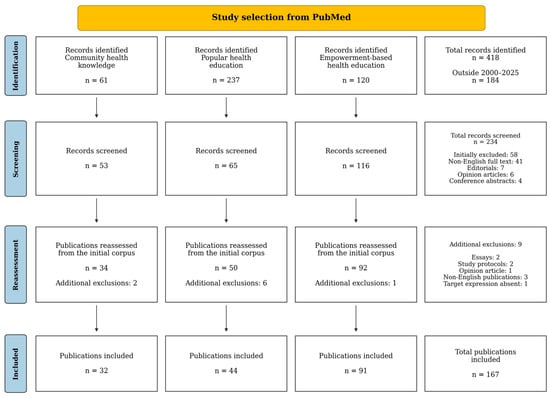
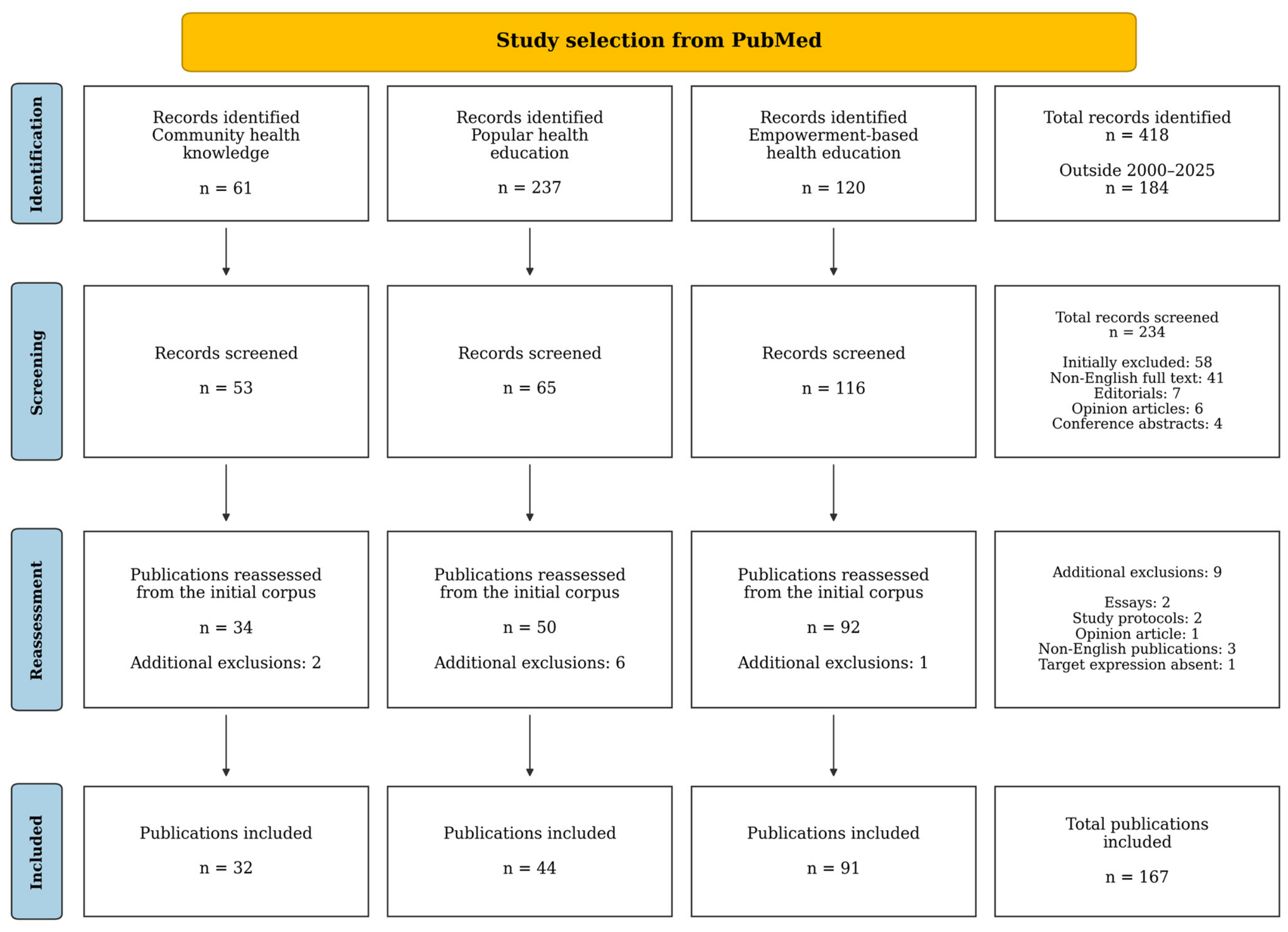
The three PubMed searches retrieved 418 records. After excluding 184 records published outside 2000–2025, 234 remained for screening. Initial screening excluded 58 records. During manuscript revision, eligibility reassessment excluded nine additional publications. The final corpus comprised 167 publications: 91 on empowerment-based health education, 44 on popular health education, and 32 on community health knowledge. Figure 1 summarizes record retrieval, initial selection, and eligibility reassessment.
Figure 1.
PRISMA flow diagram of the study selection process for the three terms.
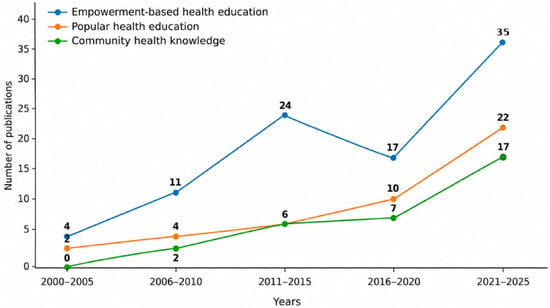
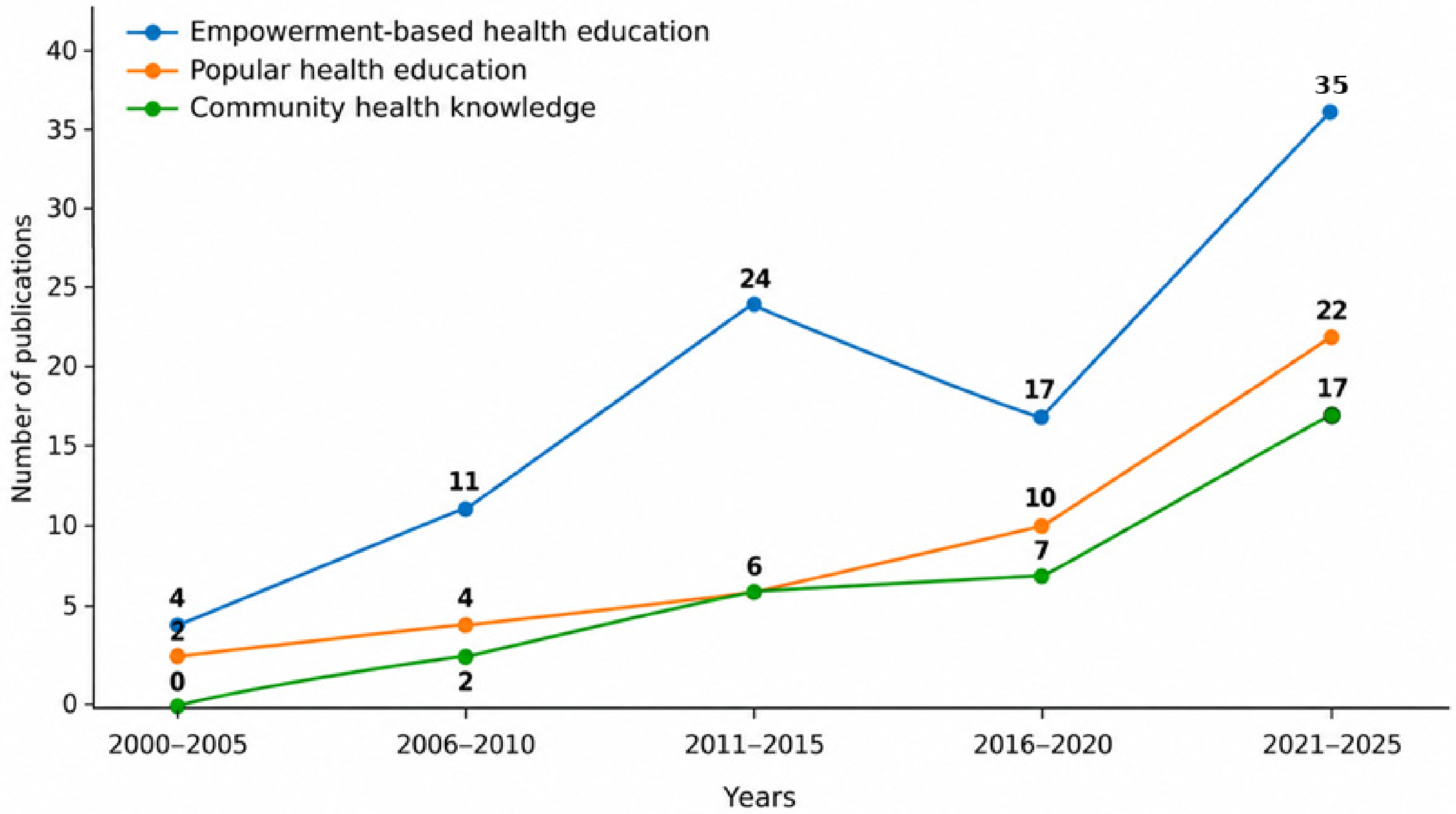
Figure 2 shows the temporal distribution of publications across the three terms. Counts were generally higher in later years, with differences in publication volume and temporal patterns across expressions. Because counts were not normalized to overall PubMed output, increases may partly reflect broader growth in scientific publishing. These patterns describe the retrieved corpus and do not establish changes in academic interest, research development, or the relative prevalence of the terms in biomedical literature.
Figure 2.
Temporal distribution of publications using the three terms, including conceptual and descriptive or incidental uses (n = 167). The first interval covers 2000–2005, followed by five-year intervals.
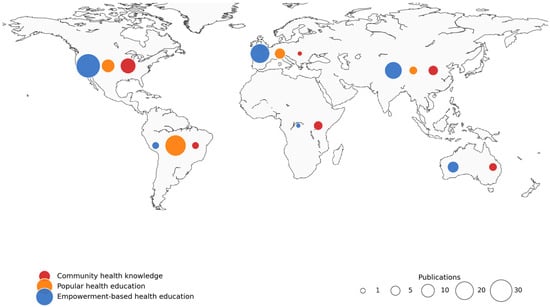
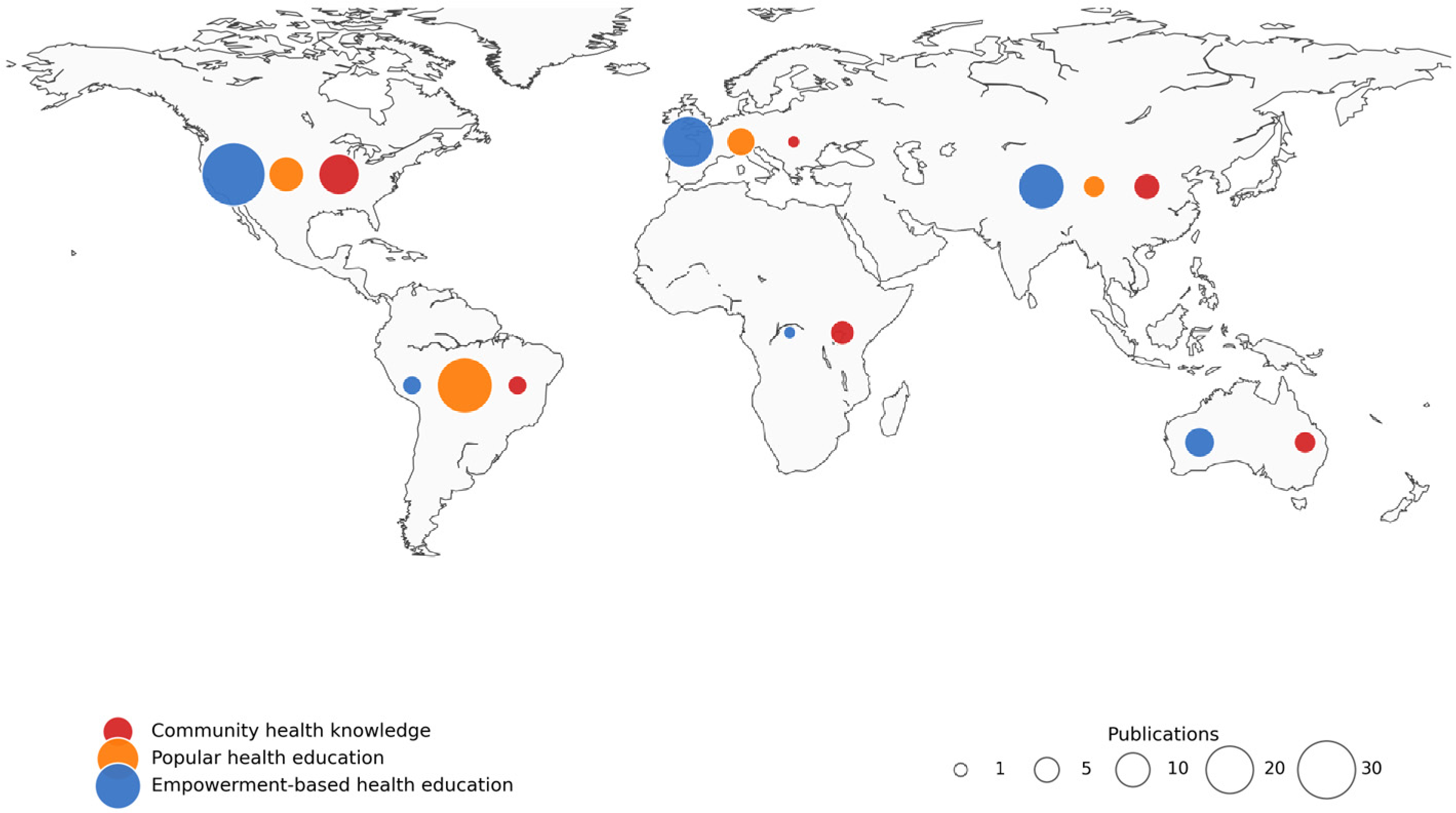
Figure 3 summarizes the country information recorded in Table S1. Brazil accounted for 22 of 44 popular health education publications (50.0%), whereas the other expressions covered a broader range of countries. Some publications listed multiple countries. These entries do not constitute a verified classification of study settings or first-author affiliations. Table S2 provides country and territory counts.
Figure 3.
Regional distribution of publications by expression across six continents. Publications associated with multiple countries or territories were counted in each corresponding region, so regional totals may exceed the number of unique publications. Bubble sizes indicate publication counts; positions are approximate.
Table 2 presents the methodological composition of the full corpus of 167 publications. Quantitative studies were the largest category overall, accounting for 79 publications (47.3%), followed by qualitative and historical studies (n = 43; 25.7%), reviews (n = 40; 24.0%), and mixed-methods studies (n = 5; 3.0%). Quantitative studies accounted for 13 of the 32 community health knowledge publications (40.6%) and 51 of the 91 empowerment-based health education publications (56.0%). Within popular health education, qualitative and historical studies constituted the largest grouped category (17/44; 38.6%), followed by quantitative studies (15/44; 34.1%) and reviews (12/44; 27.3%).
Table 2.
Methodological design of the studies included in this review.
Of the 167 publications, 103 (61.7%) used an expression as a named approach or construct, whereas 64 (38.3%) used it descriptively or incidentally. The proportion classified as conceptual differed across expressions: 85/91 (93.4%) for empowerment-based health education, 15/44 (34.1%) for popular health education, and 3/32 (9.4%) for community health knowledge. Table 3 summarizes these distributions, and Table S1 reports the classification of each publication. These proportions describe how the retrieved wording functions within publications and are sensitive to differences in phrase structure and polysemy. They should not be interpreted as substantive differences between the educational or knowledge traditions associated with the expressions.
Table 3.
Classification of expression use in the terminology-mapping corpus.
Table 1 summarizes the conceptual characteristics of the 103 publications classified as explicitly using one of the three terms as a named approach or construct. This analysis focuses on studies in which the terminology was associated with an identifiable conceptual framework, educational approach, or research perspective, rather than being used only in a descriptive context. The conceptual subsets differed substantially in size, comprising 85 publications on empowerment-based health education, 15 on popular health education, and three on community health knowledge. The findings describe the characteristics of the selected publications without implying that the three approaches are equally represented in the literature.
4. Discussion
This scoping review mapped 168 publications using three selected expressions and distinguished 103 publications with conceptual uses from 65 with descriptive or incidental uses. Empowerment-based health education was the most frequently represented expression in the selected corpus. The narrative overview identified reported characteristics such as self-management, dialogue, community knowledge, and collective action across different applications. These findings describe terminology and conceptual features. They do not establish that one expression is more closely aligned with participatory principles than another.
The representation of empowerment-based health education can be considered in the context of the importance of empowerment in health promotion since the Ottawa Charter [21]. Clinical education and chronic disease self-management were prominent applications in the charted material, with diabetes education and glycemic control alone accounting for 28 of the 92 empowerment-based health education publications (30.4%), including 27 of the 85 conceptual publications (31.8%). This emphasis is consistent with the patient-empowerment model developed by Funnell and Anderson in diabetes education [17,18]. However, the conceptual subset also included school-based and community-empowerment applications. Empowerment-based education therefore encompassed both individual and collective processes, whose participatory characteristics require examination within each source.
The distinction between conceptual and descriptive uses was particularly consequential for community health knowledge. Although the broad mapping included professional education, knowledge surveys, and contextual references, its three conceptual publications addressed Indigenous knowledge mobilization, experiential interpretations of healthcare, and local health traditions [29,30,31]. Findings from the broader corpus should therefore not be used to characterize this small conceptual subset. The distinction between setting and agency remains useful: an activity can occur in a community without assigning community members influence over knowledge production or decisions. However, this distinction does not justify describing community health knowledge itself as inherently professional or top-down.
Popular health education publications described dialogue, recognition of local knowledge, and collective educational processes, consistent with the Freirean tradition [15,16]. A participatory educational intervention involving rural caregivers in Colombia illustrates these characteristics [32]. However, these reported characteristics should not be interpreted as evidence of stronger participatory alignment than the other expressions. The publications differed in purpose, context, and reporting, and some discussed policies or theoretical frameworks without evaluating participatory practice. Community decision-making authority therefore requires examination within each source rather than inference from terminology.
Empowerment-based applications also included a school intervention developed through shared decision-making with adolescents [33] and a community-empowerment HIV prevention intervention in Tanzania [34]. These examples extend the interpretation of empowerment beyond individual self-management to include collaboration, peer education, and collective action. They also illustrate why the participatory characteristics of an intervention should be examined through the roles and decision-making opportunities described in each publication, rather than inferred from its terminology alone.
Conceptual overlap was also apparent within publications grouped under empowerment-based health education. In addition, these applications crossed theoretical traditions. Barros et al. used Freirean Culture Circles to develop a theoretical structure for youth health empowerment [35], while Spencer et al. evaluated a community health worker intervention developed through a CBPR partnership [36]. These examples show that classification under one expression does not imply an exclusive theoretical lineage or the absence of characteristics associated with other participatory traditions.
Arnstein’s distinction between forms of involvement and degrees of citizen power remains relevant to this interpretive caution [37]. Likewise, participatory partnership literature emphasizes relationships, shared responsibilities, and the processes through which knowledge and decisions are negotiated [2,5,38]. These references provide conceptual background; they do not establish that the publications in this review achieved particular levels of community authority.
The methodological distributions describe the broad mapping corpus rather than the conceptual subsets alone. Differences in study design may help contextualize the questions and outcomes addressed, but they do not establish the depth of participation. Quantitative, qualitative, historical, and mixed-methods approaches can examine different aspects of knowledge, agency, and professional–community relationships [4,5,23]. Design labels should therefore be interpreted alongside the procedures and roles reported in each source.
Geographic associations were recorded across 29 countries or territories for empowerment-based health education and 20 for community health knowledge. The United States was the most frequently recorded country in both groups, appearing in 31 of 92 empowerment-based health education publications (33.7%) and 12 of 32 community health knowledge publications (37.5%). These counts describe the charted geographic information rather than verified study settings or first-author affiliations.
Popular health education was frequently associated with South American countries in the charted material, particularly Brazil, which appeared in 22 of the 44 publications (50.0%). This pattern may reflect the historical influence of Freirean pedagogy and its institutionalization through initiatives such as Brazil’s National Policy on Popular Education in Health [39]. However, the English-language and PubMed-only scope limits interpretation of this geographic distribution. Comparable practices may also be described using different terminology in other contexts.
The geographic findings are also conditioned by the information recorded during charting. Country entries were not uniformly verified as first-author affiliations or study settings, and some publications listed countries in different regions. The map therefore represents regional associations in the charted information rather than the global distribution of participatory practice.
4.1. Implications for Research, Practice, and Scientific Indexing
The findings of this study have conceptual implications for public health research, clinical practice, and evidence synthesis. Terminological diversity is not inherently problematic; different terms legitimately reflect distinct historical roots, theoretical frameworks, and intervention goals. The problem arises when terms are treated as synonyms, potentially obscuring whether an intervention actually alters professional–community power dynamics. To advance conceptual precision, researchers must explicitly define how participation, empowerment, and community knowledge are operationalized in their work, rather than relying on broad terminology as a proxy for participation.
For evidence synthesis, three questions should be distinguished: whether an expression occurs in a source, whether it identifies an approach or construct, and whether the source reports participatory processes. Terminology counts address the first question, contextual classification addresses the second, and examination of knowledge contributions and decision-making arrangements is needed for the third. Treating these questions as equivalent risks attributing participatory characteristics to sources containing only incidental wording.
The differences in conceptual proportions likely reflect, to a substantial extent, phrase structure and polysemy, although their contribution was not quantified. ‘Empowerment-based health education’ is grammatically formulated as an approach label, whereas ‘popular’ may describe a resource as widely used or liked, and ‘community health knowledge’ may refer generically to knowledge about community health. These proportions should therefore not be interpreted as substantive properties of the associated traditions. This finding highlights a methodological challenge for terminology research: exact-phrase retrieval does not ensure that expressions function as equivalent conceptual labels.
These distinctions also have implications for literature retrieval. Standardized systems, such as Medical Subject Headings (MeSH) and the Unified Medical Language System (UMLS), support the organization and retrieval of biomedical literature [40,41,42]. Search strategies also require subject expertise and careful consideration of related terminology. However, the participatory concepts discussed in this review should not be assumed to be fully captured by any single descriptor. Phrase-based searches may miss relevant publications using different terminology, and retrieval counts alone cannot establish how extensively a participatory practice is used. Future searches could combine free-text expressions with relevant controlled vocabulary, including the MeSH descriptors “Community Participation” and “Community-Based Participatory Research”. These descriptors are suggested for broader searches and were not explicitly entered in the search conducted for this review. Multilingual terms and regional databases would also help capture literature published within different linguistic and intellectual traditions.
For practice and reporting, naming an educational framework should be accompanied by a description of who identifies needs, contributes knowledge, makes decisions, and evaluates the work. Such descriptions would help readers distinguish consultation, individual goal-setting, collaborative education, and shared community authority without assuming that these arrangements follow automatically from a particular expression.
4.2. Limitations
Several limitations must be acknowledged. First, the review examined only three expressions in English-language, PubMed-indexed publications, limiting coverage of related terminology and other linguistic and geographic contexts [43,44,45]. The specific wording of the selected expressions may have influenced retrieval. In particular, searching for “popular health education” may have missed publications using the alternative formulation “popular education in health”. In addition, excluding regional databases such as LILACS and SciELO may have particularly affected popular health education. Geographic patterns therefore describe the retrieved corpus rather than global adoption. Second, interpretation may reflect the authors’ familiarity with Brazilian popular education. No systematic assessment of participatory alignment was performed, and the conceptual subsets differed substantially in size. The findings therefore do not support a ranking of participatory alignment. Third, the absence of a registered protocol and documented deduplication procedure limits reconstruction of methodological decisions. The absence of repeated DOIs does not establish the absence of overlapping retrievals. Fourth, no critical appraisal was undertaken, and funding sources of included publications were not systematically charted. Fifth, the inclusion of both primary studies and reviews may have resulted in overlapping evidence, potentially increasing publication counts associated with certain topics, such as diabetes-related empowerment. These counts should therefore be interpreted as the number of publications addressing each topic rather than as independent sources of evidence. Finally, publication counts were not normalized to annual PubMed output, and the unequal temporal intervals limit interpretation of changes over time. The small number of publications in some periods, particularly for community health knowledge, limits the interpretation of temporal variations.
5. Conclusions
This scoping review mapped 168 publications, of which 103 used the selected expressions as named approaches or constructs and 65 used them descriptively or incidentally. Empowerment-based health education was the most frequently represented expression within the selected corpus. The conceptual publications described overlapping characteristics, including self-management, dialogue, community knowledge, and collective action, with differences in context and application. These findings do not establish a ranking of participatory alignment. Researchers should define their terminology and report whose knowledge informs an initiative and how participants influence decisions, rather than treating an expression as evidence of participation.
Supplementary Materials
The following supporting information can be downloaded at https://www.mdpi.com/article/10.3390/tph1030022/s1, Table S1: Characteristics and classification of expression use for the 167 publications included in the terminology-mapping corpus; Table S2: Distribution of included publications by country or territory and terminology (n = 167); Table S3: Preferred Reporting Items for Systematic reviews and Meta-Analyses extension for Scoping Reviews (PRISMA-ScR) Checklist.
Author Contributions
Conceptualization, S.S.P.C.F., A.N.d.O., S.R.M.B., G.H.G. and G.C.; methodology, S.S.P.C.F. and G.C.; formal analysis, S.S.P.C.F., A.N.d.O. and G.C.; investigation, S.S.P.C.F., S.R.M.B., G.H.G. and G.C.; data curation, S.R.M.B. and G.C.; writing—original draft preparation, S.S.P.C.F., S.R.M.B. and G.C.; writing—review and editing, A.N.d.O., G.H.G. and G.C. The authors were responsible for the study design, data collection, analysis, interpretation, and final scientific content. All authors have read and agreed to the published version of the manuscript.
Funding
This work was supported by the Scientific Foundation of Mato Grosso do Sul (FUNDECT; Grant No. 119/2024, SIAFIC: 814), National Council for Scientific and Technological Development (CNPq grant # 449059/2025-1), Coordination for the Improvement of Higher Education Personnel (CAPES; Finance Code 001), and the Federal University of Mato Grosso do Sul.
Institutional Review Board Statement
Not applicable.
Informed Consent Statement
Not applicable.
Data Availability Statement
The original contributions presented in this study are included in the article and Supplementary Materials. Further inquiries can be directed to the corresponding author.
Acknowledgments
We acknowledge the Coordination for the Improvement of Higher Education Personnel (CAPES), which provided scholarships to S.S.P.C.F. and A.N.O. We also wish to extend our appreciation to the graduate programs “Health and Development of the Midwest Region of Brazil (Faculty of Medicine)” and “Movement Sciences” (Institute of Health). During manuscript revision, ChatGPT (GPT-6, OpenAI) was used to assist with language editing and preparation of proposed textual revisions. It also assisted in preparing code used to redraw Figure 1, Figure 2 and Figure 3. The authors retain full responsibility for the accuracy of all references, the classification of publications, the information reported in Tables S1–S3, and the final scientific content of the manuscript.
Conflicts of Interest
The authors declare no conflicts of interest.
References
- Israel, B.A.; Schulz, A.J.; Becker, A.B.; Reyes, C.L.; Parker, E.A.; Reyes, A.G. Community-Based Participatory Research: Evolution and Significant Developments. Annu. Rev. Public Health 2026, 47, 135–157. [Google Scholar] [CrossRef] [Scilit]
- Israel, B.A.; Schulz, A.J.; Parker, E.A.; Becker, A.B. Review of community-based research: Assessing partnership approaches to improve public health. Annu. Rev. Public Health 1998, 19, 173–202. [Google Scholar] [CrossRef] [Scilit]
- Eftekhari, M.B.; Falahat, K.; Dejman, M.; Forouzan, A.S.; Afzali, H.M.; Heydari, N.; Mirabzadeh, A. The main advantages of community based participatory health programs: An experience from the Islamic Republic of Iran. Glob. J. Health Sci. 2013, 5, 28–33. [Google Scholar] [CrossRef] [Scilit]
- Cargo, M.; Mercer, S.L. The value and challenges of participatory research: Strengthening its practice. Annu. Rev. Public Health 2008, 29, 325–350. [Google Scholar] [CrossRef] [Scilit]
- Wallerstein, N.; Duran, B. Community-based participatory research contributions to intervention research: The intersection of science and practice to improve health equity. Am. J. Public Health 2010, 100, S40–S46. [Google Scholar] [CrossRef] [Scilit]
- O’Mara-Eves, A.; Brunton, G.; Oliver, S.; Kavanagh, J.; Jamal, F.; Thomas, J. The effectiveness of community engagement in public health interventions for disadvantaged groups: A meta-analysis. BMC Public Health 2015, 15, 129. [Google Scholar] [CrossRef] [Scilit]
- Carrera, J.S.; Watkins, P.C.; Bailey, R.S.; Wiggins, P.R.; Sullivan, L.; Mays, M.; Key, K. Flint Community Science Leadership: Co-Production of Knowledge around Environmental and Public Health Action. Sci. Cult. 2025, 34, 52–72. [Google Scholar] [CrossRef] [Scilit]
- Tritter, J.Q.; McCallum, A. The snakes and ladders of user involvement: Moving beyond Arnstein. Health Policy 2006, 76, 156–168. [Google Scholar] [CrossRef] [Scilit]
- Cornwall, A. Unpacking ‘Participation’: Models, meanings and practices. Community Dev. J. 2008, 43, 269–283. [Google Scholar] [CrossRef] [Scilit]
- Goodman, R.A.; Bunnell, R.; Posner, S.F. What is “community health”? Examining the meaning of an evolving field in public health. Prev. Med. 2014, 67, S58–S61. [Google Scholar] [CrossRef] [Scilit]
- Synnevåg, E.S.; Amdam, R.; Fosse, E. Public health terminology: Hindrance to a Health in All Policies approach? Scand. J. Public Health 2018, 46, 68–73. [Google Scholar] [CrossRef] [Scilit]
- Khorrami, F.; Ahmadi, M.; Sheikhtaheri, A. Standardization of Health Terminology Systems and the Roles of Responsible Organizations. Iran. J. Public Health 2018, 47, 1613–1614. [Google Scholar]
- Alpi, K.M. Expert searching in public health. J. Med. Libr. Assoc. 2005, 93, 97–103. [Google Scholar]
- Chute, C.G. Clinical classification and terminology: Some history and current observations. J. Am. Med. Inform. Assoc. 2000, 7, 298–303. [Google Scholar] [CrossRef] [Scilit]
- Brito, P.N.A.; de Santana, E.L.P.; Moraes, O.A.; da Silva, J.C.D.; Cruz, P.J.S.C. What has been discussed about Popular Health Education in recent years: A narrative review of the literature. Ciênc. Saúde Coletiva 2024, 29, e12542023. [Google Scholar] [CrossRef] [Scilit]
- Freire, P. Pedagogy of the Oppressed; Herder and Herder: New York, NY, USA, 1970. [Google Scholar]
- Funnell, M.M.; Anderson, R.M.; Arnold, M.S.; Barr, P.A.; Donnelly, M.; Johnson, P.D.; Taylor-Moon, D.; White, N.H. Empowerment: An idea whose time has come in diabetes education. Diabetes Educ. 1991, 17, 37–41. [Google Scholar] [CrossRef] [Scilit]
- Anderson, R.M.; Funnell, M.M. Patient empowerment: Myths and misconceptions. Patient Educ. Couns. 2010, 79, 277–282. [Google Scholar] [CrossRef] [Scilit]
- Zimmerman, M.A. Psychological empowerment: Issues and illustrations. Am. J. Community Psychol. 1995, 23, 581–599. [Google Scholar] [CrossRef] [Scilit]
- Wallerstein, N. What Is the Evidence on Effectiveness of Empowerment to Improve Health? WHO Regional Office for Europe: Copenhagen, Denmark, 2006. [Google Scholar]
- World Health Organization. Ottawa Charter for Health Promotion; World Health Organization: Geneva, Switzerland, 1986. [Google Scholar]
- Akerman, M.; de Castro, A.M.; Santos, C.A.; Cruz, P.J.S.C.; Rego, N.R.P.; Peres, F. Convergences between promotion of health, public health education, educommunication and health literacy. Ciênc. Saúde Coletiva 2025, 30, e05812024. [Google Scholar]
- Rifkin, S.B. Examining the links between community participation and health outcomes: A review of the literature. Health Policy Plan. 2014, 29, ii98–ii106. [Google Scholar] [CrossRef] [Scilit]
- Tricco, A.C.; Lillie, E.; Zarin, W.; O’Brien, K.K.; Colquhoun, H.; Levac, D.; Moher, D.; Peters, M.D.J.; Horsley, T.; Weeks, L.; et al. PRISMA Extension for Scoping Reviews (PRISMA-ScR): Checklist and Explanation. Ann. Intern. Med. 2018, 169, 467–473. [Google Scholar] [CrossRef] [Scilit]
- Peters, M.D.J.; Marnie, C.; Tricco, A.C.; Pollock, D.; Munn, Z.; Alexander, L.; McInerney, P.; Godfrey, C.M.; Khalil, H. Updated methodological guidance for the conduct of scoping reviews. JBI Evid. Synth. 2020, 18, 2119–2126. [Google Scholar] [CrossRef] [Scilit]
- Levac, D.; Colquhoun, H.; O’Brien, K.K. Scoping studies: Advancing the methodology. Implement. Sci. 2010, 5, 69. [Google Scholar] [CrossRef] [Scilit]
- Munn, Z.; Peters, M.D.J.; Stern, C.; Tufanaru, C.; McArthur, A.; Aromataris, E. Systematic review or scoping review? Guidance for authors when choosing between a systematic or scoping review approach. BMC Med. Res. Methodol. 2018, 18, 143. [Google Scholar]
- Lizarondo, L.; Stern, C.; Apostolo, J.; Carrier, J.; de Borges, K.; Godfrey, C.; Kirkpatrick, P.; Pollock, D.; Rieger, K.; Salmond, S.; et al. Five common pitfalls in mixed methods systematic reviews: Lessons learned. J. Clin. Epidemiol. 2022, 148, 178–183. [Google Scholar] [CrossRef] [Scilit]
- Hummel, B.; Bierstone, D.; Newhook, D.; Jetty, R.; Inuuqatigiit Centre for Inuit Children, Youth and Families. Exploring the perspectives of caregivers of urban Inuit children on child health knowledge mobilisation. Int. J. Circumpolar Health 2022, 81, 2120174. [Google Scholar]
- Paine, E.A. “Fat broken arm syndrome”: Negotiating risk, stigma, and weight bias in LGBTQ healthcare. Soc. Sci. Med. 2021, 270, 113609. [Google Scholar] [CrossRef] [Scilit]
- Mishra, A.; Nambiar, D. On the unraveling of ‘revitalization of local health traditions’ in India: An ethnographic inquiry. Int. J. Equity Health 2018, 17, 175. [Google Scholar] [CrossRef] [Scilit]
- Lombo-Caicedo, J.C.; Durán-Sabogal, R.M.; Palacio-Abello, J.D.; Lamus-Lemus, F. Intervention to strengthen caregiving capacities among rural caregivers: A replicable model. Front. Med. 2025, 12, 1613937. [Google Scholar] [CrossRef] [Scilit]
- Jonsson, L.; Fröberg, A.; Korp, P.; Larsson, C.; Berg, C.; Lindgren, E.C. Possibilities and challenges in developing and implementing an empowerment-based school-intervention in a Swedish disadvantaged community. Health Promot. Int. 2020, 35, 232–243. [Google Scholar] [CrossRef] [Scilit]
- Kerrigan, D.; Mbwambo, J.; Likindikoki, S.; Davis, W.; Mantsios, A.; Beckham, S.W.; Leddy, A.; Shembilu, C.; Mwampashi, A.; Aboud, S.; et al. Project Shikamana: Community Empowerment-Based Combination HIV Prevention Significantly Impacts HIV Incidence and Care Continuum Outcomes Among Female Sex Workers in Iringa, Tanzania. J. Acquir. Immune Defic. Syndr. 2019, 82, 141–148. [Google Scholar] [CrossRef] [Scilit]
- Barros, M.B.S.C.; Nascimento, M.M.D.S.; Rosário, H.R.V.D.; Galvão, D.M.P.G.; da Silva, R.G.M.; Soares, K.H.D.; Leandro, V.C.C.A.; Monteiro, E.M.L.M. Youth empowerment in health: A theoretical structure of literacy practices. Rev. Gauch. Enferm. 2023, 44, e20220126. [Google Scholar] [CrossRef] [Scilit]
- Spencer, M.S.; Rosland, A.M.; Kieffer, E.C.; Sinco, B.R.; Valerio, M.; Palmisano, G.; Anderson, M.; Guzman, J.R.; Heisler, M. Effectiveness of a community health worker intervention among African American and Latino adults with type 2 diabetes: A randomized controlled trial. Am. J. Public Health 2011, 101, 2253–2260. [Google Scholar] [CrossRef] [Scilit]
- Arnstein, S.R. A Ladder of Citizen Participation. J. Am. Inst. Plan. 1969, 35, 216–224. [Google Scholar] [CrossRef] [Scilit]
- Minkler, M.; Wallerstein, N. (Eds.) Community-Based Participatory Research for Health: From Process to Outcomes, 2nd ed.; Jossey-Bass: San Francisco, CA, USA, 2008. [Google Scholar]
- Ministério da Saúde. Portaria Nº 2.761, de 19 de Novembro de 2013. Institui a Política Nacional de Educação Popular em Saúde no Âmbito do Sistema Único de Saúde (PNEPS-SUS); Ministério da Saúde: Brasília, Brasil, 2013. [Google Scholar]
- Coletti, M.H.; Bleich, H.L. Medical subject headings used to search the biomedical literature. J. Am. Med. Inform. Assoc. 2001, 8, 317–323. [Google Scholar] [CrossRef] [Scilit]
- Shu, F.; Qiu, J.; Larivière, V. Mapping the biomedical sciences using Medical Subject Headings: A comparison between MeSH co-assignments and MeSH citation pairs. J. Med. Libr. Assoc. 2021, 109, 441–449. [Google Scholar] [CrossRef] [Scilit]
- Bodenreider, O. The Unified Medical Language System (UMLS): Integrating biomedical terminology. Nucleic Acids Res. 2004, 32, D267–D270. [Google Scholar] [CrossRef] [Scilit]
- Falagas, M.E.; Pitsouni, E.I.; Malietzis, G.A.; Pappas, G. Comparison of PubMed, Scopus, Web of Science, and Google Scholar: Strengths and weaknesses. FASEB J. 2008, 22, 338–342. [Google Scholar] [CrossRef] [Scilit]
- Tardy, C. The role of English in scientific communication: Lingua franca or Tyrannosaurus rex? J. Engl. Acad. Purp. 2004, 3, 247–269. [Google Scholar] [CrossRef] [Scilit]
- Amano, T.; González-Varo, J.P.; Sutherland, W.J. Languages are still a major barrier to global science. PLoS Biol. 2016, 14, e2000933. [Google Scholar] [CrossRef] [Scilit]

Disclaimer/Publisher’s Note: The statements, opinions and data contained in all publications are solely those of the individual author(s) and contributor(s) and not of MDPI and/or the editor(s). MDPI and/or the editor(s) disclaim responsibility for any injury to people or property resulting from any ideas, methods, instructions or products referred to in the content. |
© 2026 by the authors. Licensee MDPI, Basel, Switzerland. This article is an open access article distributed under the terms and conditions of the Creative Commons Attribution (CC BY) license.