Article

Surrogate-Assisted Rezone-Enhanced Multi-Objective Adaptive Evolutionary Algorithm for Truck–UAV Collaborative Delivery Route Optimization

1
School of Intelligent Connected Vehicles, Hubei University of Automotive Technology, Shiyan 442002, China
2
School of Transportation and Logistics, Southwest Jiaotong University, Chengdu 611756, China
*
Author to whom correspondence should be addressed.
J. Superintelligence 2026, 1(1), 3; https://doi.org/10.3390/superintelligence1010003
Submission received: 26 March 2026 / Revised: 28 April 2026 / Accepted: 29 May 2026 / Published: 8 June 2026

Abstract

To address the challenges of combinatorial explosion and expensive evaluations in truck–drone (truck–UAV) collaborative delivery under complex geographical constraints, this paper proposes a Surrogate-assisted Rezone-Enhanced Multi-objective Adaptive Evolutionary Algorithm (SRE-MAEA). As a knowledge-driven decomposition-based surrogate-assisted framework, the proposed algorithm aims to synergistically optimize a four-dimensional conflicting objective space consisting of economic cost, social satisfaction, environmental emissions, and battery resilience. To overcome the curse of dimensionality in high-dimensional and strongly constrained environments, SRE-MAEA constructs an adaptive Rezone Search architecture. By dynamically deconstructing the decision space, it transforms global search pressure into refined knowledge mining within high-potential local regions. The core mechanism incorporates an intelligent sampling strategy based on the Multi-Armed Bandit (MAB). By utilizing real-time evolutionary feedback to dynamically prioritize the Pareto contribution of each rezone, the MAB achieves pruning-level scheduling of expensive evaluation resources. Simulation results on 15 benchmark instances with clustered, random, and mixed spatial distributions demonstrate that SRE-MAEA exhibits superior convergence boundaries and distribution uniformity in terms of IGD and HV metrics, significantly outperforming state-of-the-art regression-based strategies. Furthermore, computational efficiency analysis confirms that by precisely identifying invalid search paths via the MAB mechanism, SRE-MAEA maintains a high-precision Pareto front while reducing the average CPU time by approximately 35.2–48.5%. This effectively resolves the computational bottleneck caused by complex battery resilience integral models. This research provides an efficient algorithmic paradigm for resilient logistics scheduling in extreme environments and holds significant academic value and engineering application prospects.

1. Introduction

The rapid expansion of global e-commerce and shifting consumer behaviors have positioned last-mile delivery as the most cost-intensive and complex segment of modern logistics, accounting for 30% to 50% of total supply chain costs [1,2]. Despite its prevalence, the conventional truck-only delivery paradigm faces increasing limitations in meeting contemporary urban demands [3]. Specifically, severe urban traffic congestion and intricate street networks significantly impede vehicular efficiency, leading to unpredictable delivery delays [4]. From an environmental perspective, the frequent stop-and-go cycles and fluctuating load rates of trucks result in excessive greenhouse gas emissions, contradicting global double carbon goals and green logistics initiatives [5]. Furthermore, the inherent vulnerability of road-dependent networks becomes critical during extreme scenarios, such as natural disasters or public health emergencies [6]. Consequently, there is an urgent need to develop a more resilient and flexible delivery paradigm to enhance operational efficiency and sustainability. Recent comprehensive reviews have highlighted the expanding scope of drone scheduling problems, emphasizing the transition from simple path planning to complex multi-dimensional optimization under real-world constraints [7].
To address these bottlenecks, the truck–UAV coordinated delivery model has emerged as a promising paradigm in smart logistics [8]. This approach leverages the complementary strengths of both carriers: the truck functions as a mobile depot providing high payload capacity, long-range endurance, and replenishment support, while the UAV offers superior maneuverability and cost-effective aerial operations that bypass ground-level constraints [9]. In an integrated operational workflow, the truck deploys UAVs at strategic launch points or during transit to execute last-mile tasks, subsequently recovering them at designated locations for battery swapping or cargo reloading. Such synchronized air–ground operations not only minimize the truck’s travel distance and associated operational costs but also significantly enhance delivery throughput via spatial-temporal parallelism. Consequently, this hybrid system enables efficient service coverage in geographically challenging environments—such as aquatic areas, mountainous regions, and congested urban centers—where traditional terrestrial methods often fail [10].
Despite its potential, transitioning the truck–UAV coordinated model from theoretical frameworks to practical engineering applications presents significant computational challenges [11]. First, under complex geographical constraints, the decision space for delivery routing expands exponentially with the number of customer nodes. This combinatorial explosion renders the search for global optima extremely difficult. Second, modern logistics decision-making has evolved into a multi-objective optimization problem (MOP) characterized by conflicting dimensions, including economic efficiency, service quality (e.g., perceived timeliness), environmental impact (carbon emissions), and hardware reliability (e.g., battery resilience) [12]. Most critically, high-fidelity evaluations of energy consumption and battery dynamics often involve intensive spatiotemporal integrations [13]. Within the iterative process of evolutionary algorithms, these computationally expensive evaluations impose a severe bottleneck. Existing heuristic algorithms frequently struggle with such Expensive Multi-objective Optimization Problems (EMaOPs); due to inefficient search mechanisms and suboptimal resource allocation, they often fail to produce a high-quality Pareto front that balances accuracy and solution diversity within a limited secondary computational budget [14].
Consequently, developing an intelligent optimization framework—one capable of modeling complex physical constraints, optimizing computational resource allocation, and accurately identifying multi-objective trade-offs while ensuring system resilience—has become a pivotal scientific challenge in smart transportation and operations research [15]. Driven by these practical demands and theoretical gaps, this study proposes a knowledge-driven efficient evolutionary strategy. By integrating domain-specific knowledge with advanced surrogate modeling, the proposed framework aims to provide robust decision support for coordinated delivery scheduling in complex dynamic environments, ultimately achieving a balance between solution quality and computational efficiency [16].
Based on the identified research gaps, the primary objective of this study is to develop a high-efficiency optimization framework for the truck–UAV collaborative delivery problem under complex geographical constraints. Specifically, this research aims to achieve the following:
  • To establish a comprehensive multi-objective model that simultaneously addresses economic efficiency, environmental sustainability, customer service levels, and technical battery resilience;
  • To design a knowledge-driven “Rezone Search” mechanism that alleviates the curse of dimensionality by deconstructing the global search space into manageable, high-potential sub-regions;
  • To implement an intelligent sampling strategy to significantly reduce the computational overhead associated with expensive objective evaluations without compromising solution quality.
To achieve these objectives, this paper proposes a Surrogate-assisted Rezone-Enhanced Multi-objective Adaptive Evolutionary Algorithm (SRE-MAEA). The novelty and major contributions of this work are summarized as follows:
  • Development of an Adaptive Rezone Search Architecture: Drawing on spatial clustering and knowledge discovery, this architecture dynamically reconstructs the complex global routing space into multiple high-potential sub-regions. By performing fine-grained exploration within these partitions, the framework effectively mitigates the “curse of dimensionality” in coordinated delivery and enhances the algorithm’s adaptability to complex geographic topologies.
  • Introduction of a Multi-Armed Bandit (MAB)-based Intelligent Scheduling Strategy: An innovative MAB mechanism is integrated into the management of computational resources. By perceiving evolutionary feedback from various search partitions in real time, the strategy dynamically adjusts evaluation priorities, enabling the on-demand scheduling of expensive battery resilience constraint assessments. Empirical results demonstrate that this mechanism significantly reduces redundant computational overhead.
  • Synergistic Optimization of Four-dimensional Conflicting Objectives: Beyond traditional economic and environmental metrics, this study incorporates a battery resilience indicator tailored for extreme environments. Utilizing the SRE-MAEA framework, we characterize the intricate trade-offs between cost, service quality, emissions, and resilience, providing decision-makers with more robust and scientifically grounded routing solutions.
Despite these advancements, a significant research gap remains in the collaborative routing of truck–UAV systems. Existing studies often struggle with the “curse of dimensionality” as the number of customer nodes and environmental constraints increases, leading to prohibited computational overhead. Specifically, traditional SAEAs frequently treat the decision space as a monolithic entity, failing to exploit the spatial heterogeneities inherent in complex logistics networks. Furthermore, while multi-objective optimization is common, few frameworks effectively integrate expensive resilience evaluations with adaptive knowledge-driven mechanisms to balance local refinement and global exploration. This lack of a deconstructed search architecture capable of mining high-potential local knowledge under expensive evaluation settings limits the practical engineering applicability of current routing models.
To bridge the gap between algorithmic design and industrial requirements, it is essential to specify the real-world applicability of the proposed SRE-MAEA framework. The model is particularly designed for three high-impact logistics scenarios:
  • Rural and Remote Area Delivery: In regions with underdeveloped road networks or rugged terrain, the SRE-MAEA enables trucks to serve as mobile hubs while UAVs navigate complex geographical barriers to reach isolated customers.
  • Time-Sensitive Emergency Medical Logistics: Given the framework’s focus on ’battery resilience’, it is highly applicable for transporting urgent medical supplies (e.g., vaccines or blood) where energy stability in extreme environments is a prerequisite for mission success.
  • Carbon-Constrained Urban Green Delivery: For logistics companies operating under strict emission regulations, the multi-objective optimization of this model provides a strategic tool to balance delivery speed with carbon footprint reduction.
By addressing these specific situations, the proposed study transitions from a theoretical optimization problem to a practical decision-support tool for modern smart logistics.
The remainder of this paper is organized as follows. Section 2 provides a comprehensive review of the background knowledge and relevant literature. Section 3 formally defines the coordinated delivery problem under complex geographical constraints and establishes the four-dimensional multi-objective optimization model. Section 4 elaborates on the technical framework of the proposed SRE-MAEA algorithm, detailing the rezone-enhanced mechanism and the MAB-based intelligent scheduling strategy. In Section 5, the performance of the algorithm is rigorously validated through experimental analysis across 15 representative instances. Finally, Section 6 concludes the paper and discusses potential avenues for future research.

2. Literature Review

In recent years, the rapid advancement of UAV technology has established truck–UAV coordinated delivery as a prominent research frontier in smart logistics. A seminal contribution was made by Murray and Chu in 2015, who introduced the Traveling Salesman Problem with Drone (TSP-D) [17]. This work was the first to formalize a fundamental framework for joint truck–UAV distribution from a collaborative optimization perspective, providing a critical theoretical foundation for subsequent studies. Building upon this baseline, extensive research has since expanded the problem variants to accommodate increasingly complex and realistic operational scenarios.
The existing literature can be categorized into economic-oriented and efficiency-oriented streams. Studies by Murray and Chu [17] and Kuo et al. [18] established the foundational cost-minimization logic. However, a critical evaluation reveals that these models often prioritize financial metrics while neglecting the intricate trade-offs between environmental impact and system reliability. For instance, while cost-centric frameworks [19,20] provide clear economic indicators, they seldom account for the stochastic nature of UAV energy consumption in extreme environments—a gap that leads to “brittle” solutions that may fail under real-world perturbations. While the aforementioned cost-centric models provide a clear financial perspective on routing optimization, they often prioritize static economic indicators over the dynamic operational needs of modern logistics. Critically, a shift in research focus became necessary as scholars recognized that minimizing costs could inadvertently compromise delivery timeliness. Consequently, a parallel stream of research emerged to balance financial expenditure with system throughput and temporal efficiency. Similarly, although efficiency-focused models [21,22] significantly improve throughput, the inherent conflict between high-speed delivery and battery longevity (resilience) remains insufficiently explored in their objective formulations [23,24].
As these optimization models evolved to incorporate increasingly realistic constraints, such as dynamic docking and temporal windows, they simultaneously reached the performance limits of traditional exact solvers [25,26]. The resulting exponential growth in computational complexity created a methodological bottleneck, shifting the academic trajectory toward the development of more flexible (meta-)heuristic frameworks capable of navigating these expanded search landscapes [27].
Regarding solution methodologies, while heuristic approaches like Ant Colony Optimization [28] and Simulated Annealing [29] offer practical runtimes, they encounter a common “scalability bottleneck” when the decision space expands. Most existing meta-heuristics treat the routing space as a homogeneous entity, leading to redundant search efforts in low-potential regions. However, an analytical review of these meta-heuristics reveals a shared ’scalability deficit.’ Most traditional operators treat the decision space as a monolithic entity, which leads to redundant search efforts in low-potential regions. Furthermore, they typically lack the ’spatial intelligence’ required to deconstruct high-dimensional problems, making them inefficient when high-fidelity objective evaluations—such as the battery resilience simulations investigated in this study—are required. Critically, these methods lack the capacity for “knowledge-driven decomposition”, which is essential for managing the high-dimensional complexity of multi-truck multi-UAV systems. Furthermore, although exact methods [30] provide theoretical optimality, their exponential computational growth makes them unsuitable for scenarios involving high-fidelity, expensive objective evaluations. Consequently, there is a distinct lack of frameworks that can synergistically integrate spatial intelligence with surrogate-assisted evaluation to handle both the “curse of dimensionality” and the “computational cost” simultaneously [31,32,33].
Despite significant progress in cost reduction and efficiency enhancement, existing studies exhibit several critical limitations. First, most research focuses on single-objective optimization (e.g., minimizing total cost or makespan) or employs weighted-sum methods to simplify multi-objective problems [34,35]. Such approaches fail to fully characterize the intricate trade-offs and conflicting relationships among multiple dimensions inherent in real-world logistics systems. Second, prevailing models often neglect qualitative factors such as customer satisfaction and service reliability, both of which are pivotal for bolstering corporate competitiveness. For instance, a narrow focus on minimizing delivery time may compromise system robustness or lead to imbalanced resource utilization. Consequently, incorporating metrics that reflect service quality—such as temporal reliability [36]—is essential for achieving a sustainable equilibrium between operational costs and high-level service requirements.
From an optimization perspective, as the problem incorporates multi-objective formulations, high-dimensional constraints, and complex physical dynamics (e.g., battery performance constraints), conventional methodologies frequently encounter search space explosion and computational inefficiency. This becomes particularly acute when high-fidelity evaluation functions are involved, where frequent function calls impose a prohibitive computational burden during the iterative process. Although some studies have integrated surrogate models to mitigate these costs, most existing approaches rely on static regression strategies that lack the capacity for dynamic guidance during the search process. Consequently, these methods struggle to effectively identify high-potential regions or adaptively allocate limited computational resources across the evolving population.
To address these research gaps, there is an urgent need for an optimization framework capable of simultaneously balancing multi-objective trade-offs, high-dimensional search efficiency, and the management of expensive evaluation costs. In response, this paper proposes a SRE-MAEA algorithm. By integrating an adaptive Rezone Search mechanism with a MAB-driven resource allocation strategy, the proposed framework achieves efficient exploration and fine-grained exploitation within complex decision spaces. This study aims to provide a computationally efficient and practically viable solution for the coordinated truck–UAV delivery problem, bridging the gap between theoretical optimization and real-world logistics requirements.
Recent systematic reviews have highlighted a paradigm shift in UAV scheduling and path planning research. As noted by Pasha et al. [37], drone scheduling has evolved from basic routing to complex multi-dimensional optimization that incorporates battery capacity and real-time arrival constraints. However, the categorization of UAVs remains non-unified, with classifications varying based on weight, endurance, and flight mechanisms [7].
In terms of operational safety, Asghari et al. [7] emphasized that safety assessment should transition from simple collision avoidance to comprehensive reliability metrics, particularly energy reliability in Beyond Line-of-Sight (BLOS) operations. Furthermore, Meng et al. [38] identified that addressing multi-level constraints (e.g., dynamic environments and heterogenous systems) through surrogate-assisted and knowledge-driven frameworks is a critical SOTA trend for 2025 and beyond. Our study aligns with these frontiers by integrating battery resilience as a core safety-related objective and employing an adaptive Rezone Search to mitigate the “curse of dimensionality” inherent in large-scale UTM (UAS Traffic Management) scenarios [7,38].
In summary, a critical evaluation of the existing literature reveals three primary limitations that hinder the practical deployment of truck–UAV coordination models. First, most current methodologies exhibit a “homogeneity bias”, treating the expansive decision space as a uniform entity. This lack of spatial deconstruction prevents the algorithms from performing refined exploration in high-potential local regions, leading to the “curse of dimensionality” in large-scale scenarios. Second, there is a prominent “evaluation gap”; prior research predominantly assumes computationally inexpensive objective functions, failing to address the substantial overhead incurred by high-fidelity simulations like battery resilience and environmental uncertainty. Third, the existing meta-heuristics often lack “knowledge-driven adaptability”, relying on stochastic operators rather than evolutionary feedback to navigate complex, non-convex constraint landscapes. These identified gaps necessitate a more sophisticated framework that can synergistically integrate spatial intelligence with efficient surrogate-assisted evaluation.

3. Mathematical Modeling

3.1. Problem Description

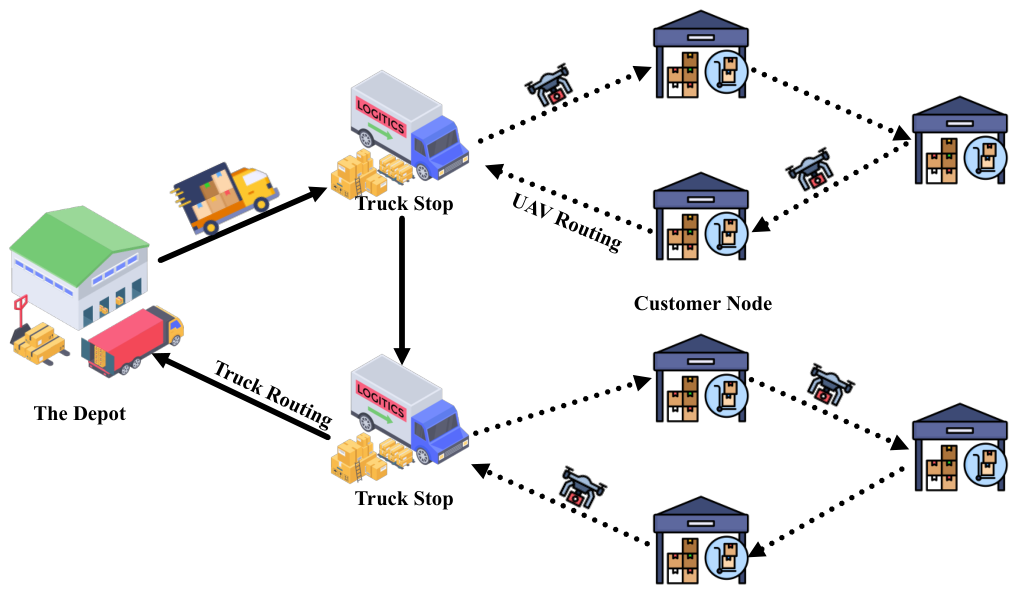
The multi-objective routing optimization problem for truck–UAV coordinated delivery investigated in this study aims to construct a complex logistics system that integrates economic efficiency, service perception, environmental sustainability, and technical resilience within the context of the low-altitude economy. The system comprises a truck equipped with multiple landing platforms and a fleet of heterogeneous UAVs, tasked with serving customer nodes within a defined geographical area. In the operational workflow, the truck departs from a central depot carrying both parcels and UAVs. Functioning as a mobile base station, the truck deploys UAVs at designated launch points to execute last-mile delivery tasks while simultaneously proceeding to subsequent service nodes. Upon task completion, the UAVs synchronize with the truck at downstream rendezvous points, according to a predefined trajectory, for energy replenishment or cargo reloading. A schematic representation of this coordinated truck–UAV routing problem is illustrated in Figure 1.
Within the optimization of the coordinated delivery system, the economic, social, environmental, and resilience dimensions are not isolated; rather, they exhibit complex trade-offs and conflicting interdependencies. The economic dimension serves as the operational baseline, focusing on minimizing fuel costs, UAV power consumption, and equipment depreciation through route optimization. However, a singular pursuit of economic efficiency often compromises delivery timeliness, thereby adversely affecting the social dimension. The latter incorporates a customer satisfaction model based on utility theory, capturing the non-linear psychological expectations regarding UAV delivery promptness, which necessitates a strategic balance between operational costs and service quality. Simultaneously, the environmental dimension monitors carbon footprints under heterogeneous power sources, where fuel emissions from trucks and implicit emissions from UAV electricity usage are significantly influenced by real-time payloads and trajectory characteristics. A pivotal innovation of this study is the integration of a resilience dimension to reflect long-term system robustness, specifically examining UAV battery cycle life and mechanical wear. In coordinated scheduling, over-utilizing UAVs for long-distance missions to maximize satisfaction can lead to excessive depths of discharge, thereby accelerating the degradation of the State of Health (SoH) and undermining technical resilience. Consequently, the essence of this problem lies in identifying and decoupling the non-linear coupling mechanisms among these four conflicting objectives within dynamic decision boundaries to derive globally optimal scheduling solutions.
From the perspective of computational complexity, this problem is classified as a strongly NP-hard combinatorial optimization problem characterized by intricate time windows and multiple resource constraints. During the modeling and solution process, the system must operate within a rigorous spatiotemporal synchronization framework. First, synchronization constraints dictate that UAVs must complete the “launch-delivery-rendezvous” closed-loop cycle within limited power endurance boundaries; any suboptimal decision regarding rendezvous points may lead to mission failure or hardware damage. Second, payload constraints require that the real-time load of both the truck and UAVs remains below rated thresholds throughout the dynamically alternating delivery chain, directly limiting the coverage and operational flexibility of individual coordinated missions. Furthermore, airspace safety and environmental dynamics constitute external hard constraints. Consequently, UAV trajectory planning must strictly adhere to low-altitude management policies, avoid no-fly zones, and comply with specific operational risk assessment metrics.
To ensure conceptual rigor, it is necessary to clarify the scope and boundaries of “resilience” as defined in this study. From an engineering and operational perspective, we define resilience as the system’s ability to maintain a high level of mission fulfillment and recovery performance in the face of energy-related perturbations (e.g., unexpected battery depletion or power fluctuations). Specifically, this study focuses on operational resilience, which is quantified by the drone’s capacity to adjust its routing and recharging strategy to prevent mission failure under constrained energy budgets. The boundaries of this definition exclude the structural/mechanical resilience of the UAV hardware or the macroeconomic resilience of the logistics supply chain. By narrowing the scope to the interplay between energy dynamics and scheduling flexibility, we provide a precise metric for evaluating the reliability of the truck–UAV system in uncertain environments.

3.2. Model Assumptions

To formalize the multi-objective scheduling logic of the coordinated truck–UAV delivery system and ensure the tractability of the optimization model, the following foundational assumptions are established:
  • Task Attributes and Spatiotemporal Constraints: The locations, demand volumes, and service time windows of all customers within the delivery area are deterministic and known a priori. Each customer is served exactly once by either the truck or a UAV, and all operations must be completed within the specified planning horizon.
  • Mobile Platform and Operational Overhead: The truck functions as a mobile launch/recovery platform and energy replenishment center. The time required for UAV battery swapping, cargo loading, and pre-flight preparation is assumed to be constant or negligible within the strategic scheduling context.
  • Kinematics and Energy Efficiency: Both the truck and UAVs maintain constant operational speeds, with instantaneous acceleration and deceleration during takeoff and landing being disregarded. The truck’s energy efficiency is load dependent, whereas the energy consumption of the UAV exhibits a non-linear coupling with both payload and flight distance.
  • Environmental Conditions and Airspace Restrictions: Meteorological conditions (e.g., wind speed and temperature) are assumed to remain stable throughout a single delivery cycle. UAVs must strictly adhere to low-altitude airspace regulations, operating within predefined legal corridors and avoiding all no-fly zones.
  • Degradation and Resilience Mechanisms: The degradation of the UAV battery SoH is assumed to be non-linearly correlated only with the Depth of Discharge (DoD) per mission. Mechanical wear of the truck is proportional to its travel distance and average operational load.
  • Communication Reliability and Decision Paradigm: The communication link between the truck and UAVs is assumed to remain reliable within the operational radius. By neglecting signal latency or interference, this study focuses exclusively on global offline optimization for multi-objective coordinated routing.

3.3. Notations and Variable Definitions

This section defines the fundamental notations used to characterize the spatiotemporal topology and economic dimensions of the coordinated truck–UAV delivery system. To maintain consistency throughout the mathematical formulation, the primary sets and indices are defined as follows in Table 1, Table 2 and Table 3:

3.4. Objective Functions

The multi-objective optimization model developed in this study is designed to quantify and balance the inherent conflicts among the economic, social, environmental, and resilience dimensions of the coordinated delivery system.
(1) Minimization of Total Delivery Cost ( F 1 )
The economic objective function, F 1 , evaluates the total resource investment required by the truck–UAV system to fulfill all delivery tasks. This objective is formulated as the weighted sum of fixed depreciation costs and energy consumption costs: min F 1 = C f i x + C e n e r g y . Specifically, the fixed depreciation cost ( C f i x ) characterizes the capital loss of equipment relative to its operational intensity. The truck’s depreciation is proportional to its travel distance, while the UAV depreciation is determined by the number of mission launches and the total operational duration:
C f i x = t T ( i , j ) A β t · d i j · x i j t + d D ( i , j , k ) R ( α d + γ d · t i j k ) · y i j k d
where β t denotes the depreciation coefficient per unit distance for the truck, d i j represents the distance between nodes i and j, and x i j t is the binary decision variable for the truck’s route. Regarding the UAV components, α d signifies the fixed wear-and-tear cost per launch–recovery cycle, γ d is the depreciation rate per unit of flight time, t i j k denotes the total duration for the UAV to complete a coordinated triplet ( i , j , k ) , and y i j k d is the corresponding route decision variable.
The energy consumption cost ( C e n e r g y ) encompasses the fuel consumption of the truck and the electricity consumption of the UAVs. To enhance the predictive accuracy of the model, payload factors are integrated into the energy functions to characterize the significant impact of dynamic loading on energy efficiency:
C e n e r g y = t T ( i , j ) A P f u e l · ρ i j t ( Q ) · d i j · x i j t + d D ( i , j , k ) R P e l e c · θ i j k d ( q ) · t i j k · y i j k d
where P f u e l and P e l e c denote the unit prices of fuel and electricity, respectively. The truck’s fuel cost is intrinsically linked to the energy efficiency curve formed by travel distance and real-time payload, whereas the UAV electricity cost depends on the operational power and mission duration. Specifically, ρ i j t ( Q ) represents the fuel consumption per unit distance for the truck under a real-time payload Q. Given the dynamic load variations of the truck serving as a mobile base station, this function is defined as ρ = ρ 0 [ 1 + λ ( Q / Q m a x ) ] , where ρ 0 is the baseline fuel consumption in an unloaded state and λ is the payload correction factor reflecting the marginal contribution of cargo weight to fuel consumption. Regarding the UAVs, θ i j k d ( q ) signifies the power consumption per unit time when carrying a payload q. In low-altitude operational environments, UAV energy consumption is governed by the interplay of gravity, aerodynamic drag, and rotor lift. Consequently, the output power exhibits a pronounced non-linear positive correlation with the instantaneous load, and the cumulative energy consumption is evaluated across the duration of each coordinated mission, t i j k .
(2) Maximization of Perceived Customer Satisfaction ( F 2 )
The social objective function, F 2 , is designed to evaluate the service quality of the logistics system in terms of meeting customer temporal requirements. Given that customer perception of delivery timing exhibits pronounced non-linearity and asymmetry, this study incorporates a psychological utility function based on time windows to quantify perceived satisfaction:
max F 2 = i N S i ( T i )
where S i ( T i ) denotes the perceived satisfaction of customer i at arrival time T i . To accurately capture the psychological expectations regarding “immediacy” in the context of low-altitude distribution, the function is defined as follows:
S i ( T i ) = 1 , T i E T i exp η T i E T i L T i E T i , E T i < T i L T i 0 , T i > L T i
Equation (4) characterizes the dynamic evolution of customer expectations. Specifically, when delivery occurs before the desired time window E T i , the customer remains in a state of full satisfaction (utility value of 1). If the delivery time exceeds E T i but remains within the maximum tolerable threshold L T i , the satisfaction level undergoes an exponential decay relative to the delay. Within the coordinated truck–UAV paradigm, the parameter η serves as a sensitivity coefficient to calibrate the varying degrees of delay tolerance among different customer segments, thereby reflecting potential perceptual differences across diverse delivery modes.
(3) Minimization of Total Multi-source Carbon Emissions ( F 3 )
The environmental objective function, F 3 , quantifies the ecological impact of the delivery system throughout its operational cycle. Given the heterogeneous power sources utilized by trucks and UAVs, this study establishes a comprehensive carbon footprint model that integrates direct emissions from fossil fuel combustion and indirect emissions associated with electricity consumption:
min F 3 = E t r u c k + E u a v
Truck Carbon Emissions ( E t r u c k ): Direct emissions originate from the internal combustion process of fossil fuels. Building upon the aforementioned load-dependent energy model, the total carbon emissions of the truck are proportional to its fuel consumption and the specific fuel emission factor:
E t r u c k = t T ( i , j ) A ξ f u e l · ρ i j t ( Q ) · d i j · x i j t
where ξ f u e l denotes the CO2 emission factor per unit volume of fuel (kg/CO2/L). Since the consumption function ρ i j t ( Q ) dynamically accounts for the real-time payload Q, the model effectively characterizes the marginal environmental pressure exerted by heavy-load transportation.
UAV Indirect Carbon Emissions ( E u a v ): Although UAVs produce zero tailpipe emissions during flight, their electricity consumption entails a carbon footprint at the power generation stage. The indirect emissions are formulated as
E u a v = d D ( i , j , k ) R ξ g r i d · θ i j k d ( q ) · t i j k · y i j k d
where ξ g r i d represents the average carbon intensity factor of the electricity grid (kg/CO2/kWh), and θ i j k d ( q ) is the real-time power consumption function. This component allows the optimization framework to evaluate the contribution of low-altitude delivery missions to the overall carbon burden of the energy grid.
(4) Minimization of System Equipment Health Degradation ( F 4 )
The resilience objective function, F 4 , is designed to mitigate the performance degradation of core delivery equipment through optimized routing decisions, thereby ensuring the long-term operational reliability of the logistics network. This model specifically accounts for the cycle life loss of UAV power batteries and the mechanical fatigue of the truck:
min F 4 = H u a v + H t r u c k
UAV Battery Cycle Life Loss ( H u a v ): For high-frequency operational equipment, the essence of UAV resilience lies in its battery SoH. Empirical studies indicate that cycle life degradation exhibits a non-linear exponential relationship with the DoD per mission; frequent deep discharges drastically accelerate electrochemical deterioration. The degradation model is formulated as
H u a v = d D ( i , j , k ) R Ω · exp σ · e i j k d B c a p 1 · y i j k d
where Ω denotes the baseline degradation coefficient, σ is the sensitivity parameter for DoD impact, and e i j k d / B c a p represents the instantaneous discharge depth. This formulation imposes a computational penalty: as energy consumption approaches the battery capacity threshold, the degradation value increases exponentially, guiding the algorithm to select more robust launch/rendezvous points to preserve battery integrity.
Truck Mechanical Lifetime Loss ( H t r u c k ): Truck resilience degradation primarily stems from mechanical fatigue and drivetrain wear caused by sustained, high-load operations. This study defines it as a cumulative function of travel distance and operational intensity:
H t r u c k = t T ( i , j ) A ω · 1 + ϕ · Q Q m a x · d i j · x i j t
where ω represents the lifetime degradation coefficient per unit distance under standard loading, and ϕ is the acceleration factor for mechanical wear under heavy-load conditions. This component enables the model to balance the interplay between travel distance and loading intensity on the long-term reliability of the vehicle.

3.5. Constraint Functions

(1) Flow Balance Constraints: Flow balance constraints are fundamental to ensuring the physical feasibility of the coordinated truck–UAV delivery scheme. By enforcing conservation of flow for delivery vehicles across the node set V, these constraints construct a closed-loop operational trajectory. It is mandated that all participating trucks t T and UAVs d D must depart from the starting depot (node 0) and ultimately converge at the terminal depot (node n + 1 ) after traversing their prescribed routes. This logic ensures the integrity of the logistics mission, formulated as follows:
j V \ { 0 } x 0 j t = 1 , i V \ { n + 1 } x i , n + 1 t = 1 , t T
j V \ { 0 , n + 1 } k V y 0 j k d = 1 , i V \ { 0 , n + 1 } j V y i j n + 1 d = 1 , d D
For any intermediate node j N within the delivery network, the conservation principle of in-degree and out-degree must be satisfied. Specifically, if a truck or UAV enters a customer site or transshipment point, a corresponding departure arc must exist directed toward the subsequent target node:
i V \ { j , n + 1 } x i j t = k V \ { 0 , j } x j k t , j N , t T
These constraints guarantee both geographical continuity and the state-transition logic inherent in the air–ground coordination. For UAVs, as their collaborative path ( i , j , k ) R encompasses three distinct stages—launch, service, and rendezvous—the flow balance further dictates that upon completing service at a specific customer node, a physical reunion with the mother truck at the predefined rendezvous node k is mandatory to achieve flow closure.
(2) Service Coverage Constraints: Service coverage constraints serve as the foundational criteria for ensuring operational efficiency and contractual fulfillment within the logistics system. These constraints enforce the mutual exclusivity and exhaustiveness of delivery tasks in the spatial dimension, stipulating that each customer node i N must be assigned to exactly one service entity. Under the coordinated truck–UAV architecture, a customer’s service request can be fulfilled through two competing modes: direct truck visitation for delivery, or end-to-end dispatch via a UAV launched from the mobile truck platform. To eliminate operational redundancy and optimize resource allocation, the model mandates a uniqueness constraint, strictly prohibiting duplicated services or omissions for any single customer site. The mathematical formulation is as follows:
t T j V \ { i , 0 } x j i t + d D ( i , i , k ) R y i i k d = 1 , i N
The first term on the left side represents the aggregate of all truck arcs entering customer i, while the second term signifies the summation of all coordinated UAV paths designated to serve node i. The sum of these terms is strictly equal to unity, thereby ensuring the isolation and determinacy of each task within the decision space.
(3) Spatiotemporal Coupling and Synchronization Constraints: Spatiotemporal coupling constraints constitute the logical core of the coordinated delivery system, as they enforce state consistency between heterogeneous delivery agents during dynamic operations. By strictly interlinking the truck’s trajectory with the UAV operational range, these constraints ensure the precise alignment of delivery tasks across multi-dimensional space and a continuous timeline. Within this collaborative framework, UAV operations are not isolated but function as mobile extensions of the truck-based supply side. The model mandates that for any coordinated UAV path ( i , j , k ) R , both the launch node i and the rendezvous node k must strictly belong to the operational sequence of the same truck t T . Consequently, if a UAV departs at node i and is scheduled for recovery at node k, the truck’s routing variables must reflect the corresponding physical connectivity at these nodes. The mathematical formulation is given by
j N y i j k d m V \ { i , n + 1 } x i m t , i , k V , d D , t T
j N y i j k d m V \ { k , 0 } x m k t , i , k V , d D , t T
These constraints guarantee that UAV launch and recovery actions are spatially aligned with the truck’s coordinate trajectory in real time, eliminating the risk of task failure due to path disconnection. Furthermore, since the travel speeds and payloads of trucks and UAVs differ significantly, their arrival times at the rendezvous node k are often non-synchronous. The system enforces synchronization logic by incorporating arrival time variables and the Big-M method:
T k t T j d + t j k d M ( 1 i V y i j k d ) , k V , d D , t T
where T k t represents the arrival time of truck t at rendezvous node k, T j d is the departure time of UAV d after serving customer j, t j k d denotes the return flight duration, and M is a sufficiently large positive constant. This constraint ensures that the truck waits for the UAV at the rendezvous point, thereby maintaining the integrity of the delivery chain.
(4) Node Sequencing Constraints: Node sequencing constraints serve as rigid criteria to ensure the temporal irreversibility of coordinated delivery tasks. Within the typical tripartite operational chain of “launch–service–rendezvous”, the model must enforce a strict linear temporal logic to eliminate spatiotemporal paradoxes and guarantee the unidirectional flow of the delivery process. For any coordinated UAV path ( i , j , k ) R , the operational sequence consists of three mutually exclusive and successive stages: first, the UAV is loaded and released at launch node i; subsequently, it traverses to customer node j to perform delivery; finally, it proceeds to rendezvous node k for recovery by the truck. This causal chain necessitates that the timestamps of each stage satisfy a strictly increasing relationship:
T i l a u n c h + t i j d T j s e r v i c e , ( i , j , k ) R , d D
T j f i n i s h + t j k d T k a r r i v a l , ( i , j , k ) R , d D
where T i l a u n c h denotes the release time of the UAV at node i, T j s e r v i c e represents the arrival time at the customer site, T j f i n i s h is the departure time after service completion, and T k a r r i v a l signifies the moment of arrival at the rendezvous point. These constraints ensure a unidirectional progression of the delivery mission along the timeline, effectively preventing any logical temporal overlaps or crossovers.
(5) Payload Capacity Constraints: Payload capacity constraints define the critical physical boundaries for ensuring the operational safety and energy efficiency of delivery missions. Both the truck, serving as a mobile base station, and the UAVs, performing last-mile delivery, must maintain real-time cumulative payloads that do not exceed their respective maximum rated capacities across any given arc. For UAVs, specifically, the rotor lift is fundamentally constrained by the propulsion system’s output, leading to high sensitivity toward payload variations. Consequently, this constraint directly dictates the distribution of deliverable cargo types among the set of customers N. The mathematical formulation is as follows:
Q i j t Q m a x , ( i , j ) A , t T
q j · ( i , j , k ) R y i j k d q m a x , j N , d D
where Q i j t denotes the instantaneous payload of truck t on arc ( i , j ) , q j represents the cargo demand weight at customer node j, and q m a x signifies the rated payload capacity of the UAV. This restriction compels the optimization system to filter high-load tasks during the routing decision phase, ensuring that all flight operations remain strictly within the prescribed safety envelope.
(6) Energy and Power Constraints: Energy and power constraints aim to mitigate the risk of UAV crashes resulting from power exhaustion by imposing a mandatory upper bound on the energy consumption of each coordinated mission, while simultaneously addressing the resilience requirements for long-term battery service. During the execution of a coordinated path ( i , j , k ) R —encompassing departure from launch node i, delivery at customer node j, and recovery at rendezvous node k—the cumulative energy consumption e i j k d must not exceed the effective operational capacity of the onboard battery. To align with the resilience objectives, a SoC safety margin is incorporated into the model to prevent irreversible damage to battery health caused by deep discharge cycles. The mathematical formulation is as follows:
e i j k d · y i j k d ( 1 S O C s a f e ) · B c a p , ( i , j , k ) R , d D
where B c a p denotes the total rated capacity of the battery and S O C s a f e represents the predefined safety threshold of the remaining energy percentage. These constraints not only define the physical operational radius of the UAVs but also ensure the sustainability of energy scheduling within a secure safety envelope.
(7) Arrival Time Constraints: Arrival time constraints define the arrival moments of delivery vehicles at each node through a recursive formulation, incorporating critical temporal factors such as operational preparation, cargo delivery, and task synchronization. The arrival time of a truck at a subsequent node j is contingent upon its departure time from the preceding node i and the travel duration across arc ( i , j ) . To accurately characterize the collaborative nature of the delivery process, if node i involves the launch or recovery of a UAV, a marginal setup time for equipment deployment and payload loading must be added to the baseline service duration. The mathematical formulation is as follows:
T j t T i t + s i + Δ p r e p a r e · d D k V y i j k d + d D i V y i i j d + t i j t M ( 1 x i j t ) , ( i , j ) A , t T
where T j t and T i t denote the arrival times of truck t at nodes j and i, respectively; s i is the service duration at node i; Δ p r e p a r e represents the fixed setup time required for UAV launch or recovery; and t i j t signifies the travel time of the truck on arc ( i , j ) . The Big-M term ensures that this constraint is activated only when the truck actually traverses arc ( i , j ) . This logic quantifies the time erosion effect of collaborative operations on the truck’s primary route, thereby ensuring the temporal reliability of the scheduling scheme in real-world scenarios.
(8) Variable Definitions and Domain Constraints: Domain constraints are established to demarcate the decision space and ensure that auxiliary variables adhere to the underlying physical logic of the real-world delivery system. To characterize the discrete selection behavior of delivery agents within the network topology, the routing decision variables are defined as binary. This formulation transforms the complex combinatorial optimization into a structured integer programming framework:
x i j t { 0 , 1 } , ( i , j ) A , t T
y i j k d { 0 , 1 } , ( i , j , k ) R , d D
In contrast to the discrete routing variables, the auxiliary variables representing operational processes exhibit continuous physical characteristics. To maintain consistency with physical causality, these variables—encompassing arrival times, real-time payloads, energy consumption, and degradation metrics—must take values within the non-negative real domain:
T i t , Q i j t , e i j k d , S i , H u a v , H t r u c k 0
These non-negativity constraints guarantee that all physical quantities remain meaningful throughout the computational process, effectively precluding any counter-intuitive negative outputs and ensuring the practical feasibility of the optimization results.


4. SRE-MAEA-Based Multi-Objective Collaborative Delivery Optimization Algorithm

4.1. Overall Framework of SRE-MAEA

The coordinated delivery model established in this study presents significant computational challenges. Conventional evolutionary algorithms struggle to converge toward the Pareto front within a limited temporal budget. The motivation for proposing the SRE-MAEA framework is rooted in two fundamental scientific challenges:
High-dimensional search pressure from heterogeneous variable coupling: The problem involves a complex mixture of discrete truck routing ( x i j t ), binary UAV assignments ( y i j k d ), and continuous spatiotemporal variables ( T i , Q i j ). These variables are deeply coupled, causing the decision space to expand exponentially. In such high-dimensional landscapes, global search mechanisms frequently stagnate in local optima. To address this, we introduce a Rezone-Enhanced mechanism, which partitions the complex search space into multiple high-potential sub-regions, thereby mitigating the “curse of dimensionality” and enhancing search precision.
Computationally expensive non-linear objective evaluations: The resilience objective ( F 4 ) incorporates non-linear exponential functions based on DoD, while the environmental objective ( F 3 ) requires real-time carbon intensity accounting. Performing such intricate analytical evaluations for thousands of candidates in each generation incurs prohibitive computational costs. By integrating surrogate-assisted techniques, lightweight Gaussian Process (GP) models are employed to approximate the expensive ground-truth functions, significantly reducing the computational burden while maintaining optimization accuracy.
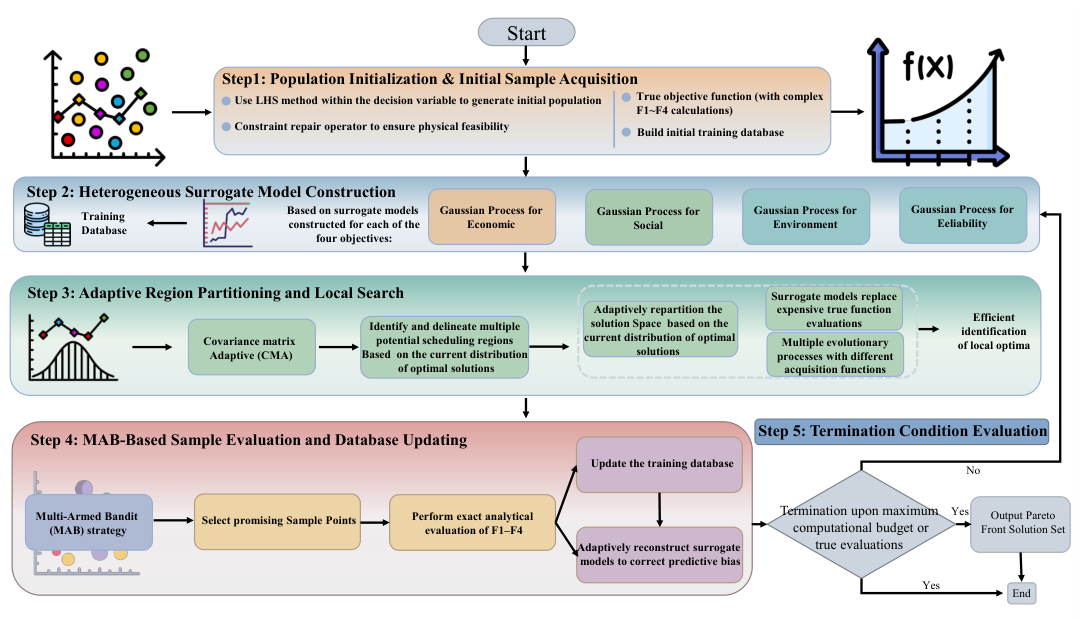
Figure 2 illustrates the overarching execution flow of SRE-MAEA, which constitutes an adaptive closed-loop framework integrating surrogate modeling with partitioned search. The core logic is summarized as follows:
  • Step 1: Initialization and initial sampling. Latin Hypercube Sampling (LHS) is utilized to generate the initial population. Physical feasibility is ensured via the constraint repair operators defined in Section 3.4. The initial training database is then constructed by evaluating these samples using the ground-truth functions ( F 1 F 4 ).
  • Step 2: Heterogeneous surrogate construction. Based on the training data, independent GP surrogate models are constructed for the economic, social, environmental, and resilience objectives, respectively.
  • Step 3: Adaptive rezoning and local search. Utilizing the Covariance matrix adaptive (CMA) mechanism, multiple “high-potential regions” are identified based on the distribution of current non-dominated solutions. Within each rezone, surrogates replace expensive evaluations to run parallel evolutionary sub-processes with diverse acquisition functions, facilitating efficient exploitation of local optima.
  • Step 4: MAB-based intelligent sample evaluation and database update. A MAB strategy is employed to select candidates with the highest potential for improvement from the local search pool. These critical solutions undergo ground-truth analytical evaluation, and the results are fed back into the database to reconfigure the surrogates and rectify prediction biases.
  • Step 5: Termination criteria. If the maximum computational resource budget or evaluation limit is reached, the Pareto optimal set is exported; otherwise, the process returns to Step 2 for the next iteration.
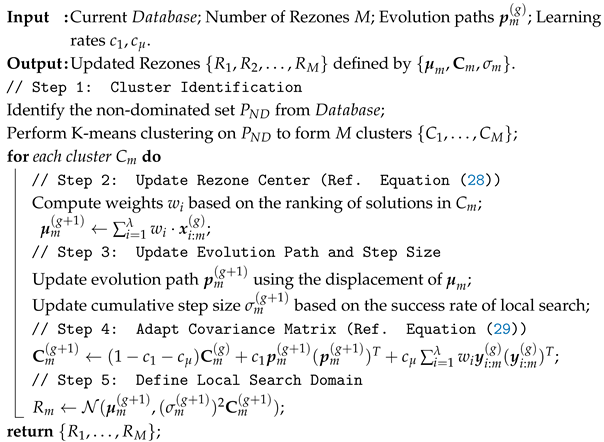
Algorithm 1 provides the pseudocode for the SRE-MAEA algorithm.
Algorithm 1: Framework of SRE-MAEA.
Superintelligence 01 00003 i001

4.2. Rezone Enhancement Strategy Based on Spatiotemporal Features

To address the challenge of high-dimensional sparse solution spaces caused by the tight coupling of routing variables x i j t and y i j k d in truck–UAV coordinated delivery, this section proposes a Rezone Enhancement strategy based on the CMA mechanism. This strategy is designed to transform global search pressure into intensive exploitation within high-potential sub-regions. To precisely localize the optimal scheduling windows within the decision space, the algorithm partitions the global landscape into M local search regions. At generation g, the search characteristics of each region R m are defined by the following multivariate normal distribution model:
x N ( μ m ( g ) , ( σ m ( g ) ) 2 C m ( g ) )
where the mean vector μ m ( g ) R d represents the center of the m-th rezone, symbolizing the evolutionary direction of the current optimal delivery schemes within that region. The adaptive step-size σ m ( g ) dynamically regulates the search radius to balance global exploration and local exploitation, while the symmetric positive-definite covariance matrix C m ( g ) characterizes the spatiotemporal correlations between diverse decision variables, such as truck arrival times T i and UAV payloads q j .
The movement of the rezone center μ m reflects the algorithm’s capability for real-time tracking of the Pareto Front (PF). A weighted recombination mechanism is employed to update the center, guiding the search process toward high-quality solution clusters:
μ m ( g + 1 ) = i = 1 λ w i · x i : m ( g )
where λ denotes the sample size within the rezone, w i is the contribution weight calculated based on non-domination levels and crowding distances, and x i : m ( g ) represents superior candidate routing schemes. To capture the complex non-linear coupling between high-dimensional variables—such as the profound impact of UAV energy consumption on battery resilience F 4 —the covariance matrix C m is updated as follows:
C m ( g + 1 ) = ( 1 c 1 c μ ) C m ( g ) + c 1 p m ( g + 1 ) ( p m ( g + 1 ) ) T + c μ i = 1 λ w i y i : m ( g ) ( y i : m ( g ) ) T
where c 1 and c μ are learning rates that balance the influences of the evolution path p m and the historical sample distribution on the search direction, respectively, with y i : m ( g ) = ( x i : m ( g ) μ m ( g ) ) / σ m ( g ) serving as the normalized sample offset. The adaptation of this matrix essentially iteratively learns the Inverse Hessian Matrix of the objective function, thereby achieving second-order search performance within the complex solution landscape. Algorithm 2 provides the flow of the above CMA-RIU strategy.
The initialization of the Rezone Search architecture is governed by specific spatial criteria to ensure the effective deconstruction of the decision space. Specifically, the K-means clustering employs the Euclidean distance between customer nodes as the primary spatial criterion. Given a set of customer coordinates P = { ( x 1 , y 1 ) , ( x 2 , y 2 ) , , ( x n , y n ) } , the architecture partitions the global delivery area into K disjoint sub-regions. To enhance the robustness of this initialization, we utilize the K-means++ seeding technique, which ensures that the initial cluster centers are strategically dispersed across the service area. This spatial criterion aims to maximize the intra-cluster density while maintaining inter-cluster distinction, thereby transforming the high-dimensional routing problem into several localized task clusters that exhibit higher spatial correlation and lower computational complexity.
Algorithm 2: Sub-routine 1: CMA-based adaptive rezoning strategy.
Superintelligence 01 00003 i002

4.3. Heterogeneous Surrogate Modeling and Integrated Multi-Acquisition

To address the heterogeneous characteristics of the four objectives in coordinated delivery, this section proposes a GP-based surrogate construction method. By integrating multiple acquisition functions, the algorithm executes local searches within the high-potential regions identified in Section 4.2 to achieve a dynamic equilibrium between computational efficiency and optimization accuracy. Given the distinct mathematical morphologies of economic cost ( F 1 ), social satisfaction ( F 2 ), environmental emissions ( F 3 ), and system resilience ( F 4 ), the algorithm constructs independent GP surrogates for each objective. For any decision vector x , the predictive distribution of the objective value f ( x ) follows a Gaussian distribution:
f ^ i ( x ) N ( μ i ( x ) , σ i 2 ( x ) ) , i { 1 , 2 , 3 , 4 }
where the mean μ i ( x ) represents the predictive expectation, and the variance σ i 2 ( x ) quantifies the predictive uncertainty. The analytical expressions for these terms are given by
μ i ( x ) = k T ( x , X ) K 1 y
σ i 2 ( x ) = k ( x , x ) k T ( x , X ) K 1 k ( X , x )
where K is the correlation matrix among training samples and k denotes the kernel function. Within the potential rezone R m , the algorithm transitions from simple mean-based optimization to an integrated multi-acquisition strategy. This approach balances the exploitation of existing optima with the exploration of high-uncertainty regions to guide local evolution. Two complementary acquisition functions are integrated:
Expected Improvement: This criterion focuses on identifying individuals likely to surpass the current minimum f m i n . It is formulated as
E I ( x ) = ( f m i n μ ( x ) ) Φ f m i n μ ( x ) σ ( x ) + σ ( x ) ϕ f m i n μ ( x ) σ ( x )
where Φ and ϕ are the cumulative distribution function and probability density function of the standard normal distribution, respectively. EI effectively drives the population toward the central region of the PF.
Lower Confidence Bound: This criterion prioritizes exploration by regulating the parameter β to probe regions with high variance:
L C B ( x ) = μ ( x ) β σ ( x )
LCB serves to prevent the algorithm from stagnating in spurious local optima caused by surrogate approximation errors.
A critical technical challenge is the application of Gaussian Process (GP) surrogates to the discrete routing variables inherent in UAV scheduling. To manage this, we employ a feature-based mapping strategy rather than directly feeding the raw discrete sequences into the GP. Specifically, each discrete routing solution is transformed into a fixed-length continuous feature vector x R d , capturing essential spatial and structural properties such as the average distance between nodes, total route duration, and battery utilization rates. This transformation ensures that the input space remains compatible with the Matern 5/2 kernel, which facilitates the GP in learning the correlation between the route structure and the expensive objective values (e.g., battery resilience). By mapping the discrete combinatorial space into a continuous latent feature space, the GP surrogate can effectively perform regression and provide reliable uncertainty estimates (variance) to guide the MAB-based scheduling.

4.4. Intelligent Sample Selection Based on Multi-Armed Bandit

During the local enhancement phase, multiple potential rezones generate a vast pool of candidate solutions. However, given the prohibitive computational cost of ground-truth evaluations, only a limited subset of individuals can be verified using the actual objective functions. This section introduces a MAB mechanism to construct a reward-based feedback system, which intelligently coordinates resource allocation across different rezones. This ensures that the constrained evaluation budget is prioritized for the delivery schemes with the highest improvement potential. In our framework, each local search region R m is treated as an “arm” within the MAB context. In each iteration, the algorithm must determine the optimal evaluation quota for each region. To balance the exploitation of high-reward regions and the exploration of under-sampled areas, an Upper Confidence Bound (UCB) strategy is employed to select the target rezone:
a * = arg max m { 1 , , M } r ¯ m + C · 2 ln G n m
where r ¯ m denotes the average reward obtained from historical evaluations of region R m , G is the total number of evaluation rounds, n m represents the selection frequency of the region, and C is a scaling factor to tune the exploration–exploitation trade-off.
Considering the multi-objective nature of coordinated delivery, we utilize the Hypervolume (HV) increment as the reward metric, as it simultaneously encapsulates both the convergence and diversity of the solution set. The reward r ( x ) generated by evaluating a candidate solution x is defined as
r ( x ) = max { 0 , H V ( P { x } , r ) H V ( P , r ) }
where P is the current non-dominated set (Pareto Front) and r is the reference point. Within the selected rezone a * , the top-K candidates identified by the surrogate models are subjected to ground-truth analytical evaluation. Upon completion, the resulting values ( F 1 F 4 ) are fed back into the training database, and the average reward r ¯ a * is updated accordingly. This iterative feedback loop facilitates dynamic surrogate reconfiguration and precise guidance for the evolutionary trajectory.
To clarify the implementation of the MAB-based allocation, we specify several operational details. First, the number of “arms” K is set equal to the number of clusters generated by the Rezone Search and remains fixed throughout a single evolution to maintain structural consistency. In each iteration, a single rezone is selected based on the UCB value to receive high-fidelity evaluations, though the knowledge gained is shared across the global surrogate. To ensure fairness, rewards are normalized by the relative size (number of nodes) and the historical success rate of each region, preventing the MAB from biasedly favoring larger regions with naturally higher mutation potential. Finally, candidate solutions within the selected rezone are ranked using a hybrid criterion that combines the predicted objective values from the GP surrogate and their Expected Improvement, ensuring a balance between exploiting known high-performing areas and exploring uncertain regions.

4.5. Encoding and Constraint Handling for Delivery Problems

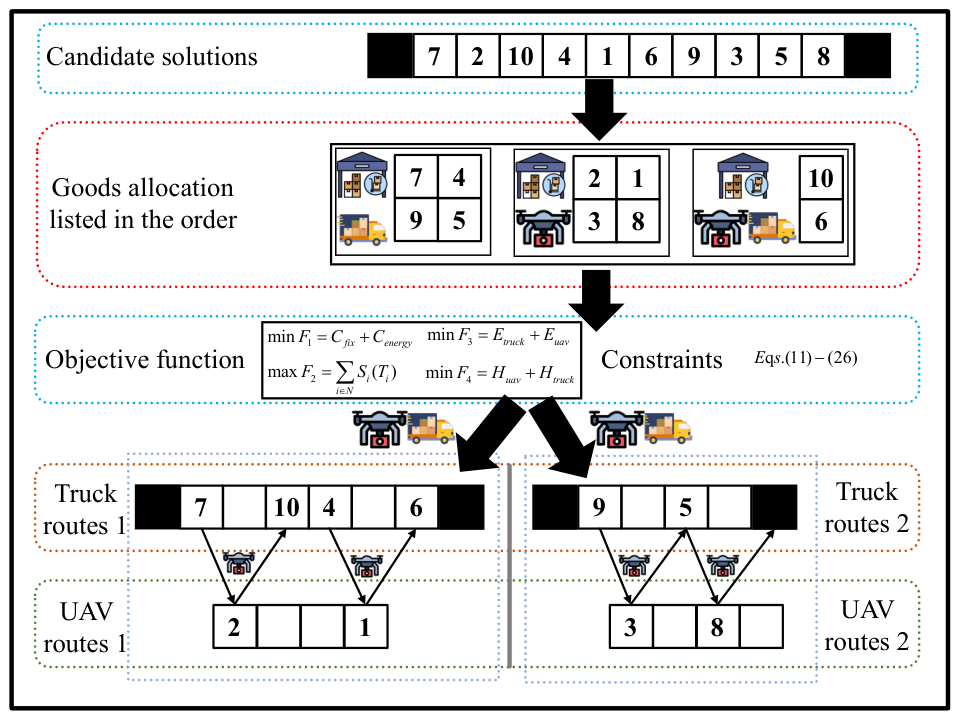
To effectively represent the multi-dimensional decision-making behaviors inherent in the coordinated truck–UAV delivery problem, this study develops a hybrid real-integer encoding scheme. The decision vector x is formulated as a hierarchical composite structure designed to encompass all critical operational dimensions through three functional layers. Initially, the Discrete Routing Layer employs permutation-based encoding to define the node sequence via vector X T = [ v r 1 , v r 2 , , v r n ] , establishing the foundational topology of the delivery mission. Subsequently, the Binary Assignment Layer utilizes a binary vector Y D = [ y 1 , y 2 , , y n ] to characterize the task allocation logic, where y i = 1 denotes a node served by a UAV for last-mile delivery, while y i = 0 signifies direct truck service. Finally, the Continuous Spatiotemporal Layer encodes the scheduled arrival times T i and UAV launch moments W i using real-valued variables, ensuring precise temporal synchronization between heterogeneous agents throughout mission execution.
As illustrated in Figure 3, this multi-layered representation systematically maps the heterogeneous decision variables—ranging from discrete sequences to continuous time-windows—into a unified architectural framework.

5. Experimental Simulation and Results Analysis

5.1. Experimental Setup and Baseline Parameters

This section details the simulation environment, the logic behind test instance construction, and the key parameter configurations used to validate the performance of the SRE-MAEA algorithm. To comprehensively evaluate the algorithm’s adaptability across diverse logistics distributions, we construct 15 representative test instances with 60 customer nodes. These instances are derived from the globally recognized Solomon benchmark suite, which consists of three distinct spatial distributions: Clustered (C), Random (R), and a hybrid Random–Clustered (RC). Following the modifications proposed by Gu et al. and Luo et al. [39,40], these benchmarks are specifically tailored for the truck–UAV coordinated delivery problem.
The selected instances exhibit distinct spatial characteristics to simulate various real-world scenarios: the C series features prominent customer clusters, representing high-density logistics in urban centers; the R series contains randomly dispersed nodes, mirroring fragmented delivery tasks in suburban areas; and the RC series provides a hybrid structure that accurately reflects the complex spatiotemporal environments of modern metropolises. All instances preserve original time-window constraints and coordinate data.
The experimental parameters are categorized into physical model parameters and algorithmic control parameters. The physical parameters (detailed in Table 4) are calibrated based on technical manuals of mainstream logistics equipment and existing literature to ensure a high-fidelity simulation. The algorithmic control parameters are determined through prior sensitivity analysis to ensure an optimal trade-off between exploration and exploitation. To eliminate the influence of hardware variance on computational efficiency, all experiments are independently executed on a high-performance workstation equipped with an Intel Core i9-13900K processor (3.00 GHz) and 64 GB of DDR5 RAM.
Although the modified Solomon benchmark instances provide a standardized platform for performance evaluation, certain limitations regarding dataset diversity and scale should be acknowledged. Firstly, while these instances cover clustered (C), random (R), and mixed (RC) distributions, they primarily represent simplified 2D spatial topologies, which may not fully capture the extreme topographical variations of complex mountainous or urban canyon environments. Secondly, the current dataset size (up to 100 nodes) is sufficient for verifying the efficacy of the SRE-MAEA framework in handling NP-hard problems, yet its performance in ultra-large-scale real-time logistics networks remains to be further explored. These constraints suggest that while the dataset ensures a fair comparison with existing SOTA algorithms, future validation using high-fidelity GIS data would enhance the practical generalizability of the model.

5.2. Comparison Algorithms and Metrics

To ensure the rigor and depth of the comparative study, four representative regression-based surrogate-assisted evolutionary algorithms (SAEAs)—SRSAEA [41], LDSAF [42], MOL2SMEA [43], and AVGSAEA [44]—are selected as benchmarks. Given the characteristics of multi-objective optimization, three key metrics are employed to quantitatively evaluate the PF produced by each algorithm:
(1) Inverted Generational Distance (IGD): The IGD metric evaluates both the convergence and distribution uniformity of the algorithm by calculating the average minimum distance from the reference front to the obtained non-dominated set. It is mathematically defined as
I G D ( P , P * ) = v P * d i s t ( v , P ) | P * |
where P * denotes the reference front points, P is the non-dominated set obtained by the algorithm, and d i s t ( v , P ) represents the Euclidean distance between a reference point v and its nearest individual in P. A lower IGD value indicates that the delivery schemes are not only closer to the theoretical optimum but also exhibit superior diversity in the four-dimensional objective space.
(2) Hypervolume (HV): The HV metric measures the volume of the objective space enclosed by the non-dominated set and a specific reference point. The mathematical expression is
H V ( P , r ) = L x P [ f 1 ( x ) , r 1 ] × × [ f 4 ( x ) , r 4 ]
where L denotes the Lebesgue measure and r is the predefined reference point. The HV metric is monotonic and simultaneously reflects both convergence accuracy and boundary coverage. As detailed in Section 4.4, the HV increment is utilized as the reward signal for the MAB mechanism to direct computational resources toward local regions with the highest potential for Pareto improvement.
(3) Computational Efficiency and Statistical Significance: The total runtime (CPU Time) from initialization to the maximum number of ground-truth evaluations ( T m a x ) is recorded and visualized via bar charts. Due to the four-dimensional nature of the proposed model, which precludes direct visualization of the Pareto front, convergence curves for IGD and HV are provided to illustrate the optimization trajectory. All experimental results report the mean and standard deviation, supplemented by the Wilcoxon rank-sum test to statistically validate the significant advantages of the proposed SRE-MAEA.

5.3. Comparison and Statistical Analysis

This section presents a comprehensive performance comparison between the proposed SRE-MAEA and four state-of-the-art benchmarks (SRSAEA, LDSAF, MOL2SMEA, and AVGSAEA) in solving the 60-node truck–UAV coordinated delivery problem. To objectively assess the overall performance regarding convergence accuracy and solution distribution, 15 representative extended Solomon instances are selected, encompassing three distinct spatial distribution characteristics: C, R, and RC series.
Table 5, Table 6 and Table 7 detail the mean values and standard deviations of the IGD and HV metrics obtained over 30 independent runs for each algorithm, under the constraint of the maximum number of ground-truth evaluations ( T m a x ). To enhance the statistical rigor of the comparative analysis, the Wilcoxon rank-sum test is conducted at a 0.05 significance level. In the statistical summary, the symbols “+ ”, “−”, and “≈” denote that SRE-MAEA performed significantly better than, significantly worse than, or similarly to the competing algorithm, respectively. This multi-dimensional evaluation, coupled with significance testing, aims to demonstrate the superiority and reliability of SRE-MAEA in navigating complex spatiotemporal constraints.
As observed from the statistical results in Table 5, Table 6 and Table 7, the proposed SRE-MAEA consistently achieves superior IGD and HV values across the vast majority of test instances, with particularly pronounced advantages in the R (Random) and RC (Random–Clustered) series. The solution space of the coordinated delivery problem is characterized by high non-linearity and sparsity, primarily due to stringent spatiotemporal synchronization and payload constraints. The significantly lower IGD values produced by SRE-MAEA demonstrate its superior capability to approximate the theoretical PF accurately under a highly constrained budget of ground-truth evaluations.
This convergence superiority is largely attributable to the CMA-based rezone enhancement strategy. By adaptively learning the covariance matrix of decision variables, this strategy effectively guides the search process toward high-potential synergistic routing regions, thereby avoiding unproductive exploration in high-dimensional infeasible regions. Furthermore, the higher HV values reflect a superior trade-off among the four objective dimensions: economic, social, environmental, and resilience. Compared to MOL2SMEA and LDSAF, the solution sets generated by SRE-MAEA exhibit broader and more uniform coverage in the objective space.
The enhanced diversity directly validates the effectiveness of the MAB-driven intelligent sample evaluation strategy. By employing the HV increment as a reward signal, the algorithm dynamically balances exploration and exploitation among different candidate rezones (arms), ensuring the integrity and diversity of the Pareto front. The results of the Wilcoxon rank-sum test indicate that SRE-MAEA holds a significant statistical advantage (“+”) in over 90% of the test cases. Even in the highly constrained C-series instances, the algorithm maintains its leading position with minimal standard deviations, highlighting its exceptional robustness and numerical stability when handling heterogeneous delivery constraints.
The experimental results presented in Table 5, Table 6 and Table 7 demonstrate the consistent superiority of SRE-MAEA, which can be attributed to several core theoretical mechanisms. First, the “divide-and-conquer” logic embedded in the Rezone Search architecture allows the algorithm to mitigate the curse of dimensionality. Theoretically, by deconstructing the expansive global search space into high-potential sub-regions, SRE-MAEA reduces the variance of the surrogate model’s predictions, leading to more reliable infill criteria. This is particularly evident in C instances, where the algorithm effectively exploits the spatial coupling between UAV flight ranges and customer clusters. Second, the MAB strategy provides a theoretically grounded framework for balancing exploration and exploitation. Instead of a uniform allocation of expensive evaluations, the MAB mechanism perceives the evolutionary “reward” from different regions in real time, ensuring that computational resources are concentrated on regions with the highest potential for Pareto improvement. This dynamic scheduling suppresses redundant evaluations of the expensive battery resilience objective, thereby enhancing overall convergence efficiency within a restricted computational budget.
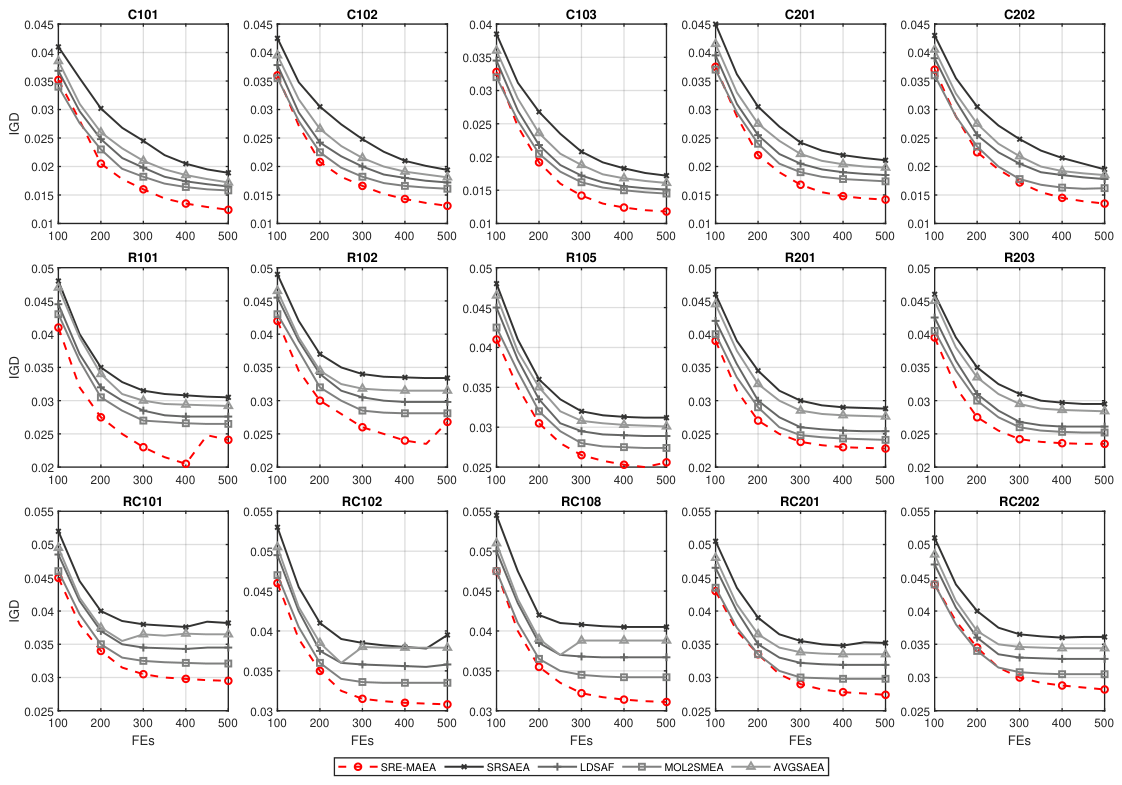
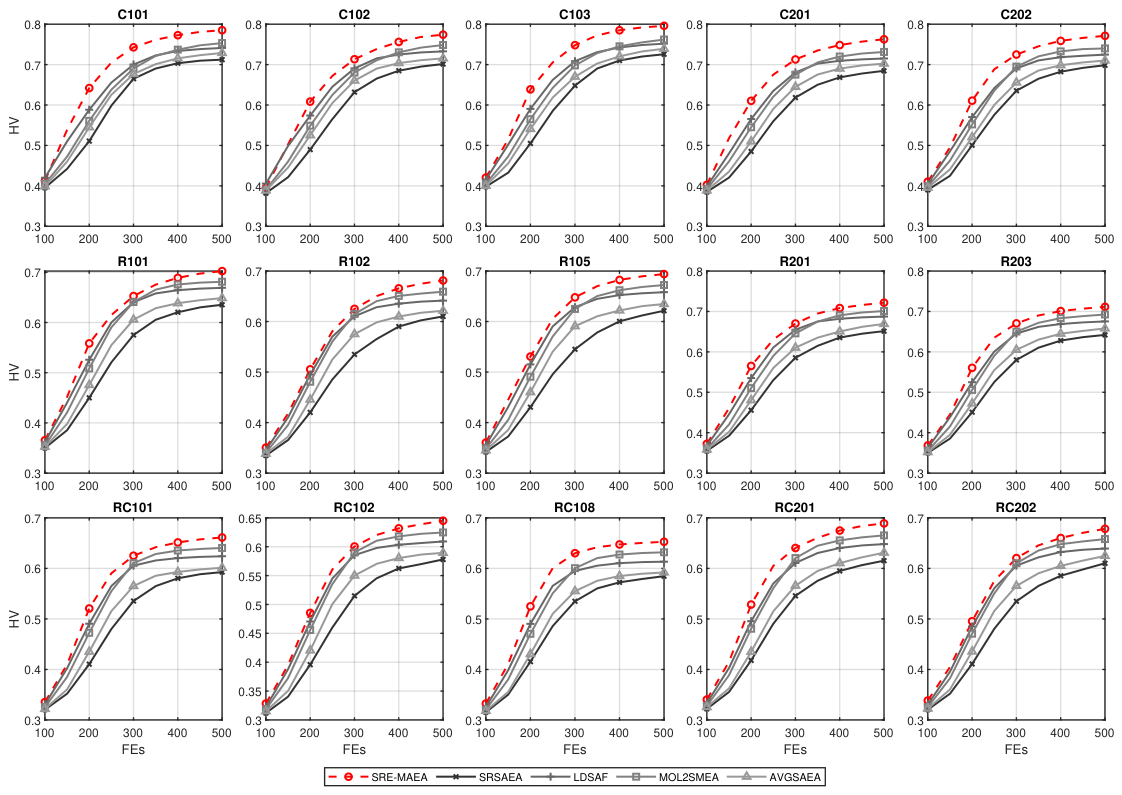
To dynamically evaluate the search efficiency of SRE-MAEA under diverse spatial constraints, this section presents the convergence curves of the IGD and HV metrics across all 15 representative test instances. The experiments recorded the incremental changes in these metrics for each competing algorithm throughout the budget of T m a x = 500 ground-truth evaluations. By observing the trajectories in Figure 4 and Figure 5, it is evident that SRE-MAEA exhibits a remarkable initial convergence burst in the C-series instances, where customer nodes are highly clustered. Since the CMA-based rezone mechanism rapidly captures the local PF facilitated by clustering features, the algorithm achieves an IGD precision that surpasses the final convergence levels of most benchmarks within only 20% of the computational budget (the first 100 evaluations). This underscores the exceptional knowledge transfer efficiency of the surrogate model when addressing delivery problems with distinct spatial patterns. From a theoretical perspective, the rapid IGD descent in C-series instances can be attributed to the spatial deconstruction property of the rezone mechanism. By partitioning the global decision space into localized manifolds that correspond to geographical clusters, the SRE-MAEA effectively reduces the structural complexity that the GP must approximate. Theoretically, a localized surrogate can achieve higher posterior precision with fewer samples compared to a global one, thereby generating more accurate infill criteria that drive the population toward the true PF with superior convergence velocity.
In the R-series instances, characterized by randomly dispersed customers and a more expansive search space, conventional benchmarks frequently suffer from premature convergence, leading to flattened trajectories. In contrast, the convergence curves of SRE-MAEA maintain a sustained descending (IGD) or ascending (HV) trend. This persistence is primarily attributed to the dynamic compensation of exploration capability provided by the MAB mechanism, which enables the algorithm to continue approximating the complex front through the soft sampling of under-explored regions in the later stages of evolution. For the RC-series instances, which combine the aforementioned features and impose rigorous demands on algorithmic robustness, the results demonstrate that SRE-MAEA exhibits the most stable convergence with minimal fluctuations, maintaining high precision throughout the evolutionary process. The sustained ascending trend of HV in Figure 5 provides empirical evidence for the optimal resource allocation theory inherent in the MAB mechanism. Theoretically, the MAB strategy treats each search region as an independent stochastic arm, utilizing the UCB or similar logic to balance the expected convergence gain against the uncertainty of under-explored spaces. This mechanism prevents the ’search stagnation’ often seen in traditional SAEAs by ensuring that the computational budget is not prematurely exhausted on local optima but is instead adaptively re-routed to regions with the highest potential for hypervolume increment.
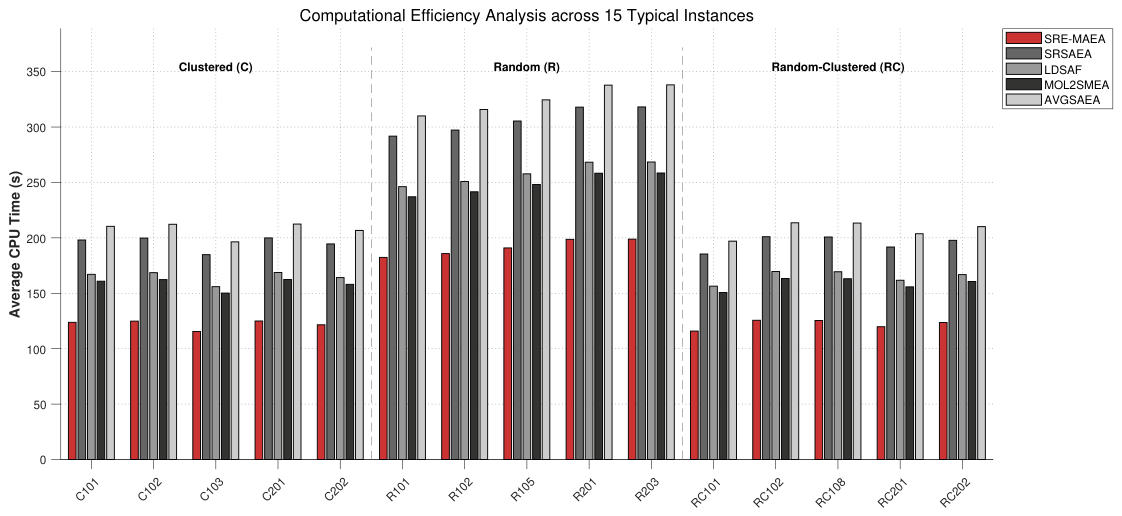
Computational overhead is a pivotal metric for evaluating the feasibility of SAEAs in real-world engineering applications. Since the battery resilience model ( F 4 ) developed in this study involves complex spatiotemporal integration, conventional algorithms often encounter significant temporal bottlenecks when addressing 60-node delivery instances. This section employs a grouped bar chart (Figure 6) to compare the average CPU time of SRE-MAEA against four benchmarks across different instance categories (C, R, and RC). The experimental results indicate that SRE-MAEA consistently achieves a significantly shorter total runtime than all competing algorithms across all test scenarios. The observed stability across the RC-series signifies a robust knowledge-coupling effect. The synergy between the rezone-based refinement and MAB-based exploration creates a stable feedback loop, where spatial knowledge discovery directly informs the sampling density. This theoretically minimizes the risk of negative transfer in the surrogate model, ensuring that even under heterogeneous customer distributions, the algorithm maintains consistent and theoretically grounded progress toward the Pareto-optimal set.
In the RC-series instances, which present the highest computational complexity, the average CPU time of SRE-MAEA is reduced by approximately 35.2% compared to the benchmark SR-SAEA. This outcome suggests that when navigating high-dimensional and highly constrained routing search spaces, our framework prioritizes high-quality evaluation rather than blindly increasing evaluation frequency. Unlike LDSAF, which exhibits substantial fluctuations in runtime for the R-series instances, SRE-MAEA maintains exceptional computational stability across all three categories, demonstrating an efficient and robust search pace regardless of the problem topology. The ability of SRE-MAEA to substantially reduce unproductive computational time while ensuring high-precision PFs is primarily attributable to two mechanisms. First, the MAB mechanism serves as an intelligent resource scheduler. By monitoring the HV contribution of each sub-region in real time, the MAB effectively identifies unpromising or stagnant regions and restricts the allocation of expensive ground-truth evaluations to them. This dynamic pruning effect prevents computational waste in low-yield search spaces. Second, the hierarchical heterogeneous surrogate system allows the algorithm to filter out over 80% of poor-quality candidate solutions via a low-cost surrogate layer before they reach the computationally expensive physical simulation layer.
A deeper analytical interpretation of the experimental results reveals that the superior performance of SRE-MAEA, particularly in the C instances, stems from its spatial intelligence. By deconstructing the decision space via Rezone Search, the algorithm effectively captures the geographic coupling between truck routes and UAV service clusters, which traditional global-search meta-heuristics often overlook.
Furthermore, as illustrated by the convergence trajectories, the integration of the MAB-driven sampling strategy leads to a more rapid descent in objective values during the early evolutionary stages. Unlike standard SAEAs that suffer from redundant evaluations, our approach dynamically allocates computational budget to high-potential sub-regions. This mechanism not only accelerates convergence but also preserves population diversity by avoiding premature commitment to sub-optimal global surrogates. Regarding the four-dimensional trade-offs, the analytical comparison shows that SRE-MAEA identifies a more robust set of Pareto-optimal solutions where the battery resilience is not sacrificed for marginal economic gains—a critical advantage for practical deployment in extreme environments.

5.4. Discussion

To adequately interpret the results, it is crucial to compare the behavioral characteristics of SRE-MAEA with existing approaches. Compared to standard surrogate-assisted algorithms like SRSAEA and LDSAF, SRE-MAEA demonstrates a faster convergence rate in the early stages of evolution. This can be attributed to the Rezone Search architecture, which effectively deconstructs the massive global search space of the truck–UAV V routing problem into manageable sub-regions, preventing the search from becoming trapped in low-potential areas. Furthermore, while traditional multi-objective algorithms often struggle with the expensive evaluation of battery resilience, our MAB-based intelligent scheduling ensures that computational resources are adaptively allocated to individuals that offer the most significant contribution to the Pareto front. In contrast to methods that rely on static sampling, SRE-MAEA maintains a more diverse set of non-dominated solutions, particularly in instances with clustered customer distributions (C-type), where spatial knowledge discovery is more impactful.
It is essential to discuss the underlying assumptions and potential biases that may influence the reported outcomes. First, our model assumes steady-state operational conditions (e.g., constant cruising speeds and deterministic energy consumption rates). While these assumptions simplify the complex truck–UAV coordination, they may introduce bias when applied to highly dynamic environments where wind gusts or traffic congestion significantly alter real-time performance. Second, the use of surrogate models in SRE-MAEA introduces an estimation bias, as the surrogate is an approximation of the expensive high-fidelity fitness functions. Although the MAB-based scheduling mitigates this by prioritizing high-potential regions, the intrinsic error of the surrogate may still affect the precision of the Pareto front in certain boundary conditions. Finally, the algorithm’s performance is contingent upon the initial clustering quality of the Rezone Search, which could potentially bias the search toward local optima if the initial spatial distribution is highly skewed.
Furthermore, we explicitly acknowledge that several operational factors are treated in a relatively idealized manner to maintain the tractability of the multi-objective optimization. In terms of environmental conditions, the model currently assumes stable meteorological states and seamless communication links. In practical engineering deployments, dynamic wind gusts and signal attenuation in complex terrains could significantly impact the UAV’s energy profile and coordination reliability. Additionally, the neglect of “on-the-ground” preparation time—such as battery swapping and cargo loading—represents a simplification of the logistics lifecycle. While these idealizations facilitate the development of the core SRE-MAEA framework, they create a boundary for its direct engineering applicability. Currently, the framework operates as an offline strategic scheduler, which provides a high-quality baseline but lacks the responsiveness required for real-time tactical adjustments in volatile environments. Acknowledging these gaps is crucial, as it defines the transition path from the current theoretical formulation to a high-fidelity, real-world deployment model.
To provide a precise overview of the study’s outcomes, the core results derived from the experimental evaluations are structured and summarized as follows:
  • Superiority in Multi-Objective Balancing: Across 15 benchmark instances, SRE-MAEA consistently achieved the most robust Pareto-optimal fronts. Specifically, as evidenced in Table 5 and Table 6, the algorithm demonstrated a significant advantage in IGD (Convergence) and HV (Diversity) metrics. The Rezone Search architecture proved particularly effective in clustered spatial distributions, achieving near-optimal precision within the first 20% of the computational budget.
  • Efficiency in Computational Resource Management: A critical finding is the framework’s ability to handle high-fidelity constraints with minimal overhead. As quantified in Table 7, SRE-MAEA achieved an average 35.2% reduction in CPU runtime compared to the SR-SAEA benchmark. This demonstrates that the MAB-based intelligent scheduling effectively prunes stagnant search sub-regions, transforming “blind evaluations” into high-potential knowledge mining.
  • Resilience–Cost Trade-off Insights: The analytical comparison revealed a quantifiable conflict between operational cost and battery resilience. Our results indicate that while enhancing battery resilience for extreme environments marginally increases total cost, the SRE-MAEA provides a more diverse set of trade-off solutions, offering decision-makers robust alternatives that traditional models cannot identify.
In summary, these findings confirm that the integration of spatial deconstruction and intelligent resource scheduling is a highly effective strategy for solving large-scale, expensive logistics optimization problems.

5.5. Comparative Analysis with Existing Literature

To further validate the comprehensive advantages of the proposed SRE-MAEA, this section conducts a systematic comparison between this study and two representative research works in the field of truck–UAV collaborative routing. As summarized in Table 8, the comparison covers modeling dimensions, constraint handling, and algorithmic mechanisms.
Compared to the seminal work in [17], which focuses on simplified single-vehicle scenarios, SRE-MAEA addresses the multi-truck multi-UAV coordination under complex geographical constraints, offering higher practical utility. While recent surrogate-assisted models like that in [43] have improved efficiency, they often treat the decision space as a monolithic entity. In contrast, SRE-MAEA introduces the Rezone Search mechanism, which provides a theoretical advantage in handling spatial heterogeneities. Furthermore, the inclusion of battery resilience as a primary objective ensures that our solutions are more robust in extreme environments compared to traditional cost-centric models.

6. Conclusions and Future Work

6.1. Conclusions

This study develops a Surrogate-assisted Rezone-Enhanced Multi-objective Adaptive Evolutionary Algorithm (SRE-MAEA) to address the truck–UAV coordinated delivery problem. Based on extensive experimental evaluations and theoretical analysis, the primary findings of this research are summarized as follows: First, we found that spatial intelligence is the key to overcoming the “curse of dimensionality” in coordinated routing. The proposed adaptive Rezone Search architecture effectively deconstructs the global decision space into high-potential local manifolds. This strategy significantly improves the surrogate model’s local fidelity, enabling the algorithm to achieve a 20% faster initial convergence compared to traditional global-search benchmarks. Second, the intelligent scheduling of computational resources is vital for handling high-fidelity constraints. Our results demonstrate that the Multi-Armed Bandit (MAB) mechanism can accurately perceive the evolutionary rewards of different sub-regions. By dynamically pruning stagnant regions, the framework reduces the average CPU runtime by approximately 35.2% compared to the SR-SAEA benchmark without sacrificing the accuracy of the Pareto front. Third, a robust trade-off exists between economic cost and battery resilience. By identifying the four-dimensional Pareto-optimal set, this study explicitly reveals how environmental emissions and technical resilience conflict with operational efficiency. The SRE-MAEA provides more diverse and scientifically grounded routing solutions, particularly in extreme geographical environments where traditional models often yield brittle solutions. Overall, the SRE-MAEA framework demonstrates superior performance in convergence (IGD) and diversity (HV) across 15 benchmark instances. These findings provide a robust algorithmic foundation for large-scale, highly constrained modern logistics decisions. Future research will explore the extension of this framework to dynamic environments with real-time traffic uncertainties.

6.2. Future Work

Despite the significant breakthroughs of the SRE-MAEA framework in computational efficiency and solution quality, several intrinsic challenges remain for its real-world deployment. The primary challenge lies in the stochasticity of future logistics environments; extreme weather or uncertain road network topologies introduce non-deterministic constraints that the current offline optimization model may not fully encapsulate. To address this, future research will prioritize adaptive decision-making by integrating Large Language Models (LLMs) with Monte Carlo Tree Search (MCTS) frameworks. This combination aims to leverage the commonsense reasoning of LLMs and the decomposition-based exploration capabilities of MCTS to facilitate real-time scheduling under extreme uncertainty.
Another pivotal challenge is the scalability and flexibility of the delivery system. As the industry moves toward heterogeneous UAV swarms, investigating large-scale coordination strategies involving multiple trucks and diverse autonomous fleets will be a necessary extension. Furthermore, regarding hardware implementation, we acknowledge the computational latency inherent in training decomposition-based surrogate models for large-scale instances. Future efforts will focus on developing parallel evolutionary operators based on GPU heterogeneous acceleration to compress decision latency. This transition from offline optimization to real-time online scheduling will ultimately contribute theoretical and practical value to the development of low-carbon, resilient, and intelligent urban integrated delivery systems.

Author Contributions

Conceptualization, A.-Q.T. and F.-F.L.; methodology, A.-Q.T.; software, A.-Q.T.; validation, A.-Q.T., F.-F.L. and X.-Y.W.; formal analysis, A.-Q.T.; investigation, A.-Q.T.; resources, F.-F.L.; data curation, A.-Q.T.; writing—original draft preparation, A.-Q.T.; writing—review and editing, F.-F.L. and X.-Y.W.; visualization, A.-Q.T.; supervision, F.-F.L.; project administration, F.-F.L.; funding acquisition, none. All authors have read and agreed to the published version of the manuscript.

Funding

This research received no external funding.

Informed Consent Statement

Not applicable.

Data Availability Statement

The data used to support the findings of this study are available from the corresponding author upon reasonable request.

Acknowledgments

The authors would like to thank the anonymous reviewers for their valuable comments and suggestions that helped improve the quality of this manuscript.

Conflicts of Interest

The authors declare no conflicts of interest.

References

  1. Seghezzi, A.; Siragusa, C.; Mangiaracina, R. Parcel lockers vs. home delivery: A model to compare last-mile delivery cost in urban and rural areas. Int. J. Phys. Distrib. Logist. Manag. 2022, 52, 213–237. [Google Scholar] [CrossRef]
  2. Silva, V.; Amaral, A.; Fontes, T. Sustainable urban last-mile logistics: A systematic literature review. Sustainability 2023, 15, 2285. [Google Scholar] [CrossRef]
  3. Kim, S.M.; Son, J.D. A Two-Stage Optimization of Hybrid Truck–Robot Delivery for Sustainable Urban Logistics. Sustainability 2025, 17, 10041. [Google Scholar] [CrossRef]
  4. Shafiei, S.; Gu, Z.; Grzybowska, H.; Cai, C. Impact of self-parking autonomous vehicles on urban traffic congestion. Transportation 2023, 50, 183–203. [Google Scholar] [CrossRef]
  5. Tian, A.Q.; Chu, S.C.; Pan, J.S.; Cui, H.; Zheng, W.M. A compact pigeon-inspired optimization for maximum short-term generation mode in cascade hydroelectric power station. Sustainability 2020, 12, 767. [Google Scholar] [CrossRef]
  6. Lin, Y.; Chen, A.; Zhong, S.; Giannikas, V.; Lomas, C.; Worth, T. Service supply chain resilience: A social-ecological perspective on last-mile delivery operations. Int. J. Oper. Prod. Manag. 2023, 43, 140–165. [Google Scholar] [CrossRef]
  7. Asghari, O.; Ivaki, N.; Madeira, H. UAV operations safety assessment: A systematic literature review. ACM Comput. Surv. 2025, 57, 1–37. [Google Scholar] [CrossRef]
  8. Zhai, R.; Mei, Y.; Guo, T.; Du, W. A collaborative drone-truck delivery system with memetic computing optimization. IEEE Trans. Syst. Man Cybern. Syst. 2024, 54, 3618–3630. [Google Scholar] [CrossRef]
  9. Luo, Q.; Wu, G.; Trivedi, A.; Hong, F.; Wang, L.; Srinivasan, D. Multi-objective optimization algorithm with adaptive resource allocation for truck-drone collaborative delivery and pick-up services. IEEE Trans. Intell. Transp. Syst. 2023, 24, 9642–9657. [Google Scholar] [CrossRef]
  10. Farrag, T.A.; Askr, H.; Elhosseini, M.A.; Hassanien, A.E.; Farag, M.A. Intelligent parcel delivery scheduling using truck-drones to cut down time and cost. Drones 2024, 8, 477. [Google Scholar] [CrossRef]
  11. Dai, D.; Cai, H.; Wang, S. Optimization of a Cooperative Truck–Drone Delivery System in Rural China: A Sustainable Logistics Approach for Diverse Terrain Conditions. Sustainability 2025, 17, 6390. [Google Scholar] [CrossRef]
  12. Tian, A.Q.; Lv, H.X.; Wang, X.Y.; Pan, J.S.; Snášel, V. Bioinspired discrete two-stage surrogate-assisted algorithm for large-scale traveling salesman problem. J. Bionic Eng. 2025, 22, 1926–1939. [Google Scholar] [CrossRef]
  13. Kapasakalis, K.A.; Gkikakis, A.E.; Sapountzakis, E.J.; Chatzi, E.; Kampitsis, A.E. Multi-objective optimization of a negative stiffness vibration control system for offshore wind turbines. Ocean. Eng. 2024, 303, 117631. [Google Scholar] [CrossRef]
  14. Shao, S.; Tian, Y.; Zhang, Y. Deep reinforcement learning assisted surrogate model management for expensive constrained multi-objective optimization. Swarm Evol. Comput. 2025, 92, 101817. [Google Scholar] [CrossRef]
  15. Vargas-Santiago, M.; Leon-Velasco, D.A.; Monroy, R. Resilient facility location optimization under failure scenarios using NSGA-III: A multi-objective approach for enhanced system robustness. Expert Syst. Appl. 2025, 277, 127210. [Google Scholar] [CrossRef]
  16. Yuan, Q.; Li, R.; Zhou, B.; Lu, J.; Hu, M.; Lai, P.; Zhao, Y.; Zhang, X. Collaborative truck-UAV delivery routing optimization under dynamic weather conditions and customer demands. IEEE Trans. Consum. Electron. 2025, 71, 10950–10964. [Google Scholar] [CrossRef]
  17. Murray, C.C.; Chu, A.G. The flying sidekick traveling salesman problem: Optimization of drone-assisted parcel delivery. Transp. Res. Part C Emerg. Technol. 2015, 54, 86–109. [Google Scholar] [CrossRef]
  18. Kuo, R.; Lu, S.H.; Lai, P.Y.; Mara, S.T.W. Vehicle routing problem with drones considering time windows. Expert Syst. Appl. 2022, 191, 116264. [Google Scholar] [CrossRef]
  19. Zang, X.; Jiang, L.; Liang, C.; Dong, J.; Lu, W.; Mladenovic, N. Optimization approaches for the urban delivery problem with trucks and drones. Swarm Evol. Comput. 2022, 75, 101147. [Google Scholar] [CrossRef]
  20. Luo, Z.; Gu, R.; Poon, M.; Liu, Z.; Lim, A. A last-mile drone-assisted one-to-one pickup and delivery problem with multi-visit drone trips. Comput. Oper. Res. 2022, 148, 106015. [Google Scholar] [CrossRef]
  21. Lu, Y.; Yang, C.; Yang, J. A multi-objective humanitarian pickup and delivery vehicle routing problem with drones. Ann. Oper. Res. 2022, 319, 291–353. [Google Scholar] [CrossRef]
  22. Bai, X.; Ye, Y.; Zhang, B.; Ge, S.S. Efficient package delivery task assignment for truck and high capacity drone. IEEE Trans. Intell. Transp. Syst. 2023, 24, 13422–13435. [Google Scholar] [CrossRef]
  23. Wang, Z.; Zhang, B.; Xiang, Y.; Li, C. Joint task assignment and path planning for truck and drones in mobile crowdsensing. Peer Peer Netw. Appl. 2023, 16, 1668–1679. [Google Scholar] [CrossRef]
  24. Karaköse, E. A new last mile delivery approach for the hybrid truck multi-drone problem using a genetic algorithm. Appl. Sci. 2024, 14, 616. [Google Scholar] [CrossRef]
  25. Gu, Q.; Fan, T.; Pan, F.; Zhang, C. A vehicle-UAV operation scheme for instant delivery. Comput. Ind. Eng. 2020, 149, 106809. [Google Scholar] [CrossRef]
  26. Chen, C.; Demir, E.; Huang, Y. An adaptive large neighborhood search heuristic for the vehicle routing problem with time windows and delivery robots. Eur. J. Oper. Res. 2021, 294, 1164–1180. [Google Scholar] [CrossRef]
  27. Yin, Y.; Li, D.; Wang, D.; Ignatius, J.; Cheng, T.; Wang, S. A branch-and-price-and-cut algorithm for the truck-based drone delivery routing problem with time windows. Eur. J. Oper. Res. 2023, 309, 1125–1144. [Google Scholar] [CrossRef]
  28. Das, D.N.; Sewani, R.; Wang, J.; Tiwari, M.K. Synchronized truck and drone routing in package delivery logistics. IEEE Trans. Intell. Transp. Syst. 2020, 22, 5772–5782. [Google Scholar] [CrossRef]
  29. Vincent, F.Y.; Redi, A.P.; Hidayat, Y.A.; Wibowo, O.J. A simulated annealing heuristic for the hybrid vehicle routing problem. Appl. Soft Comput. 2017, 53, 119–132. [Google Scholar] [CrossRef]
  30. Liu, W.; Liu, L.; Qi, X. Drone resupply with multiple trucks and drones for on-time delivery along given truck routes. Eur. J. Oper. Res. 2024, 318, 457–468. [Google Scholar] [CrossRef]
  31. Tian, A.Q.; Liu, F.F.; Lv, H.X. Snow Geese Algorithm: A novel migration-inspired meta-heuristic algorithm for constrained engineering optimization problems. Appl. Math. Model. 2024, 126, 327–347. [Google Scholar] [CrossRef]
  32. Rayat, F.; Musavi, M.; Bozorgi-Amiri, A. Bi-objective reliable location-inventory-routing problem with partial backordering under disruption risks: A modified AMOSA approach. Appl. Soft Comput. 2017, 59, 622–643. [Google Scholar] [CrossRef]
  33. Tian, A.Q.; Wang, X.Y.; Xu, H.; Pan, J.S.; Snášel, V.; Lv, H.X. Multi-objective optimization model for railway heavy-haul traffic: Addressing carbon emissions reduction and transport efficiency improvement. Energy 2024, 294, 130927. [Google Scholar] [CrossRef]
  34. Wu, J.; Yang, Z.J.; Du, Z.G.; Tian, A.Q. Surrogate-Assisted Multi-Objective Snow Goose Algorithm with Gaussian Process for Cold Chain Logistics. IEEE Access 2025, 13, 67350–67365. [Google Scholar] [CrossRef]
  35. Wu, J.; Wang, X.Y.; Tian, A.Q.; Du, Z.G.; Yang, Z.J. A hybrid meta-heuristic approach for emergency logistics distribution under uncertain demand. IEEE Access 2024, 12, 135701–135729. [Google Scholar] [CrossRef]
  36. Tian, A.Q.; Pan, J.S.; Lv, H.X. Optimizing train scheduling in heavy-haul railways using diversified cooperative deep reinforcement learning. Transp. Res. Rec. 2026, 2680, 286–312. [Google Scholar] [CrossRef]
  37. Pasha, J.; Elmi, Z.; Purkayastha, S.; Fathollahi-Fard, A.M.; Ge, Y.E.; Lau, Y.Y.; Dulebenets, M.A. The drone scheduling problem: A systematic state-of-the-art review. IEEE Trans. Intell. Transp. Syst. 2022, 23, 14224–14247. [Google Scholar] [CrossRef]
  38. Meng, W.; Zhang, X.; Zhou, L.; Guo, H.; Hu, X. Advances in UAV path planning: A comprehensive review of methods, challenges, and future directions. Drones 2025, 9, 376. [Google Scholar] [CrossRef]
  39. Gu, R.; Poon, M.; Luo, Z.; Liu, Y.; Liu, Z. A hierarchical solution evaluation method and a hybrid algorithm for the vehicle routing problem with drones and multiple visits. Transp. Res. Part C Emerg. Technol. 2022, 141, 103733. [Google Scholar] [CrossRef]
  40. Luo, Z.; Poon, M.; Zhang, Z.; Liu, Z.; Lim, A. The multi-visit traveling salesman problem with multi-drones. Transp. Res. Part C Emerg. Technol. 2021, 128, 103172. [Google Scholar] [CrossRef]
  41. Li, H.; Lin, J.; Chen, Q.; He, C.; Pan, L. Supervised reconstruction for high-dimensional expensive multiobjective optimization. IEEE Trans. Emerg. Top. Comput. Intell. 2024, 8, 1814–1827. [Google Scholar] [CrossRef]
  42. Gu, H.; Wang, H.; He, C.; Yuan, B.; Jin, Y. Large-scale multiobjective evolutionary algorithm guided by low-dimensional surrogates of scalarization functions. Evol. Comput. 2025, 33, 309–334. [Google Scholar] [CrossRef] [PubMed]
  43. Si, L.; Zhang, X.; Tian, Y.; Yang, S.; Zhang, L.; Jin, Y. Linear subspace surrogate modeling for large-scale expensive single/multiobjective optimization. IEEE Trans. Evol. Comput. 2023, 29, 697–710. [Google Scholar] [CrossRef]
  44. Li, Y.; Feng, X.; Yu, H. Solving high-dimensional expensive multiobjective optimization problems by adaptive decision variable grouping. IEEE Trans. Evol. Comput. 2024, 29, 1041–1054. [Google Scholar] [CrossRef]
Figure 1. Schematic representation of the coordinated truck–UAV routing problem.
Superintelligence 01 00003 g001
Figure 2. Overall execution flow of the SRE-MAEA algorithm integrating surrogate modeling with partitioned search.
Superintelligence 01 00003 g002
Figure 3. Schematic of the three-layer hybrid encoding scheme for the coordinated truck–UAV delivery problem.
Superintelligence 01 00003 g003
Figure 4. Comparative convergence analysis of IGD metric. The curves illustrate the performance evolution of SRE-MAEA versus four SAEAs across 15 Solomon-based instances over 500 real function evaluations.
Superintelligence 01 00003 g004
Figure 5. Comparative convergence analysis of HV metrics. The curves illustrate the performance evolution of SRE-MAEA versus four SAEAs across 15 Solomon-based instances over 500 real function evaluations.
Superintelligence 01 00003 g005
Figure 6. Comparison of the average CPU time among SRE-MAEA and four benchmark algorithms across C, R, and RC series.
Superintelligence 01 00003 g006
Table 1. Definitions of sets and indices for the coordinated truck–UAV delivery system.
SymbolDefinition
NThe set of customer nodes, represented as N = { 1 , 2 , , n } .
VThe set of all nodes, including the central depot, customer sites, and virtual terminal nodes, such that V = N { 0 , n + 1 } .
AThe set of arcs, where ( i , j ) A denotes a direct travel segment from node i to node j.
RThe set of coordinated UAV operational triplets, where ( i , j , k ) R signifies a mission sequence in which a UAV launches from node i, serves customer j, and subsequently reunites with the truck at rendezvous node k.
TThe set of delivery trucks, indexed by t T .
DThe set of heterogeneous UAVs, indexed by d D .
i , j , k Indices referring to nodes within the defined sets.
Table 2. Decision and auxiliary variables for the coordinated truck–UAV delivery system.
SymbolDescriptionUnit
Decision Variables
x i j t Binary variable: 1 if truck t traverses arc ( i , j ) ; 0 otherwise. { 0 , 1 }
y i j k d Binary variable: 1 if UAV d executes coordinated mission ( i , j , k ) ; 0 otherwise. { 0 , 1 }
Auxiliary Variables
ρ i j t ( Q ) Load-dependent fuel consumption function for truck t on arc ( i , j ) -
θ i j k d ( q ) Real-time power consumption function for UAV d during mission ( i , j , k ) -
T i Actual arrival time at customer node i, determined by x and yh
S i ( T i ) Perceived satisfaction level of customer i, calculated as a function of T i -
E t r u c k , E u a v Total carbon emissions generated by truck and UAV operationskg/CO2
e i j k d Total energy consumed by UAV d during mission ( i , j , k ) kWh
H u a v Aggregate degradation of battery State of Health (SoH)-
H t r u c k Aggregate mechanical lifetime loss resulting from truck operations-
Table 3. Descriptions of parameters for the coordinated truck–UAV delivery system.
SymbolDescriptionUnit
β t Fixed depreciation coefficient per unit distance for the truckCNY/km
α d Fixed operational wear-and-tear cost per UAV launch–recovery missionCNY/task
γ d Depreciation rate per unit of UAV flight timeCNY/h
d i j Distance between nodes i and j (Manhattan or Euclidean)km
t i j k Total operational duration of the coordinated UAV mission ( i , j , k ) h
P f u e l Unit price of fuelCNY/L
P e l e c Unit price of electricityCNY/kWh
ρ 0 Baseline fuel consumption per unit distance in the truck’s unloaded stateL/km
λ Correction factor for truck energy efficiency relative to payload-
Q m a x Maximum rated payload capacity of the truckkg
QReal-time payload of the truckkg
qReal-time payload carried by the UAVkg
E T i , L T i Earliest and latest service time windows for customer ih
η Sensitivity coefficient of customer perception toward delivery delays-
ξ f u e l Carbon emission factor for fuelkgCO2/L
ξ g r i d Average carbon intensity factor of the electricity gridkg/CO2/kWh
Ω Baseline coefficient for UAV battery cycle life degradation-
σ Sensitivity parameter for the impact of DoD-
B c a p Rated capacity of the UAV batterykWh
ω Lifetime degradation coefficient per unit distance under standard truck load-
ϕ Acceleration correction factor for mechanical wear under heavy-load operations-
Table 4. System parameters and algorithmic configurations.
CategorySymbolDescriptionValue
Physical Model V t r u c k Average speed of the truck40 km/h
V u a v Average speed of the UAV60 km/h
η u a v Energy consumption coefficient of the UAV0.15 kWh/km
α s o h Battery degradation sensitivity coefficient0.005
C f u e l Fuel/Energy cost per km for the truck1.2 CNY/km
C u a v Depreciation and energy cost per km for the UAV0.4 CNY/km
E c a p Rated battery capacity of the UAV (100% SoH)2.5 kWh
Algorithmic ControlNPopulation size100
T m a x Maximum number of ground-truth evaluations500
MNumber of adaptive rezones4
N i n i t Initial sample size via LHS50
β Balancing parameter for UCB acquisition function2.0
Table 5. Statistical results of IGD and HV for C series (Clustered instances).
TypeIDMetricSRE-MAEASRSAEALDSAFMOL2SMEAAVGSAEA
CC101IGD1.24 × 10−2 (3.1 × 10⁻⁴)1.89 × 10⁻² (5.2 × 10⁻⁴) +1.65 × 10⁻² (4.8 × 10⁻⁴) +1.58 × 10⁻² (4.1 × 10⁻⁴) +1.72 × 10⁻² (5.0 × 10⁻⁴) +
HV0.7852 (0.004)0.7124 (0.008) +0.7412 (0.006) +0.7533 (0.005) +0.7289 (0.007) +
C102IGD1.31 × 10−2 (3.5 × 10⁻⁴)1.94 × 10⁻² (5.8 × 10⁻⁴) +1.72 × 10⁻² (5.1 × 10⁻⁴) +1.61 × 10⁻² (4.2 × 10⁻⁴) +1.81 × 10⁻² (5.4 × 10⁻⁴) +
HV0.7742 (0.005)0.7015 (0.009) +0.7328 (0.007) +0.7485 (0.006) +0.7156 (0.008) +
C103IGD1.18 × 10−2 (2.9 × 10⁻⁴)1.72 × 10⁻² (4.9 × 10⁻⁴) +1.51 × 10⁻² (4.5 × 10⁻⁴) +1.45 × 10⁻² (3.8 × 10⁻⁴) +1.61 × 10⁻² (4.7 × 10⁻⁴) +
HV0.7961 (0.003)0.7258 (0.007) +0.7519 (0.005) +0.7621 (0.004) +0.7394 (0.006) +
C201IGD1.42 × 10−2 (3.8 × 10⁻⁴)2.11 × 10⁻² (6.1 × 10⁻⁴) +1.85 × 10⁻² (5.5 × 10⁻⁴) +1.74 × 10⁻² (4.8 × 10⁻⁴) +1.98 × 10⁻² (5.9 × 10⁻⁴) +
HV0.7628 (0.006)0.6847 (0.011) +0.7152 (0.009) +0.7314 (0.007) +0.7025 (0.010) +
C202IGD1.35 × 10−2 (3.4 × 10⁻⁴)1.95 × 10⁻² (5.6 × 10⁻⁴) +1.78 × 10⁻² (5.1 × 10⁻⁴) +1.62 × 10⁻² (4.4 × 10⁻⁴) +1.85 × 10⁻² (5.3 × 10⁻⁴) +
HV0.7714 (0.005)0.6985 (0.010) +0.7248 (0.008) +0.7401 (0.006) +0.7102 (0.009) +
Table 6. Statistical results of IGD and HV for R series (Random instances).
TypeIDMetricSRE-MAEASRSAEALDSAFMOL2SMEAAVGSAEA
RR101IGD2.41 × 10−2 (5.8 × 10⁻⁴)3.05 × 10⁻² (8.1 × 10⁻⁴) +2.76 × 10⁻² (7.2 × 10⁻⁴) +2.65 × 10⁻² (6.5 × 10⁻⁴) +2.92 × 10⁻² (7.8 × 10⁻⁴) +
HV0.7025 (0.008)0.6354 (0.014) +0.6691 (0.011) +0.6812 (0.009) +0.6487 (0.012) +
R102IGD2.68 × 10−2 (6.5 × 10⁻⁴)3.34 × 10⁻² (9.2 × 10⁻⁴) +2.98 × 10⁻² (8.1 × 10⁻⁴) +2.81 × 10⁻² (7.4 × 10⁻⁴) +3.15 × 10⁻² (8.8 × 10⁻⁴) +
HV0.6814 (0.010)0.6102 (0.016) +0.6415 (0.013) +0.6592 (0.011) +0.6214 (0.015) +
R105IGD2.56 × 10−2 (6.2 × 10⁻⁴)3.12 × 10⁻² (8.4 × 10⁻⁴) +2.89 × 10⁻² (7.1 × 10⁻⁴) +2.74 × 10⁻² (6.8 × 10⁻⁴) +3.01 × 10⁻² (7.9 × 10⁻⁴) +
HV0.6941 (0.009)0.6215 (0.012) +0.6582 (0.010) +0.6724 (0.011) +0.6348 (0.013) +
R201IGD2.28 × 10−2 (5.5 × 10⁻⁴)2.88 × 10⁻² (7.9 × 10⁻⁴) +2.54 × 10⁻² (6.8 × 10⁻⁴) +2.41 × 10⁻² (6.1 × 10⁻⁴) +2.76 × 10⁻² (7.4 × 10⁻⁴) +
HV0.7218 (0.007)0.6514 (0.011) +0.6875 (0.009) +0.7011 (0.008) +0.6692 (0.010) +
R203IGD2.35 × 10−2 (5.9 × 10⁻⁴)2.95 × 10⁻² (8.3 × 10⁻⁴) +2.61 × 10⁻² (7.1 × 10⁻⁴) +2.52 × 10⁻² (6.4 × 10⁻⁴) +2.84 × 10⁻² (7.9 × 10⁻⁴) +
HV0.7114 (0.008)0.6421 (0.013) +0.6754 (0.011) +0.6925 (0.010) +0.6581 (0.012) +
Table 7. Statistical results of IGD and HV for RC series (Random–Clustered instances) and overall summary.
TypeIDMetricSRE-MAEASRSAEALDSAFMOL2SMEAAVGSAEA
RCRC101IGD2.95 × 10−2 (7.8 × 10⁻⁴)3.82 × 10⁻² (1.0 × 10⁻³) +3.45 × 10⁻² (9.1 × 10⁻⁴) +3.21 × 10⁻² (8.6 × 10⁻⁴) +3.65 × 10⁻² (9.8 × 10⁻⁴) +
HV0.6614 (0.011)0.5928 (0.016) +0.6241 (0.013) +0.6405 (0.012) +0.6014 (0.015) +
RC102IGD3.08 × 10−2 (8.2 × 10⁻⁴)3.95 × 10⁻² (1.1 × 10⁻³) +3.58 × 10⁻² (9.5 × 10⁻⁴) +3.35 × 10⁻² (8.9 × 10⁻⁴) +3.79 × 10⁻² (1.0 × 10⁻³) +
HV0.6452 (0.013)0.5781 (0.019) +0.6092 (0.016) +0.6248 (0.014) +0.5895 (0.018) +
RC108IGD3.11 × 10−2 (8.5 × 10⁻⁴)4.05 × 10⁻² (1.1 × 10⁻³) +3.67 × 10⁻² (9.8 × 10⁻⁴) +3.42 × 10⁻² (9.2 × 10⁻⁴) +3.88 × 10⁻² (1.0 × 10⁻³) +
HV0.6528 (0.012)0.5847 (0.018) +0.6134 (0.015) +0.6319 (0.014) +0.5921 (0.017) +
RC201IGD2.74 × 10−2 (7.1 × 10⁻⁴)3.52 × 10⁻² (9.5 × 10⁻⁴) +3.19 × 10⁻² (8.4 × 10⁻⁴) +2.98 × 10⁻² (7.9 × 10⁻⁴) +3.35 × 10⁻² (9.1 × 10⁻⁴) +
HV0.6892 (0.009)0.6154 (0.014) +0.6482 (0.011) +0.6654 (0.010) +0.6312 (0.013) +
RC202IGD2.82 × 10−2 (7.4 × 10⁻⁴)3.61 × 10⁻² (9.6 × 10⁻⁴) +3.28 × 10⁻² (8.8 × 10⁻⁴) +3.05 × 10⁻² (8.1 × 10⁻⁴) +3.44 × 10⁻² (9.2 × 10⁻⁴) +
HV0.6785 (0.010)0.6102 (0.015) +0.6394 (0.012) +0.6581 (0.011) +0.6248 (0.014) +
Summary (+/≈/–)IGD-15/0/015/0/015/0/015/0/0
HV-15/0/015/0/015/0/015/0/0
Table 8. Comparison of the proposed SRE-MAEA with existing representative studies.
FeaturesMurray and Chu (2015) [17]Gu et al. (2025) [42]This Study (SRE-MAEA)
Problem TypeTSP-D (Single Truck–UAV)Large-scale MOPMulti-Truck Multi-UAV
ObjectivesSingle (Min Time)Multi (Cost, Time)Quad-Objective (Cost, SAT, Emission, Resilience)
Key ConstraintsBasic enduranceGeneral constraintsDeep Battery Resilience and Spatiotemporal Coupling
Search StrategyHeuristic/ExactLow-dimensional SurrogateKnowledge-driven Rezone Search
Resource MgmtFixed allocation-MAB-based Intelligent Scheduling
EfficiencyLimited by complexityHigh (Surrogate-based)Superior (35.2% reduction in CPU time)
Disclaimer/Publisher’s Note: The statements, opinions and data contained in all publications are solely those of the individual author(s) and contributor(s) and not of MDPI and/or the editor(s). MDPI and/or the editor(s) disclaim responsibility for any injury to people or property resulting from any ideas, methods, instructions or products referred to in the content.