
- Article

21 Pages
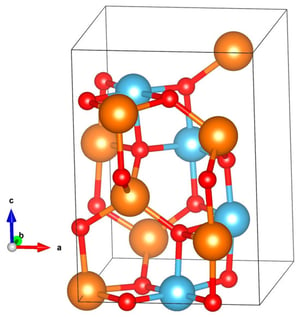
In this study, first-principles simulations of inverse spinel Mg2TiO4 (MTO) and MTO:Mn4+ on the base of the tetragonal phase were performed within the linear combination of atomic orbitals (LCAO) approximation of density functional theory (DFT), as implemented in CRYSTAL23 computer code. The effect of Mn doping on the MTO band gap structure was studied for the first time. Lattice relaxation around Mn4+ ions upon substitution was considered. Two possible spin configurations of the Mn4+ ion (3d3) in MTO:Mn4+ (total spin of system S = 3/2 and 1/2) were considered in the framework of the unrestricted (open shell) DFT-LCAO calculations. The structural, electronic, vibrational, dielectric and elastic properties of materials were investigated, compared and discussed. It has been shown that dopant atoms create new defect states within the band gap and modify the conduction band and the valence band, which is one of the most important results in the present study. The effect of isotopic substitution on the vibrational properties was analyzed. Based on the calculated elastic moduli, the Debye temperature for MTO was estimated. This study provides a basis for the assessment of the optical and luminescent properties of the doped material and its use in LED applications.
Nanomaterials
25 September 2026
![Development of HfO2-based ferroelectrics from a CMOS high-κ dielectric to ferroelectric devices. Ferroelectric hafnia was reported in 2011 [1,2,3], sub-8 nm thickness and wake-up behavior in 2015 [28], NLS in 2018 [29], approximately 1 nm ferroelectric films in 2020 [30], and mixed-ferroic superlattice gates in 2022 [31]. Recent roadmaps and FeNAND demonstrations are represented by Refs. [32,33,34].](https://mdpi-res.com/cdn-cgi/image/width=281%2Cheight=192/https://mdpi-res.com/nanomaterials/nanomaterials-16-01208/article_deploy/html/images/nanomaterials-16-01208-g001-550.jpg)