Skip to Content

Nanomaterials

Nanomaterials is an international, interdisciplinary, peer-reviewed, open access journal published semimonthly online by MDPI, and that publishes reviews, regular research papers, communications, and short notes that are relevant to any field of study that involves nanomaterials with respect to their science and applications. The Spanish Carbon Group (GEC) and The Chinese Society of Micro-Nano Technology (CSMNT) are affiliated with Nanomaterials and their members receive discounts on the article processing charges.
  • Open Access— free for readers, with article processing charges (APC) paid by authors or their institutions.
  • High Visibility: indexed within Scopus, SCIE (Web of Science), PubMed, PMC, CAPlus / SciFinder, Inspec, and other databases.
  • Journal Rank: JCR - Q2 (Physics, Applied) / CiteScore - Q1 (General Chemical Engineering )
  • Rapid Publication: manuscripts are peer-reviewed and a first decision is provided to authors approximately 12.5 days after submission; acceptance to publication is undertaken in 2.7 days (median values for papers published in this journal in the first half of 2026).
  • Recognition of Reviewers: Reviewers whose reports are timely and of high quality receive an APC discount voucher for a future publication in an MDPI journal. Become a reviewer.
  • Companion journals for Nanomaterials include: Nanomanufacturing and Applied Nano.

Get Alerted

Add your email address to receive forthcoming issues of this journal.

All Articles (22,657)

Colored reflective paints are attractive for building cooling and aesthetics. However, coloration of the paints could paradoxically increase the solar absorption, decreasing the cooling capabilities. In this work, we introduced a novel coloration strategy by using metal ion-doped ZnO nanoparticles as fillers to achieve chromatic paints with high cooling capabilities. With inorganic binder of aqueous K2SiO3 solution, it observed that the Mg-doping enabled the paint to deliver a high cooling power of 103.8 W/m2, while Fe-, Cu- and Co-doping strategies created pale buff (L* = 84.6, a* = 2.9, b* = 16.3), olive green (L* = 66.8, a* = −7.9, b* = 18.7), and pale gray (L* = 81.5, a* = −0.6, b* = 2.1) colors with highly remained cooling power of 83.9, 75.4 and 61.1 W/m2, respectively. Physical characterizations indicated that the maintained crystal structures and similar band gaps could be the main reasons for high cooling capabilities of the colored paints. In addition, the high temperature differences and strong adhesion capabilities of paints on concrete substrates enabled them to present promising cooling energy savings for buildings.

Nanomaterials

15 September 2026
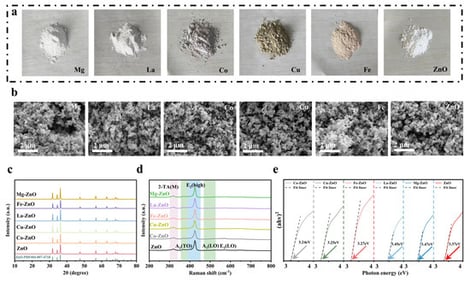
Physical characterizations on doped ZnO samples. (a) Digital photos. (b) SEM images. (c) XRD patterns. (d) Raman spectra. (e) Calculation about band gaps with UV–Vis spectra.

First-principles FP-LAPW calculations were used to investigate the structural, mechanical, electronic, optical, and thermoelectric properties of the double halide perovskites Rb2NaTaBr6 and Rb2LiTaBr6. Structural optimization confirmed their stable cubic phase. Elastic analysis shows they are mechanically stable, ductile, and anisotropic. Spin-polarized calculations reveal that both compounds are half-metallic ferromagnets with an integer total magnetic moment of 2 μB per formula unit, dominated by the Ta-d states. They exhibit strong dielectric response and strong UV light absorption originating from interband electronic transitions, despite their intrinsic metallic ground state. Boltzmann transport theory revealed a temperature-dependent enhancement of electrical conductivity and power factor. Both materials, especially Rb2LiTaBr6, show promise for high-temperature thermoelectric and UV optoelectronic applications.

Nanomaterials

14 September 2026

Access to clean and safe water remains a major environmental challenge due to the increasing release of organic pollutants, dyes, nutrients, microorganisms, and persistent contaminants into aquatic environments [...]

Nanomaterials

14 September 2026

Maintaining low leakage current with high capacitance density in metal–insulator–metal (MIM) capacitors is essential for next-generation dynamic random-access memory (DRAM) scaling. Rutile TiO2 is a promising high-k dielectric; however, its narrow bandgap causes high leakage, while defect-free stabilization in ultrathin films remains challenging. RuO2/TiO2/Ru MIM capacitors were fabricated using a reactive direct current (DC)-sputtered RuO2 bottom electrode, followed by TiO2 growth by direct plasma atomic layer deposition (DP-ALD) or remote plasma atomic layer deposition (RP-ALD) and rapid thermal annealing in O2 to reduce defects. Rutile TiO2 was deposited directly on highly crystalline RuO2 under both plasma modes, suggesting that RuO2 crystallinity governs TiO2 phase evolution. The RP-ALD film replicated the RuO2 grain morphology, yielding higher roughness than that of the DP-ALD film. Moreover, the RP-ALD film exhibited lower oxygen-vacancy density and improved stoichiometric stability. The RP-ALD-fabricated capacitors exhibited a higher dielectric constant and lower leakage current density at 0.8 V than the DP-ALD-fabricated capacitors (~100 and ~1.76 × 10⁻⁶ A/cm2 vs. ~97 and ~1.41 × 10⁻⁴ A/cm2, respectively). Ion bombardment during DP-ALD likely promoted oxygen-vacancy-related defect formation, whereas RP-ALD mitigated such damage, improving leakage characteristics. This work highlights the potential of RP-ALD-based RuO2/TiO2/Ru MIM capacitors for next-generation DRAM.

Nanomaterials

14 September 2026

Highly Accessed Articles

News & Conferences

Latest Issues

Open for Submission

Journal Sections

Advanced Nanomaterials for Water Remediation (2nd Edition)
Reprint

Advanced Nanomaterials for Water Remediation (2nd Edition)

Editors: Pedro Manuel Martins, Noelia González-Ballesteros
XFacebookLinkedIn
Nanomaterials - ISSN 2079-4991