
 Open Access
 - Review

26 Pages
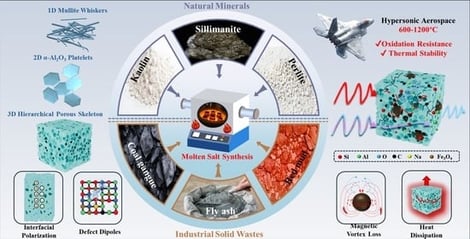
High-temperature electromagnetic functional ceramics require matrix phases, such as alumina and mullite, that combine resistance to high temperatures and oxidation with low density. Aluminosilicates derived from natural minerals or solid wastes can reduce material costs and introduce additional electromagnetic responses through associated iron-, carbon-, and alkali-metal-containing components. However, fully exploiting these advantages requires coordinated control of activation, separation, molten salt recovery, and heat treatment. This review systematically examines six precursor types—kaolin, perlite, sillimanite, red mud, fly ash, and coal gangue—with particular emphasis on their phase characteristics, phase-structure evolution and regulation mechanisms in molten-salt environments, porous-structure construction, and electromagnetic functionalization. Current evidence indicates that kaolin and sillimanite primarily follow mullitization pathways, whereas mullitization of perlite requires exogenous aluminum components. Under defined carbon-source and atmospheric conditions, fly ash, coal gangue, and red mud can form multiphase composites containing carbon, iron-based phases, and aluminosilicates. This review synthesizes the relationships among precursor composition, phase-structure evolution pathways, and interfacial structure, and identifies high-temperature in situ electromagnetic characterization, improved oxidation stability, and scalable preparation as key priorities for future research. Perlite is discussed more briefly because quantitative electromagnetic-wave absorption data for perlite-derived ceramics remain limited.
Nanomaterials
1 October 2026