


Skip to Content

Metals

Metals is an international, peer-reviewed, open access journal published monthly online by MDPI.
The Spanish Materials Society (SOCIEMAT) is affiliated with Metals and their members receive discounts on the article processing charges.
Quartile Ranking JCR - Q2 (Metallurgy and Metallurgical Engineering)

Get Alerted

Add your email address to receive forthcoming issues of this journal.

All Articles (14,764)

Based on industrial production data, the distribution patterns of elements in the oxygen-enriched top-blown Isa smelting process for lead were studied. The focus was on investigating the thermodynamic effects of different slag types and oxygen-enrichment levels on lead content in slag, and analyzing the equilibrium distribution of Pb, S, Fe, and Zn between slag and gas phases in different slag systems, thereby enabling the optimization of the smelting process and improving the lead grade in the slag phase. The optimized parameters obtained from simulation calculations were applied to the actual oxygen-enriched top-blown Isa lead smelting process. The results show that the most suitable smelting parameters are: CaO content of 3.5–4%, SiO2 content of 5.5–6%, SiO2/Fe ratio of approximately 0.9, CaO/SiO2 ratio of approximately 0.3, and oxygen-enrichment level maintained at around 60%. Under these conditions, the lead grade in the slag phase is approximately 50%, representing a relative increase of about 8% compared to that before optimization.

11 March 2026
Variation in the content of each phase with the amount of CaO added.

Advances in Modelling of Irradiation Creep Using Rate Theory

  • Malcolm Griffiths and
  • Juan Eduardo Ramos Nervi

Irradiation creep of engineering alloys in nuclear reactor cores differs from the creep that is observed outside of the irradiation environment. It exhibits characteristics like high temperature thermal creep because it occurs in an environment of elevated vacancy point defect concentrations, but one must also consider the effect of interstitial point defects and the effect of both vacancy and interstitial concentrations, which are greater than the thermal equilibrium values, on an evolving microstructure. Irradiation creep is dependent on the point defect flux to different sinks and can be modelled using conventional rate theory. The net interstitial or vacancy point defect flux to different sinks determines the strain rate in a direction that can be considered perpendicular to the plane of the sink, which is the extra half plane of an edge dislocation or the plane of a grain boundary. There has been increasing evidence that, for complex alloys such as Zr-2.5Nb pressure tubing in CANDU reactors, the irradiation creep is largely dependent on the grain structure (size and shape). While the maximum amount of thermal creep by dislocation slip will be proportional to the distance a dislocation travels, i.e., proportional to the grain dimension in the direction of slip, observations indicate that the magnitude of irradiation creep is inversely proportional to the grain dimensions, indicating a creep mechanism dependent on diffusional mass transport. Mechanistic modelling of irradiation creep based on rate theory is described and used to account for high diametral creep rates observed for pressure tubes with unusual microstructures fabricated by non-standard fabrication routes.

11 March 2026
Composite showing preferred orientation for a pressure tube and the corresponding creep compliance tensor quadric for planar stress in the longitudinal (L) and transverse (T) plane that is perpendicular to the radial (R) direction.  Derived from anisotropy factors reporetd in [10,11].

The effects of different finishing rolling temperatures on the microstructure and mechanical properties of a 580HE hole expansion steel were systematically investigated using optical microscopy, scanning electron microscopy, electron backscatter diffraction, and transmission electron microscopy. The results show that the yield strength increases with decreasing finishing rolling temperature, whereas the tensile strength and total elongation exhibit relatively small variations. Significant changes in phase fraction, grain size, spatial distribution, and NbC precipitation behavior are observed under different finishing rolling temperatures. The microstructure mainly consists of polygonal ferrite and granular bainite, while acicular ferrite is formed at higher finishing rolling temperatures. With decreasing finishing rolling temperature, the ferrite and bainite grains are markedly refined and become more uniformly distributed. Meanwhile, the ferrite fraction slightly increases, the crystallographic texture is weakened, and, more importantly, the number density of precipitates increases while their size is significantly reduced. The hole expansion ratio increases noticeably with decreasing finishing rolling temperature, which is mainly attributed to grain refinement, improved microstructural and strain homogeneity, and the selective strengthening effect of fine NbC precipitates. These factors effectively reduce stress concentration and hardness mismatch between soft and hard phases, thereby delaying crack initiation during hole expansion.

11 March 2026

Schematic illustration of the processing route.

Microstructure and Mechanical Properties of PM Ti-4Al-2Fe-3Cu Alloy Modified by Vanadium Addition

  • Mojtaba Najafizadeh,
  • Mehran Ghasempour-Mouziraji and
  • Ricardo Alves de Sousa

This study examines the effect of vanadium addition on the microstructure and mechanical properties of low-cost powder metallurgy Ti-4Al-2Fe-3Cu alloys. Alloys with and without 6 wt.% V were fabricated by hot extrusion of blended elemental powders followed by vacuum heat treatment. Microstructural analysis revealed that the base alloy exhibits a coarse lamellar α/β structure, while vanadium addition promotes a refined basketweave morphology with a significantly higher β-phase fraction, increasing from 28.1% to 46.2%. Energy-dispersive spectroscopy confirmed preferential partitioning of Fe, Cu, and V into the β phase. Mechanical testing showed that the addition of 6 wt.% V markedly enhances strength, increasing yield strength and ultimate tensile strength from 1122 MPa and 1214 MPa to 1291 MPa and 1349 MPa, respectively, while maintaining comparable tensile ductility (~3.5%). The strength improvement is attributed to α-plate refinement, increased β-phase fraction, and solid-solution strengthening of the β phase. These results demonstrate that vanadium addition is an effective approach for improving the strength of low-cost PM titanium alloys without compromising ductility.

11 March 2026

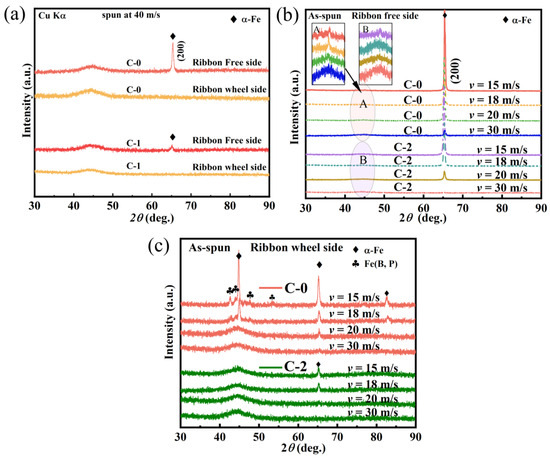
XRD patterns of Ti-4Al-2Fe-3Cu and Ti-4Al-2Fe-3Cu-6V alloys.

News & Conferences

Issues

Open for Submission

Editor's Choice

Reprints of Collections

Advances in Mineral Processing and Hydrometallurgy
Reprint

Advances in Mineral Processing and Hydrometallurgy

3rd Edition
Editors: Corby G. Anderson
Advanced Plastic Forming Processes
Reprint

Advanced Plastic Forming Processes

Theory, Experiments and Numerical Simulations
Editors: Gaochao Yu
XFacebookLinkedIn
Metals - ISSN 2075-4701