




Need Help?
Announcements
8 February 2023
Journal of Intelligence | Notable Papers in the Field of Creativity
“Intelligence and Creativity: Mapping Constructs on the Space-Time Continuum”
by Giovanni Emanuele Corazza and Todd Lubart
J. Intell. 2021, 9(1), 1; https://doi.org/10.3390/jintelligence9010001
Full text available online: https://www.mdpi.com/2079-3200/9/1/1
“A Reappraisal of the Threshold Hypothesis of Creativity and Intelligence”
by Selina Weiss, Diana Steger, Ulrich Schroeders and Oliver Wilhelm
J. Intell. 2020, 8(4), 38; https://doi.org/10.3390/jintelligence8040038
Full text available online: https://www.mdpi.com/2079-3200/8/4/38
“The Relationship between Intelligence and Divergent Thinking—A Meta-Analytic Update”
by Anne Gerwig, Kirill Miroshnik, Boris Forthmann, Mathias Benedek, Maciej Karwowski and Heinz Holling
J. Intell. 2021, 9(2), 23; https://doi.org/10.3390/jintelligence9020023
Full text available online: https://www.mdpi.com/2079-3200/9/2/23
“How Is Intelligence Test Performance Associated with Creative Achievement? A Meta-Analysis”
by Maciej Karwowski, Marta Czerwonka, Ewa Wiśniewska and Boris Forthmann
J. Intell. 2021, 9(2), 28; https://doi.org/10.3390/jintelligence9020028
Full text available online: https://www.mdpi.com/2079-3200/9/2/28
“Serial Order Effect in Divergent Thinking in Five- to Six-Year-Olds: Individual Differences as Related to Executive Functions”
by Honghong Bai, Paul P. M. Leseman, Mirjam Moerbeek, Evelyn H. Kroesbergen and Hanna Mulder
J. Intell. 2021, 9(2), 20; https://doi.org/10.3390/jintelligence9020020
Full text available online: https://www.mdpi.com/2079-3200/9/2/20
“The Creativity Diamond—A Framework to Aid Creativity”
by Peter Childs, Ji Han, Liuqing Chen, Pingfei Jiang, Pan Wang, Dongmyung Park, Yuan Yin, Elena Dieckmann and Ignacio Vilanova
J. Intell. 2022, 10(4), 73; https://doi.org/10.3390/jintelligence10040073
Full text available online: https://www.mdpi.com/2079-3200/10/4/73
“Developing Children’s Creativity and Social-Emotional Competencies through Play: Summary of Twenty Years of Findings of the Evidence-Based Interventions ‘Game Program’”
by Maite Garaigordobil, Laura Berrueco and Macarena-Paz Celume
J. Intell. 2022, 10(4), 77; https://doi.org/10.3390/jintelligence10040077
Full text available online: https://www.mdpi.com/2079-3200/10/4/77
“Creativity and Artificial Intelligence—A Student Perspective”
by Rebecca Marrone, Victoria Taddeo and Gillian Hill
J. Intell. 2022, 10(3), 65; https://doi.org/10.3390/jintelligence10030065
Full text available online: https://www.mdpi.com/2079-3200/10/3/65
“Metacognition, Mind Wandering, and Cognitive Flexibility: Understanding Creativity”
by David D. Preiss
J. Intell. 2022, 10(3), 69; https://doi.org/10.3390/jintelligence10030069
Full text available online: https://www.mdpi.com/2079-3200/10/3/69
“Being Intelligent with Emotions to Benefit Creativity: Emotion across the Seven Cs of Creativity”
by Daniel Sundquist and Todd Lubart
J. Intell. 2022, 10(4), 106; https://doi.org/10.3390/jintelligence10040106
Full text available online: https://www.mdpi.com/2079-3200/10/4/106
22 December 2022
Special Issue Mentor Program
We are pleased to announce the launch of a new initiative—the MDPI Special Issue Mentor Program.
This program will enable early career researchers (who must hold a Ph.D. in a related field) to experience editing a Special Issue in MDPI journals, under the mentorship of our experienced Editorial Board Members or other experienced scientists. The mentor program will provide an excellent opportunity for early career scientists to gain editorial experience, and to cultivate their ability to edit scientific research.
The mentee’s responsibilities include:
- Proposing a Special Issue title and assisting the mentor in preparing a summary (around 200–400 words) and 3–10 keywords describing the background, importance, and goal of the Issue;
- Writing a brief promotion plan for the Special Issue;
- Preparing a list of scholars who may be interested in the Issue and personally e-mailing invitations on behalf of Guest Editors;
- Writing an editorial for the online Special Issue together with the mentor.
The mentor’s responsibilities include:
- Conducting a final check before the Special Issue is published online;
- Performing editorial control of the Special Issue and quality control of the publications, both of which must be carried out in a timely manner;
- Providing suggestions to younger scholars if they have any doubts or concerns regarding submissions;
- Organizing video calls with young scholars and the Editorial Office regularly to discuss problems and improvement suggestions for the Special Issue;
- Making and submitting decisions regarding submissions with the assistance of mentees.
Certificates and awards:
After the Special Issue closes, the Editorial Office will provide official certificates for all the mentors and early career researchers.
If you are interested in this opportunity, please send your Special Issue proposal to the Editorial Office of a journal you choose, and we will discuss the process (i.e., mentor collaboration, Special Issue topic feasibility analysis, etc.) in further detail. The full list of MDPI journals is as follows: https://www.mdpi.com/about/journals.
In addition to the new Special Issue Mentor Program, we will continue to welcome all Special Issue proposals focusing on hot research topics.
14 December 2022
"Thanks a Million!" – One Million Articles Published in MDPI Journals
MDPI has just become the first open access (OA) publisher to reach the milestone of one million articles published. That is one million articles freely available to all, to circulate and build upon! We are proud to share this special moment with the global scientific community.
This landmark has been reached thanks to the immeasurable support of more than 600,000 expert reviewers, 66,000 editorial board members and 6700 hard-working colleagues across MDPI’s global offices.
Within more than 25 years of publishing, our journals received 2.1 million manuscripts and generated 4.6 million peer review reports to get to one million papers published.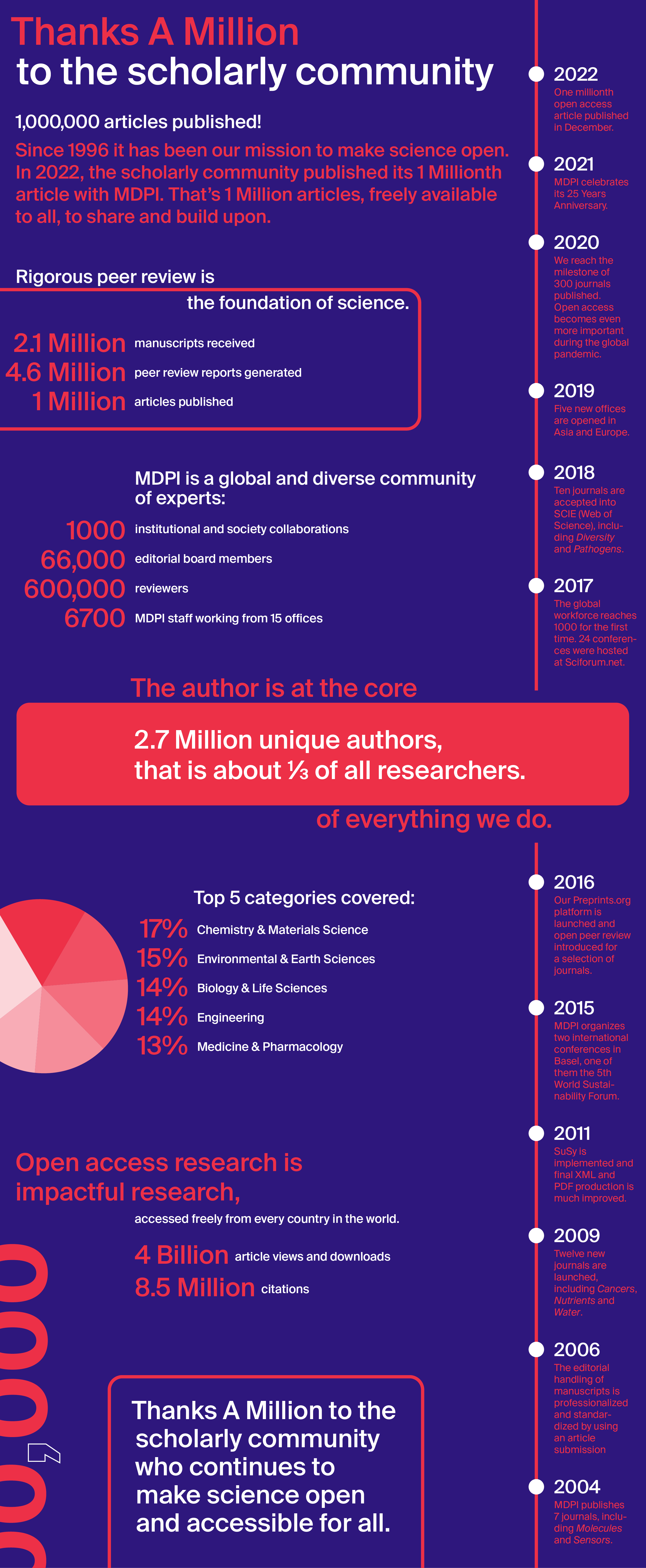
Reaching the milestone of one million articles published reinforces our mission to remove any existing barriers and to make scientific research accessible to all. Since its inception, MDPI’s goal has been to create reliable processes to make science open. This is a path towards facilitating the dissemination of novel insights in scientific communities.
Regular feedback from authors and reviewers shows that our service is greatly appreciated and needed. At the same time, the feedback helps us identify areas for further improvement.
As it stands, a significant share of published research findings remain closed access. More than half of the content published with the most well-known legacy publishers stays behind a paywall, and that is not including articles published in hybrid OA journals, or made available months or years after publication.
A new policy announced by the US administration in August 2022 requires that, as of January 2026, all US federally funded research be made freely and immediately available after publication. While the new policy does not mandate articles be published under an open access license, it is aligned with the open access movement in removing all barriers to research. Similarly, some of the most advanced research institutions in the world intend to have all funded research articles published in open access by 2025.
MDPI is proud to be the leading agent of the transition to open access.
"Thanks a Million" to all the contributors!
8 December 2022
MDPI Sustainability Foundation: New Look and Nominations for the 2023 Sustainability Awards Now Open
We are pleased to announce that the website of the MDPI Sustainability Foundation has been revamped! For the past couple of months, our UX UI team and front-end developers have been working hard to launch the website in time for the opening of the Sustainability Awards nominations.
The website is not the only thing that has had a remodeling. Indeed, the format of the Emerging Sustainability Leader Award (ESLA) has been updated. ESLA is now a competition open to individual researchers or start-ups founded by researchers under the age of 35. Nominee applications will go through 2 rounds of selection until the final 3 are decided. The finalists will then be invited to give pitch presentations during the Award Ceremony to win either first place (10,000 USD) or runner-up (2 x 5000 USD).
The World Sustainability Award, on the other hand, remains the same: a total prize money of 100,000 USD is up for grabs by senior individual researchers or groups of researchers from the international research community.
Nominations for both the World Sustainability Award and the Emerging Sustainability Leader award are now open! Check out our new website for more information on how to nominate.
1 November 2022
Editorial Board Members from the Journal of Intelligence Featured in Stanford’s List of the World’s Top 2% Scientists
Stanford University has recently released an update of the list that represents the top 2% of the most-cited scientists in various scientific fields and subfields. The report was prepared by Prof. John P. A. Ioannidis, an eminent Professor at Stanford University.
The updated version is based on the 1 September 2022 snapshot from Scopus, updated to the end of the 2021 citation year. The database provides standardized information on citations, h-indices, co-authorship adjusted hm-indices, citations to papers in different authorship positions, and a composite indicator (c-score).
We are proud to share that 20 Editorial Board Members of the Journal of Intelligence (ISSN: 2079-3200) have been recognized in the top 2 percentile rank of scientists worldwide (the list is arranged alphabetically).
|
Name |
Affiliation |
|
Andrew R. A. Conway* |
Claremont Graduate University |
|
Con K. Stough |
Swinburne University of Technology |
|
Frank Goldhammer |
Deutsches Institut für Internationale Pädagogische Forschung |
|
James C. Kaufman |
University of Connecticut |
|
Jonathan Wai |
University of Arkansas |
|
Kaarin J. Anstey |
UNSW Sydney |
|
Lars Penke |
Georg-August-Universität Göttingen |
|
Matthias von Davier |
Boston College |
|
Matthias Ziegler |
Humboldt-Universität zu Berlin |
|
Moshe Zeidner |
University of Haifa |
|
Oliver Wilhelm |
Universität Ulm |
|
Patrick Kyllonen |
Educational Testing Service |
|
Rex Eugene Jung |
The University of New Mexico |
|
Roberto Colom |
Universidad Autónoma de Madrid |
|
Roger E. Beaty |
Pennsylvania State University |
|
Samuel Greiff |
University of Luxembourg |
|
Sara A. Hart |
Florida State University |
|
Scott B. Kaufman |
Columbia University |
|
Stephen J. Ceci |
Cornell University |
|
Wendy Johnson |
The University of Edinburgh |
Note: * current affiliation: New Mexico State University.
28 September 2022
Peer Review Week 2022 – Research Integrity: Creating and Supporting Trust in Research

Peer Review Week began 19 September 2022 under the theme of “Research Integrity: Creating and Supporting Trust in Research”. Through various blog articles, podcast, and webinar, we discussed this crucial subject throughout the week, celebrating the essential role peer review plays in maintaining research quality.
To begin, we held a Webinar on the topic. Professor Peter W. Choate and Dr. Emmanuel Obeng-Gyasi joined Dr. Ioana Craciun, one of MDPI’s scientific officers, for an in-depth discussion.
We invite you to view the event recording:
During the week, the MDPI Blog in a series articles highlighted how good Peer Review safeguards research integrity. The following topics were covered:
- Peer Review Week 2022
- Research Integrity
- What We’ve Learned About Peer Review Reports
- 4 Steps to the Perfect Peer Review Report
- How to Write the Perfect Peer Review Report: An Interview
- Inviting Great Peer Reviewers
In a new edition of Insight Faster, an MDPI podcast, we were delighted to talk to the co-chairs of the Peer Review Week committee, Jayashree Rajagopalan (Senior Manager of Global Community Engagement for CACTUS) and Danielle Padula (Head of Marketing and Community Development at Scholastica) to get their take on this year’s event and its related topics.
You can find the Podcast here.
We hope you enjoy the contents!
20 September 2022
Recruiting Reviewer Board Members for the Journal of Intelligence
We are now recruiting Reviewer Board Members for the Journal of Intelligence (ISSN: 2079-3200). We aim for the review process to be constructive, supportive and rigorous. Our reviewers are expected to be subject experts, familiar with the field and the methods used in the manuscripts they agree to review.
As a Reviewer Board Member, you would have the following benefits:
- For each review, you will receive a discount voucher that can be used for reducing the article processing charge (APC) of a future submission to any MDPI journal;
- You may publish one paper per year with a 20% discount after standard peer review in the Journal of Intelligence;
- You will be considered for the journal’s Outstanding Reviewer Award;
- Reviewer Board Members are given priority to join the Editorial Board of the journal (subject to the approval of the Editor-in-Chief).
4 August 2022
MDPI’s 2021 Outstanding Reviewer Awards in “Social Sciences & Humanities”—Winners Announced
In order to acknowledge our reviewers, who so generously dedicate their time to reviewing papers and demonstrate diligence, professionalism, and timeliness when reviewing manuscripts, MDPI journals regularly offer outstanding reviewer awards to scholars who participate in the peer-review process.
We are proud to recognize the winners for the year 2021 in the “Social Sciences & Humanities” category for their outstanding contributions among the extensive competition by presenting them with an Outstanding Reviewer Award.
We would like to take this opportunity to congratulate all of the winners on their achievements. MDPI will continue to provide support and recognition to the academic community.
- Joana Costa, University of Aveiro, Portugal.
- María Napal, Universidad Pública de Navarra, Spain.
- James Russo, Monash University, Australia;
- Luis Manuel Sánchez Ruiz, Polytechnic University of Valencia, Spain;
- Lasse Christiansen, University College Northern Denmark, Denmark.
- Brad Prager, University of Missouri, USA.
- André Kretzschmar, University of Zurich, Switzerland.
Journal of Risk and Financial Management:
- Paulo Ferreira, Polytechnic Institute of Portalegre, Portugal;
- Sorin Anton, Alexandru Ioan Cuza University of Iasi, Romania;
- Peter Moffatt, University of East Anglia, UK;
- Francisco Guijarro Martínez, Universitat Politècnica de València, Spain;
- João Leitão, University of Beira Interior, Portugal;
- Mirela Panait, Petroleum-Gas University of Ploiesti, Romania;
- Błażej Prusak, Gdańsk University of Technology, Poland;
- Jakub Horák, The Institute of Technology and Business in České Budějovice, Czech Republic;
- Magdalena Ziolo, University of Szczecin, Poland;
- Tobias Basse, NORD/LB and Touro College Berlon, Germany;
- Ching Torng Lin, Da-Yeh University, Taiwan;
- Dean Fantazzini, Moscow State University, Russia;
- Doojin Ryu, Sungkyunkwan University, South Korea;
- Douglas J. Lamdin, University of Maryland, USA;
- Maria Luisa Esteban Salvador, University of Zaragoza, Spain;
- Masao Nakamura, University of British Columbia, Canada;
- Michael A. Talias, Open University of Cyprus, Cyprus;
- Sotiris Kotsiantis, University of Patras, Greece;
- Ryo Okui, Department of Economics, Seoul National University, South Korea;
- Grzegorz Mentel, Rzeszow University of Technology, Poland.
- Daniel Boscaljon, Independent Scholar and Life Coach, USA;
- Dan Bradley, Gonzaga University, USA;
- Silvio Ferrari, University of Milan, Italy;
- Yu Tao, U4niversity of Western Australia, Australia;
- Aldona Piwko, Vistula University, Poland.
- Márcio Oliveira, School of Education and Social Sciences of Leiria, Portugal.
4 August 2022
MDPI’s 2021 Young Investigator Awards in “Social Sciences & Humanities”—Winners Announced
MDPI’s Young Investigator Awards recognize promising junior researchers, acknowledge their contributions, and enhance communication among scientists. We are proud to present the winners for the year 2021 in the “Social Sciences & Humanities” category. The winners were selected by the journals’ editors.
We warmly congratulate the awarded young investigators for their outstanding contributions. MDPI will continue to provide support and recognition to the academic community.
- Okan Bulut, University of Alberta, Canada.
- Kathryn Johnson, Arizona State University, USA.
4 August 2022
MDPI’s 2021 Best Paper Awards in “Social Sciences & Humanities”—Winners Announced
The purpose of our best paper awards is to promote and recognize the most impactful contributions published within MDPI journals.
The editors of each journal carefully selected reviews and research papers through a rigorous judging process based on criteria such as the scientific merit, overall impact, and the quality of presentation of the papers published in the journal last year.
We are honored to present the winners in the “Social Sciences & Humanities” category, who were selected amongst the extensive competition, and congratulate the authors for their outstanding scientific publications.
MDPI will continue to provide support and recognition to the academic community.
- “Entrepreneurship Education in a Multidisciplinary Environment: Evidence from an Entrepreneurship Programme Held in Turin”
by Eleonora Fiore, Giuliano Sansone and Emilio Paolucci
Adm. Sci. 2019, 9(1), 28; doi 10.3390/admsci9010028 - “A Systematic Mapping Study on Customer Loyalty and Brand Management”
by Andrea Moretta Tartaglione, Ylenia Cavacece, Giuseppe Russo and Giuseppe Granata
Adm. Sci. 2019, 9(1), 8; doi 10.3390/admsci9010008
Journal of Risk and Financial Management:
- “Refined Measures of Dynamic Connectedness based on Time-Varying Parameter Vector Autoregressions”
by Nikolaos Antonakakis, Ioannis Chatziantoniou and David Gabauer
J. Risk Financial Manag. 2020, 13(4), 84; doi 10.3390/jrfm13040084 - “Digitalization of the EU Economies and People at Risk of Poverty or Social Exclusion”
by Aleksy Kwilinski, Oleksandr Vyshnevskyi and Henryk Dzwigol
J. Risk Financial Manag. 2020, 13(7), 142; doi 10.3390/jrfm13070142 - “Assessment of Bankruptcy Risk of Large Companies: European Countries Evolution Analysis”
by Nicoleta Bărbuță-Mișu and Mara Madaleno
J. Risk Financial Manag. 2020, 13(3), 58; doi 10.3390/jrfm13030058
- “Nagging Predictors”
by Ronald Richman and Mario V. Wüthrich
Risks 2020, 8(3), 83; doi 10.3390/risks8030083 - “A Longitudinal Analysis of the Impact of Distance Driven on the Probability of Car Accidents”
by Jean-Philippe Boucher and Roxane Turcotte
Risks 2020, 8(3), 91; doi 10.3390/risks8030091 - “Financial Bubbles: A Study of Co-Explosivity in the Cryptocurrency Market”
by Arianna Agosto and Alessia Cafferata
Risks 2020, 8(2), 34; doi 10.3390/risks8020034 - “A Generative Adversarial Network Approach to Calibration of Local Stochastic Volatility Models”
by Christa Cuchiero, Wahid Khosrawi and Josef Teichmann
Risks 2020, 8(4), 101; doi 10.3390/risks8040101 - “Machine Learning in Least-Squares Monte Carlo Proxy Modeling of Life Insurance Companies”
by Anne-Sophie Krah, Zoran Nikolić and Ralf Korn
Risks 2020, 8(1), 21; doi 10.3390/risks8010021
