
Skip to Content
  • 2.7
    Impact Factor
  • 4.1
    CiteScore
  • 22 days
    Submission to First Decision
  • 4 days
    Acceptance to Publication

Immuno

Immuno is an international, peer-reviewed, open access journal on immunological research and clinical applications published quarterly online by MDPI.

Get Alerted

Add your email address to receive forthcoming issues of this journal.

All Articles (286)

  • Article
  • Open Access

Background: Cigarette smoking may modulate inflammatory and innate immune responses in individuals with chronic rhinosinusitis with nasal polyps (CRSwNP). This study compared inflammatory cytokine profiles and Toll-like receptor (TLR) expression between smoking and non-smoking patients with CRSwNP and examined their associations with clinical disease severity. Methods: A total of 25 non-smoking patients with CRSwNP and 24 active smokers with CRSwNP (CRSwNP + Smoker) were enrolled. Disease severity was assessed using Lund–Mackay computed tomography (LMK-CT), total polyp score (TPS), and the 22-item Sinonasal Outcome Test (SNOT-22). Cytokine levels in nasal polyp tissues were measured using a Bio-Plex multiplex cytokine assay, while the expressions of TLR2, TLR3, TLR4, TLR7, and NF-κB were assessed via immunohistochemistry (IHC). Results: IFN-γ and TNF-α levels were significantly higher in smokers, while IFN-α and IFN-β were also increased. TLR3 and TLR7 expression was significantly stronger in smokers, whereas TLR2, TLR4, and NF-κB did not differ significantly between groups. TPS and SNOT-22 scores were significantly higher in smokers, while LMK-CT scores were comparable. TLR3, TLR7, IFN-α, and IFN-β levels were positively correlated with SNOT-22 scores. Conclusions: Smoking is associated with increased TLR3/TLR7 expression, altered inflammatory cytokine profiles, and greater subjective disease severity in CRSwNP. These findings suggest that TLR3/TLR7-associated innate immune responses may contribute to smoking-related inflammation and symptom burden.

Immuno

13 November 2026

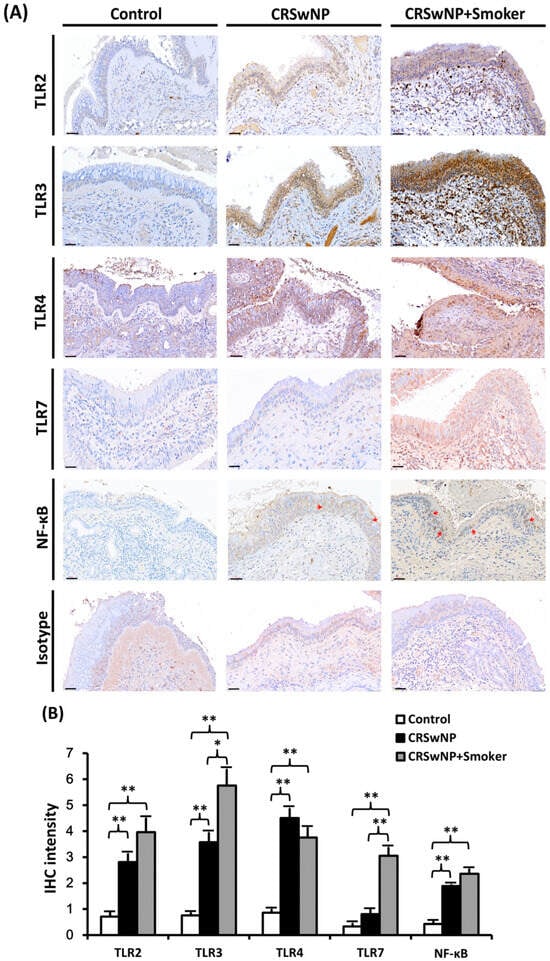
Expression of TLRs and the transcription factor NF-κB in nasal polyp tissue of CRSwNP and CRSwNP smokers. (A) This study involved three groups: the control group (n = 21), the CRSwNP group (n = 25), and the CRSwNP + Smoker group (n = 24). Nasal mucosal tissue sections were stained via IHC for TLR2, TLR3, TLR4, TLR7, and NF-κB with the corresponding normal immunoglobulin G (IgG) as the isotype control. Scale bars = 50 μm. Red arrows indicate nuclear staining. (B) Quantitative analysis graph comparing the immunohistochemical staining intensity of TLR2, TLR3, TLR4, TLR7, and NF-κB among these groups. * p < 0.05 and ** p < 0.01 were considered statistically significant.
  • Article
  • Open Access

Uterine physiology may differ among cattle managed under different farming systems. This pilot study evaluated uterine NAMPT/visfatin and SPP1/osteopontin in pregnant and luteal-phase non-pregnant cattle from one intensive beef farm (INT; n = 7; nulliparous heifers aged 14–18 months, crossbred with a predominant Limousin genetic background) and one extensive farm (EXT; n = 6; Lidia cows aged 28–34 months). Formalin-fixed paraffin-embedded uterine tissues were analyzed by RT-qPCR and immunohistochemistry. Visfatin immunoreactivity was mainly localized in the luminal epithelium and uterine glands. NAMPT expression was higher in the INT cohort than in the EXT cohort (0.6331 ± 0.0855 vs. 0.3632 ± 0.0395; p = 0.0200), whereas SPP1 expression did not differ between cohorts (0.2056 ± 0.0661 vs. 0.1806 ± 0.0562; p = 0.7786). Visfatin immunostaining scores were significantly higher in INT than EXT cows in the secretory adenomeres (median [IQR]: 2.37 [2.15–2.52] vs. 1.48 [1.38–1.77]; p = 0.0012), whereas no significant difference was detected in the combined luminal epithelium/glandular duct compartment (p = 0.4639). Because age, breed, and farm of origin were confounded with management system, these findings should be interpreted as exploratory between-cohort associations.

Immuno

10 November 2026

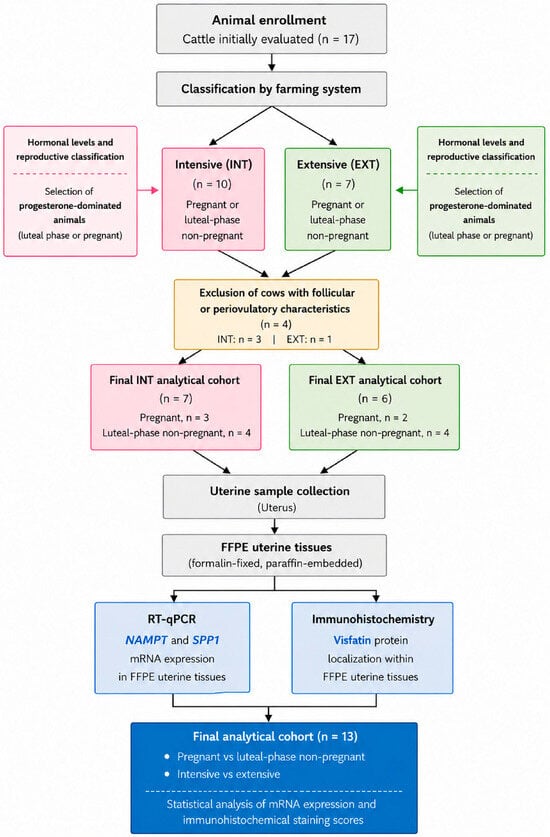
Experimental design and analytical workflow of the study. Seventeen cows were initially evaluated and classified according to farming system as intensive (INT, n = 10) or extensive (EXT, n = 7). Following reproductive classification, four cows showing follicular or periovulatory characteristics were excluded (INT, n = 3; EXT, n = 1). The final analytical cohort therefore comprised 13 cows, including five pregnant and eight luteal-phase non-pregnant animals, distributed between the INT (n = 7) and EXT (n = 6) cohorts. These biologically distinct reproductive categories were pooled only for exploratory between-cohort analyses because both were characterized by progesterone-dominated endocrine profiles. Uterine tissues collected post-mortem were processed as formalin-fixed paraffin-embedded samples and analyzed by RT-qPCR for NAMPT and SPP1 mRNA expression and by immunohistochemistry for visfatin localization and staining intensity. Comparisons were performed between the final INT and EXT analytical cohorts.
  • Review
  • Open Access

Obesity-related hypertension represents a major threat to global cardiovascular health, driven fundamentally by chronic low-grade sterile inflammation rather than simple hemodynamic aberrancy. Recently, the endosomal pattern recognition receptor, Toll-like receptor 7 (TLR7), has emerged as a crucial dual-regulatory immunometabolic checkpoint. Synthesizing current molecular and cellular evidence, this review systematically delineates the context-dependent mechanisms of TLR7 in hypernutritional microenvironments. Traditionally sensing viral nucleic acids, TLR7 is ectopically triggered in obesity by endogenous danger-associated molecular patterns (DAMPs), such as cell-free nucleic acids and modified extracellular vesicles. We decrypt how sustained endosomal TLR7 activation promotes adipose tissue inflammation, insulin resistance, and persistent vascular wall injury by inducing endothelial dysfunction, NADPH oxidase-mediated oxidative stress, and maladaptive arterial remodeling. Furthermore, we evaluate the translational traps of systemic TLR7 inhibition, including compromised host antiviral immunity. Finally, we highlight innovative engineering paradigms, such as computer-aided allosteric modulators (e.g., AlphaFold3) and spatiotemporally controlled perivascular nanomedicines, providing a precise therapeutic roadmap for obesity-related cardiovascular crises.

Immuno

9 November 2026

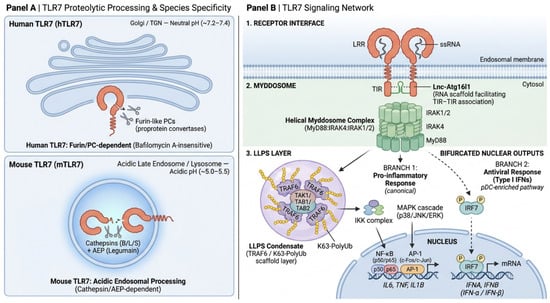
Species-specific proteolytic processing, intracellular trafficking, and bifurcated signaling dynamics of TLR7. (A) Proteolytic Processing & Species Specificity: Human TLR7 (hTLR7) undergoes cleavage by Furin-like proprotein convertases (PCs) in the Golgi/Trans-Golgi Network (TGN) under neutral pH (~7.2–7.4), rendering it bafilomycin A-insensitive. Conversely, mouse TLR7 (mTLR7) relies on acid-dependent cleavage by cathepsins (B/L/S) and asparagine endopeptidase (AEP/Legumain) within acidic late endosomes/lysosomes (pH ~5.0–5.5). (B) TLR7 Signaling Network: (1) Receptor Interface: Endosomal ssRNA/DAMP binding induces conformational dimerization, aided by the long non-coding RNA scaffold Lnc-Atg16l1, which facilitates TIR-TIR association. (2) Myddosome Assembly: Recruits MyD88, IRAK4, and IRAK1/2 to assemble a Helical Myddosome Complex (MyD88:IRAK4:IRAK1/2). (3) LLPS Layer & Bifurcated Nuclear Outputs: TRAF6 and K63-linked polyubiquitin chains form liquid–liquid phase separation (LLPS) biomolecular condensates. This scaffold layer cascades into two major functional branches: Branch 1 (Canonical Pro-inflammatory) triggers the IKK and MAPK (p38/JNK/ERK) axes, promoting NF-κB (p50/p65) and AP-1 nuclear translocation to transcribe IL6, TNF, and IL1B; Branch 2 (Antiviral Response) operates preferentially in plasmacytoid dendritic cells (pDCs), phosphorylating IRF7 to drive type I interferon (IFNA, IFNB) transcription.
  • Review
  • Open Access

Fungal infections and their pathogens have become a significant global public health issue, with 6.5 million invasive cases and 3.8 million deaths annually, particularly affecting individuals with weakened immune systems or underlying health conditions. This narrative review aims to describe current knowledge (2010–2026) on the most clinically relevant fungal pathogens (WHO list) and traditional antifungals and innovations, including rezafungin, ibrexafungerp, olorofim, and isavuconazole. Kazakhstan’s roseofungin presents as a broad-spectrum polyene for candidiasis and dermatomycoses, limited by producer productivity; however, it is promising for local markets. The review also emphasizes novel antifungal probiotic methods and their potential use as adjuncts to conventional therapy. Antifungal probiotics (Lactobacillus spp., Saccharomyces boulardii) reduce Candida biofilms and colonization as adjunctive therapies, corroborated by randomized controlled trials and meta-analyses. The rising resistance to current antifungal drugs, along with toxicity, limited pharmacological diversity, and restricted access in numerous places, continues to impede the successful management of mycoses.

Immuno

6 November 2026

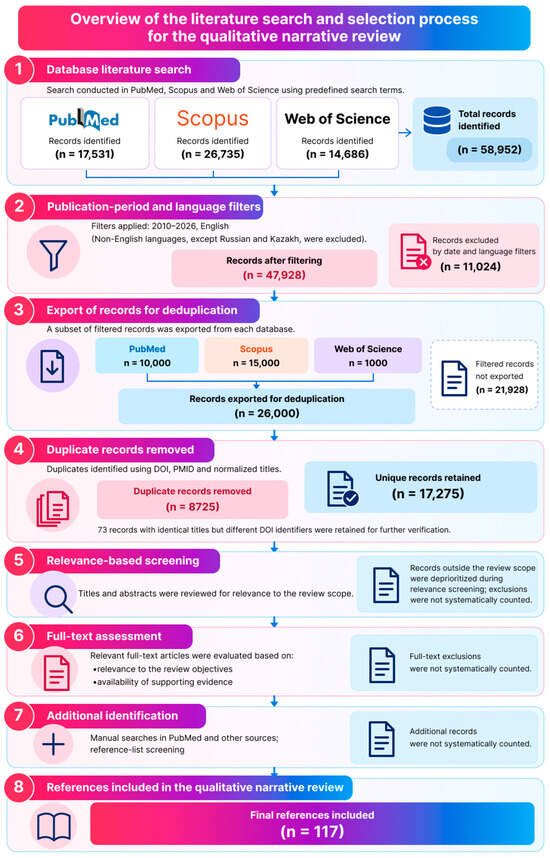
Overview of the literature search and relevance-based selection process. The search strategy, selection workflow, and scientific content were developed by the authors. The figure was created using Figma.com.

Highly Accessed Articles

News & Conferences

Latest Issues

Open for Submission

Journal Sections

XFacebookLinkedIn
Immuno - ISSN 2673-5601