


Abstract
The Bronx bears close to one-third of all violent crimes in New York City, and 90% of the victims are male young adults between the ages of 24 and 65 years of age from a racial and ethnic minority. The voices of marginal urban young adults living in communities with a high incidence of violent crime are often misunderstood and therefore excluded from research and community practice opportunities. The focus of this manuscript is to showcase the opportunity for economic evaluation to involve hard-to-reach community members in research and community-orientated violence prevention in the Bronx. This pilot study introduced the willingness-to-pay—WTP—approach among two samples of young adults to prioritize their violence prevention ideas. The WTP approach relies on surveys to elicit the subjective value that individuals place on public goods that are not traded in the marketplace. The first sample was comprised by 298 college students. This sample completed an online quantitative survey, and the second sample was divided into two qualitative focus groups with a total of 32 young adults enrolled in a community crime prevention program. This study asked participants their willingness to pay to prevent different types of violent crimes in the Bronx. The results indicate young adults perceive sexual assault as a higher priority compared to other violent crime offenses, including homicide. The results suggest that programs and interventions that illustrate the economic loss to society related to crime, such as losses in productivity, costs to health care, and ultimately the societal costs of premature mortality, may engage young adults in a meaningful conversation about crime prevention. The participants rated the Contingent Valuation (CV) methodology as innovative and were keen to discuss economic concepts and the value of life.
1. Introduction
In New York City (NYC), violent crime especially affects young adults. Among the most serious offenses in 2023, the Bronx had 121 murder cases, 651 sexual assault and rape cases, and 8260 felony assaults. The Bronx is one of the five city boroughs in NYC. This represents 30% of all murder cases in NYC, 26% of rape cases, and 30% of felony assaults [1]. The Bronx also remained a setting for gun violence, with 375 people shot in 2023.
When it comes to victims of homicides, 20% were between 18 and 24 years of age, 31% were between 25 and 34 years of age, and 90% of all victims were men [1].
In the Bronx specifically, several prevention programs have used these guidelines to tailor gun violence community prevention initiatives. These programs have different names, for example: Bronx Connect, Bronx Rises Against Gun Violence (B.R.A.G.), Guns Down, Life Up!, Save our Street (S.O.S.), and Stand Up to Violence (S.U.V.), among others. The implementation of these programs invites a multisector collaboration with neighboring hospitals, NYC Department of Education (DOE) schools, and nonprofit organizations to facilitate crime prevention and safety programs [2,3]. Most of these interventions focus on engaging young adults in employment, training, and educational opportunities and have also been shown to decrease their involvement in violent crime [4,5]. Moreover, the NYS Department of Labor (DOL) funds Gun Violence Prevention Initiative programming for NYS at-risk youth and young adults 18–24 years of age [6]. There is scarce evidence of the effectiveness of these programs in terms of violent crime prevention. The John Jay College Research Advisory Group policy report on crime prevention suggest the following to be implemented in NYC: (1) improve the physical environment, (2) policy reforms related to gun-control and reduction in substance use, (3) offer opportunities to address economic inequality, (4) improve the criminal justice system’s transparency, and (5) confront gun violence and engage with support of the youth in crime prevention, among others [5]. Although these policies have been implemented concurrently, rigorous evaluations have not linked their enactment with reductions in mortality [5]. Young people are the most affected by violent crimes, and most fatalities occur among young adults between the ages of 15–24 years. Therefore, young adults’ planning and engagement in crime prevention policies are critical for these to be successful.
To this end, this project used two methods: cost–benefit analyses (CBAs), known as Contingent Valuation (CV), and willingness-to-pay (WTP) surveys, with two samples of participants from the Bronx to capture young adults’ input in crime prevention community initiatives and their prevention priorities. The first approach was quantitative via an online survey with college students, and the second was a qualitative focus group with young adults with exposure to violent crime participating in a community program.
2. Materials and Methods
CBA methods seek to monetize the benefits and the costs of a program or intervention into a single currency to evaluate if the benefits outweigh the costs. To depict the diversity of young adults in the Bronx, this study opted to collect one quantitative sample among college students and one qualitative data collection in two different groups of young adults participating in crime prevention programs in their community. This project hypothesized that higher education is a protective factor against violent crime and that their perspectives are different from those of young adults in community prevention programs. Having two data collection methods enabled distinctive goals for each.
The qualitative portion of the research focused on gathering young adults’ perceptions of violent crime in the Bronx. This approach used a focus group format to introduce, explain and guide discussion on what causes violent crime, populations at risk and what WTP amounts participants considered viable to prevent it. The quantitative portion of the research used an online survey among a sample of college students and sought to collect the WTP amounts for different types of violent crimes and ranks of policies. An important distinction between the qualitative and the quantitative data collection was that only the qualitative method included a direct interaction with the research team to facilitate the research approach.
2.1. Inquiry Approach
CV methodology relies on surveys to elicit the subjective value that individuals place on public goods that are not traded in the marketplace, such as clean air or clean water, or a violence-free society. The method of the CV method is that respondents are asked to think about the public good as if it could be purchased in the marketplace, and then they are asked how much they would be willing to pay for it. Study participants are presented with the current risk of violent crime in their community and asked, one type of crime at a time, the hypothetical amount they are willing to pay (WTP) to prevent it. Respondents were asked about their WTP for burglary, aggravated assault, sexual assault, and homicide. As such, respondents’ (WTP) amount reflects the value they place on the public good, which can thus be used as the benefits measure. The rate at which an individual would exchange his or her own money to reduce the probability of death is used to estimate the Value of a Statistical Life (VSL) [7]. VSL summarizes the willingness-to-pay estimate for a mortality risk reduction to calculate benefits. Benefits are computed as the expected deaths avoided by the policy change times the average WTP value [7]. This study did not calculate the VSL. Theoretically, VSL values are primarily used to calculate the benefits portion of the CBA evaluations. CV studies valuing risk reduction have traditionally underestimated minority populations and currently overemphasize the value of mortality risk from wage differentials for on-the-job risk exposure [8].
2.2. Study Populations
This is a mixed-method study of quantitative and qualitative methods using the CV approach to elicit WTP surveys with two study populations comprising young adults. Developmental psychologists and medical organizations often narrow this range to 18 to 25 as individuals in a stage of young adulthood. The Society for Adolescent Health and Medicine defines this time as optimal for purposeful prevention that may alter trajectories and decrease threats to health along the adult life course [9]. The following inclusion criteria were applied to both samples: young adults between 18 and 25 years of age who reside in the Bronx; and the exclusion criteria were: young adults younger than 18 years of age and older than 25 years of age who do not reside in the Bronx.
The quantitative approach was used via an online instrument among a sample of college students enrolled at an urban public university in New York City (NYC) located in the Bronx, and the qualitative approach was applied in two focus groups of young adults participating in a community violence prevention program. The implementation of this study was post-pandemic, and conducting the online surveys for college students was feasible in 2021. While best practice with youth victims of VC is to have conversations, fostering trust and healthy community relationships, this was only possible in 2022.
2.3. Sample Recruitment
For the college students’ sample, a general announcement, via a flyer, was developed and posted across the campus to invite students to participate in the research project. Interested students were invited to participate in an online eligibility screening, and if criteria were met, students were invited to complete an online consent form along with the online survey. Students from the urban college campus located have the following overall demographic description: 68% are female; 46.2% are under 22 years of age; 56% are first-generation college students; 35% were born outside the US; 50% report having a household income lower than US$30,000; 53% report being Hispanic, and 30.3% non-Hispanic Black [10].
The sample of youth participating in the community-based crime prevention program was drawn from the Good Shepherd Services’ B.R.A.G. (Bronx Rises Against Gun Violence) program. B.R.A.G. is a community-based organization working with young adults in violence prevention. This sample was composed of sample of B.R.A.G.’s participants. Recruitment for the youth participating in the violence prevention program was done via the B.R.A.G. ongoing therapeutic workshops. Workshop participants were notified via text and email by the B.R.A.G. outreach team about the opportunity to participate in the focus group. Those interested were asked to stay an additional 1 h. from the scheduled activity. Two B.R.A.G locations in the Bronx were targeted: Mott Haven and Wakefield. A $20 e-gift card was distributed to those participating to compensate for their time [11].
2.4. The Study’s Instrument
The online survey and focus group followed the same CV survey. Few modifications were made to accommodate the focus group discussions. The online survey used the SurveyMonkey platform (SurveyMonkey Inc., San Mateo, CA, USA), while the focus groups used the Mentimeter platform (Mentimeter AB, Stockholm, Sweden). SurveyMonkey provided an http:// link to the survey to complete a consent form and the survey online. The focus groups used the Mentimeter platform to collect responses and guide the discussion. Mentimeter is an interactive education platform tool that allows the creation of interactive word clouds, live and instant polling, and developing questions and answers (Q&A). Mentimeter allowed study participants to pose and respond to questions directly and anonymously.
Following best practices in CV, the CV survey provided verbal protocols to establish the “contingent” market. Respondents were first presented with violent crime rates, graphs and infographics before being asked to state their WTP to reduce violent crime deaths in their community. These rates were presented factually with the intent to give participants current crime rates and improve the decision-making of participants when the willingness-to-pay scenarios were presented. The study samples evaluated violent crime risk in two scenarios: (1) a 10% reduction in the risk of violent crime from 100 to 90 per 100,000 in the quantitative sample and a 50% reduction in the risk of violent crime from 100 to 50 per 100,00 in the qualitative sample—different risk reduction scenarios were used to facilitate the younger sample’s understanding of mathematical decreases in risk; and (2) a reduction of one in ten violent crimes. Socio-demographic information such as age, gender, race/ethnicity, and income was collected to assess differences between groups, and a double-bounded dichotomous choice between (yes) and (no) of CV. First, the research team pilot-tested the method, and therefore, respondents were asked an initial WTP value that could range from zero to infinity. Once this value was explicit, another question followed by a second question of WTP value that was either higher, or they responded that they would consider a higher number than the first value, or lower (no) than the first WTP value, depending on the answer to the first question. The double-bounded dichotomous choice between (yes) and (no) of CV is sequential and seeks to establish the value of violent crime prevention by type of violent offense. Double-bounded dichotomous choice improves accuracy and statistical efficiency over single questions by adjusting the second price up or down based on the first answer [12].
To correct for a potential starting point of a bias of zero, the value presented—pre-tested in a focus group published elsewhere—of $25 was used to determine the baseline values [13,14]. Therefore, the first value presented to participants was open-ended above $25, and the following WTP values presented were either $25 higher (if the first response was “yes”) or $25 lower (if the first response was “no”). Both groups valued the same mortality risk reduction. The data collection instrument presented the following prompt: “Assume you have been called to vote on a proposal aimed at reducing community crime” [to different types of crime prevention: burglary, sexual assault, or homicide]. Each crime was presented separately.
This crime prevention intervention has worked in the past and has community support.
Furthermore, participants were asked to rank the following policies in terms of their perception of effectiveness: initiatives that promote gun safety; initiatives that reduce access to weapons; initiatives that promote community and civic engagement; initiatives that increase police enforcement; initiatives that modify the urban environment (i.e., city planning); and initiatives that incarcerate offenders. Policy options were extracted as examples from the “Reducing Violence Without Police: A Review of Research Evidence” policy report [5].
2.5. The Study’s Analyses
For the quantitative analysis, this study used proven methods co-authored with Corso et al. 2013 and 2017 in CV studies related to Child Maltreatment in samples in Georgia and Ecuador using survival analysis [15,16].
The analytical plan was published elsewhere [16], and described below:
Yi* is represented by the model.
Yi* = Xiβ + ∈i, where ∈i is normally distributed with a mean zero, and Xi represents individual respondent characteristics.
While Yi* was not directly observed for respondent i, it is known to lie in the interval [Yi Yi2] based on responses elicited in the CV survey. The corresponding likelihood contribution is described below:
Pr (Yi1 ≤ Yi* ≤ Yi2) = Pr (Yi1 ≤ χiβ + ∈i ≤ Yi2)
When an upper bound is unknown (right-censored data), the likelihood contribution is: Pr (Yi1 ≤ χiβ + ∈i).
When a lower bound is unknown (left-censored data), we set a lower bound of zero, and the likelihood contribution is:
Pr (0 ≤ χiβ + ∈i ≤ Yi2).
The primary independent variable of interest for the model is the indicator of whether the respondent was asked to respond to a question about mortality reduction caused by violent crime. Other variables to be included are gender, age, race and ethnicity, and income. Values were bootstrapped standard errors (1000 replications) to correct for bias, with 95% confidence intervals (CIs) on the mean WTP. The maximum likelihood function with interval regressions using the intreg command in Stata/SE version 15 was used.
To study the B.R.A.G. group this study used the WTP CV question in the quantitative study in a focus group format. Focus group responses were analyzed using a thematic analysis approach [17]. This process was complemented by Mentimeter’s interactive features. The Mentimeter interactive platform produced a PDF file with all responses.
Participants responded to the CV questions using tablets and phones. Responses were captured in word clouds, bar charts, comments boxes, and other interactive tools. Furthermore, study participants’ quotes were selected to illustrate the findings and results of the themes identified. Unedited quotes are transcribed verbatim from the focus group discussion.
3. Results
The conclusion of this manuscript are the combined results from the two samples surveyed. The qualitative research comprised young adults participating in community violence prevention from Bronx high schools studied in focus groups, and the quantitative online survey comprised a sample of college students enrolled in an urban college in the Bronx. There were no statistical differences between the samples of the study, and therefore, the following describes the socio-demographic characteristics of all studied participants. All respondents reported meeting the inclusion criteria of being between 18 and 25 years of age and residents of the Bronx. Over 75% of respondents self-identified as female, and 45% identified as non-White Hispanic, with Dominican descent as the most common Hispanic ancestry, followed by Puerto Rican, Cuban, Mexican, Honduran, and El Salvadoran. Only 10% of the sample self-identified as Black/African American and 7% as multiracial. No statistical differences were found between the two genders. When it comes to family composition, close to 40% described their household as living with adults with no children or dependents (examples: living by yourself, roommates, or family adults); 30% responded as having two-parent households, understood as adults with dependents who are minors (note this could be: biological parents, stepparents, or grandparents); 20% were from single-parent families, understood as one adult raising one or more children on his/her own; and 14% from an extended family, understood as families with dependents of different ages and more than one adult responsible for the family unit (examples: stepchildren; grandparents).
This project sought to test whether willingness-to-pay and CV questions that present mortality risk associated with violent crime are valid methods to collect young adults’ priorities in violence prevention and identify their violence prevention priorities. Superficially, the qualitative portion of the research focused on gathering young adults’ perceptions of violent crime in the Bronx, and the quantitative portion on collecting the WTP amounts for different types of violent crimes and ranks of policies. To this end, this section is divided into the results obtained by each method to adequately present the sample sizes, analytic units, and the interpretation of willingness-to-pay estimates of each.
3.1. Quantitative Results
The study recruited 298 college students for the online WTP sample with college students. The analysis focused on WTP values for murder/homicide and sexual assault. The NYC Police Department classifies these as upper-tier crimes [18]. A t-test indicates no significant differences in the mean values of the WTP to a reduction in risk of 10% after the first and second probe. The results from this analysis are presented in Table 1.
Table 1.
Results from WTP online quantitative survey with college students (N = 298).
Participants reported higher mean values for sexual assault at the questions of WTP at all levels of questions (<less than 100 dollars, 100 ≥ 1000, and at >1000 dollars). The maximum value in the WTP for murder was from the first probe to the next probe, increasing from $1000 to $1500, while the minimum remained at $25. For the minimum and maximum values for sexual assault, the minimum remained at $25, while the maximum was $2000. Both these ranges explain that the mean values are greater for sexual assault than for murder.
Furthermore, Table 2 presents the results of the ranking of perceptions of policy effectiveness toward crime prevention among the college students’ sample.
Table 2.
Ranking of participants’ perception of policy effectiveness toward sexual assault prevention (n = 290) *.
The quantitative results indicate that young adults enrolled in college perceive sexual assault as a higher priority compared to other violent crime offenses, including homicide, and participants in the focus groups confirmed this finding and discussed in depth that sexual assault/rape was six times higher than homicide and victims are overwhelmingly young women. The most effective policies to prevent sexual assault are to have strong and non-tolerant prosecution of sex offenders. Therefore, the results indicate that among the policies proposed, young adults ranked as #1 initiatives that incarcerate offenders to prevent violent crime, followed by initiatives that promote gun safety. Initiatives that modify the urban environment or promote community and civic engagement were ranked the lowest.
3.2. Qualitative Results
Focus group participants were more active in describing sexual assault/rape risk using narratives than using economic terms. Two B.R.A.G focus groups were executed for the qualitative analysis. The focus groups were executing in Mott Haven and in Wakefield. A total of 32 young adults participated in the focus groups. Each location had 16 participants who met the eligibility criteria for the study, in terms of age and Bronx residency.
The focus group format allowed for the WTP questions, along with discussion of crime prevention in the Bronx. The WTP exercise in the focus group was divided into several questions and different types of crime. Table 3 presents the WTP values for burglary, murder, and sexual assault. In addition, two questions were added to assess participants’ overall WTP for all types of crimes and crime prevention policies. Mean values were not significant, and participants expressed higher values for sexual assault prevention.
Table 3.
WTP values (all the data) (2 focus groups) March–April 2022.
The CV questions that prompted the most discussion were the following: (1) “Why do you think it is important to discuss violent crime prevention?”; and (2) “What precautionary measures do you think can be put in place to avoid being a victim of crime?” Participants were encouraged through discussion to propose more than one answer to the question (see Table 4). Table 4 The table was created by the authors to facilitate the interpretations of participants.
Table 4.
Qualitative discussion related to importance and precautionary measures to violent crime prevention.
The participants’ responses focused on the relation between violence and public safety and therefore on police and justice involvement in the Mott Haven youth group. On the other hand, the Wakefield youth group linked violent crime to community prevention and socio-determinants of health. These include mental health, public safety, family, peers, and others. Furthermore, the focus group’s discussion focused on asking participants about their perception of community. Participants answered the following question: “Why do you think young people should be discussing violent crime prevention strategies?” Some of the participants’ answers are listed below (note: responses have not been edited for grammatical correctness and reflect the exact responses of participants in the word cloud exercises):
“To help each other”“We are the future”“Because it’s needed”“Because we are young”“Cause we are the future and if we are killing each other we have no future”“Cuz most crimes are often caused by teens”“Because a lot of kids are dieing”Because we are the demographic that commits the crimeTo prevent other youth from being affected from itAlso younger voices can be heard more because we’re the new
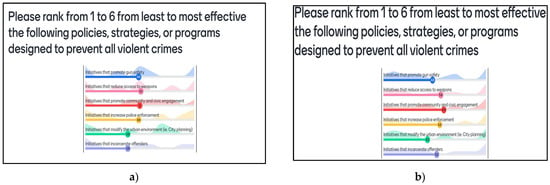
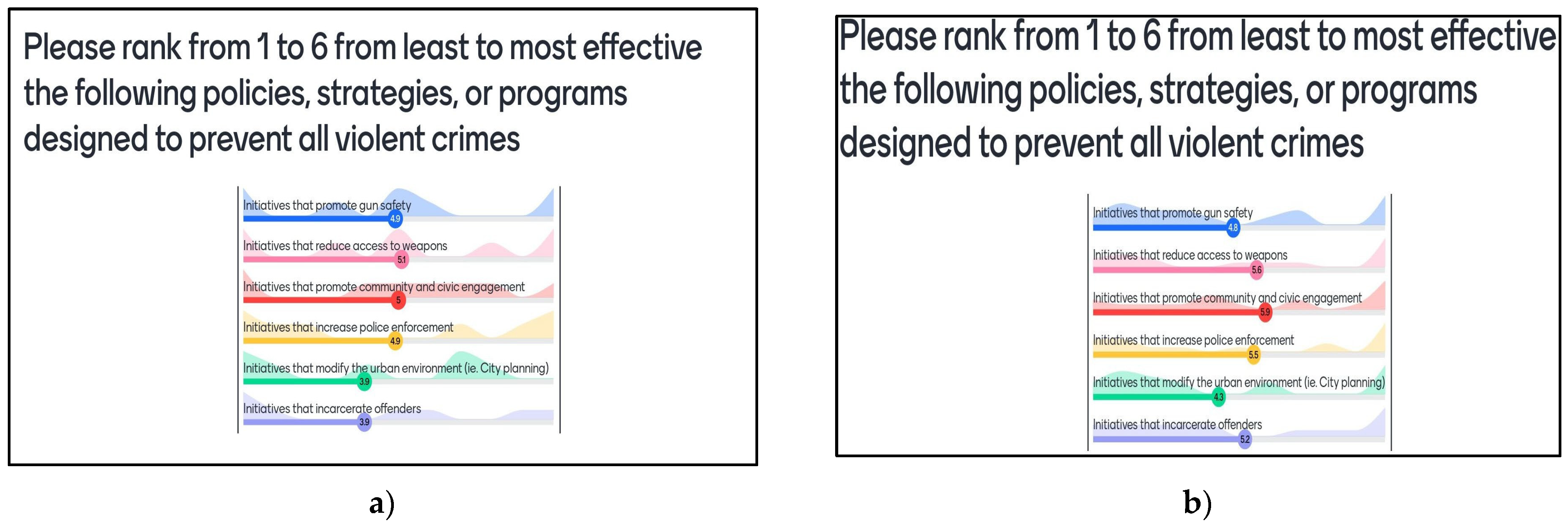
Participants were asked about and discussed the policy priorities. Figure 1a,b illustrate participants’ responses. The results indicate young adults in community crime prevention initiatives rank them equally to initiatives related to reducing access to weapons and gun safety proposals. Incarceration proposals were the lowest-ranked.
Figure 1.
(a,b) Graph produced by the Mentimeter platform.
4. Discussion
The results from this investigation indicate young adults and young adults perceive sexual assault as a higher priority compared to other violent crime offenses, including homicide. This is especially clear among the college sample. This finding is contrary to other CV results that suggest that mortality risk is associated with higher WTP amounts [19]. However, the sample was represented mainly by female respondents and supported by the literature as the population with a higher perception of risk of sexual assault [20]. Mean values in the range between 100 dollars and less than $100 are similar for murder and sexual assault. At the baseline, participants are willing to pay $249 and $208 of their household income annually to a community-driven initiative that targets murder or sexual assault, respectively, as presented in Table 1. When asked about an amount greater than $1000 dollars, participants were willing to pay a higher amount for sexual assault prevention than homicide. WTP values for sexual assaults were $3391 compared to $429 for homicide. These results, based on data from the college student and the quantitative survey, suggest young adults in the Bronx perceive a greater risk and are more willing to participate in violent crime prevention that addresses sexual assault. The results in Table 3 on the qualitative survey mimic the same trend: sexual assault yields the highest mean WTP among the violent crimes surveyed. This finding is marginally consistent with 2023 studies that compare low- and high-harm crimes at WTP estimates [21]. These results associate high-harm crimes with the number of crimes, which results in higher WTP for low-volume, high-harm crimes (e.g., sexual assault) than high-volume, low-harm crimes (e.g., theft from cars) [21]. The present study did not include the volume of sexual assaults in any particular time period in the WTP elicitation, which may explain these differences.
For sexual assault, the initiatives that were ranked #1 as having the most policy effectiveness are the incarceration of offenders, followed by gun control initiatives. These findings need to be interpreted with caution, as there are large standard deviations and confidence intervals observed in some WTP categories that suggest considerable heterogeneity among the respondents. Evidence exists of the usefulness of the CV approach for valuing the benefits of violence prevention. CV research on crime prevention focusing on presenting study participants with hypothetical risk reductions using rates (i.e., one crime in 10, or 100 in 10,000) has yielded estimates of WTP amounts of $100 to $150 per year for different types of crime. Collectively, these estimates suggested community members were willing to pay $25,000 per burglary, $70,000 per serious assault, $237,000 per sexual assault, and $9.7 million per homicide [22], while other research suggests that using percentage-based language yields higher amounts. Researchers found that presenting participants with a survey of crime reduction in 30% yielded a WTP amount of USD 1.2 million per injury [23,24]. Furthermore, evidence of CV research on interpersonal violence suggests WTP valuations are associated with knowledge or experience of violence. Corso et al. 2011 valued the benefits of preventing Child Maltreatment deaths [25], and Shadoin 2007 valued how much respondents would be willing to pay for programs to prevent child abuse deaths, sexual abuse, and physical abuse [26]. These studies reported a mean WTP per person of $148 (in 2008 US$) and a median of $151 (in 2008 US$), for a one in 100 000 reduction in the mortality risk associated with CM, and the latter suggested a positive correlation between WTP for prevention of CM and both knowledge of CM and self-reported empathy [26,27]. More research is needed that explores higher risk reductions to investigate if these levels of risk would result in better engagement or different priority settings.
The young adults encountered challenges with CV methodology in the focus groups, as theyanswered informally, using full sentences instead of numbers, and required lengthy explanations of the concepts. The facilitators recognized the group lacked experience in policy discussions, and lack of experience may have resulted in casual responses. With this being said, in the final discussion with participants about why they should be included in policy prevention conversations and discussions, participants believed firmly they should be included as they are victims and perpetrators of violent crime in the Bronx, and welcomed the opportunity to be included in policy discussions. Evidence on the risk and protective factors and intervention strategies to prevent youth crime could offer important keys for predicting future offense outcomes and assist in developing effective preventive and early intervention strategies [26].
The findings of this research, therefore, support that CV methods are an innovative approach and attractive concept for this age group. The young adults in the focus group enjoyed speaking about economic concepts and the value of life. Programs that illustrate the economic loss to society because of crime, such as losses in productivity, costs to health care, and ultimately the societal costs of premature mortality, may engage young adults in meaningful conversations about crime prevention.
5. Conclusions
The results from this study indicate young adults are active participants in crime prevention discussions. And among the different violent crime offenses, sexual assault is a priority for young adults in the Bronx.
The strength of the results lies in selecting a violent injury most relevant to this demographic, and less on the point estimate of WTP. The researchers of this paper adapt economic evaluation tools to the field of community violence prevention. The results consistently indicate that respondents perceive sexual assault as a higher priority than homicide and other violent crimes, both in terms of willingness-to-pay estimates and policy preferences. Violent crime data indicate young adults can be victims and potential perpetrators, and therefore rank prevention strategies that deter crime involvement, such as programs that promote incarceration, as the highest priority. By targeting the economic aspects of general crime-related losses, adolescents are more involved in discussions and more engaged in meaningful conversations on these topics. The qualitative findings further reinforce the importance of community engagement, mental health and well-being, and youth participation in prevention initiatives. Lessons from the willingness-to-pay exercise indicate young adults need visual aids and in-depth discussion to process the CV of crime in terms of costs and benefits. That said, when costs and benefits are valued from examples from the literature, young adults in this study were motivated and engaged in the discussion. CBAs are an important tool of regulatory and policy development and require an adequate measure of the economic value of prevention programs. However, estimating the benefits of prevention is challenging when the health outcome is reduced mortality gaps. Therefore, community exercises that introduce decision analysis tools and economic evaluation methods need to be explored.
Author Contributions
M.I.R. conceptualized and developed the methods and formal analysis of the research protocol. C.D. conducted the community outreach, recruitment and contributed to the data curation and analyses. All authors have read and agreed to the published version of the manuscript.
Funding
This research was funded by PSC CUNY grant cycle 54; and by the Center for Medicaid and Medicare Services grant number 1W1CMS331932.
Institutional Review Board Statement
This study obtained approval from the Institutional Review Board, the Ethics Committee under the research protocol titled: “Using contingent-evaluation to estimate the economic value community place to prevent community violent crime in the Bronx, NY” from CUNY HRRP under the protocol number 2021–2176, approved on 2 May 2024. The Principal Investigators of this research are CITI-certified to conduct human subject research.
Informed Consent Statement
Informed consent was obtained from all subjects involved in the study.
Data Availability Statement
The raw data supporting the conclusions of this article will be made available by the authors on request. Raw data requires formatting and therefore authors would need time to gather and compile to share with other researchers.
Acknowledgments
The authors thank the staff of Good Shepherd Services’ B.R.A.G. (Bronx Rises Against Gun Violence) program and to the Bronx service-based organization Compassion for their support in this grant and dedication to preventing gun violence in the Bronx.
Conflicts of Interest
The authors declare no conflicts of interest.
References
- Office of the District Attorney Bronx County. 2023 Annual Report; Office of the District Attorney Bronx County: Bronx, NY, USA, 2023.
- New York State Department of Health. NYS Health Improvement Agenda’s Blueprint; New York State Department of Health: New York, NY, USA, 2020.
- New York State Department of Health. NYS Health Improvement Agenda’s Blueprint; New York State Department of Health: New York, NY, USA, 2024.
- Wood, G.; Tyler, T.R.; Papachristos, A.V. Procedural justice training reduces police use of force and complaints against officers. Proc. Natl. Acad. Sci. USA 2020, 117, 9815–9821. [Google Scholar] [CrossRef] [Scilit] [PubMed]
- John Jay College Research Advisory Group on Preventing and Reducing Community Violence. Reducing Violence Without Police: A Review of Research Evidence; Research and Evaluation Center—John Jay College of Criminal Justice, City University of New York: New York, NY, USA, 2020. [Google Scholar]
- Tollestrup, J.; Lynch, K.E.; Bradley, D.H.; Cornell, A.S.; Morton, W.R.; Napili, A.; Sekar, K.; Shohfi, K.D. Labor, Health and Human Services, and Education: FY2022 Appropriations; CRS Report R47029, Version 5. Updated; Congressional Research Service: Washington, DC, USA, 2022.
- Hanemann, W.M. Willingness to pay and willingness to accept: How much can they differ? Am. Econ. Rev. 1991, 81, 635–647. [Google Scholar]
- Viscusi, W.K.; Aldy, J.E. The Value of a Statistical Life: A Critical Review of Market Estimates Throughout the World. J. Risk Uncertain. 2003, 27, 5–76. [Google Scholar] [CrossRef] [Scilit]
- Society for Adolescent Health and Medicine. Young Adult Health and Well-Being: A Position Statement of the Society for Adolescent Health and Medicine. J. Adolesc. Health 2017, 60, 758–759. [Google Scholar] [CrossRef] [Scilit] [PubMed]
- Lehman College. Facts About Lehman. Available online: https://www.lehman.cuny.edu/about/fast-facts/ (accessed on 4 August 2026).
- Mentimeter. Mentimeter. 2023. Available online: https://www.mentimeter.com/solutions/education (accessed on 4 August 2026).
- Aikoh, T.; Shoji, Y.; Tsuge, T.; Shibasaki, S.; Yamamoto, K. Application of the double-bounded dichotomous choice model to the estimation of crowding acceptability in natural recreation areas. J. Outdoor Recreat. Tour. 2020, 32, 100195. [Google Scholar] [CrossRef] [Scilit]
- Cuccia, T. Contingent valuation. In Handbook of Cultural Economics, 3rd ed.; Edward Elgar Publishing: Cheltenham, UK, 2020. [Google Scholar]
- Roldós, M.I. Perceptions of Violent Crime Among a Sample of Bronx College Students: Results From Focus Groups. In Urban Social Work; Springer: Berlin/Heidelberg, Germany, 2024. [Google Scholar]
- Corso, P.S.; Ingels, J.B.; Roldós, M.I. A Comparison of Willingness to Pay to Prevent Child Maltreatment Deaths in Ecuador and the United States. Int. J. Environ. Res. Public Heal. 2013, 10, 1342–1355. [Google Scholar] [CrossRef] [Scilit] [PubMed]
- Roldós, M.I.; Corso, P.; Ingels, J. How much are Ecuadorians Willing to Pay to Reduce Maternal Mortality? Results from a Pilot Study on Contingent Valuation. Int. J. MCH AIDS 2017, 6, 1–8. [Google Scholar] [CrossRef] [Scilit] [PubMed]
- Saunders, C.H.; Sierpe, A.; Von Plessen, C.; Kennedy, A.M.; Leviton, L.C.; Bernstein, S.L.; Goldwag, J.; King, J.R.; Marx, C.M.; Pogue, J.A. Practical thematic analysis: A guide for multidisciplinary health services research teams engaging in qualitative analysis. BMJ 2023, 381, e074256. [Google Scholar] [CrossRef] [Scilit] [PubMed]
- Office of the District Attorney Bronx County. 2021 Annual Report; Office of the District Attorney Bronx County: Bronx, NY, USA, 2021.
- Miller, T.R.; Cohen, M.A.; Swedler, D.I.; Ali, B.; Hendrie, D.V. Incidence and costs of personal and property crimes in the USA, 2017. J. Benefit-Cost Anal. 2021, 12, 24–54. [Google Scholar] [CrossRef] [Scilit]
- McGraw, L.K.; Tyler, K.A.; Simons, L.G. Risk factors for sexual assault of heterosexual and sexual minority college women. J. Interpers. Violence 2022, 37, NP8032–NP8055. [Google Scholar] [CrossRef] [Scilit] [PubMed]
- Raffan Gowar, B.L.; Farrington, D.P.; Ttofi, M.M. Measuring the costs of crime using the willingness-to-pay method. Crim. Behav. Ment. Health 2023, 33, 97–105. [Google Scholar] [CrossRef] [Scilit] [PubMed]
- Cohen, M.A.; Rust, R.T.; Steen, S.; Tidd, S.T. Willingness-to-pay for crime control programs. Criminology 2004, 42, 89–110. [Google Scholar] [CrossRef] [Scilit]
- Ludwig, J.; Cook, P.J. The Benefits of Reducing Gun Violence: Evidence from Contingent-Valuation Survey Data; Report No.: 0898-2937; National Bureau of Economic Research: Cambridge, MA, USA, 1999.
- Ludwig, J.; Cook, P.J. The benefits of reducing gun violence: Evidence from contingent-valuation survey data. J. Risk Uncertain. 2001, 22, 207–226. [Google Scholar] [CrossRef] [Scilit]
- Corso, P.S.; Fang, X.; Mercy, J.A. Benefits of Preventing a Death Associated With Child Maltreatment: Evidence From Willingness-to-Pay Survey Data. Am. J. Public Heal. 2011, 101, 487–490. [Google Scholar] [CrossRef] [Scilit] [PubMed]
- Shadoin, A.L. Demographic and Attitudinal Characteristics Predicting Taxpayer Willingness to Pay for Child Maltreatment Prevention; National Children’s Alliance: Washington, DC, USA, 2007. [Google Scholar]
- Corso, P.S.; Fertig, A.R. The economic impact of child maltreatment in the United States: Are the estimates credible? Child Abus. Negl. 2010, 34, 296. [Google Scholar] [CrossRef] [Scilit] [PubMed]

Disclaimer/Publisher’s Note: The statements, opinions and data contained in all publications are solely those of the individual author(s) and contributor(s) and not of MDPI and/or the editor(s). MDPI and/or the editor(s) disclaim responsibility for any injury to people or property resulting from any ideas, methods, instructions or products referred to in the content. |
© 2026 by the authors. Licensee MDPI, Basel, Switzerland. This article is an open access article distributed under the terms and conditions of the Creative Commons Attribution (CC BY) license.