



Battery-Based Energy Storage Systems: Latest Results on Design, Safety and Performance

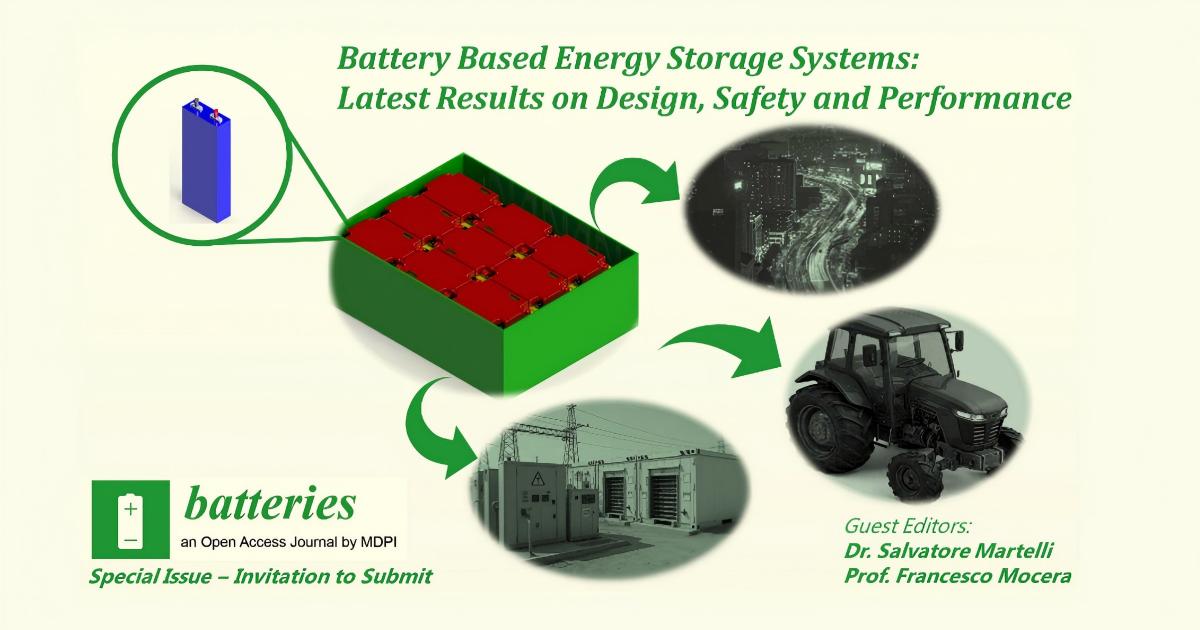
A Special Issue of Batteries (ISSN 2313-0105) belonging to the section "Electric Vehicles and Mobile Energy Storage Systems".

Deadline for manuscript submissions: 10 March 2027 | Viewed by 2912
Editors


E-Mail Website
Guest Editor
Department of Mechanical and Aerospace Engineering, Politecnico di Torino, Corso Duca degli Abruzzi 24, 10129 Torino, Italy
Interests: Li-ion batteries and systems; sensor technology and application; design of electrified powertrain for working vehicles; autonomous robots; life-cycle assessment

E-Mail Website
Guest Editor
Department of Mechanical and Aerospace Engineering, Politecnico di Torino, Corso Duca degli Abruzzi 24, 10129 Torino, Italy
Interests: design of innovative hybrid and electric powertrains for working machines in the agri-construction sector; study of electro-mechanical performance of lithium-ion batteries
Special Issues, Collections and Topics in MDPI journals

Special Issue Information

Dear Colleagues,

The market presence of products integrating Lithium-Ion-based battery packs is showing a steady increase, and in recent years, this phenomenon has also started to arise in sectors typically characterized by a high use of fossil fuels. Nevertheless, challenges related to the safety, monitoring and performance improvement of these systems remain highly relevant. The aim of this Special Issue is to collect the most recent and notable findings in these research fields, with the included outcomes providing both theoretical groundwork and practical insights to support advancements in battery system technologies. The topics covered by this Special Issue include, but are not limited to, the following:

  • Mechanical Safety Structures of Battery Packs.
  • Battery Systems Monitoring and Diagnostic Techniques.
  • Battery Management Strategies.
  • Battery Management System Architectures.
  • Thermal Management Strategies.
  • Thermal Runaway Prediction and Mitigation.
  • Li-Ion Cell State Estimation.
  • Safety and Reliability of Battery Systems.
  • Mechanical Strength of Li-Ion Cells.
  • Environmental Impact of Battery-Based Energy Storage Systems.

Dr. Salvatore Martelli
Dr. Francesco Mocera
Guest Editors

Manuscript Submission Information

Manuscripts should be submitted online at www.mdpi.com by registering and logging in to this website. Once you are registered, click here to go to the submission form. Manuscripts can be submitted until the deadline. All submissions that pass pre-check are peer-reviewed. Accepted papers will be published continuously in the journal (as soon as accepted) and will be listed together on the special issue website. Research articles, review articles as well as short communications are invited. For planned papers, a title and short abstract (about 250 words) can be sent to the Editorial Office for assessment.

Submitted manuscripts should not have been published previously, nor be under consideration for publication elsewhere (except conference proceedings papers). All manuscripts are thoroughly refereed through a single-anonymized peer-review process. A guide for authors and other relevant information for submission of manuscripts is available on the Instructions for Authors page. Batteries is an international peer-reviewed open access monthly journal published by MDPI.

Please visit the Instructions for Authors page before submitting a manuscript. The Article Processing Charge (APC) for publication in this open access journal is 2700 CHF (Swiss Francs). Submitted papers should be well formatted and use good English. Authors may use MDPI's English editing service prior to publication or during author revisions.

Keywords

  • Li-ion battery and systems
  • battery safety
  • battery monitoring
  • battery performance
  • battery management systems and strategies

Benefits of Publishing in a Special Issue

  • Ease of navigation: Grouping papers by topic helps scholars navigate broad scope journals more efficiently.
  • Greater discoverability: Special Issues support the reach and impact of scientific research. Articles in Special Issues are more discoverable and cited more frequently.
  • Expansion of research network: Special Issues facilitate connections among authors, fostering scientific collaborations.
  • External promotion: Articles in Special Issues are often promoted through the journal's social media, increasing their visibility.
  • Reprint: MDPI Books provides the opportunity to republish successful Special Issues in book format, both online and in print.

Further information on MDPI's Special Issue policies can be found here.

Published Papers (3 papers)

Order results
Result details
Select all
Export citation of selected articles as:

Research

Jump to: Review

32 pages, 32008 KB  
Article
Thermally Robust and Highly Wettable Polyethylene Separators for Lithium-Metal Batteries Using Water-Based Processing of a Glass Platelet Coating
by Philipp Rank, Sebastian Müllner, Thorsten Gerdes and Christina Roth
Batteries 2026, 12(9), 347; https://doi.org/10.3390/batteries12090347 - 9 Sep 2026
Viewed by 215
Abstract
Commercial polyolefin separators for lithium-ion batteries (LIBs) exhibit only inadequate wettability and thermal stability. In large-scale production, high electrolyte uptake and wetting are essential to enable rapid electrolyte filling during battery assembly to reduce costs. In addition, it is imperative to develop separators [...] Read more.
Commercial polyolefin separators for lithium-ion batteries (LIBs) exhibit only inadequate wettability and thermal stability. In large-scale production, high electrolyte uptake and wetting are essential to enable rapid electrolyte filling during battery assembly to reduce costs. In addition, it is imperative to develop separators with enhanced thermal stability for improved performance and safety. The focus of this study is the structure–property–performance relationship of separator coatings. Platelet-shaped glass particles are utilized as inorganic coating material for polyethylene (PE) separators. Styrene–butadiene rubber (SBR) was selected as binder due to its high thermal stability. Hybrid separators are prepared using a colloidal coating technology employing a water-based slurry. As the excessive use of binder in the coating can block pores, precise control of the binder content was essential to maintain battery performance. The resulting separators with an optimized binder content of 1 wt.% in the coating demonstrate high porosity, instantaneous wetting with electrolyte, and a 25 K increase in onset temperature for shrinkage. The utilization of glass platelets with an aspect ratio of 10 as coating material provided the best balance among processability, coating homogeneity, thermal stability, ionic conductivity, and cycling performance under the investigated processing conditions. Full article
Show Figures

Graphical abstract

27 pages, 16648 KB  
Article
Impact of Busbar Resistance and Series–Parallel Topology on Current Inhomogeneity and Safety Limits in Battery Packs
by Xiaoxuan Chen, Dmitri L. Danilov, Tim-Andy Benning, Luc H. J. Raijmakers and Rüdiger-A. Eichel
Batteries 2026, 12(9), 324; https://doi.org/10.3390/batteries12090324 - 25 Aug 2026
Viewed by 612
Abstract
Current distribution in serial–parallel battery packs is commonly assumed to be uniform in the absence of cell-to-cell variations. However, in practical systems, the electrical topology and finite resistance of current-collecting busbars can introduce significant inhomogeneities even when all cells are identical. In this [...] Read more.
Current distribution in serial–parallel battery packs is commonly assumed to be uniform in the absence of cell-to-cell variations. However, in practical systems, the electrical topology and finite resistance of current-collecting busbars can introduce significant inhomogeneities even when all cells are identical. In this work, a matrix-based modeling framework is developed to analyze the current and voltage distribution in large battery packs with arbitrary serial–parallel configurations. The results reveal that the resistance of current-supplying busbars plays a dominant role in shaping current distribution, leading to pronounced current imbalance that increases with both resistance and operating C-rate. To quantify this effect, a current non-uniformity factor is introduced and used to define an illustrative criterion for acceptable operation. Based on this metric, together with a maximum-cell-voltage constraint, design maps are constructed to identify operating regions that are acceptable or critical with respect to current overload and localized overvoltage as a function of busbar resistance and charging rate. The analysis further demonstrates that topology-induced current inhomogeneity can lead to cell-level voltage divergence and localized overcharge under high-current operation. Such local effects may remain hidden when only the pack voltage or the voltage of a series-connected cell group is monitored, because conventional battery management systems (BMSs) typically do not resolve individual cell currents or local voltage drops within parallel-connected cell groups. The proposed approach enables the derivation of design-oriented constraints linking electrical performance to physical parameters such as busbar resistance and cell spacing. The resulting design maps provide a practical tool for battery pack engineering, enabling the determination of the maximum allowable busbar resistance or operating current to ensure safe, homogeneous pack operation. Full article
Show Figures

Figure 1

Review

Jump to: Research

40 pages, 7240 KB  
Review
Failure Modes, Mitigation Strategies, and Future Directions in Battery–Supercapacitor Hybrid Energy Storage Systems: A Comprehensive Review
by Muzamil Hussain Wadho, Alessandro Serpi and Mario Porru
Batteries 2026, 12(7), 233; https://doi.org/10.3390/batteries12070233 - 28 Jun 2026
Viewed by 1599
Abstract
Hybrid Energy Storage Systems (HESSs) have emerged as an inevitable solution in modern power systems and transport electrification. An HESS combines two or more complementary storage technologies—such as Batteries (BTs) with Supercapacitors (SCs), or BTs with thermal or mechanical energy storage, etc., to [...] Read more.
Hybrid Energy Storage Systems (HESSs) have emerged as an inevitable solution in modern power systems and transport electrification. An HESS combines two or more complementary storage technologies—such as Batteries (BTs) with Supercapacitors (SCs), or BTs with thermal or mechanical energy storage, etc., to leverage their virtues. The robustness of HESS configurations is of utmost importance for exploring failure analysis and resilience approaches in BT-SC-based HESSs, which are crucial for long-term reliability, safety, and contributions towards future decarbonization goals. Hence, based on this motivation, this work focuses on the study of conventional and advanced HESS configurations, together with a method of configuration selection. Subsequently, the review aims to obtain a systematic identification, characterization, and understanding of the reasons behind HESS failures. This paper thus defines what HESS failures are and their possible mitigations, discussing many state-of-the-art research studies that may help researchers in finding correct and updated literature content concerning this research area. Finally, future trends and developments in BT-SC-based HESSs are discussed. Full article
Show Figures

Figure 1

Back to TopTop