
You are currently viewing a new version of our website. To view the old version click .

Applied Microbiology, Volume 4, Issue 3

September 2024 - 30 articles

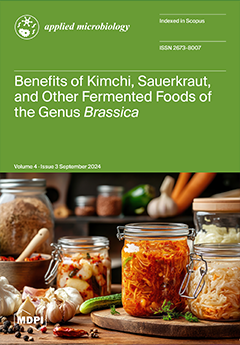
Cover Story: Cruciferous vegetables of the genus Brassica, such as cabbage, broccoli, and cauliflower, are commonly used to produce fermented foods like sauerkraut, kimchi, pao cai, fermented turnips, and others. We examined 12 clinical trials investigating fermented foods of the genus Brassica and mainly assessed the health benefits of kimchi or sauerkraut consumption, and we found that regular intake can alleviate symptoms of irritable bowel syndrome (IBS), aid weight loss, and enhance metabolic health. Seven observational studies observed health benefits when consuming fermented foods of the genus Brassica. This review underscores the potential of fermented cruciferous vegetables as functional foods, and advocates for more clinical trials and mechanistic studies to understand and optimize their health benefits. View this paper
  • Issues are regarded as officially published after their release is announced to the table of contents alert mailing list .
  • You may sign up for email alerts to receive table of contents of newly released issues.
  • PDF is the official format for papers published in both, html and pdf forms. To view the papers in pdf format, click on the "PDF Full-text" link, and use the free Adobe Reader to open them.

Articles (30)

  • Article
  • Open Access
1 Citations
3,877 Views
15 Pages

The Isolation, Identification and Characterization of a Wild-Type Strain Pseudomonas aeruginosa PM1012 from the Cloacal Microbiota of a Common Wall Lizard (Podarcis muralis Laurenti, 1768)

  • Irina Lazarkevich,
  • Stephan Engibarov,
  • Simona Mitova,
  • Rumyana Eneva,
  • Tsvetelina Paunova-Krasteva,
  • Dayana Borisova,
  • Emiliya Vacheva,
  • Nikola Stanchev,
  • Steliyana Popova and
  • Yana Gocheva
  • + 1 author

22 September 2024

Pseudomonas aeruginosa is a ubiquitous environmental Gram-negative bacterium and also an opportunistic pathogen for both humans and animals, causing acute or chronic infections. It has been frequently detected in healthy and diseased reptiles, more c...

  • Article
  • Open Access
2 Citations
2,211 Views
12 Pages

Investigation of SARS-CoV-2 Contamination of Indoor Air and Highly Touched Surfaces On-Campus Buildings

  • Nita Khanal,
  • Lauren Roppolo Brazell,
  • Md Ariful Islam Juel,
  • Cynthia Gibas,
  • Jessica Schlueter and
  • Mariya Munir

22 September 2024

Severe acute respiratory syndrome coronavirus-2 (SARS-CoV-2) spreads primarily through respiratory droplets, aerosols, and contaminated surfaces. While high-traffic locations like hospitals and airports have been studied extensively, detecting signif...

  • Review
  • Open Access
3 Citations
3,265 Views
22 Pages

Recent Progress in Terrestrial Biota-Derived Anti-Biofilm Agents for Medical Applications

  • Todorka G. Vladkova,
  • Younes Smani,
  • Boris L. Martinov and
  • Dilyana N. Gospodinova

18 September 2024

The terrestrial biota is a rich source of biologically active substances whose anti-biofilm potential is not studied enough. The aim of this review is to outline a variety of terrestrial sources of antimicrobial agents with the ability to inhibit dif...

  • Article
  • Open Access
2 Citations
2,621 Views
14 Pages

18 September 2024

Lignocellulosic biomass is contemplated to be an inexpensive and copious feedstock that can be used for numerous industrial applications. However, lignin forms the lignin sheath and provides a physical barrier to enzymatic hydrolysis. In addition, li...

  • Article
  • Open Access
1,743 Views
13 Pages

18 September 2024

Background: Elongation factor protein (EF-P) in bacteria helps ribosomes to incorporate contiguous proline residues (xPro) into proteins. In this way, EF-P rescues ribosomes from stalling at these xPro motifs. Whereas EF-P deficiency is lethal for so...

  • Article
  • Open Access
3 Citations
6,117 Views
15 Pages

Specific Synbiotic Sugars Stimulate Streptococcus salivarius BLIS K12 and BLIS M18 Lantibiotic Production to Expand Bacterial Inhibition Range and Potency

  • Liam K. Harold,
  • Nicola C. Jones,
  • Sarah L. Barber,
  • Abigail L. Voss,
  • Rohit Jain,
  • John R. Tagg and
  • John D. F. Hale

16 September 2024

Synbiotics are mixtures of prebiotics and probiotics that enhance the activity of probiotic bacteria when co-administered to provide greater benefits to the host. Traditionally, the synbiotics that have been discovered enhance gut probiotic strains a...

  • Review
  • Open Access
1 Citations
2,783 Views
11 Pages

14 September 2024

Various microorganisms, referred to as kuratsuki microorganisms, inhabit each sake brewery. Previously, kuratsuki yeasts had been used for sake production in each sake brewery. Kuratsuki lactic acid bacteria have been used to produce kimoto, a fermen...

  • Article
  • Open Access
3,877 Views
15 Pages

Microbial Fermentation and Shelf Life of Potential Biotechnological Products Capable of Pesticide Degradation

  • Katharina Kraxberger,
  • Tanja Kostić,
  • Livio Antonielli and
  • Angela Sessitsch

7 September 2024

The pesticide active ingredient azoxystrobin is widely used in agriculture and has negative effects for the environment and contained organisms. Bacterial strains have been reported to degrade azoxystrobin, but precise methodologies for producing and...

  • Article
  • Open Access
5 Citations
2,598 Views
11 Pages

6 September 2024

Sclerotinia minor (S. minor) Jagger is a phytopathogenic fungus that causes lettuce drop, a serious problem in lettuce (Lactuca sativa L.) production. The control of this pathogen is challenging because of the resistance of sclerotia, which can survi...

  • Article
  • Open Access
3 Citations
2,166 Views
15 Pages

Addition of Chicken Litter Compost Changes Bacteriobiome in Fallow Soil

  • Natalia Naumova,
  • Pavel Barsukov,
  • Olga Baturina,
  • Olga Rusalimova and
  • Marsel Kabilov

3 September 2024

Composting is an environmentally friendly process, turning animal waste into fertilizer. Chicken litter compost (CLC) improves soil properties, increasing crop yields. However, the CLC effect on the soil microbiome is understudied. This study aimed t...

of 3

Get Alerted

Add your email address to receive forthcoming issues of this journal.

XFacebookLinkedIn
Appl. Microbiol. - ISSN 2673-8007