You are currently viewing a new version of our website. To view the old version click .

Conservation, Volume 5, Issue 3

September 2025 - 26 articles

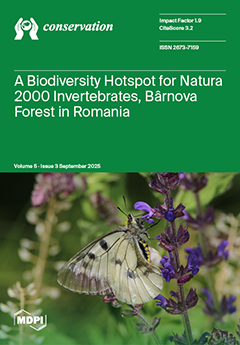
Cover Story: Natura 2000 is a key European conservation network aimed at protecting biodiversity across Europe. Effective implementation of the Natura 2000 network requires comprehensive scientific knowledge, adaptive management, biodiversity monitoring, and adequate funding. Bârnova-Repedea Forest can be considered a true mosaic of habitats, providing favourable conditions for the existence of these rare Natura 2000 species. This study is based on 30 years of field data and highlights both the biodiversity value of the area and the urgent need to update the management strategies. Multiple threats, including habitat loss and climate change, endanger rare saproxylic and pollinator species. The paper offers evidence-based recommendations to support long-term conservation in this valuable natural habitat. View this paper
  • Issues are regarded as officially published after their release is announced to the table of contents alert mailing list .
  • You may sign up for email alerts to receive table of contents of newly released issues.
  • PDF is the official format for papers published in both, html and pdf forms. To view the papers in pdf format, click on the "PDF Full-text" link, and use the free Adobe Reader to open them.

Articles (26)

  • Article
  • Open Access
1,627 Views
16 Pages

Reproductive Ecology of the Freshwater Snail, Pila globosa, Considering Environmental Factors in a Tropical Freshwater Swamp Forest

  • Suhel Das,
  • Mohammad Amzad Hossain,
  • Gourab Chowdhury,
  • Monayem Hussain,
  • Debasish Pandit,
  • Mrityunjoy Kunda,
  • Petra Schneider and
  • Mohammed Mahbub Iqbal

The apple snail Pila globosa is a widely distributed mollusc in tropical freshwater ecosystems, where it plays a crucial ecological role. This study examined the morphometric features, condition indices, and reproductive traits of P. globosa to gain...

  • Review
  • Open Access
4,697 Views
24 Pages

Human–wildlife conflict (HWC) is intensifying in Japan, driven by complex socio-ecological changes. While the Social–Ecological Systems (SES) framework offers a valuable analytical tool, standard applications often fail to capture the cru...

  • Article
  • Open Access
4,432 Views
36 Pages

ROSCI0135 Bârnova-Repedea Forest, covering 12,236.20 ha, is a relatively large Natura 2000 site from Romania, though not as large as other Natura 2000 sites. However, in terms of the number of invertebrate species of community importance, with...

  • Article
  • Open Access
910 Views
19 Pages

Due to small population size, Population Viability Analysis (PVA) of endangered species often pools all individuals into a single matrix to decrease variation in estimation of transition rates. These pooled populations may mask significant environmen...

  • Article
  • Open Access
1 Citations
2,238 Views
13 Pages

Seed Germination Requirements of the Threatened Local Greek Endemic Campanula pangea Hartvig Facilitating Species-Specific Conservation Efforts

  • Margarita Paradisiotis,
  • Elias Pipinis,
  • Stefanos Kostas,
  • Georgios Tsoktouridis,
  • Stefanos Hatzilazarou,
  • Anna Mastrogianni,
  • Ioannis Tsiripidis and
  • Nikos Krigas

Ex situ conservation is a vital strategy of preserving plant species at risk, offering practical methods to obtain information regarding species-specific germination characteristics. Campanula pangea, a local endemic species of NE Greece, has been pr...

  • Review
  • Open Access
1,045 Views
17 Pages

Quantifying the Diversity of Normative Positions in Conservation Sciences

  • Rodrigue Castro Gbedomon,
  • Kolawolé Valère Salako,
  • Damien Delorme and
  • Martin A. Schlaepfer

What elements of nature do people involved in conservation projects seek to protect, and why? How do they identify and relate to nature? Answers to such fundamental questions are shaped by normative assumptions that can result in distinct conservatio...

  • Article
  • Open Access
1 Citations
1,791 Views
36 Pages

Floristic Diversity and Stand Structure of Tree Species in Historical Rubber Plantations (Hevea brasiliensis Wild ex A. Juss) in Sankuru, DR Congo: Implications for Biodiversity Conservation

  • Joël Mobunda Tiko,
  • Serge Shakanye Ndjadi,
  • Jean Pierre Azenge,
  • Yannick Useni Sikuzani,
  • Lebon Aganze Badesire,
  • Prince Baraka Lucungu,
  • Maurice Kesonga Nsele,
  • Julien Bwazani Balandi,
  • Jémima Lydie Obandza-Ayessa and
  • Josué Muganda Matabaro
  • + 3 authors

The rubber plantations in Sankuru province, located in the Democratic Republic of Congo (DRC), have historically been pivotal to the regional economy. However, the absence of suitable silvicultural practices has promoted self-regeneration, resulting...

  • Article
  • Open Access
1,740 Views
19 Pages

Accurate taxonomy is fundamental for assessing extinction risks and implementing conservation strategies. We evaluated the extinction risk of Grindelia atlantica (Asteraceae), endemic to southern Brazil, using the IUCN criteria, and comparing three s...

  • Review
  • Open Access
2 Citations
3,105 Views
33 Pages

Scientific Research for Amazonia: A Review on Key Trends and Gaps

  • Carolina Cristina Fernandes,
  • Lira Luz Benites Lazaro,
  • Nádia Matioli Yazbek Bitar,
  • Marco A. Franco and
  • Paulo Artaxo

Scientific research in Amazonia plays a fundamental role in identifying pathways to sustainable development for the region, addressing the challenges posed by climate change, preserving its unique ecosystems, and aligning with societal challenges and...

  • Article
  • Open Access
1,631 Views
19 Pages

Evaluation of High Andean Plant Species in the Absorption and Translocation of Heavy Metals in the Moorlands of Reten IchuBamba, Ecuador

  • Maritza Lucia Vaca-Cárdenas,
  • María Verónica González-Cabrera,
  • Erica Estefania Andino-Peñafiel,
  • Miguel Ángel Guallpa-Calva,
  • Martha Marisol Vasco-Lucio,
  • Pedro Vicente Vaca-Cárdenas,
  • Eduardo Antonio Muñoz-Jácome,
  • Carmen Alicia Zavala-Toscano,
  • Guicela Margoth Ati-Cutiupala and
  • Diego Francisco Cushquicullma-Colcha

Phytoremediation is based on the use of plants to decontaminate water and soil. In this work, the capacity of high Andean vegetation in the absorption and translocation of heavy metals was analyzed. Species were identified to analyze the presence of...

of 3

Get Alerted

Add your email address to receive forthcoming issues of this journal.

XFacebookLinkedIn
Conservation - ISSN 2673-7159