You are currently viewing a new version of our website. To view the old version click .

Journal of Fungi, Volume 11, Issue 3

March 2025 - 74 articles

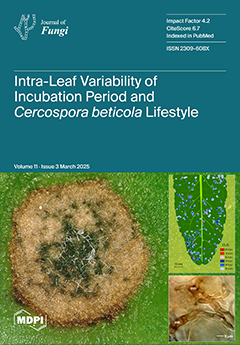
Cover Story: Cercospora beticola, the most important fungal pathogen in sugar beets, has a long incubation period (IP) and is classified as a hemibiotroph. A single infection period under controlled conditions resulted in minor IP differences among host genotypes and individual plants, greater differences among leaves within plants, and substantial variation within individual leaves. A GIS approach enabled the tracking of lesion appearance and growth for up to 27 days. The first lesions appeared 10 days after inoculation; however, the number of lesions increased for another 7 to 17 days, while lesion growth was limited. The asymptomatic fungal colonization of tissue was associated with thick hyphae, which became thinner after the appearance of lesions. Despite the lengthy incubation period, evidence of a C. beticola biotroph phase is lacking. View this paper
  • Issues are regarded as officially published after their release is announced to the table of contents alert mailing list .
  • You may sign up for email alerts to receive table of contents of newly released issues.
  • PDF is the official format for papers published in both, html and pdf forms. To view the papers in pdf format, click on the "PDF Full-text" link, and use the free Adobe Reader to open them.

Articles (74)

  • Article
  • Open Access
2 Citations
1,588 Views
18 Pages

Culturable Yeast Diversity Associated with Industrial Cultures of the Microalga Microchloropsis gaditana and Their Ability to Produce Lipids and Biosurfactants

  • Madalena Matos,
  • Mónica A. Fernandes,
  • Inês Costa,
  • Natacha Coelho,
  • Tamára F. Santos,
  • Veronica Rossetto,
  • João Varela and
  • Isabel Sá-Correia

17 March 2025

The marine oleaginous microalga Microchloropsis gaditana (formerly Nannochloropsis gaditana) exhibits a high capacity to thrive in a broad range of environmental conditions, being predominantly utilized as feed in aquaculture. This article reports th...

  • Article
  • Open Access
1,407 Views
21 Pages

17 March 2025

Rice brown spot disease, caused by Bipolaris oryzae, is a significant fungal disease that poses a major threat to global rice production. Despite its widespread impact, genomic studies of B. oryzae remain limited, particularly those involving high-qu...

  • Article
  • Open Access
3 Citations
1,693 Views
37 Pages

Diversity of Alternaria Section Nimbya in Iran, with the Description of Eight New Species

  • Abdollah Ahmadpour,
  • Youbert Ghosta,
  • Zahra Alavi,
  • Fatemeh Alavi,
  • Alireza Poursafar and
  • Pabulo Henrique Rampelotto

15 March 2025

Alternaria includes endophytes, saprophytes, and pathogens affecting both plants and animals, with a global distribution across various hosts and substrates. It is categorized into 29 sections, each defined by a type species and six monophyletic line...

  • Communication
  • Open Access
4 Citations
1,479 Views
9 Pages

Evaluation of Serum Biomarkers for Improved Diagnosis of Candidemia

  • Amélie Kinet-Poleur,
  • Corentin Deckers,
  • Imane Saad Albichr,
  • Pierre Bogaerts,
  • Patrick M. Honoré,
  • Pierre Bulpa,
  • Nathalie Ausselet,
  • Frederic Foret,
  • François Kidd and
  • Te-Din Huang
  • + 1 author

15 March 2025

Background: Candidemia, associated with high morbidity and mortality, remains challenging to diagnose due to the limitations of blood cultures. Serological biomarkers offer faster detection, enabling earlier treatment and improving outcomes. Methods:...

  • Review
  • Open Access
2 Citations
1,510 Views
18 Pages

Transcription Factors in Biocontrol Fungi

  • Han-Jian Song,
  • Xiao-Feng Li,
  • Xin-Ran Pei,
  • Zhan-Bin Sun and
  • Han-Xu Pan

15 March 2025

Transcription factors are extensively found in fungi and are involved in the regulation of multiple biological processes, including growth, development, conidiation, morphology, stresses tolerance, and virulence, as well as the production of secondar...

  • Article
  • Open Access
1,173 Views
18 Pages

14 March 2025

Arbuscular mycorrhizal fungi (AMF) are considered crucial for the survival of many endangered plant species. However, the dynamics of AMF communities in the roots and rhizosphere soil of Heptacodium miconioides, particularly along elevation gradients...

  • Article
  • Open Access
936 Views
24 Pages

14 March 2025

Chitin synthase 3 complex assembly begins at the endoplasmic reticulum where the formation of a Chs3/Chs7 complex facilitates its exit from the ER and its transport along the secretory route. In the present study, our work shows that orphan molecules...

  • Article
  • Open Access
1 Citations
4,324 Views
15 Pages

Fungal-Infected Weeds: A Potential Source of Leaf Spot Disease in Rubber Trees from Southern Thailand

  • Narit Thaochan,
  • Chaninun Pornsuriya,
  • Thanunchanok Chairin,
  • Kodeeyah Thoawan,
  • Putarak Chomnunti and
  • Anurag Sunpapao

14 March 2025

The rubber tree (Hevea brasiliensis) is an economically important crop in Thailand. Severe defoliation caused by emerging diseases has been reported to substantially reduce rubber yields during the leaf fall phase. The classical disease dispersal pat...

  • Article
  • Open Access
2,784 Views
14 Pages

13 March 2025

Cordyceps cicadae (C. cicadae) is an important edible medicinal fungus; however, owing to its wild growth and lack of genome annotation, construction of a stable genetic transformation system in C. cicadae is greatly limited, impeding the extensive e...

of 8

Get Alerted

Add your email address to receive forthcoming issues of this journal.

XFacebookLinkedIn
J. Fungi - ISSN 2309-608X