Abstract
Species of Ganoderma (Ganodermataceae, Polyporales) have been extensively utilized in traditional Chinese medicine for over two millennia, owing to their remarkable medicinal properties and diverse chemical constituents. Hainan Island, located in tropical China, harbors a rich diversity of Ganoderma species. Among these, certain varieties referred to as “Lingzhi Wang” or “Zhu Lingzhi” by indigenous communities are distinguished by their diminutive pilei and slender stipes. Despite their traditional recognition, these species have been subject to morphological confusion. In this study, specimens labeled as “Lingzhi Wang” or “Zhu Lingzhi” were subjected to comprehensive morphological examinations and molecular phylogenetic analyses. The findings reveal that the Ganoderma species characterized by small pilei and gracile stipes encompass at least five distinct species. Among these, two are new to science: G. baisuzhenii and G. shennongii. The remaining three species, G. bambusicola, G. flexipes, and G. subflexipes, have been previously described. Taxonomically, G. bambusicola was reported for the first time on the Chinese mainland. This study provides a clearer taxonomic framework for these medicinally significant fungi.
1. Introduction
The family Ganodermataceae (Polyporales, Basidiomycota) is a globally distributed taxonomic group comprising fourteen accepted genera: Amauroderma Murrill, Amaurodermellus Costa-Rezende, Drechsler-Santos & Góes-Neto, Cristataspora Robledo & Costa-Rezende, Foraminispora Robledo, Costa-Rez. & Drechsler-Santos, Furtadoella B.K. Cui & Y.F. Sun, Ganoderma P. Karst., Haddowia Steyaert, Humphreya Steyaert, Magoderna Steyaert, Neoganoderma B.K. Cui & Y.F. Sun, Sanguinoderma Y.F. Sun, D.H. Costa & B.K. Cui, Sinoganoderma B.K. Cui, J.H. Xing & Y.F. Sun, Tomophagus Murrill, and Trachydermella B.K. Cui & Y.F. Sun [1,2]. Among these, the genus Ganoderma, typified by G. lucidum (Curtis) P. Karst., is the most widely recognized. It is characterized by sessile to stipitate basidiomata, double-walled and truncated basidiospores, and its wood-decaying properties [2,3]. According to the Index Fungorum database (http://www.indexfungorum.org/, accessed on 25 January 2025), there are 498 records under Ganoderma, although many of these epithets are synonyms [1,4]. In China, more than 40 species of this genus have been accepted to date [1,2,5,6,7,8,9,10].
For more than a century, the highly valued medicinal fungus “Lingzhi” or “Ruizhi”, widely cultivated and utilized in China, including Hainan Island, has been taxonomically classified as G. lucidum (Curtis) P. Karst., a species first described in Europe. However, recent studies have revealed that the famous “G. lucidum” in China is genetically and taxonomically distinct from the authentic European G. lucidum. This Chinese species has been scientifically named G. lingzhi S.H. Wu, Y. Cao & Y.C. Dai [10,11]. Despite this, Yao et al. and Du et al. have argued that the correct name for the widely recognized Ganoderma species by the public in China should be G. sichuanense J.D. Zhao & X.Q. Zhang, with G. lingzhi considered a later synonym [12,13]. The scientific nomenclature of this fungus remains a contentious issue, with ongoing debates between G. lingzhi and G. sichuanense.
Ganoderma species, including G. lingzhi or G. sichuanense, have been used in traditional Chinese medicine for more than 6800 years [14,15,16]. These fungi are celebrated for their rich array of natural bioactive compounds, which exhibit a broad spectrum of pharmacological properties, including immunoregulatory, anti-tumor, anti-fatigue, gut microbiota regulation, and hepatocyte protection activities [17,18,19]. Subtropical and tropical regions of China, particularly Hainan Island, are biodiversity hotspots for Ganoderma species [20,21]. In these regions, numerous wild Ganoderma species are commercially traded [22], and their fruiting bodies are commonly used by local residents, either soaked in wine or boiled in water, for health preservation and disease treatment [23].
Among the Ganoderma species in Hainan Island, certain varieties are locally known as “Lingzhi Wang” (king of Ganoderma) or “Zhu Lingzhi” (bamboo host of Ganoderma). These species are distinguished by their diminutive pilei and gracile stipes. Due to their high popularity in the region (based on our investigations), they are often subject to morphological confusion, with homonyms (different Ganoderma species sharing the same name) and synonyms (the same Ganoderma species referred to by different names) being common. To address these taxonomic challenges, this study conducted comprehensive field investigations, key informant interviews, morphological examinations, and molecular phylogenetic analyses to accurately identify and clarify the taxonomy of these species.
2. Materials and Methods
2.1. Key Informant Interview Methodology
Key informants were selected based on their expertise and involvement in the collection, trade, or traditional use of Ganoderma species on Hainan Island. The interviews were semi-structured, combining open-ended questions with a predefined interview guide to ensure flexibility and depth. The interview guide covered the following topics: background information, traditional knowledge, harvesting and trade practices, cultural significance, and conservation perspectives.
2.2. Sample Collection and Morphological Studies
Fresh basidiomata of Ganoderma species were collected during the rainfall seasons in southern China, particularly on Hainan Island. Specimens were photographed in situ at their collection sites to document their natural habitat and morphological features. Detailed morphological characteristics, including color, shape, and size, were recorded from fresh samples. The collected specimens were then dried at approximately 60 °C overnight to ensure complete dehydration and were subsequently deposited in the Hainan Biodiversity Science and Technology Museum (FHMU) or the Cryptogamic Herbarium (HKAS) of the Kunming Institute of Botany, Chinese Academy of Sciences. Color descriptions were standardized using the color codes provided by Kornerup and Wanscher [24].
For microscopic analysis, thin sections were prepared freehand using a razor blade and mounted in 5% potassium hydroxide (KOH) solution or Cotton Blue and Melzer’s reagent. These sections were examined under an OLYMPUS CX23 optical microscope to observe and measure microscopic features. All microscopic structures were illustrated freehand based on the observations. The following notations and abbreviations were used in this study: IKI (Melzer’s reagent; IKI– indicates neither amyloid nor dextrinoid reactions); CB (Cotton Blue; CB+ denotes cyanophilous reactions); and basidiospore measurements are expressed as n/m/p, where n = the total number of basidiospores measured from the m basidiomata of p collections. Basidiospore dimensions are presented in the format (a)b–c(d), where b–c represents the range encompassing at least 90% of the measured values, and extreme values (a and d, when present) are given in parentheses. Additional abbreviations include L (mean basidiospore length), W (mean basidiospore width), and Q (quotient of basidiospore length to width, L/W). All measurements were based on a minimum of 20 basidiospores per species.
2.3. Molecular Procedures
Genomic DNA was extracted from dried basidiomata samples using the Magnetic Beads Genomic DNA Extraction Kit (Magen, Guangzhou, China) in accordance with the manufacturer’s protocol. The ITS region, including internal transcribed spacers 1 and 2, along with the 5.8S rDNA, was amplified using the primer pair ITS5/ITS4 [25]. Additionally, the partial RNA polymerase second-largest subunit region (rpb2) was amplified using primers bRPB2-6F/bRPB2-7.1R [26], and the partial translation elongation factor 1-α (tef1) region was amplified using primers EF1-F and EF1-R [27]. All PCR reactions were conducted in 25 μL volumes, containing 13 µL of 2× Taq PCR MasterMix (KANGWEI Company, Guangzhou, China), 2 µL of each primer (10 mM), 2 µL of DNA template, and 8 µL of nuclease-free water. The PCR conditions for all genetic regions included an initial denaturation step at 95 °C for 4 min, followed by 35 cycles of denaturation at 94 °C for 30 s, annealing at specific temperatures (50 °C for ITS, 53 °C for tef1, and 52 °C for rpb2) for 30 s, extension at 72 °C for 120 s, and a final extension at 72 °C for 7 min. PCR products were visualized on 1% (w/v) agarose gels, and those exhibiting a bright single band were purified and sequenced using an ABI 3730xl DNA Analyzer (Guangzhou Branch of BGI, Guangzhou, China) with the same primers used for amplification [28]. The accuracy of the newly obtained sequences was confirmed by comparison with sequences available in GenBank [https://www.ncbi.nlm.nih.gov/genbank/ (accessed on 1 February 2025)]. The sequences were assembled and edited using BioEdit v7.0.9.0 [29] and subsequently deposited in GenBank (Table 1).
2.4. Dataset Assembly
The phylogenetic analyses were conducted using a sequence dataset comprising three loci: ITS, rpb2, and tef1. Foraminispora concentrica (J. Song, Xiao L. He & B.K. Cui) Y.F. Sun & B.K. Cui was selected as the outgroup, which was suggested by Sun et al. [30]. Additionally, other reference taxa for the phylogenetic analysis were retrieved from GenBank and relevant publications, as detailed in Table 1. To assess potential phylogenetic conflicts among the different gene regions, single-gene phylogenetic trees were constructed for ITS, rpb2, and tef1 separately using the maximum likelihood (ML) method. The results indicated no significant conflicts among the gene fragments, supporting their combination for further analysis. The sequences of the three loci were aligned using MUSCLE v. 3.6 [31] and subsequently concatenated into a single dataset using Phyutility v. 2.2 [32] for comprehensive phylogenetic analysis.
Table 1.
Taxa, vouchers, locations, and GenBank accession numbers of DNA sequences used in this study.
Table 1.
Taxa, vouchers, locations, and GenBank accession numbers of DNA sequences used in this study.
| GenBank Accession Nos. | ||||||
|---|---|---|---|---|---|---|
| Taxon | Voucher | Locality | ITS | rpb2 | tef1 | Reference |
| Cristataspora coffeata | FLOR 50933 | Brazil | KU315204 | — | — | [33] |
| C. coffeata | Robledo 3183 | Brazil | MN077526 | — | MN061695 | [34] |
| C. coffeata | Robledo 3182 | Brazil | MN077525 | — | — | [34] |
| C. flavipora | Robledo 3288 | Argentina | MN077521 | — | MN061694 | [34] |
| Foraminispora concentrica | Cui 16238 | Yunnan, SW China | MK119816 | MK121504 | MK121565 | [30] |
| F. concentrica | Cui 16239 | Yunnan, SW China | MK119817 | MK121506 | MK121566 | [30] |
| Ganoderma acaciicola | Cui 16815 | Australia | MZ354895 | MZ245384 | — | [2] |
| G. acaciicola | Cui 16814 | Australia | MZ354894 | MZ245383 | — | [2] |
| G. acontextum | JV 0611/21G | Guatemala | KF605667 | MG367489 | MG367538 | [2] |
| G. acontextum | JV 1208/11J | USA | KF605668 | MG367490 | MG367540 | [2] |
| G. adspersum | ITA 39 | Italy | EF060011 | — | — | [35] |
| G. adspersum | PF263 | Italy | JN176908 | — | — | Unpublished |
| G. alpinum | Cui 17467 | Yunnan, SW China | MZ354912 | — | — | [2] |
| G. alpinum | Cui 18402 | Xizhang, western China | MZ354910 | — | — | [2] |
| G. angustisporum | Cui 13817 | Fujian, SE China | MG279170 | MG367507 | MG367563 | [6] |
| G. angustisporum | Cui 14578 | Guangdong, southern China | MG279171 | — | MG367564 | [6] |
| G. applanatum | Cui 14062 | Jinlin, NE China | MZ354913 | MZ358846 | MZ221635 | [2] |
| G. applanatum | Cui 14070 | Jinlin, NE China | MZ354914 | MZ245387 | MZ221636 | [2] |
| G. aridicola | Dai 12588 | South Africa | KU572491 | — | KU572502 | [36] |
| G. aridicola | GanoTK25 | Cameroon | JN105707 | — | — | [2] |
| G. artocarpicola | HL173 | Yunnan, SW China | ON994239 | OP508428 | OP508442 | [37] |
| G. artocarpicola | HL188 | Yunnan, SW China | ON994240 | OP508427 | OP508441 | [37] |
| G. australe | DHCR411 | Australia | MF436675 | — | MF436677 | [38] |
| G. australe | DHCR417 | Australia | MF436676 | — | MF436678 | [38] |
| G. austroafricanum | CBS138724 | South Africa | KM507324 | — | — | [39] |
| G. bambusicola | Wu 1207-151 | Taiwan, SE China | MN957781 | LC517944 | LC517941 | [8] |
| G. baisuzhenii | N.K. Zeng2080 (FHMU2334) | Hainan, southern China | — | PP785032 | PV066218 | This study |
| G. baisuzhenii | N.K. Zeng2519 (FHMU7350) | Hainan, southern China | PP663110 | PP785031 | PV066219 | This study |
| G. bambusicola | N.K. Zeng1892 (FHMU1217) R71 | Hainan, southern China | — | — | PP922172 | This study |
| G. bambusicola | N.K. Zeng1892-1 (FHM7610) | Hainan, southern China | — | — | PP922173 | This study |
| G. bambusicola | N.K. Zeng10386 (FHMU8798) | Hainan, southern China | PV052368 | — | PV066216 | This study |
| G. bambusicola | N.K. Zeng10387 (FHMU8803) | Hainan, southern China | PV052369 | — | — | This study |
| G. bambusicola | N.K. Zeng10388 (FHMU8791) | Hainan, southern China | PV052370 | PV066220 | — | This study |
| G. bambusicola | N.K. Zeng10340 (FHMU7930) | Hainan, southern China | PV052371 | PV066221 | PV066217 | This study |
| G. boninense | WD 2028 | Japan | KJ143905 | KJ143964 | KJ143924 | [40] |
| G. boninense | WD 2085 | Japan | KJ143906 | KJ143965 | KJ143925 | [40] |
| G. brownii | JV 1105/9J | Australia | MG279159 | MG367494 | MG367547 | [6] |
| G. brownii | JV 0709/109 | — | KF605662 | MG367495 | MG367548 | [2,6] |
| G. bubalinomarginatum | Dai 20074 | Guangxi, southern China | MZ354926 | MZ245388 | MZ221637 | [2] |
| G. bubalinomarginatum | Dai 20075 | Guangxi, southern China | MZ354927 | MZ245389 | MZ221638 | [2] |
| G. calidophilum | MFLU 19-2174 | Yunnan, SW China | MN398337 | — | — | [3] |
| G. calidophilum | H36 | Yunnan, SW China | MW750241 | MW839003 | MW838997 | [1] |
| G. carnosum | JV 8709/8 | Czech Republic | KU572493 | — | — | [36] |
| G. carnosum | MJ 21/08 | Czech Republic | KU572492 | — | — | [36] |
| G. carocalcareus | DMC 322 | Cameroon | EU089969 | — | — | [41] |
| G. carocalcareus | DMC 513 | Cameroon | EU089970 | — | — | [41] |
| G. castaneum | Dai 16500 | Hainan, southern China | MZ354918 | MZ245390 | MZ221639 | [2] |
| G. castaneum | Cui 13893 | Hainan, southern China | MZ221640 | MZ245391 | MZ354919 | [2] |
| G. casuarinicola | Dai 16336 | Guangdong, southern China | MG279173 | MG367508 | MG367565 | [6] |
| G. casuarinicola | Dai 16337 | Guangdong, southern China | MG279174 | MG367509 | MG367566 | [6] |
| G. chalceum | URM80457 | Brazil | JX310812 | — | — | [42] |
| G. chocoense | QCAM 3123 | Ecuador | MH890527 | — | — | [43] |
| G. chuxiongense | Cui 17262 | Yunnan, SW China | MZ354907 | — | — | [2] |
| G. cocoicola | Cui 16791 | Australia | MZ354984 | MZ245393 | MZ221643 | [2] |
| G. cocoicola | Cui 16792 | Australia | MZ354985 | MZ245394 | MZ221644 | [2] |
| G. concinnum | Robledo 3192 (FCOS) | — | MN077522 | — | — | [34] |
| G. concinnum | Robledo 3235 (FCOS) | — | MN077523 | — | — | [34] |
| G. cupreum | GanoTK4 | Cameroon | JN105701 | — | — | Unpublished |
| G. cupreum | GanoTK7 | Cameroon | JN105702 | — | — | Unpublished |
| G. curtisii | CBS 100131 | NC, USA | JQ781848 | KJ143966 | KJ143926 | [11,40] |
| G. curtisii | CBS 100132 | NC, USA | JQ781849 | KJ143967 | KJ143927 | [11,40] |
| G. destructans | CMW43670 | South Africa | KR183856 | — | — | [39] |
| G. dianzhongense | L4331 | Yunnan, SW China | MW750237 | MZ467043 | MW838993 | [1] |
| G. dianzhongense | L4969 | Yunnan, SW China | MW750240 | MZ467044 | MW838996 | [1] |
| G. dorsale | MVHC 5701 | Uruguay | MN191581 | — | — | [44] |
| G. dorsale | MVHC 5653 | Uruguay | MN191578 | — | — | [44] |
| G. dunense | CMW42149 | South Africa | MG020248 | — | MG020226 | [45] |
| G. dunense | CMW42157 | South Africa | MG020255 | — | — | [45] |
| G. ecuadorense | ASL799 | Ecuador | KU128524 | — | — | [46] |
| G. ecuadorense | PMC126 | Ecuador | KU128525 | — | — | [46] |
| G. eickeri | CMW 49692 | South Africa | MH571690 | — | MH567287 | [47] |
| G. eickeri | CMW 50325 | South Africa | MH571689 | — | MH567290 | [47] |
| G. ellipsoideum | GACP14080966 | Hainan, southern China | MH106867 | — | — | [5] |
| G. ellipsoideum | GACP14080968 | Hainan, southern China | MH106868 | — | — | [5] |
| G. ellipsoideum | GACP14081228 | Hainan, southern China | MH106886 | — | — | [5] |
| G. enigmaticum | CMW43669 | South Africa | KR183855 | — | — | [39] |
| G. enigmaticum | CBS 139792 | South Africa | NR132918 | — | — | [39] |
| G. esculentum | L4935 | Yunnan, SW China | MW750242 | MW839004 | MW838998 | [1] |
| G. esculentum | HL107 | Yunnan, SW China | ON994243 | OP508424 | OP508437 | [48] |
| G. fallax | JV 1009/27 | USA | KF605655 | — | — | [2] |
| G. fallax | JV 0709/39 | USA | KF605658 | — | — | [2] |
| G. flexipes | Cui 13841 | Hainan, southern China | MZ354923 | MZ245401 | MZ221655 | [2] |
| G. flexipes | Cui 13863 | Hainan, southern China | MZ354924 | MZ245402 | MZ221656 | [2] |
| G. flexipes | GACP14045450 | Hainan, southern China | MH106873 | — | — | [5] |
| G. flexipes | Wei5200 | China | JN383978 | — | — | [49] |
| G. flexipes | N.K. Zeng2607 (FHMU3352) | Hainan, southern China | PP663099 | — | — | This study |
| G. flexipes | N.K. Zeng2042 (FHMU2329) | Hainan, southern China | PP663094 | PP785027 | PP911339 | This study |
| G. flexipes | N.K. Zeng2616 (FHMU5678) | Hainan, southern China | PP663101 | — | — | This study |
| G. flexipes | N.K. Zeng2617 (FHMU5663) | Hainan, southern China | PP663096 | — | — | This study |
| G. flexipes | N.K. Zeng2624 (FHMU5681) | Hainan, southern China | PP663103 | — | — | This study |
| G. flexipes | N.K. Zeng2627 (FHMU5659) | Hainan, southern China | PP663098 | — | — | This study |
| G. flexipes | N.K. Zeng2606 (FHMU3360) | Hainan, southern China | PP663100 | — | — | This study |
| G. flexipes | N.K. Zeng2614 (FHMU5672) | Hainan, southern China | PP663104 | — | — | This study |
| G. flexipes | N.K. Zeng210 (FHMU2292) | Hainan, southern China | PP663095 | — | — | This study |
| G. flexipes | N.K. Zeng2618 (FHMU5661) | Hainan, southern China | PP663097 | — | — | This study |
| G. flexipes | N.K. Zeng4561 (FHMU4863) | Hainan, southern China | PP663106 | — | PP922159 | This study |
| G. flexipes | N.K. Zeng4595 (FHMU4898) | Hainan, southern China | PP663102 | — | PP922158 | This study |
| G. flexipes | N.K. Zeng2087 (FHMU2337) | Hainan, southern China | PP663107 | PP785029 | PP922162 | This study |
| G. flexipes | N.K. Zeng2085 (FHMU2336) | Hainan, southern China | PP663108 | PP785028 | PP922161 | This study |
| “G. flexipes” | Wei5491 | Hainan, southern China | JQ781850 | KJ143968 | — | [11,40] |
| “G. flexipes” | Wei5494 | Hainan, southern China | JN383979 | — | — | [11] |
| G. gibbosum | Cui 13940 | China | MZ354972 | MZ245404 | MZ221658 | [2] |
| G. gibbosum | Cui 14338 | China | MZ354969 | MZ245405 | MZ221659 | [2] |
| G. guangxiense | Cui 14453 | Guangxi, southern China | MZ354939 | MZ245407 | MZ221661 | [2] |
| G. guangxiense | Cui 14454 | Guangxi, southern China | MZ354941 | MZ245408 | MZ221662 | [2] |
| G. guixiense | GXU3457 | Guangxi, southern China | OQ788244 | PP187389 | — | [50] |
| G. guixiense | GXU3709 | Guangxi, southern China | OR271986 | — | — | [50] |
| G. hochiminhense | MFLU 19-2224 | Vietnam | MN398324 | — | MN423176 | [3] |
| G. hochiminhense | MFLU 19-2225 | Vietnam | MN396662 | — | MN423177 | [3] |
| G. hoehnelianum | GACP14080913 | Hainan, southern China | MH106881 | — | — | [5] |
| G. hoehnelianum | MFLU 19-2168 | Myanmar | MN396316 | MN423123 | MN423158 | [3] |
| G. knysnamense | CMW 47755 | South Africa | MH571681 | — | MH567261 | [47] |
| G. knysnamense | CMW 47756 | South Africa | MH571684 | — | MH567274 | [47] |
| G. leucocontextum | GDGM 40200 | Xizang, western China | KF011548 | — | — | [51] |
| G. lingzhi | Dai 12479 | Anhui, central China | JQ781864 | JX029979 | JX029975 | [11] |
| G. lingzhi | Wu 1006-38 | Hubei, eastern China | JQ781858 | JX029980 | JX029976 | [11] |
| G. lobatum | JV 0402/24 | — | KF605677 | — | — | Unpublished |
| G. lobatum | JV 1212/10J | — | KF605676 | — | — | Unpublished |
| G. lucidum | Rivoire 4195 | France | KJ143909 | KJ143969 | — | [40] |
| G. lucidum | K 175217 | UK | KJ143911 | KJ143971 | KJ143929 | [40] |
| G. magniporum | Dai 19966 | Yunnan, SW China | — | MZ345728 | MZ221670 | [2] |
| G. martinicense | SWMart08-55 | Martinique | KF963256 | — | — | [52] |
| G. mbrekobenum | UMN7-3 GHA | Ghana | KX000896 | — | — | [46] |
| G. mbrekobenum | UMN7-4 GHA | Ghana | KX000898 | — | — | [46] |
| G. meredithiae | UMNFL50 | USA | MG654103 | — | — | [53] |
| G. meredithiae | UMNFL64 | USA | MG654106 | MG754863 | — | [53] |
| G. mexicanum | MUCL 49453 SW17 | Martinique | MK531811 | MK531836 | MK531825 | [54] |
| G. mexicanum | MUCL 55832 | Martinique | MK531815 | MK531839 | MK531829 | [54] |
| G. mirabile | Cui 18271 | Malaysia | MZ354958 | MZ345729 | MZ221672 | [2] |
| G. mirabile | Cui 18283 | Malaysia | MZ354959 | MZ345730 | MZ221673 | [2] |
| G. mizoramense | UMN-MZ4 | India | KY643750 | — | — | [55] |
| G. mizoramense | UMN-MZ5 | India | KY643751 | — | — | [55] |
| G. multipileum | CWN 04670 (TNM) | Taiwan, SE China | KJ143913 | KJ143972 | KJ143931 | [40] |
| G. multipileum | Dai 9447 (IFP) | Hainan, southern China | KJ143914 | KJ143973 | KJ143932 | [40] |
| G. multipileum | MFLU 19-2166 | Thailand | MN401406 | MN423142 | MN423172 | [3] |
| G. mutabile | Yuan 2289 | Yunnan, SW China | JN383977 | — | — | [50] |
| G. mutabile | CLZhao 982 | Yunnan, SW China | MG231527 | — | — | Unpublished |
| G. myanmarense | MFLU 19-2167 | Myanmar | MN396330 | — | — | [3] |
| G. myanmarense | MFLU 19-2169 | Myanmar | MN396330 | — | — | [3] |
| G. nasalanense | GACP17060211 | Laos | MK345441 | — | — | [3] |
| G. nasalanense | GACP17060212 | Laos | MK345442 | — | — | [49] |
| G. neojaponicum | FFPRI WD-1285 | Japan | MN957784 | — | — | [8] |
| G. neojaponicum | FFPRI WD-1532 | Japan | MN957785 | — | — | [8] |
| G. nitidum | JV 1504/73 | Hainan, southern China | MZ354933 | — | MZ221681 | [2] |
| G. obscuratum | Lsh88 | Yunnan, SW China | ON994237 | — | OP508450 | [48] |
| G. obscuratum | Lsh89 | Yunnan, SW China | ON994238 | — | OP508451 | [48] |
| G. orbiforme | Cui 13880 | Hainan, southern China | MG279187 | MG367523 | MG367577 | [6] |
| G. orbiforme | Cui 13891 | China | MZ354953 | MZ345736 | MZ221682 | [2] |
| G. oregonense | CBS 265.88 | USA | JQ781875 | KJ143974 | KJ143933 | [11,40] |
| G. oregonense | CBS 266.88 | USA | JQ781876 | KJ143975 | — | [11,40] |
| G. ovisporum | HKAS123193 | Guizhou, SW China | MZ519547 | MZ547661 | — | [9] |
| G. ovisporum | GACP20071602 | Guizhou, SW China | MZ519548 | MZ547662 | — | [9] |
| G. parvulum | URM83343 | Brazil | JQ618246 | — | — | [45] |
| G. parvulum | URM80765 | Brazil | JX310822 | — | — | [45] |
| G. pfeifferi | K(M)120818 | UK | AY884185 | — | — | Unpublished |
| G. philippii | MFLU 19-2222 | Thailand | MN401410 | — | MN423174 | [3] |
| G. philippii | MFLU 19-2223 | Thailand | MN401411 | — | MN423175 | [3] |
| G. phyllanthicola | L4948 | Yunnan, SW China | PP869245 | — | — | [37] |
| G. phyllanthicola | HL308 | Yunnan, SW China | PP869246 | — | [37] | |
| G. platense | BAFC384 | Argentina | AH008109 | — | — | [56] |
| G. platense | BAFC2374 | Argentina | AH008110 | — | — | [56] |
| G. podocarpense | QCAM 6422 | Ecuador | MF796661 | — | — | [55] |
| G. podocarpense | JV 1504/126 | — | MZ354942 | MZ345737 | MZ221687 | [2] |
| G. polychromum | UMNOR3 | USA | MG654204 | — | MG754744 | [53] |
| G. polychromum | MS343OR | USA | MG654197 | — | MG754743 | [53] |
| G. puerense | Dai 20427 | Yunnan, SW China | MZ345738 | MZ221688 | [2] | |
| G. ramosissium | xsd08085 | — | FJ478127 | — | — | [2] |
| G. ramosissium | xsd08032 | — | EU918700 | — | — | [2] |
| G. ravenelii | MS187FL | USA | MG654211 | MG754865 | MG754745 | [53] |
| G. ravenelii | 151FL | USA | MG654208 | — | — | [53] |
| G. resinaceum | BCRC 36147 | Netherlands | KJ143916 | — | KJ143934 | [40] |
| G. resinaceum | BR 4150 | France | KJ143915 | — | — | [40] |
| G. ryvardenii | HKAS58053 | Cameroon | HM138671 | — | — | [57] |
| G. ryvardenii | HKAS 58054 | Cameroon | HM138672 | — | — | [57] |
| G. sanduense | SA18012501 | Guizhou, SW China | MK345450 | — | — | [58] |
| G. sanduense | L4906 | Yunnan, SW China | ON994251 | OP508430 | OP508444 | [48] |
| G. sessile | JV 1209/9 | USA | KF605629 | — | KJ143936 | [40] |
| G. sessile | V 1209/27 | USA | KF605630 | KJ143976 | KJ143937 | [40] |
| G. shanxiense | BJTC FM423 | Shanxi, northern China | MK764268 | MK783940 | MK783937 | [59] |
| G. shanxiense | HSA 539 | Shanxi, northern China | MK764269 | MK789681 | — | [59] |
| G. shennongii | N.K. Zeng203 (FHMU2290) | Hainan, southern China | PP663109 | — | — | This study |
| G. sichuanense | HMAS 42798 | Sichuan, SW China | JQ781877 | — | — | [11] |
| G. sichuanense | Cui 7691 | Guangdong, southern China | JQ781878 | — | — | [11] |
| G. sinense | Cui 14526 | Guangxi, southern China | MZ354961 | MZ345743 | MZ221694 | [2] |
| G. sinense | Cui 14461 | China | MZ354963 | MZ345744 | MZ221695 | [2] |
| G. steyaertanum | II-121-1 | Indonesia | KJ654427 | — | — | [60] |
| G. steyaertanum | 6-WN-15(M)-A | Indonesia | KJ654459 | — | — | [60] |
| G. suae | L4651 | Yunnan, SW China | PP869243 | PP894784 | PP894782 | [37] |
| G. suae | L4817 | Yunnan, SW China | PP869244 | — | PP894783 | [37] |
| G. subangustisporum | Cui 18592 | Yunnan, SW China | MZ354981 | — | MZ221697 | [2] |
| G. subangustisporum | Cui 18593 | Yunnan, SW China | MZ354982 | — | MZ221698 | [2] |
| G. subellipsoideum | Cui 18241 | Malaysia | — | — | MZ221701 | [2] |
| G. subellipsoideum | Cui 18325 | Malaysia | — | — | MZ221702 | [2] |
| G. subflexipes | HKAS81926-3 | Fujian, SE China | PP465553 | — | PP922169 | [61], this study |
| G. subflexipes | N.K. Zeng1893-2 (FHMU7611) | Hainan, southern China | — | — | PP922171 | This study |
| G. subflexipes | HKAS80249 | Fujian, SE China | — | — | PP922168 | This study |
| G. subflexipes | N.K. Zeng4086 (FHMU3731) | Guangdong, southern China | — | — | PP922165 | This study |
| G. subflexipes | N.K. Zeng1455 (FHMU2320) | Fujian, SE China | PP465552 | PP785030 | PP922167 | [61], this study |
| G. subflexipes | N.K. Zeng4114 (FHMU5725) | Guangdong, southern China | PP465551 | — | PP922164 | [61], this study |
| G. subflexipes | HKAS79603 | Guangdong, southern China | PP465550 | — | PP922166 | [61], this study |
| G. subflexipes | HKAS81926-1 | Hainan, southern China | PP465549 | — | PP922163 | [61], this study |
| G. subflexipes | Cui 17257 | Guangdong, southern China | MZ354922 | MZ245396 | MZ221646 | [2] |
| G. sublobatum | Cui 16804 | Australia | MZ354973 | MZ345747 | MZ221704 | [2] |
| G. sublobatum | Cui 16806 | Australia | MZ354974 | — | MZ221705 | [2] |
| G. thailandicum | HKAS 104640 | Thailand | MK848681 | MK875831 | MK875829 | [62] |
| G. thailandicum | HKAS 104641 | Thailand | MK848682 | MK875832 | MK875830 | [62] |
| G. tongshanense | Cui 17168 | Hubei, central China | MZ354975 | — | MZ221706 | [2] |
| G. tropicum | BCRC 37122 | Taiwan, SE China | EU021457 | — | — | [63] |
| G. tropicum | GACP1408 1518 | Hainan, southern China | MH106884 | — | — | [5] |
| G. tsugae | UMNMI20 | USA | MG654324 | MG754764 | [64] | |
| G. tsugae | UMNMI30 | USA | MG654326 | MG754871 | MH025362 | [64] |
| G. tuberculosum | GVL-21 | Mexico | MT232639 | — | — | [65] |
| G. tuberculosum | GVL-40 | Mexico | MT232634 | — | — | [65] |
| G. weberianum | GanoTK17 | Cameroon | JN105705 | — | — | [66] |
| G. weixiensis | YL02 | Yunnan, SW China | MK302445 | — | MK302443 | [7] |
| G. weixiensis | YL01 | Yunnan, SW China | MK302444 | — | MK302442 | [7] |
| G. wiiroense | UMN-21-GHA | Ghana | KT952363 | — | — | [67] |
| G. wiiroense | UMN-20-GHA | Ghana | KT952361 | — | — | [67] |
| G. williamsianum | Dai 17790 | Singapore | MZ354947 | — | — | [2] |
| G. williamsianum | Dai 16809 | Thailand | MG279183 | MG367535 | MG367588 | [6] |
| G. yunlingense | Cui 16288 | Yunnan, SW China | MZ354915 | — | MZ221718 | [2] |
| G. yunlingense | Cui 17043 | Yunnan, SW China | MZ354916 | — | MZ221719 | [2] |
| G. yunnanense | HL45 | Yunnan, SW China | ON994235 | OP508422 | OP508436 | [48] |
| G. yunnanense | L4812 | Yunnan, SW China | ON994236 | OP508429 | OP508443 | [48] |
| G. zonatum | FL-02 | USA | KJ143921 | KJ143979 | KJ143941 | [40] |
| G. zonatum | FL-03 | USA | KJ143922 | KJ143980 | KJ143942 | [40] |
New sequences are shown in bold. SW: southwestern; NE: northeastern; SE: southeastern.
2.5. Phylogenetic Analyses
The phylogenetic tree based on the combined dataset (ITS + rpb2 + tef1) was reconstructed using both maximum likelihood (ML) and Bayesian inference (BI) methods. For the ML analysis, tree generation and bootstrap analyses were conducted using RAxML 7.2.6 [68], with 1000 bootstrap replicates integrated into an ML search. Bayesian analysis was performed using MrBayes 3.1 [69], employing the Markov Chain Monte Carlo (MCMC) technique. The substitution models for the combined dataset were determined using MrModeltest 2.3 [70], with the best-fit models identified as HKY + I + G for ITS and GTR + I + G for both rpb2 and tef1. The Bayesian analysis of the combined nuclear dataset (ITS + rpb2 + tef1) was run for 60 million generations, with trees sampled every 1000 generations. The first 25% of the sampled trees were discarded as burn-in, and a majority consensus tree was constructed from the remaining trees. Bayesian posterior probabilities (PPs) were calculated for the consensus tree. Branches with ML bootstrap values ≥ 70% and Bayesian posterior probabilities (PPs) ≥ 0.95 were considered to have significant support.
3. Results
3.1. Molecular Data
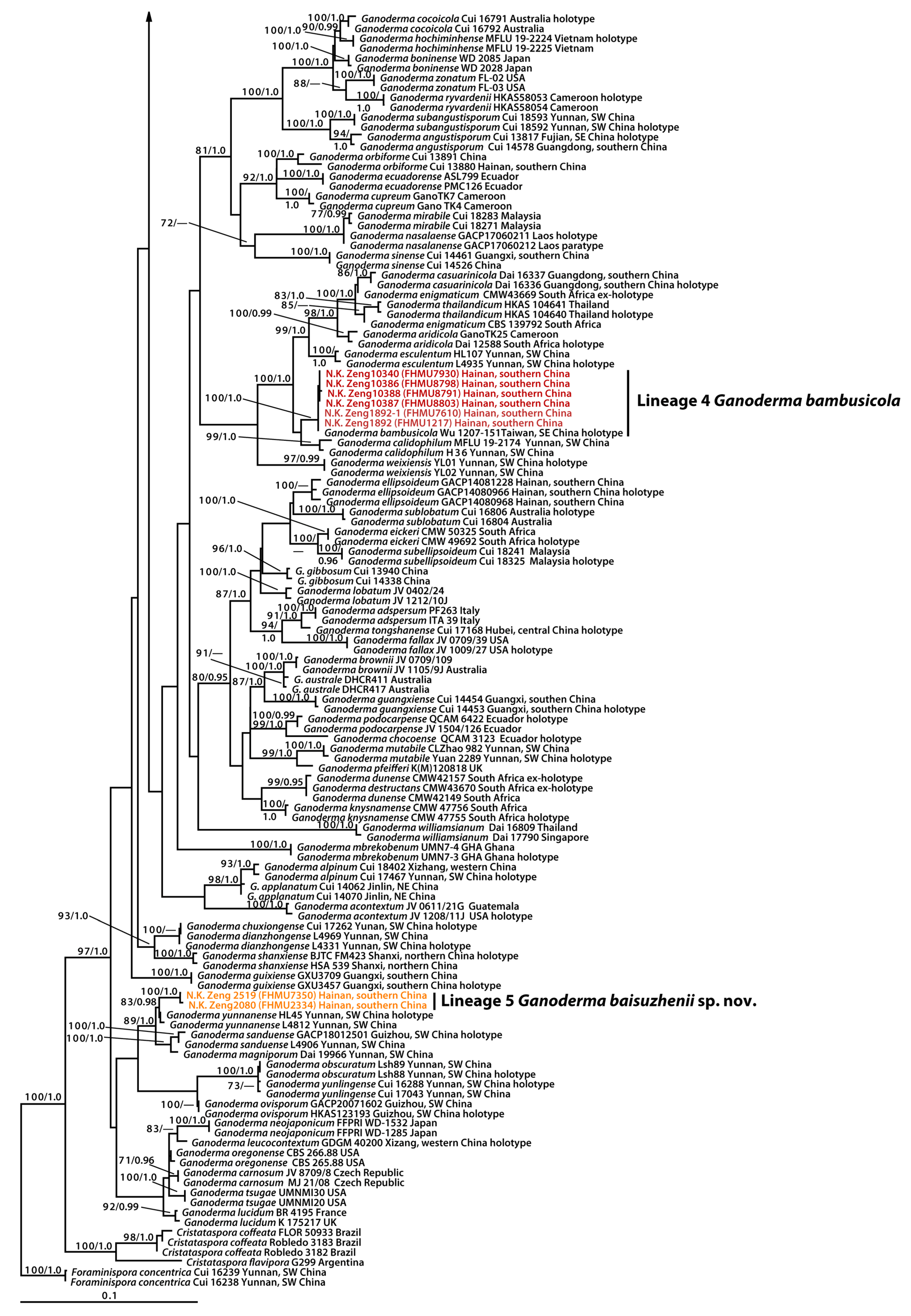
The combined dataset (ITS + rpb2 + tef1) comprised 224 sequences with 2032 nucleotide sites. A phylogram generated using RAxML, displaying branch lengths and support values, is presented in Figure 1. The tree topologies inferred from maximum likelihood (ML) and Bayesian inference (BY) analyses were identical, although slight differences in statistical support were observed (Figure 1). Based on the combined dataset, our newly collected Ganoderma specimens with diminutive pilei and gracile stipes were grouped into five distinct lineages (Figure 1). Lineage 1, with strong statistical support (BS = 97%, PP = 0.99), included four collections of G. flexipes Pat. and 14 newly collected specimens (FHMU2292, FHMU2329, FHMU2336, FHMU2337, FHMU3352, FHMU3360, FHMU4863, FHMU4898, FHMU5659, FHMU5661, FHMU5663, FHMU5672, FHMU5678, and FHMU5681). Lineage 2, also with strong statistical support (BS = 98%, PP = 1.0), consisted of two collections labeled as G. flexipes (Wei5491 and Wei5494) and one newly collected specimen (FHMU2290). Lineage 3, with strong statistical support (BS = 98%, PP = 1.0), included the holotype of G. subflexipes B.K. Cui, J.H. Xing & Y.F. Sun and eight newly collected specimens (FHMU2320, FHMU3731, FHMU5725, FHMU7611, HKAS79603, HKAS80249, HKAS81926-1, and HKAS81926-3). Lineage 4, with robust statistical support (BS = 100%, PP = 1.0), grouped the holotype of G. bambusicola Sheng H. Wu, C.L. Chern & T. Hatt. with six new specimens (FHMU1217, FHMU7610, FHMU7930, FHMU8791, FHMU8798, and FHMU8803). Finally, Lineage 5, also with strong statistical support (BS = 100%, PP = 1.0), comprised two newly collected specimens (FHMU2334 and FHMU7350).

Figure 1.
Phylogram for Ganoderma species generated from maximum likelihood analysis of ITS, rpb2, and tef1 sequence dataset using RAxML. BS ≥ 70% and PP ≥ 0.95 are indicated above or below the branches as RAxML BS/PP.
3.2. Taxonomy
Based on morphological examinations and molecular phylogenetic analyses, our new Ganoderma collections from the southern region of China, particularly Hainan Island, were identified as five distinct taxa. Among these, three were recognized as G. bambusicola, G. flexipes, and G. subflexipes, while the remaining two represented novel species. In accordance with local tradition, G. baisuzhenii, G. flexipes, and G. shennongii are commonly known as “Lingzhi Wang”, whereas G. bambusicola and G. subflexipes are referred to as “Zhu Lingzhi”. Detailed morphological descriptions of these five species are provided in the following sections.
Figure 2.
Ganoderma baisuzhenii (a–c) Basidiomata [(a,b) from FHMU2334, holotype; (c) from FHMU7350]. (d) Section of pileus (FHMU2334). Scale bars = 1 cm. Photos by N.K. Zeng.
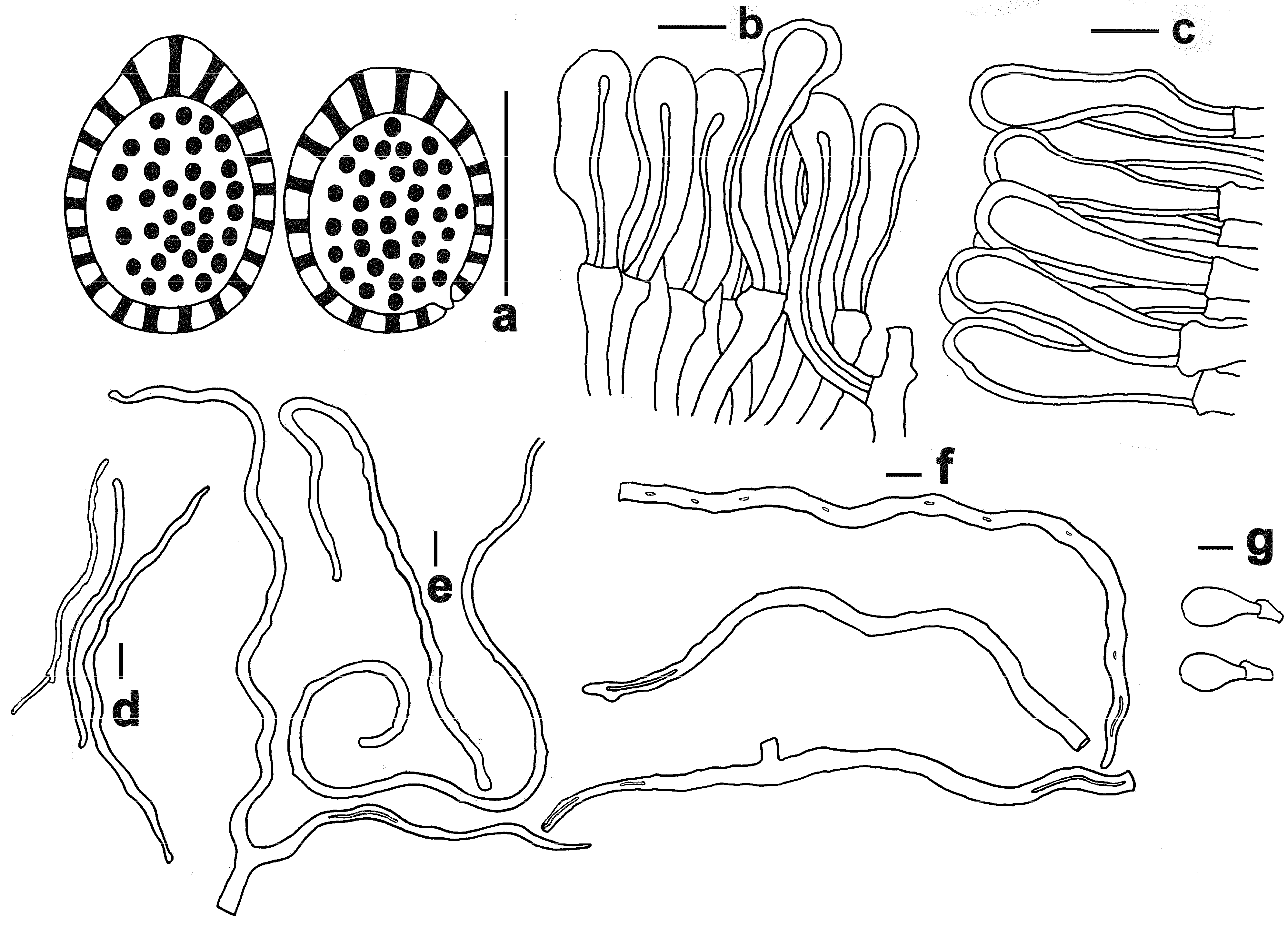
Figure 3.
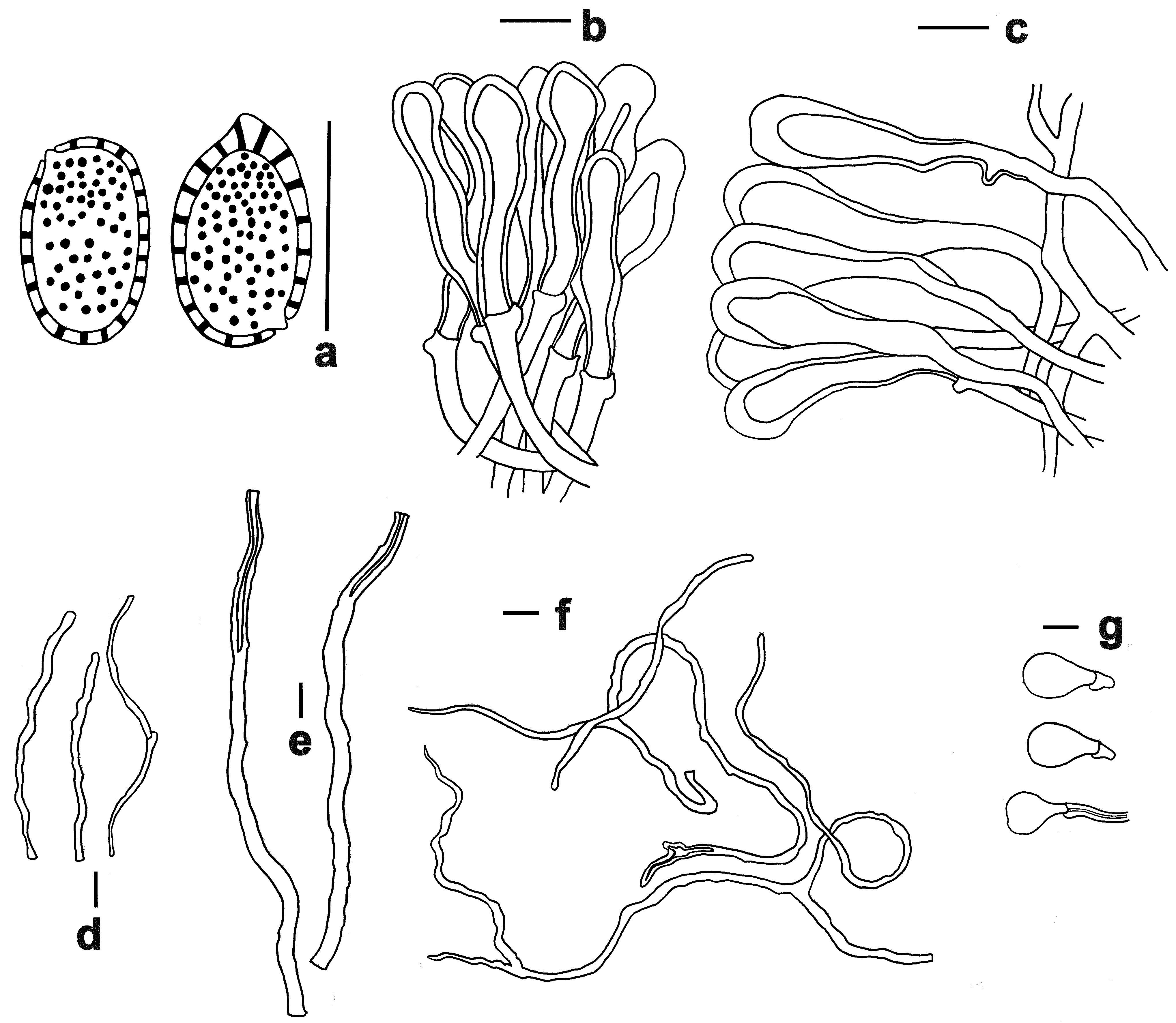
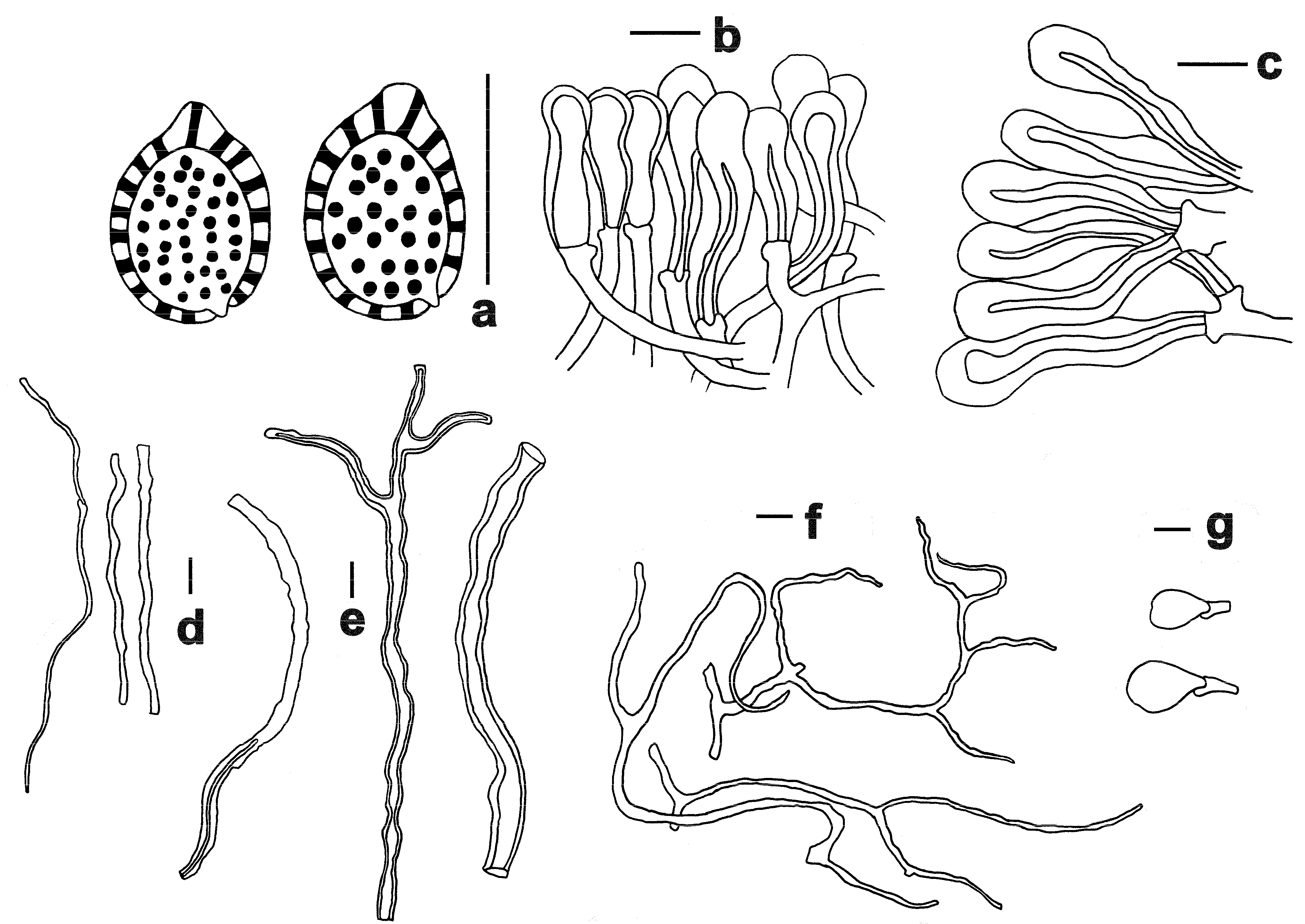
Microscopic features of Ganoderma baisuzhenii (FHMU 2334, holotype). (a) Basidiospores. (b) Pileipellis. (c) Stipitipellis. (d) Generative hyphae. (e) Skeletal hyphae. (f) Binding hyphae. (g) Basidioles. Scale bars = 10 μm. Drawings by R. Tian.
MycoBank: MB854442
Etymology: “baisuzhenii” is given in honor of Su-Zhen Bai, an ancient Chinese mythical figure who risked her life in search of Lingzhi to save her husband.
Diagnosis: It differs from the closest species of Ganoderma by a brownish-red to dark brownish-red pileus, a nearly white context, large pores, a pore surface that was initially yellowish, fading to white with age, and relatively large basidiospores, and it grows on decaying hardwood (underground).
Holotype: CHINA. Hainan Province: Changjiang County, Bawangling of Hainan Tropical Rainforest National Park, elev. 850 m, 28 June 2015, N.K. Zeng2080 (FHMU2334).
Description: Basidiomata annual, dorso-laterally stipitate, corky. Pilei up to 2.6 cm diameter and 0.9 cm thick, solitary, sub-reniform to reniform, or flabelliform. Pileal surface brownish-red (8E8) to dark brownish-red (8F8), strongly laccate, glabrous, with concentric furrows and inconspicuously radial rugose; margin obtuse, entire, incurved. Pore surface yellowish when young, then white, turning yellowish-brown (4C5) when injured; pore 2–3 per mm, subcircular, circular or angular; dissepiments slightly thick to moderately thick, entire. Context up to 0.5 cm thick, nearly white (4A3), hard woody. Tube up to 0.7 cm long, brown (5C5), indistinctively stratified. Stipe up to 10 cm long and 0.65 cm diameter, subcylindrical, solid, woody; surface brownish-black (8F7), glabrous to bumpy, laccate.
Hyphal system trimitic; generative hyphae with clamp connections; all hyphae IKI –, CB +; tissues darkening in KOH. Generative hyphae in context 1–3.5 µm diameter, colorless, thin-walled; skeletal hyphae in context 3–6.5 µm diameter, yellowish-brown, thick-walled with a wide to narrow lumen or sub-solid, seldom branched; binding hyphae in context 2.5–4 µm diameter, pale yellow, thin to slight thick-walled, sub-solid to solid, branched and flexuous. Generative hyphae in tubes 2.5–4 µm diameter, colorless, thin-walled; skeletal hyphae in tubes 3–6.5 µm diameter, yellowish-brown, usually thick-walled, solid to sub-solid, rarely branched; binding hyphae in tube 2–4.7 µm diameter, pale yellow, thin to slight thick-walled, sub-solid to solid, branched and flexuous. Pileipellis composed of clamped generative hyphae, thick-walled to sub-solid; apical cells 20–45 × 4–12 μm, clavate, slightly inflated, yellowish-brown, forming a regular palisade. Stipitipellis composed of clamped generative hyphae, thick-walled to sub-solid; apical cells 25–40 × 6–10 μm, clavate, slightly inflated, grayish-yellow, forming a regular palisade. Cystidia and cystidioles absent. Basidioles 15–23 × 10–13.5 μm, clavate, colorless, thin-walled. Basidia not observed. Basidiospores (11–) 11.5–14 (–15) × (7–) 8–10 μm, L = 13.13 μm, W = 9.35 μm, Q = 1.40 (n = 20/1/1, with myxosporium), 9–11 (–11.5) × 6–8 (–8.5) μm, L = 9.9 μm, W = 7.25 μm, Q = 1.37 (n = 20/1/1, without myxosporium), ellipsoid to broadly ellipsoid, pale yellowish-brown to brown, IKI –, CB +, double-walled with distinctly thick walls, exospore wall smooth, endospore wall with dense spinules.
Habitat: Solitary or gregarious, growing on decaying hardwood (often underground) of fagaceous trees, particularly those of the genus Cyclobalanopsis.
Known distribution: Southern China (Hainan Province).
Additional specimen examined: CHINA. Hainan Province: Yinggeling of Hainan Tropical Rainforest National Park, elev. 750 m, 3 August 2015, N.K. Zeng2519 (FHMU7350).
Notes: Ganoderma baisuzhenii, commonly referred to as “Lingzhi Wang” on Hainan Island in tropical China, has been frequently misidentified as G. flexipes (based on our investigations). Ganoderma flexipes can be distinguished from G. baisuzhenii by its richer red pileus, white pore surface, brown pileal context, and smaller basidiospores (see details below). Morphologically and phylogenetically, G. baisuzhenii is closely related to G. magniporum J.D. Zhao & X.Q. Zhang, G. sanduense Hapuar., T.C. Wen & K.D. Hyde, and G. yunnanense Jun He & Shu H. Li. However, these species exhibit distinct characteristics: G. magniporum, originally described in Guangxi in southern China, features a blackish-brown to black pileus, a brown context, and smaller basidiospores measuring 8.7–10.4 × 5.2–7 μm [71]; G. sanduense, first described in Guizhou in southwestern China, is characterized by a reddish-black to brownish-black pileus, smaller pores, and a brown to dark brown context [58]; and G. yunnanense, originally described in Yunnan in southwestern China, has smaller pores (4–6 per mm), a white pore surface, and smaller basidiospores measuring 9–12 × 7–8 μm [48].
Ganoderma bambusicola Sheng H. Wu, C.L. Chern & T. Hatt. Phytotaxa 456(1): 79, 2020 (Figure 4 and Figure 5)
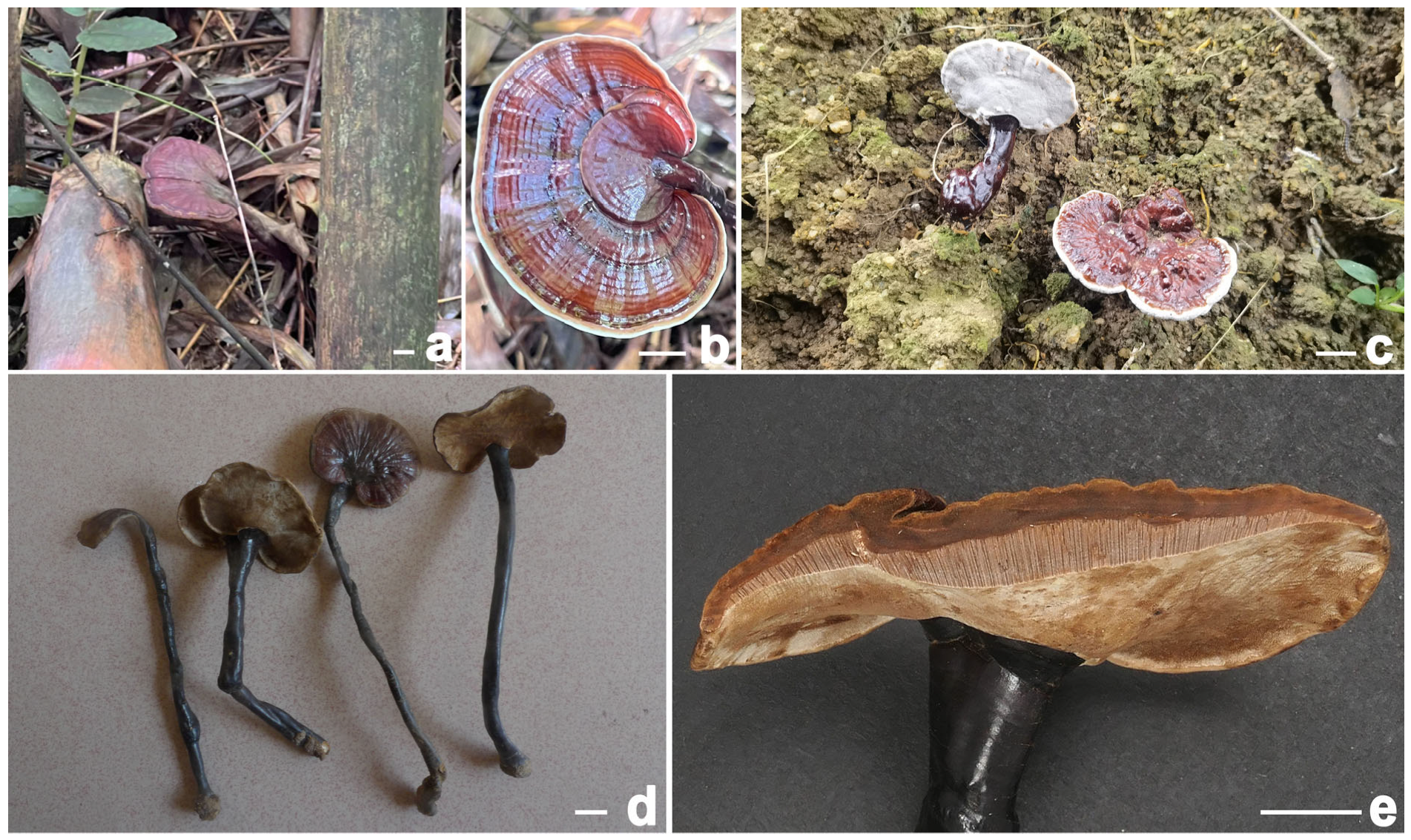
Figure 4.
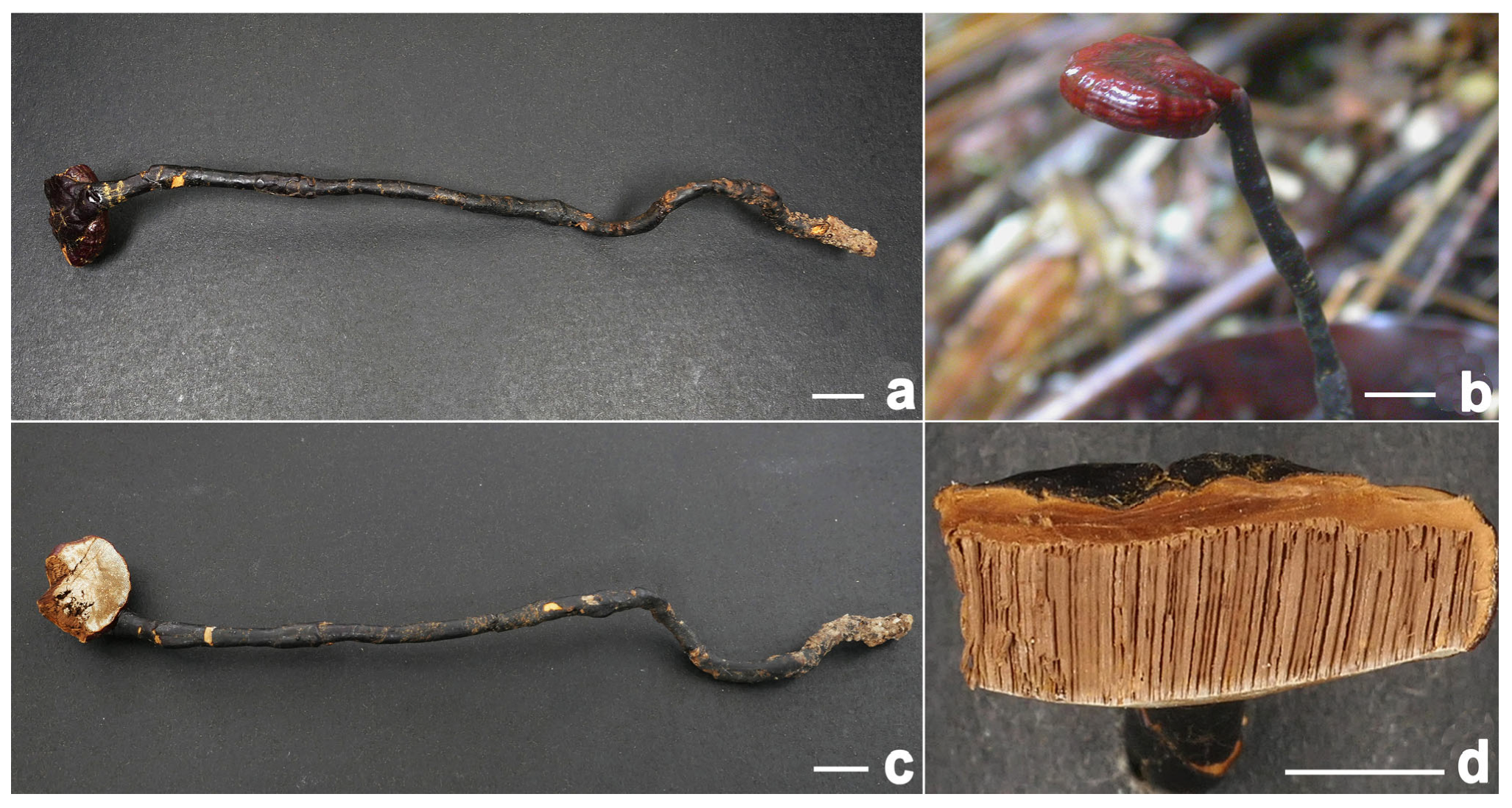
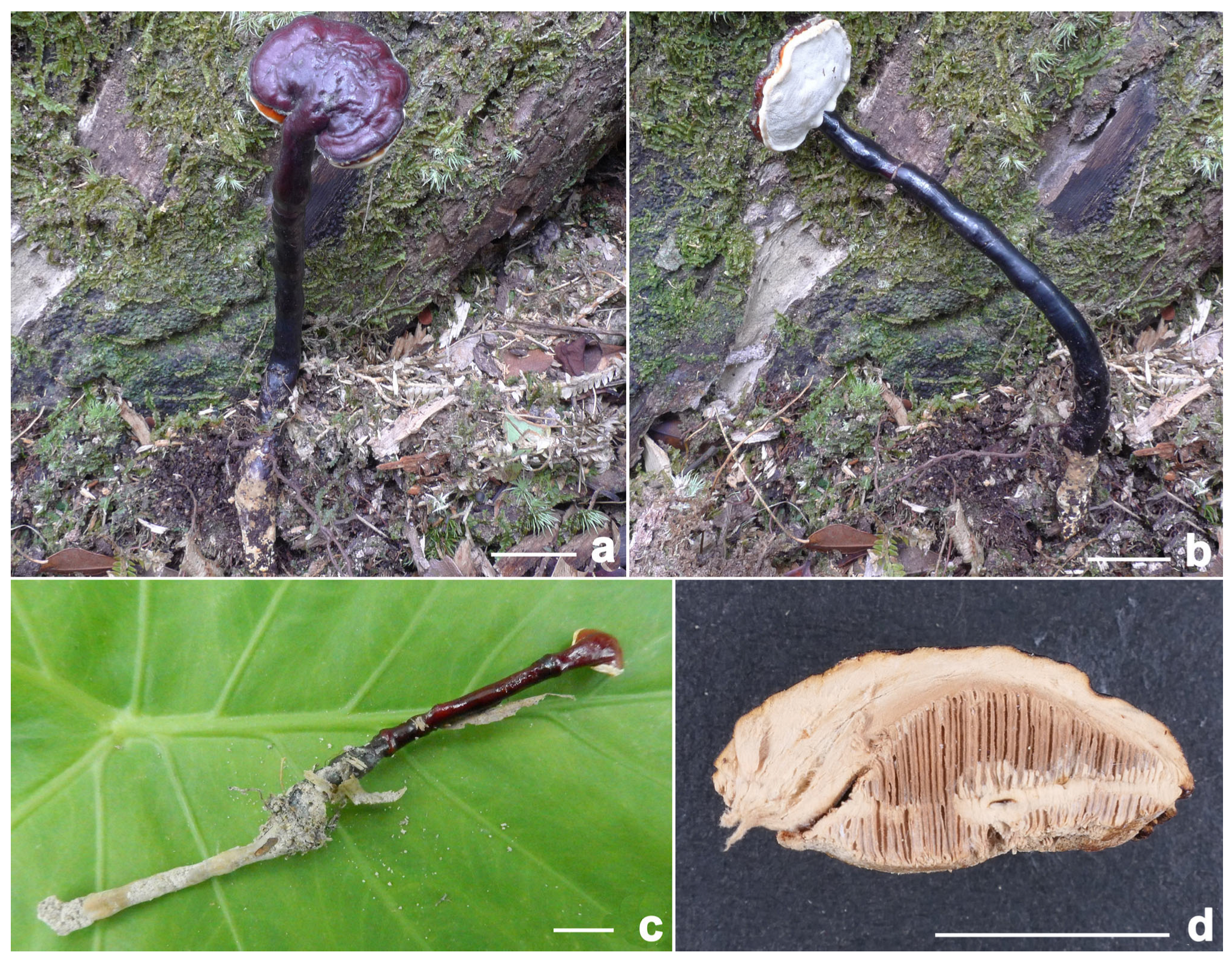
Ganoderma bambusicola (a–d) Basidiomata [(a,b) from FHMU8798; (c) from FHMU7930, cultivated fruit bodies; (d) from FHMU1217]. (e) Section of pileus (FHMU1217). Scale bars = 1 cm. Photos: (a,b) by Y. Liu and (c–e) by N.K. Zeng.
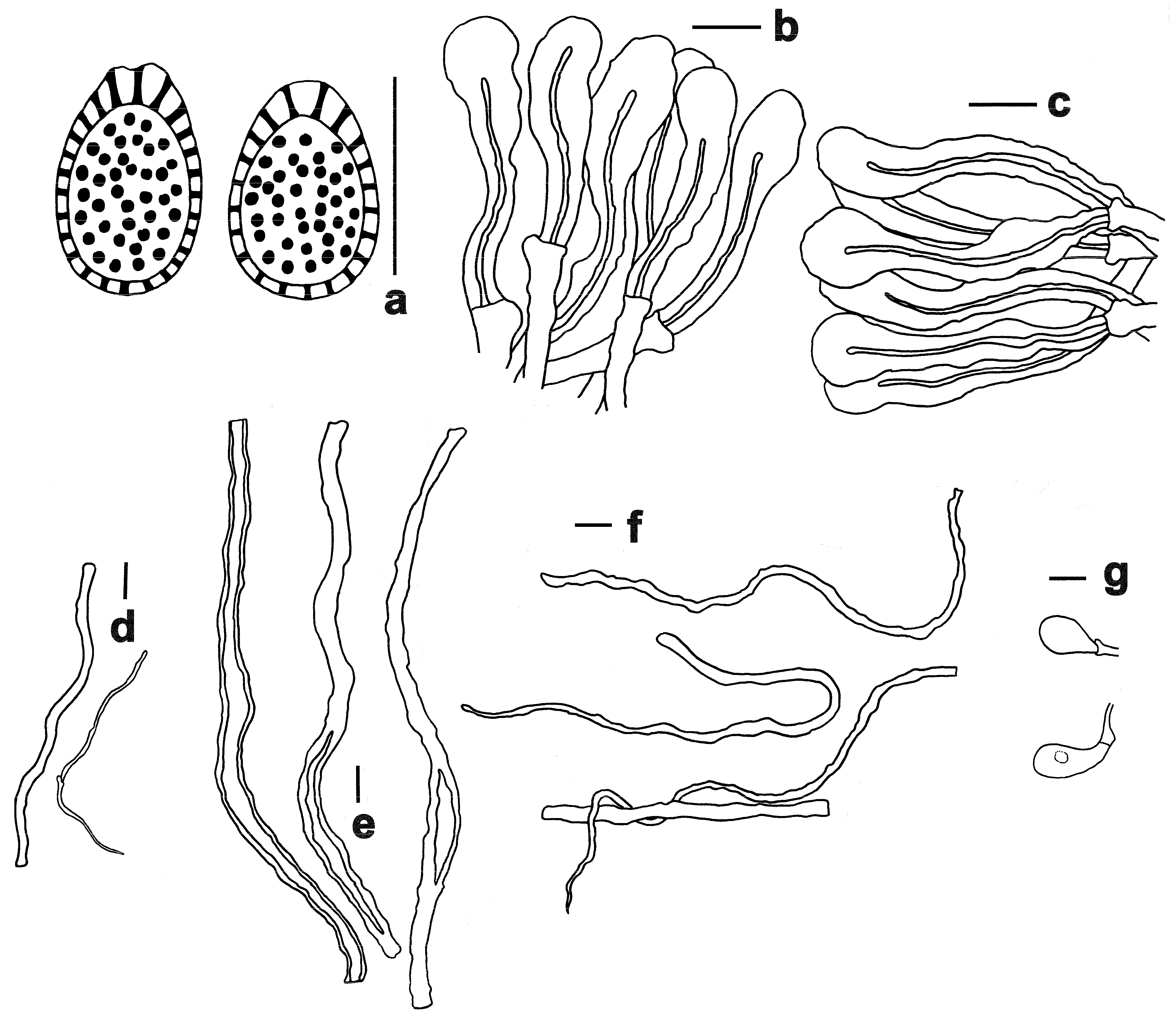
Figure 5.
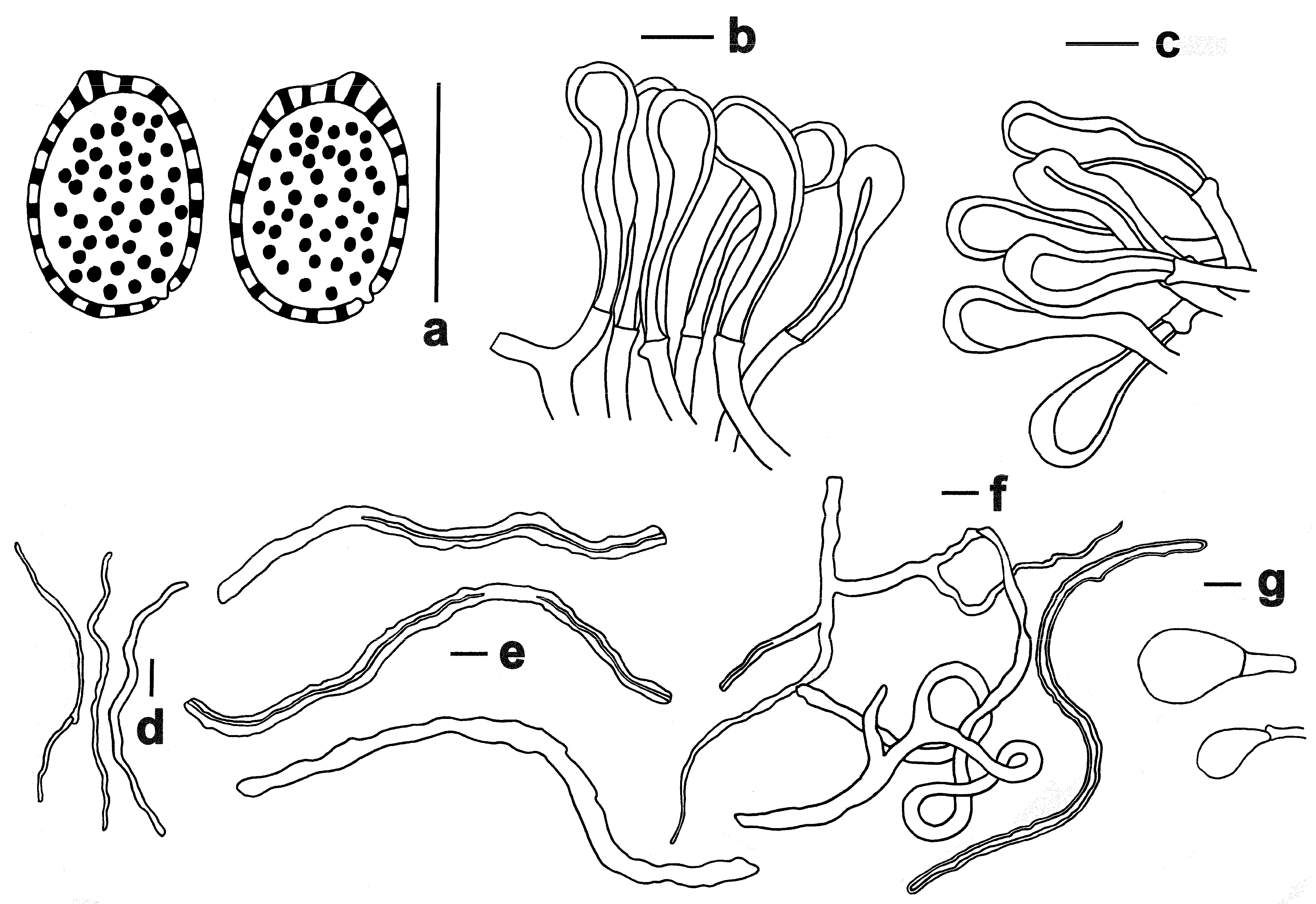
Microscopic features of Ganoderma bambusicola (FHMU1217). (a) Basidiospores. (b) Pileipellis. (c) Stipitipellis. (d) Generative hyphae. (e) Skeletal hyphae. (f) Binding hyphae. (g) Basidioles. Scale bars = 10 μm. Drawings by R. Tian.
MycoBank: MB835651
Description: Basidiomata annual, dorso-laterally stipitate, woody. Pilei up to 7 cm diameter and 2 mm thick, solitary, applanate, sub-reniform to reniform, or flabelliform. Pileal surface brownish-black (8F7–8F8), reddish-black (10F8) to purplish-brown (12E6–12E7), laccate, glabrous, with conspicuously or obscurely concentric furrows and strongly radial rugose; margin obtuse, entire, slightly incurved. Pore surface white (2B2–2B3), turning yellowish-brown (5D5–5D6) when injured; pores 4–6 per mm, subcircular to circular or angular; dissepiments thin, mostly entire. Context up to 0.3 cm thick, dark brown (5E5–5E8), fibrous to corky. Tubes up to 0.4 cm long, grayish-yellow (5C3–5C4), indistinctively stratified. Stipe up to 15 cm long and 1.5 cm diameter, cylindrical to subcylindrical, solid, woody; surface blackish (7F7), glabrous to bumpy, laccate.
Hyphal system trimitic; generative hyphae with clamp connections; all hyphae IKI –, CB +; tissues darkening in KOH. Generative hyphae in context 2–4 µm diameter, nearly colorless, thin-walled; skeletal hyphae in context 4–7 µm diameter, grayish-yellow, thick-walled with a medium to narrow lumen or sub-solid, rarely branched; binding hyphae in context 3–5 µm diameter, light orange, slightly thick-walled, sub-solid, frequently branched. Generative hyphae in tubes 3–6 μm diameter, colorless, thin-walled; skeletal hyphae in tubes grayish-yellow, thick-walled with a narrow lumen to sub-solid, frequently arboriform and flexuous; binding hyphae in tubes 1.5–3.5 μm diameter, light orange, thick-walled, branched and flexuous. Pileipellis composed of clamped generative hyphae, thick-walled to sub-solid; apical cells 30–64 × 6–14 μm, clavate, slightly inflated, yellowish-brown, forming a regular palisade. Stipitipellis composed of clamped generative hyphae, thick-walled to sub-solid; apical cells 35–50 × 7–15 μm, clavate, slightly inflated, yellowish-brown, forming a regular palisade. Cystidia and cystidioles absent. Basidioles 17–24.5 × 9–13 μm, clavate, colorless, thin-walled. Basidia not observed. Basidiospores 9.5–12.5 × 5–7 μm, L = 11.13 μm, W = 6.32 μm, Q = 1.76 (n = 160/8/7, with myxosporium), 7–11 × 4–5.5 μm, L = 9.03 μm, W = 5.08 μm, Q = 1.78 (n = 160/8/7, without myxosporium), ellipsoid to broadly ellipsoid, pale yellowish-brown to brown, IKI–, CB+, double-walled with distinctly thick walls, exospore wall smooth, endospore wall with dense spinules.
Habitat: Solitary or gregarious, occurring on dead roots of bamboo, particularly those of Dendrocalamus latiflorus Munro.
Known distribution: Southern (Hainan Province) and southeastern (Taiwan Province) China, Laos, and Myanmar [8].
Specimens examined: CHINA. Hainan Province, Haikou City, bought from market, 14 January 2015, N.K. Zeng1892 (FHMU1217); same location and date, N.K. Zeng1892-1 (FHMU7610); Baisha County, Qingsong Town, Edible and Medicinal Fungi Cultivation Base, 2 October 2024, N.K. Zeng10340 (FHMU7930); Baisha County, Nankai Town, elev. 520 m, 7 October 2024, N.K. Zeng10386 (FHMU8798); same location and date, N.K. Zeng10387 (FHMU8803); same location and date, N.K. Zeng10388 (FHMU8791).
Notes: Ganoderma bambusicola was originally described in Taiwan in southeastern China [8]. Taxonomically, this species represents a newly recorded addition to the fungal flora of the Chinese mainland. Commonly referred to as “Zhu Lingzhi” on Hainan Island in tropical China, it has been successfully cultivated (based on our investigations). This species is characterized by a brownish-black, reddish-black to purplish-brown pileus, relatively small pores, a white pore surface, and a dark brown context. It is typically found growing on dead bamboo roots.
Figure 6.
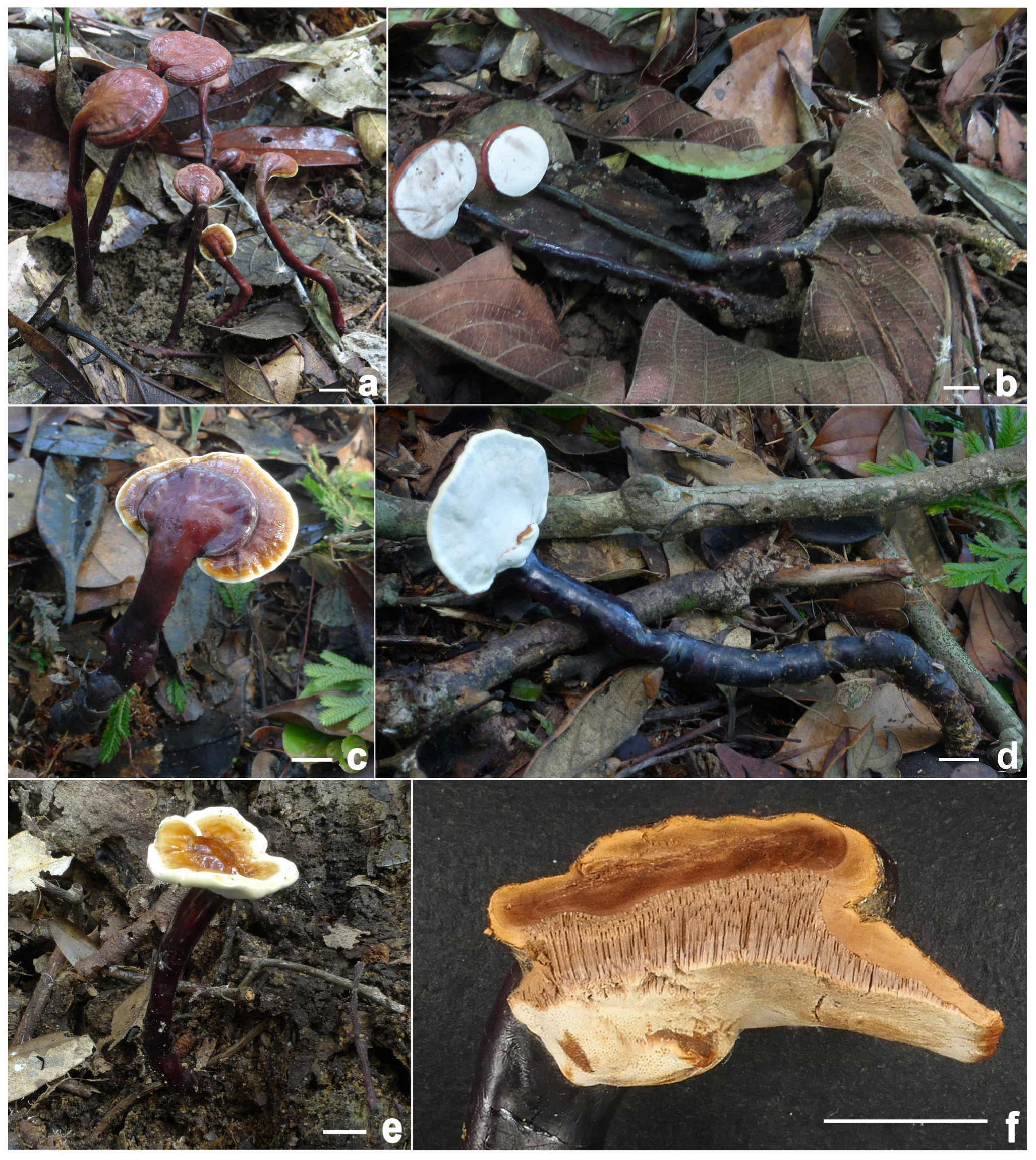
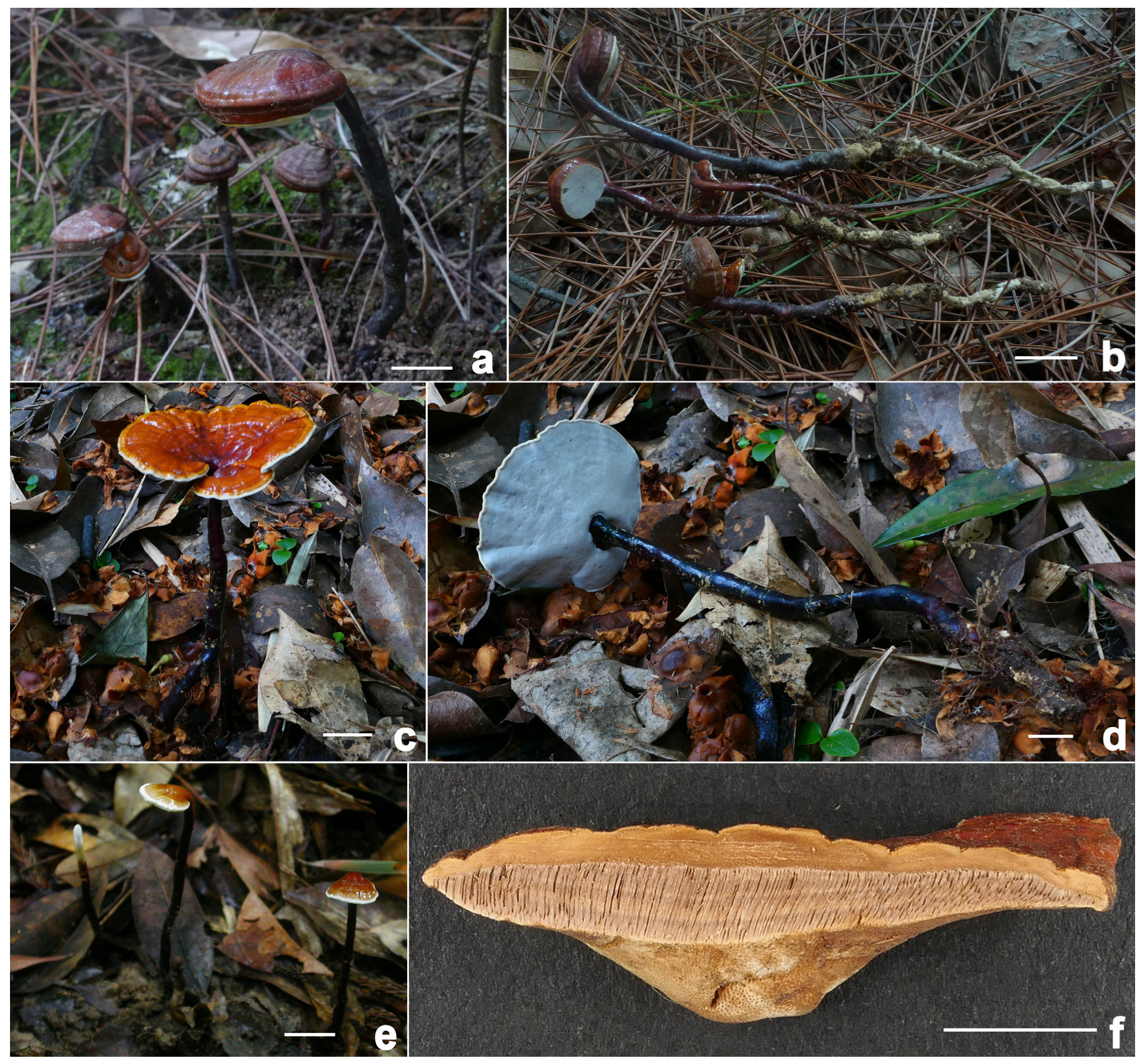
Ganoderma flexipes (a–e) Basidiomata [(a,b) from FHMU2985; (c,d) from FHMU2329; (e) from FHMU2337]. (f) Section of pileus (FHMU2329). Scale bars = 1 cm. Photos by N.K. Zeng.
Figure 7.
Microscopic features of Ganoderma flexipes (FHMU2985). (a) Basidiospores. (b) Pileipellis. (c) Stipitipellis. (d) Generative hyphae. (e) Skeletal hyphae. (f) Binding hyphae. (g) Basidioles. Scale bars = 10 μm. Drawings by R. Tian.
≡ Fomes flexipes (Pat.) Sacc. & Traverso, Syll. fung. (Abellini) 19: 710, 1910
≡ Polyporus flexipes (Pat.) Lloyd, Mycol. Writ. 3 (Syn. Stip. Polyporoids): 104, 1912
= Ganoderma atrum J.D. Zhao et al., Acta Microbiol. Sin. 19: 268, 1979
= Ganoderma hainanense J.D. Zhao et al., Acta Microbiol. Sin. 19: 269, 1979
= Ganoderma parviungulatum J.D. Zhao & X.Q. Zhang, Acta Mycol. Sin. 5: 88, 1986
MycoBank: MB249905
Description: Basidiomata annual, dorso-laterally, sometimes centrally stipitate, corky. Pilei solitary, up to 5 cm diameter and 0.6 cm thick, sub-reniform to reniform, subflabellate to flabellate, shell-like or circular. Pileal surface brownish-red (8E5–8E6) to reddish, strongly laccate, glabrous when young, then bumpy, with obvious concentric furrows and slightly radial rugose; margin obtuse, entire, slightly incurved. Pore surface white, turning brownish (5D5–5D6) when injured; pore 3–4 per mm, subcircular, circular or angular; dissepiments slightly thick, entire. Context up to 3 mm thick, upper layer yellowish-brown (5D5–5D6), lower layer brown to dark brown (8E8), fibrous to corky. Tubes pale brown (5B3–5B4), indistinctively stratified, up to 0.6 cm long. Stipe up to 17.5 cm long and 0.6 cm diameter, flattened to subcylindrical, solid, woody; surface brownish-red (8E8) to reddish-black (8F8), glabrous to bumpy, laccate.
Hyphal system trimitic; generative hyphae with clamp connections; all hyphae IKI–, CB+; tissues darkening in KOH. Generative hyphae in context 1–2.5 µm diameter, colorless, thin-walled; skeletal hyphae in context 4–6 µm diameter, yellowish-brown, thick-walled with a wide to narrow lumen or sub-solid, arboriform and flexuous; binding hyphae in context 4–6 µm diameter, colorless, thick-walled, branched and flexuous. Generative hyphae in tubes 1–3 μm diameter, colorless, thin-walled; skeletal hyphae in tubes 2.5–5 μm diameter, colorless, sub-solid, arboriform and flexuous; binding hyphae in tubes 1–3 μm diameter, colorless, thick-walled, branched and flexuous. Pileipellis composed of clamped generative hyphae, thick-walled; apical cells 30–50 × 5–13 µm, clavate, slightly inflated, yellowish-brown or brownish-orange, forming a regular palisade. Stipitipellis composed of clamped generative hyphae, thick-walled to sub-solid; apical cells 32–50 × 5–12 μm, clavate, slightly inflated, pale brown or brownish-orange, forming a regular palisade. Cystidia and cystidioles absent. Basidioles 17.5–23 × 7–11.5 μm, clavate, colorless, thin-walled. Basidia not observed. Basidiospores 8.5–12 × 5.5–7.5 μm, L = 10.15 μm, W = 6.45 μm, Q = 1.57 (n = 80/4/3, with myxosporium); 6.5–9 × 4–6 μm, L = 7.59 μm, W = 5.2 μm, Q = 1.46 (n = 80/4/3, without myxosporium), ellipsoid, not obviously truncated, light yellow (4A5–4A6) to pale yellowish-brown (5C5–5C6), IKI –, CB +, double-walled with moderately thick walls, exospore wall smooth, endospore wall with dense spinules.
Habitat: Solitary or gregarious, occurring on decaying hardwood (often underground) of fagaceous trees, particularly those of Quercus patelliformis Chun.
Known distribution: Southern (Hainan and Guangdong Provinces) [2], southeastern (Taiwan Province) [72], and southwestern (Yunnan Province) China [3], Vietnam, India, Laos, Nepal, Pakistan, and Myanmar [3,58].
Specimens examined: CHINA. Hainan Province: Wuzhishan of Hainan Tropical Rainforest National Park, elev. 1200 m, 30 May 2009, N.K. Zeng210 (FHMU2292); Jianfengling of Hainan Tropical Rainforest National Park, elev. 900 m, 30 June 2015, N.K. Zeng2087 (FHMU2337); same location, 27 June 2018, N.K. Zeng3420 (FHMU2985); same location, 10 August 2020, N.K. Zeng4561 (FHMU4863); same location, 11 August 2020, N.K. Zeng4595 (FHMU4898); Bawangling of Hainan Tropical Rainforest National Park, elev. 950 m, 28 June 2015, N.K. Zeng2042 (FHMU2329); same location and date, N.K. Zeng2085 (FHMU2336); Yinggeling of Hainan Tropical Rainforest National Park, elev. 800 m, 5 August 2015, N.K. Zeng2606 (FHMU3360); same location and date, N.K. Zeng2607 (FHMU3352); Ledong County, Jianfeng Town, 16 November 2015, bought from the market, N.K. Zeng2614 (FHMU5672); same location and date, N.K. Zeng2616 (FHMU5678); same location and date, N.K. Zeng2617 (FHMU5663); same location and date, N.K. Zeng2618 (FHMU5661); same location and date, N.K. Zeng2624 (FHMU5681); same location and date, N.K. Zeng2627 (FHMU5659).
Notes: Ganoderma flexipes was originally described in Vietnam [73] and has since been reported in several other regions, including China, India, Laos, Nepal, Pakistan, and Myanmar [3,58,72,74,75]. In Hainan Island, tropical China, this species is commonly referred to as “Lingzhi Wang”. It is characterized by a brownish-red to reddish pileus, a white pore surface, and a yellowish-brown to dark brown context. It typically grows on the decaying hardwood (often underground) of fagaceous trees.
Figure 8.
Ganoderma shennongii (FHMU2290, holotype) (a–c) Basidiomata. (d) Section of pileus. Scale bars = 1 cm. Photos by N.K. Zeng.
Figure 9.
Microscopic features of Ganoderma shennongii (FHMU2290, holotype). (a) Basidiospores. (b) Pileipellis. (c) Stipitipellis. (d) Generative hyphae. (e) Skeletal hyphae. (f) Binding hyphae. (g) Basidioles. Scale bars = 10 μm. Drawings by R. Tian.
MycoBank: MB854441
Etymology: “shennongii” is given in honor of our ancestor represented by Shennong who dared to taste hundreds of herbs including Ganoderma spp.
Diagnosis: It differs from the closest species of Ganoderma by a relatively small basidioma, a dark reddish pileus, a white pore surface, relatively small pores, and a yellowish-brown to brown context, and it grows on decaying dead wood (underground).
Holotype: CHINA. Hainan Province, Diaoluoshan of Hainan Tropical Rainforest National Park, elev. 950 m, 28 May 2009, N.K. Zeng203 (FHMU2290).
Description: Basidiomata annual, dorso-laterally stipitate, corky. Pilei up to 1.8 cm diameter and 0.6 cm thick, solitary, sub-reniform to reniform, or subflabellate to flabellate. Pileal surface dark reddish (9E5–9E6), strongly laccate, glabrous, with conspicuously concentric furrows and slightly radial rugose; margin obtuse, entire, incurved. Pore surface white, turning brown (5C5–5C6) when injured; pores 4–5 per mm, subcircular to circular or angular; dissepiments slightly thick to moderately thick, entire. Context up to 0.1 cm thick, yellowish-brown (4C5) to brown (5D7–5D8), fibrous to corky. Tube up to 0.1 cm long, brown (5C5), indistinctively stratified. Stipe up to 12.5 cm long and 4 mm diameter, cylindrical to subcylindrical, solid, fibrous to woody; surface brownish-black (8F7), glabrous to bumpy, laccate.
Hyphal system trimitic; generative hyphae with clamp connections; all hyphae IKI–, CB+; tissues darkening in KOH. Generative hyphae in context 1.2–2 µm diameter, colorless, thin-walled; skeletal hyphae in context 3.8–5 µm diameter, pale yellowish-brown, thick-walled with a wide to narrow lumen or sub-solid, arboriform and flexuous; binding hyphae in context 1.2–3.2 µm diameter, colorless, thick-walled, branched and flexuous. Generative hyphae in tubes 1–2 µm diameter, colorless, thin-walled; skeletal hyphae in tubes 4–6.5 µm diameter, colorless, thick-walled with a wide to narrow lumen or sub-solid, arboriform and flexuous; binding hyphae in tubes 1–3 µm diameter, colorless, thick-walled, branched and flexuous. Pileipellis composed of clamped generative hyphae, thick-walled; apical cells 25–45 × 7–14 μm, clavate, inflated, dark brown, anticlinal, forming a regular palisade. Stipitipellis composed of clamped generative hyphae, thick-walled; apical cells 20–40 × 5–10 μm, clavate, inflated, dark brown, anticlinal, forming a regular palisade. Cystidia and cystidioles absent. Basidioles 20–25 × 9–20 μm, subclavate to clavate, colorless, thin-walled. Basidia not observed. Basidiospores 10–11.5 × 7–8.5 μm, L = 10.44 μm, W = 7.55 μm, Q = 1.38 (n = 20/1/1, with myxosporium), 7.5–9.5 × 5–8 μm, L = 8.17 μm, W = 6.72 μm, Q = 1.12 (n = 20/1/1, without myxosporium), ellipsoid to broadly ellipsoid, pale yellowish-brown, IKI –, CB +, double-walled with slightly thick walls, exospore wall smooth, endospore wall with dense spinules.
Habitat: Solitary or gregarious, occurring on decaying hardwood (often underground) in forests predominantly composed of fagaceous trees.
Known distribution: Southern China (Hainan Province).
Notes: Ganoderma shennongii, commonly referred to as “Lingzhi Wang” on Hainan Island in tropical China, was historically misidentified as G. flexipes [40]. However, G. flexipes can be distinguished by its larger pores and narrower basidiospores, measuring 8.5–12 × 5.5–7.5 μm (see above). In addition to G. flexipes, G. shennongii is morphologically and phylogenetically closely related to G. subflexipes. Nevertheless, G. subflexipes exhibits smaller pores and narrower basidiospores, measuring 8–11.5 × 5–7.5 μm (see below). Furthermore, G. shennongii shares morphological similarities with G. bambusicola; however, the latter is characterized by a more blackish pileus, narrower basidiospores (9.5–12.5 × 5–7 μm), and a specific habitat preference for growing on dead bamboo roots (see above).
Ganoderma subflexipes B.K. Cui, J.H. Xing & Y.F. Sun, Stud. Mycol. 101: 350, 2022 (Figure 10 and Figure 11)
Figure 10.
Ganoderma subflexipes (a–e) Basidiomata [(a,b) from FHMU2320; (c,d) from FHMU5725; (e) from FHMU2299]. (f) Section of pileus (FHMU5725). Scale bars = 1 cm. Photos by N.K. Zeng.
Figure 11.
Microscopic features of Ganoderma subflexipes (FHMU2320). (a) Basidiospores. (b) Pileipellis. (c) Stipitipellis. (d) Generative hyphae. (e) Skeletal hyphae. (f) Binding hyphae. (g) Basidioles. Scale bars = 10 μm. Drawings by R. Tian.
MycoBank: MB839675
Description: Basidiomata annual, eccentric or dorso-laterally stipitate, corky. Pilei up to 5 cm diameter and 0.5 cm thick, solitary, applanate, sub-reniform to reniform, or subflabellate to flabellate. Pileal surface reddish-brown (8D7–8D8) to orangish-brown (6B8), strongly laccate, glabrous when young, then bumpy, with conspicuously concentric furrows and slightly radial rugose; margin obtuse, entire, incurved. Pore surface white, turning yellowish-brown (4C5–4C6) when injured; pore 5–6 per mm, subcircular to circular or angular. Context up to 1.5 cm thick, yellowish-brown (4C5) to brown (5D7–5D8), fibrous to corky. Tubes up to 0.5 cm long, pale yellow (1A3–1A4) to grayish-yellow (4B4), indistinctively stratified. Stipe up to 15 cm long and 7 mm diameter, cylindrical to subcylindrical, solid, fibrous to woody; surface reddish-brown (7E7) to chocolate brown (8E7), glabrous to bumpy, laccate.
Hyphal system trimitic; generative hyphae with clamp connections; all hyphae IKI–, CB+; tissues darkening in KOH. Generative hyphae in context 1–2 µm diameter, colorless, thin-walled; skeletal hyphae in context 2–6 µm in diameter, pale yellowish-brown, thick-walled with a wide to narrow lumen or sub-solid, arboriform and flexuous; binding hyphae in context 1–3.5 µm diameter, colorless, thick-walled, branched and flexuous. Generative hyphae in tubes 1.5–3 µm diameter, colorless, thin-walled; skeletal hyphae in tubes 3–5 µm in diameter, pale yellow, thick-walled with a wide to narrow lumen or sub-solid, arboriform and flexuous; binding hyphae in context 1–3.5 µm diameter, colorless, thick-walled, branched and flexuous. Pileipellis composed of clamped generative hyphae, thick-walled; apical cells 20–50 × 5–12 μm, clavate, inflated, dark brown, anticlinal, forming a regular palisade. Stipitipellis composed of clamped generative hyphae, thick-walled; apical cells 20–40 × 6–12 μm, clavate, inflated, dark brown, forming a regular palisade. Cystidia and cystidioles absent. Basidioles 15–19 × 8.5–13 μm, subclavate to clavate, colorless, thin-walled. Basidia not observed. Basidiospores 8–11.5 (–12) × 5–7.5 (–8) μm, L = 10.27 μm, W = 6.76 μm, Q = 1.52 (n = 120/6/3, with myxosporium), 6–9.5 × 4–7 μm, L = 7.78 μm, W = 5.34 μm, Q = 1.46 (n = 120/6/3, without myxosporium), ellipsoid to broadly ellipsoid, pale yellow, IKI–, CB+, double-walled with slightly thick walls, exospore wall smooth, endospore wall with dense spinules.
Habitat: It is solitary or gregarious and primarily found on dead roots of bamboo, particularly those of Bambusa chungii McClure. Occasionally, it may also occur on decaying hardwood (often underground) in forests dominated by fagaceous trees or in mixed forests where fagaceous trees and Pinus massoniana Lamb. are predominant.
Known distribution: Southern (Hainan and Guangdong Provinces), southeastern (Fujian Province), and eastern China (Jiangxi Province) [2].
Specimens examined: CHINA. Fujian Province: Zhangping City, Xingqiao Town, Chengkou Village, elev. 350 m, 20 August 2013, N.K. Zeng1455 (FHMU2320); Sanming City, Geshikao National Forest Park, elev. 380 m, 8 July 2013, Y.J. Hao969 (HKAS80249); Sanming City, Nature Reserve for Wild Sarcandra glabra, 8 July 2013, T. Guo724 (HKAS81926). Guangdong Province: Fengkai County, Heishiding Nature Reserve, elev. 360 m, 2 June 2013, Q. Cai924 (HKAS79603); Shaoguan City, Danxia National Nature Reserve, elev. 380 m, 5 June 2019, N.K. Zeng4086 (FHMU3731); same collection, 4 June 2019, N.K. Zeng4114 (FHMU5725). Hainan Province: Limushan of Hainan Tropical Rainforest National Park, elev. 650 m, 4 June 2009, N.K. Zeng242 (FHMU2299); Haikou City, 14 January 2015, bought from market, N.K. Zeng1893 (FHMU1218); same location and date, N.K. Zeng 1893-2 (FHMU7611).
Notes: Ganoderma subflexipes, originally described in Guangdong in southern China [2], is commonly referred to as “Zhu Lingzhi” on Hainan Island in tropical China. This species is characterized by a reddish-brown to orangish-brown pileus, relatively small pores, a white pore surface, and a yellowish-brown to brown context. It typically grows on dead bamboo roots, though it is occasionally found on decaying hardwood (often underground).
4. Discussion
The species diversity of Ganoderma has been extensively documented in southern China, particularly on Hainan Island [2]. However, wild populations of Ganoderma species, including those referred to as “Lingzhi Wang” or “Zhu Lingzhi” on Hainan Island, have significantly declined due to overharvesting. Consequently, many species within this genus have been classified as priority protected species in the Hainan Tropical Rainforest National Park [76,77]. Effective conservation of these species necessitates accurate identification. Furthermore, there is an urgent need to reliably distinguish “Lingzhi Wang” or “Zhu Lingzhi”, which are crucial medicinal fungi in Hainan Island, from their close relatives, counterfeits, adulterants, and inferior substitutes to ensure their medicinal efficacy [78]. The present study identifies “Lingzhi Wang” as including G. baisuzhenii, G. flexipes, and G. shennongii, and “Zhu Lingzhi” as including G. bambusicola and G. subflexipes. The precise definition of these species provides essential data for the conservation and medicinal utilization of these Ganoderma species (Table 2).
Table 2.
Main characters of five Ganoderma species called “Lingzhi Wang” or “Zhu Lingzhi” in Hainan Island, tropical China.
In addition to the aforementioned species—namely, G. baisuzhenii, G. bambusicola, G. flexipes, G. shennongii, and G. subflexipes—other taxa such as G. atrum J.D. Zhao, L.W. Hsu & X.Q. Zhang, G. calidophilum J.D. Zhao, L.W. Hsu & X.Q. Zhang, G. hainanense J.D. Zhao, L.W. Hsu & X.Q. Zhang, G. luteomarginatum J.D. Zhao, L.W. Hsu & X.Q. Zhang, and G. parviungulatum J.D. Zhao & X.Q. Zhang, all originally described on Hainan Island in tropical China, are also characterized by their diminutive pilei and gracile stipes [79,80]. Cao et al. [11] proposed that G. atrum, G. hainanense, and G. parviungulatum are synonymous with G. flexipes, a suggestion later supported by Sun et al. [2]. Similarly, G. luteomarginatum was suggested to be synonymous with G. sinense J.D. Zhao, L.W. Hsu & X.Q. Zhang [2]. Although G. calidophilum was initially believed to be synonymous with G. flexipes [11,72], this viewpoint has been challenged in recent studies. The protologue of G. calidophilum does not align well with that of G. flexipes, as the former exhibits denser pores (4–6 per mm) and larger basidiospores, measuring 10–12.1 × 6.2–8.7 μm [79]. Consequently, the taxonomic relationship between G. flexipes and G. calidophilum remains unresolved and warrants further investigation in future studies.
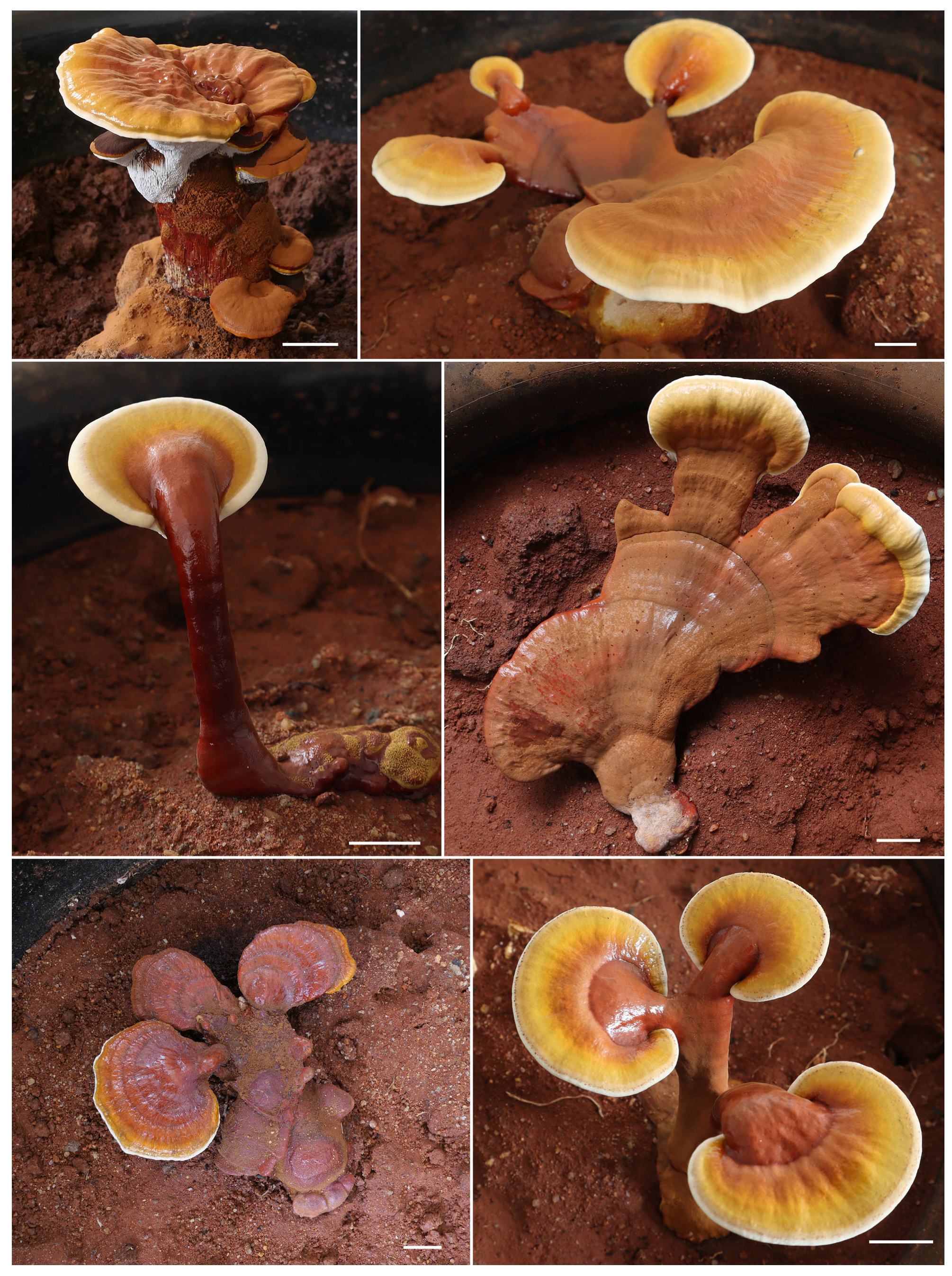
Among Ganoderma species, high phenotypic plasticity at the macroscopic level is a well-documented phenomenon [81]. In a previous study [61], we successfully induced the formation of fruit bodies of G. subflexipes in a greenhouse environment. Notably, the cultivated G. subflexipes exhibited considerable morphological variation, with fruit bodies displaying diverse shapes (Figure 12). Additionally, the pilei of cultivated G. subflexipes were significantly larger, measuring up to 10 cm in length and 8.5 cm in width. These findings align with the observation that the morphological features of G. subflexipes fruit bodies are influenced by growing conditions, consistent with the views of Gilbertson and Ryvarden [82], who emphasized the high variability of fruit bodies in Ganoderma species. It is also noteworthy that the attachment type of the stipe to the pileus in G. flexipes exhibits considerable variation, ranging from lateral (Figure 6a–d) to nearly central (Figure 6e). This morphological variability underscores the challenges of relying solely on macroscopic characteristics for species identification. Therefore, in addition to morphological evaluation, DNA sequence data play a crucial role in the accurate identification of Ganoderma species. Integrating molecular data with traditional morphological approaches is essential for resolving taxonomic ambiguities and ensuring reliable species delineation.
Figure 12.
The varied fruit bodies from cultivated G. subflexipes. Scale bars = 1 cm. Photos by R. Tian.
DNA sequence data play a pivotal and indispensable role in resolving taxonomic delimitations within the genus Ganoderma, as evidenced by previous studies [1,2,3,40,51]. To conclusively address the taxonomic ambiguities surrounding “Lingzhi Wang” or “Zhu Lingzhi” specimens, comprehensive multilocus DNA phylogenetic analyses should be prioritized. Our current investigation has identified five candidate species corresponding to these vernacular names, yet this likely represents only a fraction of the taxonomic diversity. Notably, Hainan Island, a tropical biodiversity hotspot in China, harbors remarkable Ganoderma diversity [2,5]. We anticipate that future investigations incorporating advanced molecular techniques will reveal additional taxa characterized by the diagnostic morphological features of diminutive pilei and gracile stipes.
5. Conclusions
The present study reveals that the Ganoderma species characterized by small pilei and gracile stipes on Hainan Island in tropical China comprise at least five distinct species. Among these, two species—G. baisuzhenii and G. shennongii—are newly described. The remaining three species, G. bambusicola, G. flexipes, and G. subflexipes, have been previously documented. Notably, G. bambusicola is reported for the first time on the Chinese mainland. Furthermore, this study clarifies the taxonomic identities of “Lingzhi Wang” and “Zhu Lingzhi”, identifying “Lingzhi Wang” as encompassing G. baisuzhenii, G. flexipes, and G. shennongii, and “Zhu Lingzhi” as including G. bambusicola and G. subflexipes. These findings provide a foundation for the accurate identification, conservation, and sustainable utilization of these medicinally significant fungi.
| Key to five Ganoderma species called “Lingzhi Wang” or “Zhu Lingzhi” in Hainan Island, tropical China | |
| 1. Host is bamboo | 2 |
| 1. Host is hardwood (especially Fagaceae trees) | 3 |
| 2. Pileus color is brownish-black, reddish-black to purplish-brown; basidiospore size 9.5–12.5 × 5–7 μm | G. bambusicola |
| 2. Pileus color is reddish-brown to orangish-brown; basidiospore size 8–11.5 × 5–7.5 μm | G. subflexipes |
| 3. Pileus context is nearly white; pore density up to 3 per mm; basidiospore up to 14 μm in length and 10 μm in width | G. baisuzhenii |
| 3. Pileus context is brown, pore density up to 5 per mm; basidiospore up to 12 μm in length and 8.5 μm in width | 4 |
| 4. Pileus color is brownish-red to reddish; pore density 3–4 per mm; basidiospore size 8.5–12 × 5.5–7.5 μm | G. flexipes |
| 4. Pileus color is dark reddish; pore density 4–5 per mm; basidiospore size 10–11.5 × 7–8.5 μm | G. shennongii |
Author Contributions
Conceptualization, N.-K.Z. and X.-D.C.; methodology, performing the experiment, and formal analysis, R.T. and H.-Z.Q.; resources, N.-K.Z., Z.-Q.L., X.-Y.Z., X.-D.M., L.X. and T.-C.W.; writing—original draft preparation, R.T. and Q.Z.; writing—review and editing, N.-K.Z. and X.-D.C.; supervision, N.-K.Z.; project administration, N.-K.Z.; funding acquisition, N.-K.Z. All authors have read and agreed to the published version of the manuscript.
Funding
The work was financially supported by the Special Fund Project for Environmental Protection of Hainan Province: Investigation and Assessment of Biodiversity in Changjiang County; the Hainan Institute of National Park, HINP, KY-24ZK02; the Hainan Province Science and Technology Special Fund (ZDYF2023RDYL01); and the Innovation and Entrepreneurship Training Program for College Students in Hainan Province, China (No. S202411658028).
Institutional Review Board Statement
Not applicable.
Informed Consent Statement
Not applicable.
Data Availability Statement
The datasets presented in this study have been deposited in NCBI GenBank (https://www.ncbi.nlm.nih.gov/genbank/ (accessed on 13 March 2025)) and Mycobank (https://www.mycobank.org/page/Home/MycoBank (accessed on 13 March 2025)).
Acknowledgments
We are grateful to W.Z. Ma, Kunming Institute of Botany, Chinese Academy of Sciences, for providing access to the herbariums to examine the collections of Ganoderma; Y. Liu, Hainan Squirrel Study Abroad Consulting Service Co., Ltd. Haikou, China, for her kind contribution of several specimens and photographs of G. bambusicola; and the forest rangers, Hainan Tropical Rainforest National Park, for their kind help during the field investigations.
Conflicts of Interest
The authors confirm that there are no known conflicts of interest associated with this publication.
References
- He, J.; Luo, Z.L.; Tang, S.M.; Li, Y.J.; Li, S.H.; Su, H.Y. Phylogenetic analyses and morphological characters reveal two new species of Ganoderma from Yunnan province, China. MycoKeys 2021, 84, 141. [Google Scholar] [CrossRef] [PubMed]
- Sun, Y.F.; Xing, J.H.; He, X.L.; Wu, D.M.; Song, C.G.; Liu, S.; Vlasák, J.; Gates, G.; Gibertoni, T.B.; Cui, B.K. Species diversity, systematic revision and molecular phylogeny of Ganodermataceae (Polyporales, Basidiomycota) with an emphasis on Chinese collections. Stud. Mycol. 2022, 101, 287–415. [Google Scholar] [CrossRef]
- Luangharn, T.; Karunarathna, S.C.; Dutta, A.K.; Paloi, S.; Promputtha, I.; Hyde, K.D.; Xu, J.; Mortimer, P.E. Ganoderma (Ganodermataceae, Basidiomycota) species from the greater Mekong subregion. J. Fungi 2021, 7, 819. [Google Scholar] [CrossRef] [PubMed]
- Kirk, P.M.; Cannon, P.F.; Minter, D.; Stalpers, J.A. Dictionary of the Fungi, 10th ed.; CAB International: Wallingford, UK, 2008. [Google Scholar]
- Hapuarachchi, K.K.; Karunarathna, S.C.; Raspé, O.; De Silva, K.H.W.L.; Thawthong, A.; Wu, X.L.; Kakumyan, P.; Hyde, K.D.; Wen, T.C. High diversity of Ganoderma and Amauroderma (Ganodermataceae, Polyporales) in Hainan Island, China. Mycosphere 2018, 9, 931–982. [Google Scholar] [CrossRef]
- Xing, J.H.; Sun, Y.F.; Han, Y.L.; Cui, B.K.; Dai, Y.C. Morphological and molecular identification of two new Ganoderma species on Casuarina equisetifolia from China. MycoKeys 2018, 34, 93–108. [Google Scholar] [CrossRef]
- Ye, L.; Karunarathna, S.C.; Mortimer, P.E.; Li, H.; Qiu, M.; Peng, X.; Luangharn, T.; Li, Y.; Promputtha, I.; Hyde, K.; et al. Ganoderma weixiensis (Polyporaceae, Basidiomycota), a new member of the G. lucidum complex from Yunnan Province, China. Phytotaxa 2019, 423, 75–86. [Google Scholar] [CrossRef]
- Wu, S.H.; Chern, C.L.; Wei, C.L.; Chen, Y.P.; Akiba, M.; Hattori, T. Ganoderma bambusicola sp. nov. (Polyporales, Basidiomycota) from southern Asia. Phytotaxa 2020, 456, 75–85. [Google Scholar] [CrossRef]
- Yang, H.D.; Ding, Y.; Wen, T.C.; Hupuarachchi, K.K.; Wei, D.P. Ganoderma ovisporum sp. nov. (Polyporales, Polyporaceae) from Southwest China. Biodivers. Data J. 2022, 197, e80034. [Google Scholar] [CrossRef]
- Cui, B.K.; Pan, X.H.; Pan, F.; Sun, Y.F.; Xing, J.H.; Dai, Y.C. Species diversity and resources of Ganoderma in China. Mycosystema 2023, 42, 170–178. [Google Scholar] [CrossRef]
- Cao, Y.; Wu, S.H.; Dai, Y.C. Species clarification of the prize medicinal Ganoderma mushroom “Lingzhi. Fungal Divers. 2012, 56, 49–62. [Google Scholar] [CrossRef]
- Yao, Y.J.; Li, Y.; Du, Z.; Wang, K.; Wang, X.C.; Kirk, P.M.; Spooner, B.M. On the typification of Ganoderma sichuanense (Agaricomycetes)−the widely cultivated lingzhi medicinal mushroom. Int. J. Med. Mushrooms 2020, 22, 45–54. [Google Scholar] [CrossRef]
- Du, Z.; Li, Y.; Wang, X.C.; Wang, K.; Yao, Y.J. Re-examination of the holotype of Ganoderma sichuanense (Ganodermataceae, Polyporales) and a clarification of the identity of Chinese cultivated lingzhi. J. Fungi 2023, 9, 323. [Google Scholar] [CrossRef] [PubMed]
- Wagner, R.; Mitchell, D.A.; Sassaki, G.L.; Amazonas, M.A.L.A.; Berovič, M. Current techniques for the cultivation of Ganoderma lucidum for the production of biomass, ganoderic acid and polysaccharides. Food Technol. Biotech. 2003, 41, 371–382. Available online: https://hrcak.srce.hr/125310 (accessed on 13 March 2025).
- Wu, X.L.; Mao, X.L.; Tuli, G.E.; Song, B.; Li, T.H. Medicinal Fungi of China; Science Press: Beijing, China, 2013. [Google Scholar]
- Yuan, Y.; Wang, Y.J.; Sun, G.P.; Wang, Y.R.; Cao, L.J.; Shen, Y.M.; Yuan, B.; Han, D.; Huang, L. Archaeological evidence suggests earlier use of Ganoderma in Neolithic China. Chin. Sci. Bull. 2018, 63, 1180–1188. [Google Scholar] [CrossRef]
- Lin, Z.; Sun, L. Antitumor effect of Ganoderma (Lingzhi) mediated by immunological mechanism and its clinical application. In Ganoderma and Health; Springer: Berlin/Heidelberg, Germany, 2019; pp. 39–77. [Google Scholar] [CrossRef]
- Ren, L.; Zhang, J.; Zhang, T. Immunomodulatory activities of polysaccharides from Ganoderma on immune effector cells. Food Chem. 2021, 340, 127933. [Google Scholar] [CrossRef]
- Chen, S.; Guan, X.; Yong, T.; Gao, X.; Xiao, C.; Xie, Y.; Chen, D.; Hu, H.; Wu, Q. Structural characterization and hepatoprotective activity of an acidic polysaccharide from Ganoderma lucidum. Food Chem. 2022, 13, 100204. [Google Scholar] [CrossRef]
- Li, B.Y.; Wu, X.L.; Song, B.; Li, T.H.; Zhong, J.X.; Chen, H.Q. Distribution of the medicinal Ganoderma ssp. in Hainan. Guangdong Agric. Sci. 2013, 3, 171–172. [Google Scholar] [CrossRef]
- Zhao, J.D. The Ganodermataceae in China. Bibl. Mycol. 1989, 132, 1–176. [Google Scholar]
- Zhong, J.X.; Guo, J.R.; Xiao, M.; Chen, H.Q.; He, S.Z.; Zou, F.L.; Wu, X.L. Study on the medicinal ganoderma resources in Hainan Island. Chin. Pharm. J. 1998, 33, 652–655. [Google Scholar]
- Zeng, N.K.; Jiang, S. Atlas of Macrofungi from Yinggeling of Hainan, China; South Sea Publishing Company: Haikou, China, 2020. [Google Scholar]
- Kornerup, A.; Wanscher, J.H. Taschenlexikon der Farben. 3. Aufl.; Muster-Schmidt Verlag: Göttingen, Germany, 1981. [Google Scholar]
- White, T.J.; Bruns, T.; Lee, S.; Taylor, J. Amplification and direct sequencing of fungal ribosomal RNA genes for phylogenetics. In PCR Protocols: A Guide to Methods and Applications; Innis, M.A., Gelflfland, D.H., Sninsky, J.J., White, T.J., Eds.; Academic Press: New York, NY, USA, 1990; pp. 315–322. [Google Scholar] [CrossRef]
- Matheny, P.B. Improving phylogenetic inference of mushrooms with RPB1 and RPB2 nucleotide sequences (Inocybe; Agaricales). Mol. Phylogenet. Evol. 2005, 35, 1–20. [Google Scholar] [CrossRef]
- Zeng, N.K.; Tang, L.P.; Li, Y.C.; Tolgor, B.; Zhu, X.T.; Zhao, Q.; Yang, Z.L. The genus Phylloporus (Boletaceae, Boletales) from China: Morphological and multilocus DNA sequence analyses. Fungal Divers. 2013, 58, 73–101. [Google Scholar] [CrossRef]
- Zeng, N.K.; Chai, H.; Jiang, S.; Xue, R.; Wang, Y.; Hong, D.; Liang, Z.Q. Retiboletus nigrogriseus and Tengioboletus fujianensis, two new boletes from the south of China. Phytotaxa 2018, 367, 45–54. [Google Scholar] [CrossRef]
- Hall, T.A. BioEdit: A user-friendly biological sequence alignment editor and analyses program for Windows 95/98/NT. Nucleic Acids Symp. Ser. 1999, 41, 95–98. [Google Scholar] [CrossRef]
- Sun, Y.F.; Costa-Rezende, D.H.; Xing, J.H.; Zhou, J.L.; Zhang, B.; Gibertoni, T.B.; Gates, G.; Dai, Y.C.; Cui, B.K. Multi-gene phylogeny and taxonomy of Amauroderma s. lat. (Ganodermataceae). Persoonia 2020, 44, 206–239. [Google Scholar] [CrossRef]
- Edgar, R.C. MUSCLE: Multiple sequence alignment with high accuracy and high throughput. Nucleic Acids Res. 2004, 32, 1792–1797. [Google Scholar] [CrossRef]
- Smith, S.A.; Dunn, C.W. Phyutility: A phyloinformatics tool for trees, alignments and molecular data. Bioinformation 2008, 24, 715–716. [Google Scholar] [CrossRef]
- Costa-Rezende, D.H.; Gugliotta, A.M.; Góes-Neto, A.; Reck, M.A.; Robledo, G.L.; Drechsler-Santos, E.R. Amauroderma calcitum sp. nov. and notes on taxonomy and distribution of Amauroderma species (Ganodermataceae). Phytotaxa 2016, 244, 101–124. [Google Scholar] [CrossRef]
- Costa-Rezende, D.H.; Robledo, G.L.; Drechsler-Santos, E.R.; Glen, M.; Gates, G.; de Madrignac Bonzi, B.R.; Popoff, O.F.; Crespo, E.; Góes-Neto, A. Taxonomy and phylogeny of polypores with ganodermatoid basidiospores (Ganodermataceae). Mycol. Prog. 2020, 19, 725–741. [Google Scholar] [CrossRef]
- Terho, M.; Hantula, J.; Hallaksela, A.M. Occurrence and decay patterns of common wood-decay fungi in hazardous trees felled in the Helsinki City. Forest Pathol. 2007, 37, 420–432. [Google Scholar] [CrossRef]
- Xing, J.; Song, J.; Decock, C.; Cui, B.K. Morphological characters and phylogenetic analysis reveal a new species within the Ganoderma lucidum complex from South Africa. Phytotaxa 2016, 266, 115–124. [Google Scholar] [CrossRef]
- He, J.; Li, X.J.; Tan, W.Z.; Wu, X.Q.; Wu, D.; Luo, Z.L.; Zhou, Q.W.; Li, E.X.; Li, S.H. Two new species of Ganoderma (Ganodermataceae, Basidiomycota) from Southwest China. MycoKeys 2024, 106, 97–116. [Google Scholar] [CrossRef]
- Costa-Rezende, D.H.; Robledo, G.L.; Góes-Neto, A.; Reck, M.A.; Crespo, E.; Drechsler-Santos, E.R. Morphological reassessment and molecular phylogenetic analyses of Amauroderma s. lat. raised new perspectives in the generic classification of the Ganodermataceae family. Persoonia 2017, 39, 254–269. [Google Scholar] [CrossRef] [PubMed]
- Coetzee, M.P.; Marincowitz, S.; Muthelo, V.G.; Wingfield, M.J. Ganoderma species, including new taxa associated with root rot of the iconic Jacaranda mimosifolia in Pretoria, South Africa. IMA Fungus 2015, 6, 249–256. [Google Scholar] [CrossRef] [PubMed]
- Zhou, L.W.; Cao, Y.; Wu, S.H.; Vlasák, J.; Li, D.W.; Li, M.J.; Dai, Y.C. Global diversity of the Ganoderma lucidum complex (Ganodermataceae, Polyporales) inferred from morphology and multilocus phylogeny. Phytochemistry 2015, 114, 7–15. [Google Scholar] [CrossRef]
- Douanla-Meli, C.; Langer, E. Ganoderma carocalcareus sp. nov., with crumbly-friable context parasite to saprobe on Anthocleista nobilis and its phylogenetic relationship in G. resinaceum group. Mycol. Prog. 2009, 8, 145–155. [Google Scholar] [CrossRef]
- de Lima Júnior, N.C.; Gibertone, T.B.; Malosso, E. Delimitation of some neotropical laccate Ganoderma (Ganodermataceae): Molecular phylogeny and morphology. Rev. Biol. Trop. 2014, 62, 1197–1208. [Google Scholar] [CrossRef]
- Crous, P.W.; Luangsa-ard, J.J.; Wingfield, M.J.; Carnegie, A.J.; Hernández-Restrepo, M.; Lombard, L.; Roux, J.; Barreto, R.W.; Baseia, I.G.; Cano-Lira, J.F.; et al. Fungal planet description sheets: 785–867. Persoonia 2018, 41, 238–417. [Google Scholar] [CrossRef] [PubMed]
- Morera, G.; Lupo, S.; Alaniz, S.; Robledo, G. Diversity of the Ganoderma species in Uruguay. Neotrop. Biodivers. 2021, 7, 570–585. [Google Scholar] [CrossRef]
- Tchoumi, J.M.T.; Coetzee, M.P.A.; Rajchenberg, M.; Wingfield, M.J.; Roux, J. Three Ganoderma species, including Ganoderma dunense sp. nov., associated with dying Acacia cyclops trees in South Africa. Australas. Plant Pathol. 2018, 47, 431–447. [Google Scholar] [CrossRef]
- Crous, P.W.; Wingfield, M.J.; Richardson, D.M.; Leroux, J.J.; Strasberg, D.; Edwards, J.; Roets, F.; Hubka, V.; Taylor, P.W.J.; Heykoop, M.; et al. Fungal planet description sheets: 400–468. Persoonia 2016, 36, 316–458. [Google Scholar] [CrossRef]
- Tchoumi, J.M.T.; Coetzee, M.P.A.; Rajchenberg, M.; Roux, J. Taxonomy and species diversity of Ganoderma species in the Garden Route National Park of South Africa inferred from morphology and multilocus phylogenies. Mycologia 2019, 111, 730–747. [Google Scholar] [CrossRef]
- He, J.; Han, X.; Luo, Z.L.; Li, E.X.; Tang, S.M.; Luo, H.M.; Niu, K.Y.; Su, X.J.; Li, S.H. Species diversity of Ganoderma (Ganodermataceae, Polyporales) with three new species and a key to Ganoderma in Yunnan Province, China. Front. Microbiol. 2022, 13, 1035434. [Google Scholar] [CrossRef] [PubMed]
- Cao, Y.; Yuan, H.S. Ganoderma mutabile sp. nov. from southwestern China based on morphological and molecular data. Mycol. Prog. 2013, 12, 121–126. [Google Scholar] [CrossRef]
- Wei, Q.L.; Zheng, H.F.; Shao, Y.Y.; Rasheed, U.; Lin, J.T.; Huang, F.C.; Liu, B. A new species of Ganoderma (Ganodermataceae, Polyporales) from southern China and optimum condition for mycelia production. Mycobiology 2024, 52, 58–67. [Google Scholar] [CrossRef] [PubMed]
- Li, T.H.; Hu, H.P.; Deng, W.Q.; Wu, S.H.; Wang, D.M. Ganoderma leucocontextum, a new member of the G. lucidum complex from southwestern China. Mycoscience 2015, 56, 81–85. [Google Scholar] [CrossRef]
- Welti, S.; Courtecuisse, R. The Ganodermataceae in the French West Indies (Guadeloupe and Martinique). Fungal Divers. 2010, 43, 103–126. [Google Scholar] [CrossRef]
- Loyd, A.L.; Held, B.W.; Linder, E.R.; Smith, J.A.; Blanchette, R.A. Elucidating wood decomposition by four species of Ganoderma from the United States. Fungal Biol. 2018, 122, 254–263. [Google Scholar] [CrossRef] [PubMed]
- Cabarroi-Hernández, M.; Villalobos-Arámbula, A.R.; Torres-Torres, M.G.; Decock, C.; Guzmán-Dávalos, L. The Ganoderma weberianum-resinaceum lineage: Multilocus phylogenetic analysis and morphology confirm G. mexicanum and G. parvulum in the Neotropics. MycoKeys 2019, 59, 95–131. [Google Scholar] [CrossRef]
- Crous, P.W.; Wingfield, M.J.; Burgess, T.I.; Hardy, G.E.S.T.J.; Barber, P.A.; Alvarado, P.; Barnes, C.W.; Buchanan, P.K.; Heykoop, M.; Moreno, G.; et al. Fungal planet description sheets: 558–624. Persoonia 2017, 38, 240. [Google Scholar] [CrossRef]
- Gottlieb, A.M.; Ferrer, E.; Wright, J.E. rDNA analyses as an aid to the taxonomy of species of Ganoderma. Mycol. Res. 2000, 104, 1033–1045. [Google Scholar] [CrossRef]
- Kinge, T.R.; Mih, A.M. Ganoderma ryvardense sp. nov. associated with basal stem rot (BSR) disease of oil palm in Cameroon. Mycosphere 2011, 2, 179–188. [Google Scholar]
- Hapuarachchi, K.K.; Karunarathna, S.C.; Phengsintham, P.; Yang, H.D.; Kakumyan, P.; Hyde, K.D.; Wen, T.C. Ganodermataceae (Polyporales): Diversity in Greater Mekong Subregion countries (China, Laos, Myanmar, Thailand and Vietnam). Mycosphere 2019, 10, 221–309. [Google Scholar] [CrossRef]
- Liu, H.; Guo, L.J.; Li, S.L.; Fan, L. Ganoderma shanxiense, a new species from northern China based on morphological and molecular evidence. Phytotaxa 2019, 406, 129–136. [Google Scholar] [CrossRef]
- Glen, M.; Bougher, N.L.; Francis, A.A.; Nigg, S.Q.; Lee, S.S.; Irianto, R.; Barry, K.M.; Beadle, C.L.; Mohammed, C.L. Ganoderma and Amauroderma species associated with root-rot disease of Acacia mangium plantation trees in Indonesia and Malaysia. Australas. Plant Pathol. 2009, 38, 345–356. [Google Scholar] [CrossRef]
- Tian, R.; Chen, L.F.; Zhao, R.X.; Zeng, N.K. Biological characteristics and cultivation of Ganoderma subflexipes. Mycosystema 2024, 1–22. [Google Scholar] [CrossRef]
- Luangharn, T.; Karunarathna, S.C.; Mortimer, P.E.; Hyde, K.D.; Xu, J. Additions to the knowledge of Ganoderma in Thailand: Ganoderma casuarinicola, a new record; and Ganoderma thailandicum sp. nov. MycoKeys 2019, 59, 47. [Google Scholar] [CrossRef]
- Wang, D.M.; Wu, S.H.; Su, C.H.; Peng, J.T.; Shih, Y.H.; Chen, L.C. Ganoderma multipileum, the correct name for ‘G. lucidum’ in tropical Asia. Bot. Stud. 2009, 50, 451–458. [Google Scholar]
- Loyd, A.L.; Barnes, C.W.; Held, B.W.; Schink, M.J.; Smith, M.E.; Smith, J.A.; Blanchette, R.A. Elucidating “lucidum”: Distinguishing the diverse laccate Ganoderma species of the United States. PLoS ONE 2018, 13, e0199738. [Google Scholar] [CrossRef]
- Espinosa-García, V.; Mendoza, G.; Shnyreva, V.A.; Padrón, J.M.; Trigos, Á. Biological activities of different strains of the genus Ganoderma spp. (Agaricomycetes) from Mexico. Int. J. Med. Mushrooms 2021, 23, 67–77. Available online: https://pubmed.ncbi.nlm.nih.gov/33639082/ (accessed on 13 March 2025). [CrossRef]
- Park, Y.J.; Kwon, O.C.; Son, E.S.; Yoon, D.E.; Han, W.; Nam, J.Y.; Yoo, Y.B.; Lee, C.S. Genetic diversity analysis of Ganoderma species and development of a specific marker for identification of medicinal mushroom Ganoderma lucidum. Afr. J. Microbiol. Res. 2012, 25, 5417–5425. [Google Scholar] [CrossRef]
- Crous, P.W.; Wingfield, M.J.; Le Roux, J.J.; Richardson, D.M.; Strasberg, D.; Shivas, R.G.; Alvarado, P.; Edwards, J.; Moreno, G.; Sharma, R.; et al. Fungal planet description sheets: 371–399. Persoonia 2015, 35, 264–327. [Google Scholar] [CrossRef]
- Stamatakis, A. RAxML-VI-HPC: Maximum likelihood-based phylogenetic analyses with thousands of taxa and mixed models. Bioinformatics 2006, 22, 2688–2690. [Google Scholar] [CrossRef] [PubMed]
- Nylander, J.A.A. MrModeltest 2.3. Program Distributed by the Author; Evolutionary Biology Center, Uppsala University: Uppsala, Sweden, 2004. [Google Scholar]
- Huelsenbeck, J.P.; Ronquist, F. Bayesian Analysis of Molecular Evolution Using MrBayes; Springer: New York, NY, USA, 2005; pp. 183–226. [Google Scholar] [CrossRef]
- Zhao, J.D.; Xu, L.W.; Zhang, X.Q. Taxonomic studies on the Ganodermataceae of China III. Acta Mycol. Sin. 1984, 3, 15–23. [Google Scholar]
- Wang, D.M.; Wu, S.H. Two species of Ganoderma new to Taiwan. Mycotaxon 2007, 102, 373–378. [Google Scholar]
- Patouillard, N. Champignons du Kouytcheou. Monde Plants 1907, 2, 31–32. [Google Scholar]
- Steyaert, R.L. Species of Ganoderma and related genera mainly of the Bogor and Leiden Herbaria. Persoonia 1972, 7, 55–118. [Google Scholar]
- Zhao, J.D.; Zhang, X.Q. Flora Fungorum Sinicorum Vol. 18: Ganodermataceae; Science Press: Beijing, China, 2000. [Google Scholar]
- Wang, J.C.; Liang, W.; Yan, Y.H.; Zeng, N.K. A Field Guide to the Priority Protected Species in Hainan Tropical Rainforest National Park; China Environment Publishing Group: Beijing, China, 2023. [Google Scholar]
- Xiao, F.R.; Liang, W.; Yan, Y.H.; Zeng, N.K.; Hao, X.; Wang, J.C. The checklist of priority protected species in Hainan Tropical Rainforest National Park and its application in national park managemen. Natl. Park 2024, 2, 43–55. [Google Scholar] [CrossRef]
- Chen, S.; Pang, X.; Song, J.; Shi, L.; Yao, H.; Han, J.; Leon, C.A. Renaissance in herbal medicine identification: From morphology to DNA. Biotechnol. Adv. 2014, 32, 1237–1244. [Google Scholar] [CrossRef]
- Zhao, J.D.; Xu, L.W.; Zhang, X.Q. Taxonomic studies on the subfamily Ganodermoideae of China. Acta Mycol. Sin. 1979, 19, 265–279. [Google Scholar]
- Zhao, J.D.; Zhang, X.Q.; Xu, L.W. Studies on the taxonomy of Ganodermataceae in China IV. Acta Mycol. Sin. 1986, 5, 86–93. [Google Scholar]
- Hapuarachchi, K.K.; Karunarathna, S.C.; McKenzie, E.H.C.; Wu, X.L.; Kakumyan, P.; Hyde, K.D.; Wen, T.C. High phenotypic plasticity of Ganoderma sinense (Ganodermataceae, Polyporales) in China. Asian J. Mycol. 2019, 2, 1–47. [Google Scholar] [CrossRef]
- Gilbertson, R.L.; Ryvarden, L. North American Polypores, Volume 1, Abortiporus–Lindtneria. J. Basic Microbiol. 1986, 27, 282. [Google Scholar]
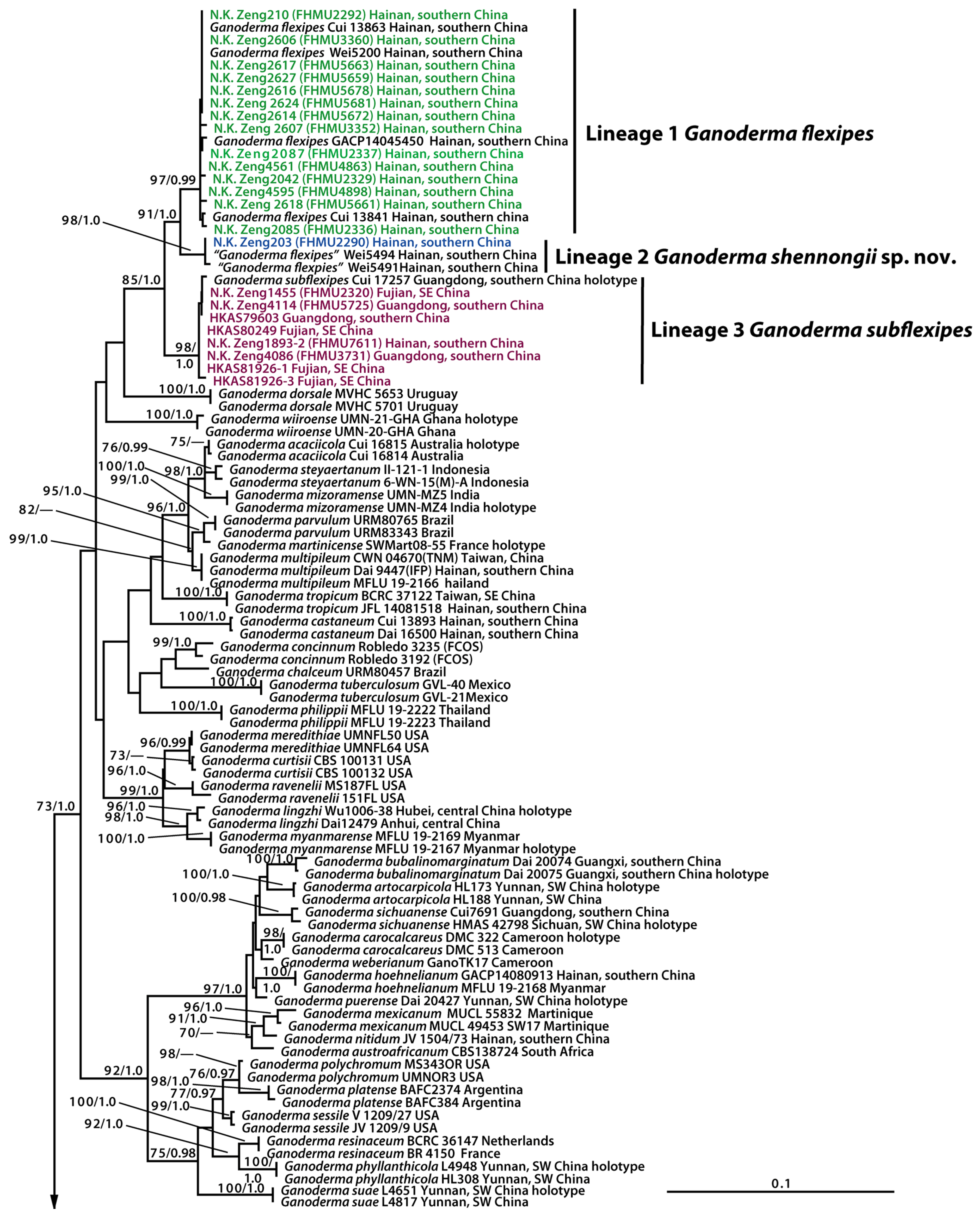
Disclaimer/Publisher’s Note: The statements, opinions and data contained in all publications are solely those of the individual author(s) and contributor(s) and not of MDPI and/or the editor(s). MDPI and/or the editor(s) disclaim responsibility for any injury to people or property resulting from any ideas, methods, instructions or products referred to in the content. |
© 2025 by the authors. Licensee MDPI, Basel, Switzerland. This article is an open access article distributed under the terms and conditions of the Creative Commons Attribution (CC BY) license (https://creativecommons.org/licenses/by/4.0/).