You are currently viewing a new version of our website. To view the old version click .

Toxics, Volume 9, Issue 2

February 2021 - 25 articles

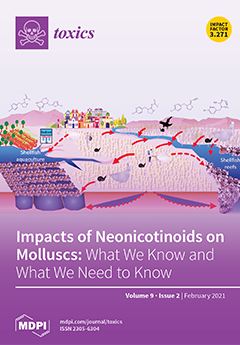
Cover Story: The use of neonicotinoid insecticides has been steadily increasing in many countries, despite bans on their use by the European Union and Canada. Among the main concerns have been their impacts on non-target invertebrates, including molluscs. Increasing evidence from studies on terrestrial, freshwater and marine molluscs have demonstrated the detrimental effects of concentrations of neonicotinoids that have been detected in soil, food and water. The accumulation of neonicotinoid residues in the flesh of molluscs can also cause the accidental exposure of other organisms higher in the food chain, including humans. Further studies are required using all commercially available neonicotinoids, across all life stages of a broad range of ecologically and economically valuable molluscs, to comprehensively understand the magnitude of impacts from ongoing neonicotinoid use. View this paper
  • Issues are regarded as officially published after their release is announced to the table of contents alert mailing list .
  • You may sign up for email alerts to receive table of contents of newly released issues.
  • PDF is the official format for papers published in both, html and pdf forms. To view the papers in pdf format, click on the "PDF Full-text" link, and use the free Adobe Reader to open them.

Articles (25)

  • Feature Paper
  • Article
  • Open Access
21 Citations
6,026 Views
12 Pages

4 February 2021

Global regulations of biocides have been continuously enhanced for protecting human health and the environment from potentially harmful biocidal products. Such regulations consider the combined toxicity caused by mixture components in a biocidal prod...

  • Article
  • Open Access
35 Citations
5,583 Views
11 Pages

Effects of Sub-Lethal Doses of Selenium Nanoparticles on the Health Status of Rats

  • Lenka Urbankova,
  • Sylvie Skalickova,
  • Magdalena Pribilova,
  • Andrea Ridoskova,
  • Pavlina Pelcova,
  • Jiri Skladanka and
  • Pavel Horky

3 February 2021

Selenium nanoparticles (SeNPs) are fast becoming a key instrument in several applications such as medicine or nutrition. Questions have been raised about the safety of their use. Male rats were fed for 28 days on a monodiet containing 0.5, 1.5, 3.0 a...

  • Article
  • Open Access
15 Citations
4,276 Views
13 Pages

Local Toxicity of Biocides after Direct and Aerosol Exposure on the Human Skin Epidermis and Airway Tissue Models

  • Nahyun Lee,
  • Dae Yong Jang,
  • Do Hyeon Lee,
  • Haengdueng Jeong,
  • Ki Taek Nam,
  • Dal-Woong Choi and
  • Kyung-Min Lim

3 February 2021

Biocides are commonly used as spray- or trigger-type formulations, thus dermal and respiratory exposure to biocide aerosol is unavoidable. However, little is known about the impact of aerosolization on the local toxicity of biocides on the skin or th...

  • Article
  • Open Access
15 Citations
3,748 Views
13 Pages

Disturbance in Mammalian Cognition Caused by Accumulation of Silver in Brain

  • Anna A. Antsiferova,
  • Marina Yu. Kopaeva,
  • Vyacheslav N. Kochkin,
  • Pavel K. Kashkarov and
  • Mikhail V. Kovalchuk

3 February 2021

The influence of daily prolonged administration of silver nanoparticles on the cognitive functions of a model mammal was studied. The accumulation of silver in the whole brain and the hippocampus, cerebellum, cortex and residual brain tissue of the m...

  • Feature Paper
  • Article
  • Open Access
8 Citations
4,615 Views
19 Pages

3 February 2021

Fish consumption is the main exposure pathway of the neurotoxicant methylmercury (MeHg) in humans. The risk associated with exposure to MeHg may be modified by its interactions with selenium (Se) and arsenic (As). In vitro bioaccessibility studies ha...

  • Feature Paper
  • Review
  • Open Access
8 Citations
3,714 Views
13 Pages

2 February 2021

The groundwater risk assessment in the vicinity of landfill sites requires, among others, representative monitoring and testing for pollutants leaching from the waste. Lysimeter studies can serve as an example of dynamic leaching tests. However, due...

  • Review
  • Open Access
48 Citations
19,491 Views
18 Pages

Benzodiazepines: Their Use either as Essential Medicines or as Toxics Substances

  • Edilma Sanabria,
  • Ronald Edgardo Cuenca,
  • Miguel Ángel Esteso and
  • Mauricio Maldonado

1 February 2021

This review highlights the nature, characteristics, properties, pharmacological differences between different types of benzodiazepines, the mechanism of action in the central nervous system, and the degradation of benzodiazepines. In the end, the eff...

  • Feature Paper
  • Article
  • Open Access
21 Citations
5,214 Views
32 Pages

31 January 2021

Seaweed bioactive compounds have shown anticancer activities in in vitro and in vivo studies. However, tests remain limited, with conflicting results, and effects in combination with anticancer drugs are even scarcer. Here, the cytotoxic effects of f...

  • Review
  • Open Access
219 Citations
22,637 Views
30 Pages

Cognitive Impairment Induced by Lead Exposure during Lifespan: Mechanisms of Lead Neurotoxicity

  • Daniela Ramírez Ortega,
  • Dinora F. González Esquivel,
  • Tonali Blanco Ayala,
  • Benjamín Pineda,
  • Saul Gómez Manzo,
  • Jaime Marcial Quino,
  • Paul Carrillo Mora and
  • Verónica Pérez de la Cruz

28 January 2021

Lead (Pb) is considered a strong environmental toxin with human health repercussions. Due to its widespread use and the number of people potentially exposed to different sources of this heavy metal, Pb intoxication is recognized as a public health pr...

  • Article
  • Open Access
8 Citations
3,410 Views
13 Pages

Impact of Acid-Base Status on Mortality in Patients with Acute Pesticide Poisoning

  • Hyo-Wook Gil,
  • Min Hong,
  • HwaMin Lee,
  • Nam-jun Cho,
  • Eun-Young Lee and
  • Samel Park

23 January 2021

We investigated clinical impacts of various acid-base approaches (physiologic, base excess (BE)-based, and physicochemical) on mortality in patients with acute pesticide intoxication and mutual intercorrelated effects using principal component analys...

of 3

Get Alerted

Add your email address to receive forthcoming issues of this journal.

XFacebookLinkedIn
Toxics - ISSN 2305-6304