


You are currently viewing a new version of our website. To view the old version click .

Foods, Volume 13, Issue 22

November-2 2024 - 185 articles

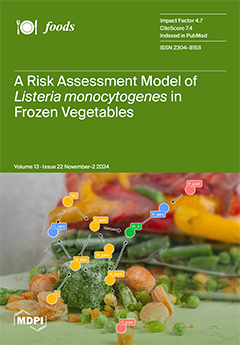
Cover Story: A risk assessment model was developed to evaluate the risk of listeriosis linked to the consumption of non-ready-to-eat frozen vegetables. In a reference scenario, the model estimated that 9.4% of 500 g packages of frozen vegetables would be contaminated at the end of processing, although at levels < 10 CFU/g. Assuming that during handling at home 20% of 50 g portions of frozen vegetables would be left to thaw at room temperature for 2 hours, the lot-level mean risk of listeriosis in the susceptible population would be 2.765 × 10⁻¹⁷ (median 5.184 × 10⁻¹⁸) for cooked servings. Multiple scenarios showed that not cooking the non-RTE product contributes to the risk to a greater extent than the level of contamination in the incoming raw vegetables, which in turn is more influential than the level of contamination in the processing environment. View this paper
  • Issues are regarded as officially published after their release is announced to the table of contents alert mailing list .
  • You may sign up for email alerts to receive table of contents of newly released issues.
  • PDF is the official format for papers published in both, html and pdf forms. To view the papers in pdf format, click on the "PDF Full-text" link, and use the free Adobe Reader to open them.

Articles (185)

  • Article
  • Open Access
8 Citations
2,309 Views
13 Pages

20 November 2024

This research evaluated the impact of Lactobacillus starter cultures on post-acidification, viable cell counts (VCC), antioxidant activities (such as DPPH radical scavenging, Ferric Reducing Antioxidant Power (FRAP), and Ferrous Ion Chelating (FIC) a...

  • Article
  • Open Access
2 Citations
1,599 Views
20 Pages

Different Pretreatment Methods to Strengthen the Microwave Vacuum Drying of Honeysuckle: Effects on the Moisture Migration and Physicochemical Quality

  • Xiaoping Yang,
  • Zhengying Ma,
  • Fangxin Wan,
  • Ao Chen,
  • Wenkang Zhang,
  • Yanrui Xu,
  • Zepeng Zang and
  • Xiaopeng Huang

20 November 2024

In this study, we analyzed the effects of three pretreatment methods—microwave, steam, and blanching—on the quality of Honeysuckle to determine the optimal pretreatment method; we then investigated the influence of different drying temper...

  • Article
  • Open Access
3 Citations
1,824 Views
21 Pages

20 November 2024

The impact of mechanized processes on the properties of Xifeng Baijiu, as well as the differences between Baijiu produced through mechanized versus traditional methods, remains insufficiently understood. In this study, the differences in physicochemi...

  • Article
  • Open Access
4 Citations
1,886 Views
16 Pages

20 November 2024

Two-component systems (TCS) of Salmonella enterica serovar Enteritidis are composed of a histidine kinase and a response regulator (RR) and represent a critical mechanism by which bacteria develop resistance to environmental stress. Here, we characte...

  • Article
  • Open Access
3 Citations
1,672 Views
14 Pages

High-Energy Fluidic Microfluidizer Produced Whole Germinant Oat Milk: Effects on Physical Properties and Nutritional Quality

  • Qimin Wei,
  • Jun Chen,
  • Taotao Dai,
  • Feiyue Ma,
  • Lizhen Deng,
  • Yingying Ke,
  • Yihui Wang,
  • Laichun Guo,
  • Chunlong Wang and
  • Chao Zhan
  • + 2 authors

20 November 2024

Whole oat milk (WOM) was prepared from germinated oat by an innovatively designed high-energy fluidic microfluidizer (HEFM). The results indicated that germination treatment significantly raised the content of total protein, γ-aminobutyric acid...

  • Article
  • Open Access
2,534 Views
17 Pages

Cooking Alters the Metabolites of Onions and Their Ability to Protect Nerve Cells from Lead Damage

  • Li Zhao,
  • Liping Wang,
  • Nan Wang,
  • Xinchang Gao,
  • Bin Zhang,
  • Yufen Zhao and
  • Ning Wang

20 November 2024

Onions (Allium cepa L.) are nutritious vegetables; however, variations in processing methods can influence their chemical composition and functional properties. Raw processing and cooking are the two main food-processing methods for onions, but it is...

  • Article
  • Open Access
5 Citations
4,114 Views
15 Pages

20 November 2024

Essential oils (EOs), such as thyme essential oil (TEO), are widely known for their antimicrobial properties; however, their direct application in food systems is limited due to their poor stability, which affects their efficacy. This study aims to i...

  • Article
  • Open Access
3 Citations
1,967 Views
18 Pages

Microbiological and Physicochemical Profile of Traditionally Produced Chouriça de Carne Dry-Fermented Sausages: Towards Benchmarking of Products Against Established Quality Groups

  • Ana Sofia Faria,
  • Olga María Bonilla-Luque,
  • Laís Carvalho,
  • Nathália Fernandes,
  • Miguel Angel Prieto,
  • Vasco Cadavez and
  • Ursula Gonzales-Barron

20 November 2024

The physicochemical and microbiological properties of traditional Portuguese ready-to-eat dry fermented sausage chouriça de carne samples from 14 regional producers were analysed and subjected to multivariate analysis to determine the relation...

  • Article
  • Open Access
2 Citations
1,561 Views
16 Pages

20 November 2024

This study investigated the impact of whey protein isolate (WPI) addition on the dry heat modification of corn (CS) and wheat starch (WS). Starches were treated under dry heating conditions at 130 °C for 2 and 4 h. The physicochemical and structu...

  • Article
  • Open Access
5 Citations
2,689 Views
16 Pages

Effect of Inulin and Psyllium Husk Powder on Gel Properties and In Vitro Digestion of Hypophthalmichthys molitrix and Argopecten irradians Blended Surimi

  • Wenhao Geng,
  • Miaomiao Tian,
  • Xinyue Zhang,
  • Maodong Song,
  • Xinru Fan,
  • Meng Li,
  • Yongsheng Ma,
  • Soottawat Benjakul and
  • Qiancheng Zhao

20 November 2024

Dietary fiber is crucial in enhancing the nutritional and textural properties of surimi-based products. This study investigated blended surimi produced from silver carp and bay scallops, with the addition of different amounts (0%, 0.5%, 1%, 2%, and 3...

of 19

Get Alerted

Add your email address to receive forthcoming issues of this journal.

XFacebookLinkedIn
Foods - ISSN 2304-8158