

You are currently viewing a new version of our website. To view the old version click .

Plants, Volume 12, Issue 17

September-1 2023 - 157 articles

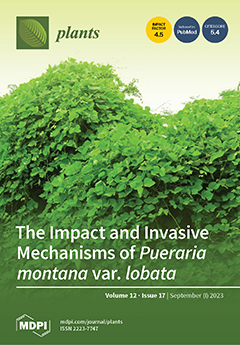
Cover Story: Pueraria montana var. lobata has been listed in the top 100 of the world’s worst invasive alien species. Its stands expand quickly and threaten the native flora and fauna including microbiota. The characteristics of the fast growth, thick canopy structure, enormous vegetative reproduction, and adaptative ability to the various environmental conditions may contribute to the invasiveness and naturalization. The characteristics of P. montana for the defense functions against their natural enemies, and allelopathy may also contribute to the invasiveness of the species. In addition, fewer herbivore insects were found in the introduced ranges. These characteristics of P. montana may be involved in the invasive mechanisms of the species. View this paper
  • Issues are regarded as officially published after their release is announced to the table of contents alert mailing list .
  • You may sign up for email alerts to receive table of contents of newly released issues.
  • PDF is the official format for papers published in both, html and pdf forms. To view the papers in pdf format, click on the "PDF Full-text" link, and use the free Adobe Reader to open them.

Articles (157)

  • Review
  • Open Access
15 Citations
4,691 Views
18 Pages

4 September 2023

Iron is an essential element required for the growth and survival of nearly all forms of life. It serves as a catalytic component in multiple enzymatic reactions, such as photosynthesis, respiration, and DNA replication. However, the excessive accumu...

  • Article
  • Open Access
2 Citations
5,314 Views
17 Pages

Fungal–Algal Association Drives Lichens’ Mutualistic Symbiosis: A Case Study with Trebouxia-Related Lichens

  • Ya-Bo Zuo,
  • Da-Yong Han,
  • Yan-Yan Wang,
  • Qiu-Xia Yang,
  • Qiang Ren,
  • Xin-Zhan Liu and
  • Xin-Li Wei

4 September 2023

Biotic and abiotic factors influence the formation of fungal–algal pairings in lichen symbiosis. However, the specific determinants of these associations, particularly when distantly related fungi are involved, remain poorly understood. In this...

  • Article
  • Open Access
7 Citations
2,191 Views
17 Pages

Genome-Wide Identified MADS-Box Genes in Prunus campanulata ‘Plena’ and Theirs Roles in Double-Flower Development

  • Chaoren Nie,
  • Xiaoguo Xu,
  • Xiaoqin Zhang,
  • Wensheng Xia,
  • Hongbing Sun,
  • Na Li,
  • Zhaoquan Ding and
  • Yingmin Lv

4 September 2023

The MADS-box gene family plays key roles in flower induction, floral initiation, and floral morphogenesis in flowering plants. To understand their functions in the double-flower formation of Prunus campanulata ‘Plena’ (hereafter referred...

  • Review
  • Open Access
6 Citations
3,366 Views
18 Pages

4 September 2023

Aluminium toxicity and phosphorus deficiency in soils are the main interconnected problems of modern agriculture. The aluminium-activated malate transporters (ALMTs) comprise a membrane protein family that demonstrates various physiological functions...

  • Article
  • Open Access
1 Citations
2,375 Views
23 Pages

4 September 2023

Receptor-like cytoplasmic kinase VII (RLCK-VII) subfamily members are vital players in plant innate immunity and are also involved in plant development and abiotic stress tolerance. As a widely cultivated textile crop, upland cotton (Gossypium hirsut...

  • Article
  • Open Access
5 Citations
2,131 Views
9 Pages

The Genus Sagina (Caryophyllaceae) in Italy: Nomenclatural Remarks

  • Duilio Iamonico,
  • Laura Guglielmone and
  • Emanuele Del Guacchio

4 September 2023

A contribution to the nomenclature of the genus Sagina is presented. The following 10 taxa are recognized as being part of the Italian flora: S. alexandrae, S. apetala, S. glabra, S. maritima, S. micropetala, S. nodosa, S. pilifera, S. procumbens, S....

  • Article
  • Open Access
8 Citations
6,680 Views
18 Pages

Antioxidant, Anti-Inflammatory and Antiproliferative Effects of Osmanthus fragrans (Thunb.) Lour. Flower Extracts

  • Steven Kuan-Hua Huang,
  • Paolo Robert P. Bueno,
  • Patrick Jay B. Garcia,
  • Mon-Juan Lee,
  • Kathlia A. De Castro-Cruz,
  • Rhoda B. Leron and
  • Po-Wei Tsai

4 September 2023

Osmanthus fragrans (Thunb.) Lour. flowers (OF-F) have been traditionally consumed as a functional food and utilized as folk medicine. This study evaluated the antioxidant, anti-inflammatory and cytotoxic effects of OF-F extracts on prostate cancer ce...

  • Communication
  • Open Access
19 Citations
3,080 Views
10 Pages

OsGSTU17, a Tau Class Glutathione S-Transferase Gene, Positively Regulates Drought Stress Tolerance in Oryza sativa

  • Jinyan Li,
  • Lijun Meng,
  • Shuohan Ren,
  • Chunying Jia,
  • Ruifang Liu,
  • Hongzhen Jiang and
  • Jingguang Chen

4 September 2023

As a great threat to the normal growth of rice, drought not only restricts the growth of rice, but also affects its yield. Glutathione S-transferases (GSTs) have antioxidant and detoxification functions. In rice, GSTs can not only effectively cope wi...

  • Review
  • Open Access
23 Citations
7,186 Views
21 Pages

In Vitro Cultivation and Ginsenosides Accumulation in Panax ginseng: A Review

  • Fengjiao Xu,
  • Anjali Kariyarath Valappil,
  • Ramya Mathiyalagan,
  • Thi Ngoc Anh Tran,
  • Zelika Mega Ramadhania,
  • Muhammad Awais and
  • Deok Chun Yang

3 September 2023

The use of in vitro tissue culture for herbal medicines has been recognized as a valuable source of botanical secondary metabolites. The tissue culture of ginseng species is used in the production of bioactive compounds such as phenolics, polysacchar...

  • Article
  • Open Access
2 Citations
2,603 Views
16 Pages

Plant Growth Hormones and Micro-Tuberization in Breaking the Seed Dormancy of Bunium persicum (Boiss.) Fedts

  • Mudasir Hafiz Khan,
  • Niyaz Ahmad Dar,
  • Bashir Ahmad Alie,
  • Ghulam Hassan Mir,
  • Uzma Fayaz,
  • Azra Khan,
  • Basharat Bashir,
  • Ajaz Ahmad,
  • Sheikh Mansoor and
  • Yong Suk Chung
  • + 1 author

3 September 2023

Bunium persicum is a valuable medicinal plant with limited production but high market demand. It thrives predominantly in high-altitude regions. The main challenges hindering its widespread cultivation are seed dormancy and a lengthy seed-to-seed cyc...

of 16

Get Alerted

Add your email address to receive forthcoming issues of this journal.

XFacebookLinkedIn
Plants - ISSN 2223-7747