You are currently viewing a new version of our website. To view the old version click .

Plants, Volume 11, Issue 23

December-1 2022 - 223 articles

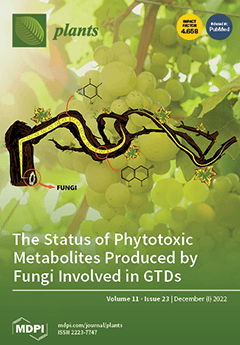
Cover Story: Grapevines are one of the most economically important crops worldwide. Grapevine trunk diseases (GTDs), caused by pathogenic fungi, are limiting factors for the production of wine grapes. The search for effective protectants against GTDs remains a challenge to plant pathologists. Many studies have been carried out to investigate the virulence factors that assist fungi in invading and colonizing grapevines. Among them, fungal phytotoxic metabolites (PMs) may be linked to the development of disease symptoms. This review provides an illustrative overview of the biological and chemical characterization of PMs produced by fungi involved in GTDs. Moreover, challenges and opportunities on how these studies may result in more sustainable and specific control of GTDs in vineyards will also be explored. View this paper
  • Issues are regarded as officially published after their release is announced to the table of contents alert mailing list .
  • You may sign up for email alerts to receive table of contents of newly released issues.
  • PDF is the official format for papers published in both, html and pdf forms. To view the papers in pdf format, click on the "PDF Full-text" link, and use the free Adobe Reader to open them.

Articles (223)

  • Article
  • Open Access
1 Citations
1,878 Views
15 Pages

Investigation of Bioactive Components in New Resistant Hungarian Tomato Hybrids

  • Barbara Schmidt-Szantner,
  • Mária Berki,
  • Éva Lengyel-Kónya,
  • Péter Milotay,
  • Ágnes Molnár-Mondovics,
  • Hussein G. Daood and
  • Rita Tömösközi-Farkas

6 December 2022

The aim of the present work was to evaluate the influence of genetic impact on the content of some characteristic secondary metabolites in tomato fruits. The study was conducted to screen 14 different tomato genotypes for antioxidant capacity and qua...

  • Article
  • Open Access
7 Citations
3,109 Views
23 Pages

Phytochemicals and Their Correlation with Molecular Data in Micromeria and Clinopodium (Lamiaceae) Taxa

  • Dario Kremer,
  • Valerija Dunkić,
  • Ivan Radosavljević,
  • Faruk Bogunić,
  • Daniella Ivanova,
  • Dalibor Ballian,
  • Danijela Stešević,
  • Vlado Matevski,
  • Vladimir Ranđelović and
  • Eleni Eleftheriadou
  • + 2 authors

6 December 2022

A study of the phytochemical and molecular characteristics of ten Micromeria and six Clinopodium taxa (family Lamiaceae) distributed in the Balkan Peninsula was carried out. The phytochemicals detected in essential oils by gas chromatography, mass sp...

  • Article
  • Open Access
10 Citations
2,856 Views
15 Pages

Morphoanatomical, Physiological, and Biochemical Indicators in Lactuca sativa L. Germination and Growth in Response to Fluoride

  • Arthur Almeida Rodrigues,
  • Douglas Almeida Rodrigues,
  • Juliana de Fátima Sales,
  • Sebastião Carvalho Vasconcelos Filho,
  • Alan Carlos Costa,
  • Cássia Lino Rodrigues,
  • Adinan Alves da Silva,
  • Marisa Domingos and
  • Caroline Müller

6 December 2022

Fluoride is one of the main phytotoxic environmental pollutants, and high concentrations (10–30 mg L−1) are commonly detected in surface and groundwater. Little, however, is known about the effects of this pollutant on crops that require...

  • Article
  • Open Access
6 Citations
3,030 Views
12 Pages

The Use of Mycoendophyte-Based Bioformulations to Control Apple Diseases: Toward an Organic Apple Production System in the Aurès (Algeria)

  • Oussama A. Bensaci,
  • Toufik Aliat,
  • Rafik Berdja,
  • Anna V. Popkova,
  • Dmitry E. Kucher,
  • Regina R. Gurina and
  • Nazih Y. Rebouh

6 December 2022

The present study aims to investigate the effectiveness of bioformulations based on endophytic fungi to control apple scab and Valsa canker disease in two orchards in the Aurès region (Algeria). In both orchards, the results showed that the tr...

  • Article
  • Open Access
17 Citations
3,462 Views
27 Pages

6 December 2022

Salinity is an abiotic stress factor that reduces yield and threatens food security in the world’s arid and semi-arid regions. The development of salt-tolerant genotypes is critical for mitigating yield losses, and this journey begins with the...

  • Communication
  • Open Access
4 Citations
2,050 Views
7 Pages

6 December 2022

Chinese local gazetteers have long been widely used by scholars to investigate the local products, culture, economy, and much more. Confronted with large-scale digitized resources nowadays, researchers can explore historical texts in a novel way. In...

  • Review
  • Open Access
11 Citations
3,688 Views
24 Pages

Plant-Associated Bacteria as Sources for the Development of Bioherbicides

  • Wei Fang,
  • Fang Liu,
  • Zhaoyuan Wu,
  • Zhigang Zhang and
  • Kaimei Wang

6 December 2022

Weeds cause significant yield losses in crop production and influence the health of animals and humans, with some exotic weeds even leading to ecological crises. Weed control mainly relies on the application of chemical herbicides, but their adverse...

  • Article
  • Open Access
4 Citations
3,003 Views
16 Pages

6 December 2022

The Indochinese Peninsula is a main center of speciation of Capparis, but the taxonomic treatment of the genus is still critical in this area. With regard to Vietnam, a discordant number of species was recorded by different authors during the last ce...

  • Review
  • Open Access
24 Citations
5,419 Views
14 Pages

6 December 2022

Cold stress breeding that focuses on the improvement of chilling tolerance at the germination stage is constrained by the complexities of the trait which involves integrated cellular, biochemical, hormonal and molecular responses. Biological membrane...

  • Article
  • Open Access
15 Citations
3,562 Views
20 Pages

Neutrophil Immunomodulatory Activity of Nerolidol, a Major Component of Essential Oils from Populus balsamifera Buds and Propolis

  • Igor A. Schepetkin,
  • Gulmira Özek,
  • Temel Özek,
  • Liliya N. Kirpotina,
  • Polina I. Kokorina,
  • Andrei I. Khlebnikov and
  • Mark T. Quinn

6 December 2022

Propolis is a resinous mixture of substances collected and processed from various botanical sources by honeybees. Black poplar (Populus balsamifera L.) buds are one of the primary sources of propolis. Despite their reported therapeutic properties, li...

of 23

Get Alerted

Add your email address to receive forthcoming issues of this journal.

XFacebookLinkedIn
Plants - ISSN 2223-7747