You are currently viewing a new version of our website. To view the old version click .

Vaccines, Volume 9, Issue 7

July 2021 - 122 articles

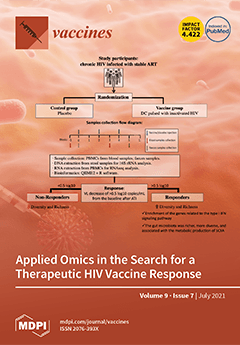
Cover Story: The aim of the present study was to identify mRNA expression profiles and to assess the impact of gut microbiome composition for predicting viral load control after antiretroviral therapy interruption upon vaccination. Patients with a decrease in their viral load of >0.5 log10 copies/mL by 12 weeks after antiretroviral therapy interruption were considered to be responders. In total, 66 genes were differentially expressed between the responders and non-responders; they were involved in the host defense response to a virus. Regarding the gut microbiota, we found important differences at the genus level, and it was associated with the metabolic production of short-chain fatty acids. The evidence now consistently shows that short-chain fatty acid depletion occurs in HIV-infected individuals receiving antiretroviral treatment. View this paper
  • Issues are regarded as officially published after their release is announced to the table of contents alert mailing list .
  • You may sign up for email alerts to receive table of contents of newly released issues.
  • PDF is the official format for papers published in both, html and pdf forms. To view the papers in pdf format, click on the "PDF Full-text" link, and use the free Adobe Reader to open them.

Articles (122)

  • Article
  • Open Access
27 Citations
5,746 Views
20 Pages

Acceptance of COVID-19 Vaccination in Cancer Patients in Hong Kong: Approaches to Improve the Vaccination Rate

  • Wing-Lok Chan,
  • Yuen-Hung Tricia Ho,
  • Carlos King-Ho Wong,
  • Horace Cheuk-Wai Choi,
  • Ka-On Lam,
  • Kwok-Keung Yuen,
  • Dora Kwong and
  • Ivan Hung

Emerging efficacy and safety data have led to the authorization of COVID-19 vaccines worldwide, but most trials excluded patients with active malignancies. This study evaluates the intended acceptance of COVID-19 vaccination in cancer patients in Hon...

  • Article
  • Open Access
42 Citations
5,187 Views
19 Pages

Vaccination is the best way to prevent influenza virus infections, but the diversity of antigenically distinct isolates is a persistent challenge for vaccine development. In order to conquer the antigenic variability and improve influenza virus vacci...

  • Article
  • Open Access
27 Citations
10,162 Views
19 Pages

Young Adults’ Intentions and Rationales for COVID-19 Vaccination Participation: Evidence from a Student Survey in Ho Chi Minh City, Vietnam

  • Quy Van Khuc,
  • Trang Nguyen,
  • Thuy Nguyen,
  • Linh Pham,
  • Dang-Trung Le,
  • Hong-Hai Ho,
  • Tien-Binh Truong and
  • Quoc-Khai Tran

The COVID-19 pandemic, a source of fear and anxiety worldwide, has caused many adverse impacts. Collaborative efforts to end COVID-19 have included extensive research on vaccines. Many vaccination campaigns have been launched in many countries, inclu...

  • Article
  • Open Access
8 Citations
4,393 Views
18 Pages

Using Household Surveys to Assess Missed Opportunities for Simultaneous Vaccination: Longitudinal Examples from Colombia and Nigeria

  • Dale A. Rhoda,
  • Mary L. Prier,
  • Caitlin B. Clary,
  • Mary Kay Trimner,
  • Martha Velandia-Gonzalez,
  • M. Carolina Danovaro-Holliday and
  • Felicity T. Cutts

One important strategy to increase vaccination coverage is to minimize missed opportunities for vaccination. Missed opportunities for simultaneous vaccination (MOSV) occur when a child receives one or more vaccines but not all those for which they ar...

  • Article
  • Open Access
27 Citations
6,253 Views
15 Pages

Acceptance of the COVID-19 vaccine will play a crucial role in combating the current pandemic. Vaccine rollouts have started in most countries. To reach the desirable vaccine coverage and to enhance its uptake, it is imperative to assess vaccine hesi...

  • Review
  • Open Access
24 Citations
11,209 Views
26 Pages

Animal Models Utilized for the Development of Influenza Virus Vaccines

  • Ericka Kirkpatrick Roubidoux and
  • Stacey Schultz-Cherry

Animal models have been an important tool for the development of influenza virus vaccines since the 1940s. Over the past 80 years, influenza virus vaccines have evolved into more complex formulations, including trivalent and quadrivalent inactivated...

  • Article
  • Open Access
17 Citations
5,017 Views
20 Pages

Efficiency in COVID-19 Vaccination Campaigns—A Comparison across Germany’s Federal States

  • Georg Götz,
  • Daniel Herold,
  • Phil-Adrian Klotz and
  • Jan Thomas Schäfer

Vaccination programs are considered a central pillar of the efforts to stop COVID-19. However, vaccine doses are scarce and several organizational and logistical obstacles, such as the timing of and reserves for second shots and delivery failures, ap...

  • Article
  • Open Access
4 Citations
3,014 Views
11 Pages

Urban and Rural Disparities in Pneumococcal Carriage and Resistance in Jordanian Children, 2015–2019

  • Adnan Al-Lahham,
  • Nashat Khanfar,
  • Noor Albataina,
  • Rana Al Shwayat,
  • Rawsan Altwal,
  • Talal Abulfeilat,
  • Ghaith Alawneh,
  • Mohammad Khurd and
  • Abdelsalam Alqadi Altamimi

Background: A pneumococcal carriage surveillance study took place examining Jordanian children in urban and rural areas in the period 2015–2019. Objectives: To determine urban and rural differences in pneumococcal carriage rate, resistance, and serot...

  • Review
  • Open Access
27 Citations
10,065 Views
22 Pages

Producing Vaccines against Enveloped Viruses in Plants: Making the Impossible, Difficult

  • Hadrien Peyret,
  • John F. C. Steele,
  • Jae-Wan Jung,
  • Eva C. Thuenemann,
  • Yulia Meshcheriakova and
  • George P. Lomonossoff

The past 30 years have seen the growth of plant molecular farming as an approach to the production of recombinant proteins for pharmaceutical and biotechnological uses. Much of this effort has focused on producing vaccine candidates against viral dis...

  • Article
  • Open Access
7 Citations
3,930 Views
18 Pages

A fusion chimeric vaccine comprising multiple protective domains of different blood-stage Plasmodium falciparum antigens is perhaps necessary for widening the protective immune responses and reducing the morbidity caused by the disease. Here we conti...

of 13

Get Alerted

Add your email address to receive forthcoming issues of this journal.

XFacebookLinkedIn
Vaccines - ISSN 2076-393X