You are currently on the new version of our website. Access the old version .

Brain Sciences, Volume 15, Issue 7

2025 July - 111 articles

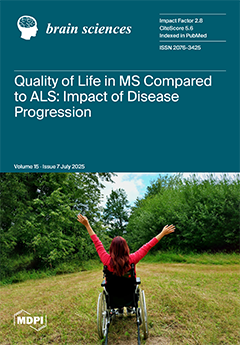
Cover Story: In this study, we focus on indicators of psychosocial adjustment (PSA) in patients with Multiple Sclerosis (MS), examining how fatigue and disease progression negatively impact quality of life (QoL) and depressiveness. Using patient-reported outcomes, we identified depressiveness and physical, mental, and subjective QoL as key indicators of PSA in MS. Fatigue, both cognitive and motor, emerges as a central predictor of PSA in MS. To unravel the impact of disease trajectory on PSA, a comparison with patients with Amyotrophic Lateral Sclerosis (ALS) was performed, revealing both similarities and differences in mental well-being as one indicator of PSA, i.e., slower disease progression in MS may facilitate more favorable PSA. These findings emphasize the need for tailored psychotherapeutic interventions to facilitate psychosocial adjustment even in the face of severe physical challenges. View this paper
  • Issues are regarded as officially published after their release is announced to the table of contents alert mailing list .
  • You may sign up for email alerts to receive table of contents of newly released issues.
  • PDF is the official format for papers published in both, html and pdf forms. To view the papers in pdf format, click on the "PDF Full-text" link, and use the free Adobe Reader to open them.

Articles (111)

  • Article
  • Open Access
964 Views
15 Pages

Background: Biomechanical and neuromuscular differences between falls and recoveries have been well-studied; however, the cortical correlations remain unclear. Using mobile brain imaging via electroencephalography (EEG), we examined differences in se...

  • Systematic Review
  • Open Access
1 Citations
1,985 Views
18 Pages

Mental Health and Quality of Life in Patients with Untreated Unruptured Intracranial Aneurysms: A Systematic Review and Meta-Analysis of 417,152 Patients with Trial Sequential Analysis

  • Plamen Penchev,
  • Kiril Ivanov,
  • Daniela Milanova-Ilieva,
  • Lyubomir Gaydarski,
  • Kiril Kostov,
  • Nikola Boyadzhiev,
  • Petar-Preslav Petrov,
  • Patrice Mehandzhiev,
  • Remzi Hyusein and
  • Nikolai Ramadanov
  • + 12 authors

Introduction: Unruptured intracranial aneurysms (UIAs) can induce psychological stress, leading to anxiety, depression, and impaired quality of life (QoL). Most studies on this topic are limited by small sample sizes, cross-sectional designs, and a f...

  • Article
  • Open Access
3 Citations
9,468 Views
18 Pages

Background: More than merely determining our sleep pattern, our body’s internal clock also improves the quality of our sleep, alleviates the symptoms of depression, and maintains the balance of our gut flora. Methods: We carried out a 12-week r...

  • Perspective
  • Open Access
1 Citations
5,023 Views
16 Pages

The human voice is an invaluable tool for communication, carrying information about a speaker’s emotional state and cognitive health. Recent research highlights the potential of acoustic biomarkers to detect early signs of mental health and neu...

  • Perspective
  • Open Access
1 Citations
3,498 Views
18 Pages

This article aims to offer a broad perspective on the use of non-invasive brain stimulation (NIBS) techniques in the context of chronic musculoskeletal pain (CMP) conditions. While NIBS has demonstrated promising efficacy in certain chronic pain popu...

  • Review
  • Open Access
1,804 Views
25 Pages

Ischemic stroke ranks among the top global causes of disability and mortality, with a highly dynamic pathological process. Post-stroke neuroinflammation, mediated by microglia, demonstrates a dual role in both injury and repair. The CX3CR1/CX3CL1 sig...

  • Article
  • Open Access
1 Citations
1,718 Views
10 Pages

Symptom-Triggered Alcohol Detoxification Compared to Fixed-Dose Regimen of Benzodiazepines: A Retrospective Case–Control Study

  • Laurent Becciolini,
  • Fabienne Wehrli,
  • Jens Kronschnabel,
  • Carolina Wiesendanger,
  • Norbert Scherbaum and
  • Patrik Roser

Background: Alcohol withdrawal syndrome is a common clinical challenge that may lead to significant complications if not properly managed. Symptom-triggered therapy (STT) represents a promising alternative to fixed-dose regimens (FDRs) providing benz...

  • Article
  • Open Access
1 Citations
3,747 Views
14 Pages

Delving into the Perception, Use, and Context of Duloxetine in Clinical Practice: An Analysis Based on the Experience of Healthcare Professionals

  • Oscar Fraile-Martinez,
  • Cielo Garcia-Montero,
  • Miguel Angel Alvarez-Mon,
  • Miguel A. Ortega,
  • Melchor Alvarez-Mon and
  • Javier Quintero

Background and objectives: Duloxetine is widely used for the treatment of major depressive disorder (MDD), generalized anxiety disorder (GAD), and various types of neuropathic pain. While its efficacy is well documented in clinical trials, less is kn...

  • Review
  • Open Access
1 Citations
1,575 Views
21 Pages

Translating Exosomal microRNAs from Bench to Bedside in Parkinson’s Disease

  • Oscar Arias-Carrión,
  • María Paulina Reyes-Mata,
  • Joaquín Zúñiga and
  • Daniel Ortuño-Sahagún

Parkinson’s disease (PD) is a progressive neurodegenerative disorder marked by dopaminergic neuronal loss, α-synuclein aggregation, and chronic neuroinflammation. Recent evidence suggests that exosomal microRNAs (miRNAs)—small, non-...

  • Review
  • Open Access
2 Citations
3,985 Views
17 Pages

Post-Concussion Syndrome and Functional Neurological Disorder: Diagnostic Interfaces, Risk Mechanisms, and the Functional Overlay Model

  • Ioannis Mavroudis,
  • Foivos Petridis,
  • Eleni Karantali,
  • Alin Ciobica,
  • Sotirios Papagiannopoulos and
  • Dimitrios Kazis

Background: Post-concussion syndrome (PCS) and Functional Neurological Disorder (FND), including Functional Cognitive Disorder (FCD), are two frequently encountered but diagnostically complex conditions. While PCS is conceptualized as a sequela of mi...

of 12

Get Alerted

Add your email address to receive forthcoming issues of this journal.

XFacebookLinkedIn
Brain Sci. - ISSN 2076-3425