Skip Content
You are currently on the new version of our website. Access the old version .

Brain Sciences, Volume 10, Issue 5

2020 May - 68 articles

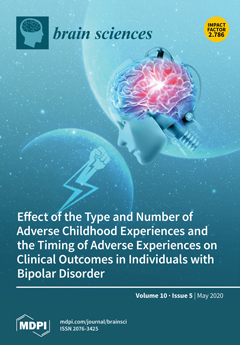
Cover Story: We aimed to clarify the effect of the type and number of adverse childhood experiences (ACE) and the timing of adverse experiences on clinical outcomes in 2,675 patients with bipolar disorders. We found that ACE have robust negative effects on clinical outcomes, including earlier age at onset, presence of psychotic episodes, suicide attempts, mixed symptoms, substance misuse comorbidity, and worse life functioning. Specifically, the number of ACE had the most significant effect on clinical outcomes; however, specific ACE, such as physical abuse, had a considerable influence. Moreover, post-childhood adverse experiences had a weaker effect on clinical outcomes than ACE.View this paper.
  • Issues are regarded as officially published after their release is announced to the table of contents alert mailing list .
  • You may sign up for email alerts to receive table of contents of newly released issues.
  • PDF is the official format for papers published in both, html and pdf forms. To view the papers in pdf format, click on the "PDF Full-text" link, and use the free Adobe Reader to open them.

Articles (68)

  • Feature Paper
  • Article
  • Open Access
19 Citations
7,503 Views
11 Pages

Promoting the Social Inclusion of Children with ASD: A Family-Centred Intervention

  • Roy McConkey,
  • Marie-Therese Cassin and
  • Rosie McNaughton

The social isolation of children with autism spectrum disorder (ASD) is well documented. Their dearth of friends outside of the family and their lack of engagement in community activities places extra strains on the family. A project in Northern Irel...

  • Article
  • Open Access
7 Citations
5,760 Views
18 Pages

Gulf War Illness (GWI) is a debilitating condition characterized by dysfunction of cognition, pain, fatigue, sleep, and diverse somatic symptoms with no known underlying pathology. As such, uncovering objective biomarkers such as differential regions...

  • Case Report
  • Open Access
5 Citations
4,992 Views
8 Pages

Intracranial Carotid Artery Aneurysm Treatment: First Reported Case of DERIVO®Flow-Diverter Placement by Direct Carotid Artery Puncture

  • Giuseppe Guzzardi,
  • Bruno Del Sette,
  • Carmelo Stanca,
  • Andrea Paladini,
  • Andrea Galbiati,
  • Marco Spinetta,
  • Massimiliano Cernigliaro,
  • Massimiliano Leigheb and
  • Alessandro Carriero

Brain health may be threatened by aneurysm ruptures, and early recognition of these vascular malformations allows for neuroradiological intervention. Neurointerventional procedures are usually performed with femoral artery access. In patients with se...

  • Erratum
  • Open Access
2 Citations
2,889 Views
2 Pages

Erratum: Pagonabarraga, J.; et al. A Spanish Consensus on the Use of Safinamide for Parkinson’s Disease in Clinical Practice. Brain Sci. 2020, 10, 176

  • Javier Pagonabarraga,
  • José Matías Arbelo,
  • Francisco Grandas,
  • Maria-Rosario Luquin,
  • Pablo Martínez Martín,
  • Maria Cruz Rodriguez-Oroz,
  • Francesc Valldeoriola and
  • Jaime Kulisevsky

We would like to submit the following erratum to our recently published paper [...]

  • Article
  • Open Access
2 Citations
4,144 Views
15 Pages

Massive Data Management and Sharing Module for Connectome Reconstruction

  • Jingbin Yuan,
  • Jing Zhang,
  • Lijun Shen,
  • Dandan Zhang,
  • Wenhuan Yu and
  • Hua Han

Recently, with the rapid development of electron microscopy (EM) technology and the increasing demand of neuron circuit reconstruction, the scale of reconstruction data grows significantly. This brings many challenges, one of which is how to effectiv...

  • Article
  • Open Access
4 Citations
3,547 Views
20 Pages

Liver Growth Factor Induces Glia-Associated Neuroprotection in an In Vitro Model of Parkinson´s Disease

  • Rafael Gonzalo-Gobernado,
  • Diana Reimers,
  • María José Casarejos,
  • Lucía Calatrava Ferreras,
  • Manuela Vallejo-Muñoz,
  • Adriano Jiménez-Escrig,
  • Juan José Diaz-Gil,
  • Gonzalo M. Ulzurrun de Asanza and
  • Eulalia Bazán

Parkinson’s disease is a neurodegenerative disorder characterized by the progressive death of dopaminergic (DA) neurons in the substantia nigra (SN), which leads to a loss of the neurotransmitter dopamine in the basal ganglia. Current treatment...

  • Article
  • Open Access
11 Citations
4,027 Views
17 Pages

Evaluation of Psychological Stress Parameters in Coronary Patients by Three Different Questionnaires as Pre-Requisite for Comprehensive Rehabilitation

  • Ana Maria Pah,
  • Nicoleta Florina Buleu,
  • Anca Tudor,
  • Ruxandra Christodorescu,
  • Dana Velimirovici,
  • Stela Iurciuc,
  • Maria Rada,
  • Gheorghe Stoichescu-Hogea,
  • Marius Badalica-Petrescu and
  • Simona Dragan
  • + 3 authors

Background: Negative psychological conditions are common in patients with cardiovascular diseases. Although depression has been scrutinized over the years in these patients, only recently has anxiety emerged as another important risk factor. The purp...

  • Article
  • Open Access
2 Citations
3,208 Views
16 Pages

The present study examined whether the left posterior parietal cortex contributes to the selection process for the initial swing leg in gait initiation. Healthy humans initiated the gait in response to an auditory start cue. Transcranial magnetic sti...

  • Review
  • Open Access
17 Citations
8,626 Views
14 Pages

Stroke remains a global leading cause of disability. Novel treatment approaches are required to alleviate impairment and promote greater functional recovery. One potential candidate is transcranial direct current stimulation (tDCS), which is thought...

  • Article
  • Open Access
7 Citations
3,602 Views
15 Pages

Glutamatergic Fate of Neural Progenitor Cells of Rats with Inherited Audiogenic Epilepsy

  • Alexandra A. Naumova,
  • Ekaterina A. Oleynik,
  • Elena V. Chernigovskaya and
  • Margarita V. Glazova

Epilepsy is associated with aberrant neurogenesis in the hippocampus and may underlie the development of hereditary epilepsy. In the present study, we analyzed the differentiation fate of neural progenitor cells (NPC), which were isolated from the hi...

  • Article
  • Open Access
34 Citations
7,847 Views
16 Pages

Background: Non-Hispanic Black (NHB) youth are at a higher risk of high-risk behaviors compared to non-Hispanic White (NHW) youth. Some of this racial gap is shown to be due to weaker effects of parental educational attainment on reducing the prevale...

  • Review
  • Open Access
14 Citations
6,082 Views
20 Pages

Update on Atypicalities of Central Nervous System in Autism Spectrum Disorder

  • Ahmad Naqib Shuid,
  • Putri Ayu Jayusman,
  • Nazrun Shuid,
  • Juriza Ismail,
  • Norazlin Kamal Nor and
  • Isa Naina Mohamed

Autism spectrum disorder (ASD) is a heterogeneous, behaviorally defined, neurodevelopmental disorder that has been modeled as a brain-based disease. The behavioral and cognitive features of ASD are associated with pervasive atypicalities in the centr...

  • Article
  • Open Access
13 Citations
4,992 Views
13 Pages

Disentangling Restrictive and Repetitive Behaviors and Social Impairments in Children and Adolescents with Gilles de la Tourette Syndrome and Autism Spectrum Disorder

  • Mariangela Gulisano,
  • Rita Barone,
  • Salvatore Alaimo,
  • Alfredo Ferro,
  • Alfredo Pulvirenti,
  • Lara Cirnigliaro,
  • Selena Di Silvestre,
  • Serena Martellino,
  • Nicoletta Maugeri and
  • Renata Rizzo
  • + 2 authors

Gilles de la Tourette syndrome (GTS) and autism spectrum disorder (ASD) are two neurodevelopmental disorders with male predominance, frequently comorbid, that share clinical and behavioral features. The incidence of ASD in patients affected by GTS wa...

  • Review
  • Open Access
47 Citations
5,444 Views
12 Pages

In the Russian Federation, multiple sclerosis prevalence rates vary from 10 to 80 cases per 100,000, depending on region and the nationality of the population. The main characteristics of multiple sclerosis epidemiology in the XX century in this big...

  • Article
  • Open Access
35 Citations
6,948 Views
14 Pages

Anhedonia to Gentle Touch in Fibromyalgia: Normal Sensory Processing but Abnormal Evaluation

  • Rebecca Boehme,
  • Helene van Ettinger-Veenstra,
  • Håkan Olausson,
  • Björn Gerdle and
  • Saad S. Nagi

Social touch is important for interpersonal interaction. Gentle touch and slow brushing are typically perceived as pleasant, the degree of pleasantness is linked to the activity of the C-tactile (CT) fibers, a class of unmyelinated nerves in the skin...

  • Article
  • Open Access
19 Citations
7,359 Views
24 Pages

Auditory and Visual Response Inhibition in Children with Bilateral Hearing Aids and Children with ADHD

  • Laura Bell,
  • Wolfgang Scharke,
  • Vanessa Reindl,
  • Janina Fels,
  • Christiane Neuschaefer-Rube and
  • Kerstin Konrad

Children fitted with hearing aids (HAs) and children with attention deficit/hyperactivity disorder (ADHD) often have marked difficulties concentrating in noisy environments. However, little is known about the underlying neural mechanism of auditory a...

  • Article
  • Open Access
12 Citations
5,397 Views
11 Pages

Transcranial direct current stimulation (tDCS) has been shown to support cognition and brain function in older adults. However, there is an absence of research specifically designed to determine optimal stimulation protocols, and much of what is know...

  • Article
  • Open Access
3 Citations
3,514 Views
10 Pages

Milnacipran is a reuptake inhibitor of both serotonin and noradrenaline, used in the treatment of fibromyalgia with severe depression. However, few studies have been conducted on the efficacies of milnacipran drug on the functional connectivity of th...

  • Case Report
  • Open Access
12 Citations
5,805 Views
11 Pages

Post-stroke sensorimotor deficits impair voluntary movements. This impairment may alter a person’s sense of agency, which is the awareness of controlling one’s actions. A previous study showed that post-stroke patients incorrectly aligned...

  • Case Report
  • Open Access
47 Citations
10,988 Views
13 Pages

Stroke is a neurologic disorder considered the first cause of disability worldwide due to motor, cognitive, and sensorial sequels. Balance dysfunctions in stroke survivors increase the risk of falls and physiotherapeutic rehabilitation is essential t...

  • Case Report
  • Open Access
3 Citations
5,787 Views
8 Pages

Gaze Palsy as a Manifestation of Todd’s Phenomenon: Case Report and Review of the Literature

  • Karmele Olaciregui Dague,
  • Manuel Dafotakis,
  • Jörg B. Schulz and
  • Rainer Surges

Background: Though Todd’s phenomenon (TP) is a relatively rare occurrence, its correct identification is of key diagnostic and therapeutic importance as a stroke mimic. Here we describe a case of isolated gaze palsy as a manifestation of TP, discuss...

  • Article
  • Open Access
10 Citations
3,849 Views
9 Pages

Background: Transcranial magnetic stimulus induced motor evoked potentials (MEPs) are quantified either with a single suprathreshold stimulus or using a stimulus response curve. Here, we explored variability in MEPs influenced by different stimulus i...

  • Review
  • Open Access
31 Citations
7,936 Views
17 Pages

Boosting Slow Oscillations during Sleep to Improve Memory Function in Elderly People: A Review of the Literature

  • Federico Salfi,
  • Aurora D’Atri,
  • Daniela Tempesta,
  • Luigi De Gennaro and
  • Michele Ferrara

Sleep represents a crucial time window for the consolidation of memory traces. In this view, some brain rhythms play a pivotal role, first of all the sleep slow waves. In particular, the neocortical slow oscillations (SOs), in coordination with the h...

  • Article
  • Open Access
21 Citations
4,315 Views
12 Pages

Modulation of Fibers to Motor Cortex during Thalamic DBS in Tourette Patients Correlates with Tic Reduction

  • Pablo Andrade,
  • Petra Heiden,
  • Moritz Hoevels,
  • Marc Schlamann,
  • Juan C. Baldermann,
  • Daniel Huys and
  • Veerle Visser-Vandewalle

Probabilistic tractography in Tourette syndrome (TS) patients have shown an alteration in the connectivity of the primary motor cortex and supplementary motor area with the striatum and thalamus, suggesting an abnormal connectivity of the cortico-str...

  • Article
  • Open Access
19 Citations
4,509 Views
8 Pages

Deep Brain Stimulation for Gilles de la Tourette Syndrome: Toward Limbic Targets

  • Domenico Servello,
  • Tommaso Francesco Galbiati,
  • Roberta Balestrino,
  • Guglielmo Iess,
  • Edvin Zekaj,
  • Sara De Michele and
  • Mauro Porta

Gilles de la Tourette syndrome (GTS) is a complex neurodevelopmental disorder characterized by tics and, frequently, psychiatric and behavioral comorbidities. Above all, obsessive compulsive disorder/behavior (OCD/OCB) influences the clinical picture...

  • Feature Paper
  • Review
  • Open Access
17 Citations
7,204 Views
20 Pages

Molecular Interventions towards Multiple Sclerosis Treatment

  • Athanasios Metaxakis,
  • Dionysia Petratou and
  • Nektarios Tavernarakis

Multiple sclerosis (MS) is an autoimmune life-threatening disease, afflicting millions of people worldwide. Although the disease is non-curable, considerable therapeutic advances have been achieved through molecular immunotherapeutic approaches, such...

  • Article
  • Open Access
1 Citations
4,788 Views
16 Pages

In moral dilemma tasks, high levels of psychopathic traits often predict increased utilitarian responding—specifically, endorsing sacrificing one person to save many. Research suggests that increased arousal (i.e., somatic marker production) un...

  • Article
  • Open Access
3 Citations
4,335 Views
14 Pages

During training in a novel dynamic environment, the non-dominant upper limb favors feedback control, whereas the dominant limb favors feedforward mechanisms. Early somatosensory evoked potentials (SEPs) offer a means to explore differences in cortica...

  • Article
  • Open Access
35 Citations
7,011 Views
14 Pages

Self-Reported Autistic Traits Using the AQ: A Comparison between Individuals with ASD, Psychosis, and Non-Clinical Controls

  • Laura Fusar-Poli,
  • Alessia Ciancio,
  • Alberto Gabbiadini,
  • Valeria Meo,
  • Federica Patania,
  • Alessandro Rodolico,
  • Giulia Saitta,
  • Lucia Vozza,
  • Antonino Petralia and
  • Eugenio Aguglia
  • + 1 author

The term “autism” was originally coined by Eugen Bleuler to describe one of the core symptoms of schizophrenia. Even if autism spectrum disorder (ASD) and schizophrenia spectrum disorders (SSD) are now considered two distinct conditions,...

  • Review
  • Open Access
36 Citations
18,703 Views
28 Pages

Research on the predominantly inattentive attention-deficit/hyperactivity disorder (ADHD-PI) subtype/presentation is important given its high prevalence, but paradoxically it is under-recognized and undertreated. The temporal stability of the inatten...

  • Article
  • Open Access
11 Citations
9,649 Views
10 Pages

Preconception Risk Factors for Autism Spectrum Disorder—A Pilot Study

  • Hankus Magdalena,
  • Kazek Beata,
  • Paprocka Justyna,
  • Kapinos-Gorczyca Agnieszka,
  • Magdalena Szczepara-Fabian,
  • Agata Buczek and
  • Emich-Widera Ewa

Autism spectrum disorder (ASD) is a neurodevelopmental disorder of multifactorial etiology. Preconception risk factors are still poorly understood. A survey on preconception risk factors for ASD was conducted among parents of 121 ASD patients aged 3&...

  • Article
  • Open Access
10 Citations
5,423 Views
16 Pages

Background: Research highlights the positive effects of early intensive intervention with parent and school involvement for preschool children with Autism Spectrum Disorder (ASD) on general developmental outcomes and social skills in randomized contr...

  • Article
  • Open Access
4 Citations
11,276 Views
22 Pages

Cellular Localization of gdnf in Adult Zebrafish Brain

  • Chee Ern David Wong,
  • Khang Hua,
  • Simon Monis,
  • Anwar Norazit,
  • Suzita Mohd Noor and
  • Marc Ekker

Glial cell line-derived neurotrophic factor (GDNF) was initially described as important for dopaminergic neuronal survival and is involved in many other essential functions in the central nervous system. Characterization of GDNF phenotype in mammals...

  • Editorial
  • Open Access
8 Citations
3,626 Views
7 Pages

The Long Road of Immunotherapeutics against Multiple Sclerosis

  • Vasso Apostolopoulos,
  • Abdolmohamad Rostami and
  • John Matsoukas

This commentary highlights novel immunomodulation and vaccine-based research against multiple sclerosis (MS) and reveals the amazing story that triggered this cutting-edge MS research in Greece and worldwide. It further reveals the interest and solid...

  • Article
  • Open Access
4 Citations
3,349 Views
17 Pages

Persistent Roseoloviruses Infection in Adult Patients with Epilepsy

  • Santa Rasa-Dzelzkaleja,
  • Sabine Gravelsina,
  • Svetlana Chapenko,
  • Zaiga-Nora Krukle,
  • Simons Svirskis,
  • Normunds Suna,
  • Elena Kashuba,
  • Guntis Karelis and
  • Modra Murovska

Background: Human herpesviruses (HHV)-6A, HHV-6B and HHV-7 are considered to be involved in the pathogenesis of epilepsy, a common neurological disorder. The objective of this study was to determine the association of roseoloviruses infection with ep...

  • Feature Paper
  • Article
  • Open Access
62 Citations
7,352 Views
29 Pages

The Role of BDNF on Aging-Modulation Markers

  • Claudio Molinari,
  • Vera Morsanuto,
  • Sara Ruga,
  • Felice Notte,
  • Mahitab Farghali,
  • Rebecca Galla and
  • Francesca Uberti

An important link between brain aging and a class of growth/survival factors called neurotrophins has recently been demonstrated. In particular, brain-derived neurotrophic factor (BDNF) plays a fundamental role during age-related synaptic loss, preve...

  • Case Report
  • Open Access
2 Citations
4,357 Views
9 Pages

Spinal Cord Impairment in Anti-Mag Neuropathy: Evidence from Somatosensory Evoked Potentials

  • Marilisa Boscarino,
  • Jacopo Lanzone,
  • Lorenzo Ricci,
  • Mario Tombini,
  • Vincenzo Di Lazzaro and
  • Giovanni Assenza

Anti-Myelin Associated Glycoprotein (anti-MAG) neurological involvement classically manifests as a peripheral neuropathy with prominent sensitive symptoms. We describe a case report of a patient with positive anti-MAG antibodies presenting with clini...

  • Article
  • Open Access
15 Citations
5,489 Views
16 Pages

Event-Related Potentials (ERP) Indices of Motivation during the Effort Expenditure for Reward Task

  • Julie Giustiniani,
  • Magali Nicolier,
  • Juliana Teti Mayer,
  • Thibault Chabin,
  • Caroline Masse,
  • Nathan Galmès,
  • Lionel Pazart,
  • Benoit Trojak,
  • Djamila Bennabi and
  • Damien Gabriel
  • + 2 authors

Dynamic and temporal facets of the various constructs that comprise motivation remain to be explored. Here, we adapted the Effort Expenditure for Reward Task, a well-known laboratory task used to evaluate motivation, to study the event-related potent...

  • Review
  • Open Access
63 Citations
18,053 Views
8 Pages

While we are still learning more about COVID-19, caused by the novel SARS-CoV-2 virus, finding alternative and already available methods to reduce the risk and severity of the disease is paramount. One such option is vitamin D, in the form of vitamin...

  • Article
  • Open Access
10 Citations
4,653 Views
11 Pages

This study investigated the relationship between the structural characteristics of the left arcuate fasciculus (AF) reconstructed using diffusion tensor image (DTI) and the type of fluent aphasia according to hemorrhage lesions in patients with fluen...

  • Article
  • Open Access
5 Citations
5,878 Views
20 Pages

Cerebral palsy (CP) is an umbrella term covering a group of permanent developmental disorders of movement and posture characterized by highly variable clinical features. The aim of this study was to assess the short-term and mid-term effects of neuro...

  • Article
  • Open Access
1 Citations
3,758 Views
22 Pages

Attentional Flexibility Predicts A-Not-B Task Performance in 14-Month-Old-Infants: A Head-Mounted Eye Tracking Study

  • Hanna Mulder,
  • Carolien A. Van Houdt,
  • Ineke J. M. Van der Ham,
  • Stefan Van der Stigchel and
  • Ora Oudgenoeg-Paz

Early individual differences in executive functions (EFs) are predictive of a range of developmental outcomes. However, despite the importance of EFs, little is known about the processes underlying these early individual differences. Therefore, we in...

  • Article
  • Open Access
30 Citations
6,643 Views
15 Pages

Automatic Recognition of Personality Profiles Using EEG Functional Connectivity during Emotional Processing

  • Manousos A. Klados,
  • Panagiota Konstantinidi,
  • Rosalia Dacosta-Aguayo,
  • Vasiliki-Despoina Kostaridou,
  • Alessandro Vinciarelli and
  • Michalis Zervakis

Personality is the characteristic set of an individual’s behavioral and emotional patterns that evolve from biological and environmental factors. The recognition of personality profiles is crucial in making human–computer interaction (HCI...

  • Article
  • Open Access
17 Citations
4,171 Views
15 Pages

Transcriptome Analysis of Alcohol Drinking in Non-Dependent and Dependent Mice Following Repeated Cycles of Forced Swim Stress Exposure

  • Sean P. Farris,
  • Gayatri R. Tiwari,
  • Olga Ponomareva,
  • Marcelo F. Lopez,
  • R. Dayne Mayfield and
  • Howard C. Becker

Chronic stress is a known contributing factor to the development of drug and alcohol addiction. Animal models have previously shown that repeated forced swim stress promotes escalated alcohol consumption in dependent animals. To investigate the under...

  • Article
  • Open Access
32 Citations
5,131 Views
15 Pages

Effects of Combined Transcranial Direct Current Stimulation with Cognitive Training in Girls with Rett Syndrome

  • Rosa Angela Fabio,
  • Antonio Gangemi,
  • Martina Semino,
  • Aglaia Vignoli,
  • Alberto Priori,
  • Maria Paola Canevini,
  • Gabriella Di Rosa and
  • Tindara Caprì

Background: Transcranial Direct Current Stimulation (tDCS) combined with traditional rehabilitative techniques has not been widely applied to Rett Syndrome (RTT). The aim of this study was to examine the effects of combined cognitive traditional trai...

  • Article
  • Open Access
24 Citations
5,534 Views
15 Pages

Clinical Predictors of 3- and 6-Month Outcome for Mild Traumatic Brain Injury Patients with a Negative Head CT Scan in the Emergency Department: A TRACK-TBI Pilot Study

  • Debbie Y. Madhok,
  • John K. Yue,
  • Xiaoying Sun,
  • Catherine G. Suen,
  • Nathan A. Coss,
  • Sonia Jain,
  • Geoffrey T. Manley and
  • the TRACK-TBI Investigators

A considerable subset of mild traumatic brain injury (mTBI) patients fail to return to baseline functional status at or beyond 3 months postinjury. Identifying at-risk patients for poor outcome in the emergency department (ED) may improve surveillanc...

  • Article
  • Open Access
5 Citations
4,103 Views
12 Pages

7,8-Dihydroxyflavone Enhances Cue-Conditioned Alcohol Reinstatement in Rats

  • Samuel J. Hogarth,
  • Elvan Djouma and
  • Maarten van den Buuse

Alcohol use disorder (AUD) is a detrimental disease that develops through chronic ethanol exposure. Reduced brain-derived neurotrophic factor (BDNF) expression has been associated with AUD and alcohol addiction, however the effects of activation of B...

  • Article
  • Open Access
20 Citations
8,089 Views
12 Pages

Investigating electrophysiological measures during resting-state might be useful to investigate brain functioning and responsivity in individuals under diagnostic assessment for attention deficit hyperactivity disorder (ADHD) and autism. EEG was reco...

  • Feature Paper
  • Article
  • Open Access
9 Citations
4,078 Views
14 Pages

Alcohol consumption by pregnant women may produce neurological abnormalities that affect cognitive processes in children and are together defined as fetal alcohol spectrum disorders (FASDs). However, the molecular underpinnings are still poorly defin...

of 2

Get Alerted

Add your email address to receive forthcoming issues of this journal.

XFacebookLinkedIn
Brain Sci. - ISSN 2076-3425