

You are currently viewing a new version of our website. To view the old version click .

Microorganisms, Volume 8, Issue 9

September 2020 - 199 articles

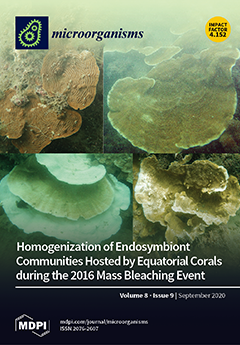
Cover Story: Thermal stress drives the bleaching of reef corals and alters their mutualistic relationship with Symbiodiniaceae endosymbionts. In 2016, a major global-scale bleaching event hit countless tropical reefs. Our study analysed the relative abundances of Cladocopium and Durusdinium in bleached and healthy colonies of the common coral Pachyseris speciosa in Singapore during and after the bleaching event. Given the importance of specific endosymbiont taxa for thermal tolerance, it is surprising that bleached tissue showed limited change compared to healthy tissue during the bleaching event. However, Symbiodiniaceae communities appear to be more homogeneous during the mass bleaching than before and after the event, suggesting a complex community-level response to bleaching. View this paper
  • Issues are regarded as officially published after their release is announced to the table of contents alert mailing list .
  • You may sign up for email alerts to receive table of contents of newly released issues.
  • PDF is the official format for papers published in both, html and pdf forms. To view the papers in pdf format, click on the "PDF Full-text" link, and use the free Adobe Reader to open them.

Articles (199)

  • Article
  • Open Access
2 Citations
3,742 Views
18 Pages

Syngas as Electron Donor for Sulfate and Thiosulfate Reducing Haloalkaliphilic Microorganisms in a Gas-Lift Bioreactor

  • Caroline M. Plugge,
  • João A. B. Sousa,
  • Stephan Christel,
  • Mark Dopson,
  • Martijn F. M. Bijmans,
  • Alfons J. M. Stams and
  • Martijn Diender

Biodesulfurization processes remove toxic and corrosive hydrogen sulfide from gas streams (e.g., natural gas, biogas, or syngas). To improve the efficiency of these processes under haloalkaline conditions, a sulfate and thiosulfate reduction step can...

  • Article
  • Open Access
20 Citations
5,090 Views
17 Pages

Chlorine Disinfection of Legionella spp., L. pneumophila, and Acanthamoeba under Warm Water Premise Plumbing Conditions

  • Rebekah L. Martin,
  • Kara Harrison,
  • Caitlin R. Proctor,
  • Amanda Martin,
  • Krista Williams,
  • Amy Pruden and
  • Marc A. Edwards

Premise plumbing conditions can contribute to low chlorine or chloramine disinfectant residuals and reactions that encourage opportunistic pathogen growth and create risk of Legionnaires’ Disease outbreaks. This bench-scale study investigated t...

  • Article
  • Open Access
29 Citations
4,473 Views
16 Pages

Enhancing the Rice Seedlings Growth Promotion Abilities of Azoarcus sp. CIB by Heterologous Expression of ACC Deaminase to Improve Performance of Plants Exposed to Cadmium Stress

  • Helga Fernández-Llamosas,
  • Juan Ibero,
  • Sofie Thijs,
  • Valeria Imperato,
  • Jaco Vangronsveld,
  • Eduardo Díaz and
  • Manuel Carmona

Environmental pollutants can generate stress in plants causing increased ethylene production that leads to the inhibition of plant growth. Ethylene production by the stressed plant may be lowered by Plant Growth-Promoting Bacteria (PGPB) that metabol...

  • Review
  • Open Access
35 Citations
6,496 Views
14 Pages

Francisella tularensis Subspecies holarctica and Tularemia in Germany

  • Sandra Appelt,
  • Mirko Faber,
  • Kristin Köppen,
  • Daniela Jacob,
  • Roland Grunow and
  • Klaus Heuner

Tularemia is a zoonotic disease caused by Francisella tularensis a small, pleomorphic, facultative intracellular bacterium. In Europe, infections in animals and humans are caused mainly by Francisella tularensis subspecies holarctica. Humans can be e...

  • Article
  • Open Access
37 Citations
5,854 Views
18 Pages

Bacteriophages are viruses capable of recognizing with high specificity, propagating inside of, and destroying their bacterial hosts. The phage lytic life cycle makes phages attractive as tools to selectively kill pathogenic bacteria with minimal imp...

  • Article
  • Open Access
26 Citations
4,831 Views
16 Pages

Multicenter Comparative Study of Six Cryptosporidium parvum DNA Extraction Protocols Including Mechanical Pretreatment from Stool Samples

  • Nicolas Valeix,
  • Damien Costa,
  • Louise Basmaciyan,
  • Stéphane Valot,
  • Anne Vincent,
  • Romy Razakandrainibe,
  • Florence Robert-Gangneux,
  • Céline Nourrisson,
  • Bruno Pereira and
  • Emilie Fréalle
  • + 3 authors

Background: Nowadays, many commercial kits allow the detection of Cryptosporidium sp. in stool samples after deoxyribonucleic acid (DNA) extraction. Protocols of stool pretreatment have been proposed to optimize oocysts’ DNA extraction. Among t...

  • Review
  • Open Access
39 Citations
12,372 Views
17 Pages

Microbial Nitrogen Cycling in Antarctic Soils

  • Max Ortiz,
  • Jason Bosch,
  • Clément Coclet,
  • Jenny Johnson,
  • Pedro Lebre,
  • Adeola Salawu-Rotimi,
  • Surendra Vikram,
  • Thulani Makhalanyane and
  • Don Cowan

The Antarctic continent is widely considered to be one of the most hostile biological habitats on Earth. Despite extreme environmental conditions, the ice-free areas of the continent, which constitute some 0.44% of the total continental land area, ha...

  • Article
  • Open Access
16 Citations
4,499 Views
17 Pages

Root-knot nematode (RKN) Meloidogyne javanica presents a great challenge to Solanaceae crops, including potato. In this study, we investigated transcriptional responses of potato roots during a compatible interaction with M. javanica. In this respect...

  • Communication
  • Open Access
11 Citations
5,104 Views
8 Pages

Plasmid DNA Production in Proteome-Reduced Escherichia coli

  • Mitzi de la Cruz,
  • Elisa A. Ramírez,
  • Juan-Carlos Sigala,
  • José Utrilla and
  • Alvaro R. Lara

The design of optimal cell factories requires engineering resource allocation for maximizing product synthesis. A recently developed method to maximize the saving in cell resources released 0.5% of the proteome of Escherichia coli by deleting only th...

  • Article
  • Open Access
4 Citations
4,387 Views
18 Pages

Development of a High-Resolution Single-Nucleotide Polymorphism Strain-Typing Assay Using Whole Genome-Based Analyses for the Lactobacillus acidophilus Probiotic Strain

  • Chien-Hsun Huang,
  • Chih-Chieh Chen,
  • Shih-Hau Chiu,
  • Jong-Shian Liou,
  • Yu-Chun Lin,
  • Jin-Seng Lin,
  • Lina Huang and
  • Koichi Watanabe

Lactobacillus acidophilus is one of the most commonly used industrial products worldwide. Since its probiotic efficacy is strain-specific, the identification of probiotics at both the species and strain levels is necessary. However, neither phenotypi...

of 20

Get Alerted

Add your email address to receive forthcoming issues of this journal.

XFacebookLinkedIn
Microorganisms - ISSN 2076-2607