



You are currently viewing a new version of our website. To view the old version click .

Microorganisms, Volume 7, Issue 9

September 2019 - 98 articles

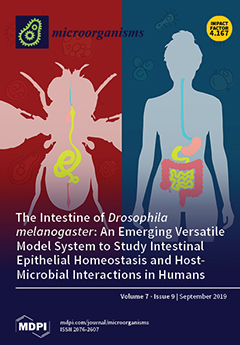
Cover Story: Over twenty years of research efforts have contributed to defining the structure and physiology of the intestine of the genetic model organism Drosophila melanogaster and to establishing its similarity with the human gastrointestinal tract. The development of state-of-the-art genetic tools to study the Drosophila intestine enhanced the number of discoveries that affirmed the conservation of pathways that govern the (patho)physiology of the intestine Drosophila and in humans. Thus, Drosophila melanogaster has become a versatile model organism for human enteric studies. Here, Capo et al, summarize our current knowledge of the structure and functions of the Drosophila melanogaster intestine, asserting its validity as an emerging model system to study gut physiology, regeneration, immune defenses, and host–microbiota interactions. View this paper.
  • Issues are regarded as officially published after their release is announced to the table of contents alert mailing list .
  • You may sign up for email alerts to receive table of contents of newly released issues.
  • PDF is the official format for papers published in both, html and pdf forms. To view the papers in pdf format, click on the "PDF Full-text" link, and use the free Adobe Reader to open them.

Articles (98)

  • Article
  • Open Access
10 Citations
3,820 Views
9 Pages

Characterization of CRISPR-Cas Systems in Serratia marcescens Isolated from Rhynchophorus ferrugineus (Olivier, 1790) (Coleoptera: Curculionidae)

  • Maria Scrascia,
  • Pietro D’Addabbo,
  • Roberta Roberto,
  • Francesco Porcelli,
  • Marta Oliva,
  • Carla Calia,
  • Anna Maria Dionisi and
  • Carlo Pazzani

The CRISPR-Cas adaptive immune system has been attracting increasing scientific interest for biological functions and biotechnological applications. Data on the Serratia marcescens system are scarce. Here, we report a comprehensive characterisation o...

  • Article
  • Open Access
26 Citations
5,093 Views
10 Pages

Ehrlichia minasensis, a recently described Ehrlichia species that is the most closely related to, but clearly distinct from, Ehrlichia canis, has been circulating in not only bovines, cervids, and dogs but also several tick species from Canada, Brazi...

  • Communication
  • Open Access
11 Citations
5,843 Views
8 Pages

Bioactive Compounds of Nigella Sativa Essential Oil as Antibacterial Agents against Chlamydia Trachomatis D

  • Tímea Mosolygó,
  • Ahmad Mouwakeh,
  • Munira Hussein Ali,
  • Annamária Kincses,
  • Csilla Mohácsi-Farkas,
  • Gabriella Kiskó and
  • Gabriella Spengler

Urogenital tract infection caused by obligate intracellular bacterium Chlamydia trachomatis D (CtrD) is a leading cause of sexually transmitted diseases. Essential oil (EO) of Nigella sativa has a broad antimicrobial spectrum. The aim of this study w...

  • Article
  • Open Access
54 Citations
6,931 Views
15 Pages

This study revealed for the first time the dynamic changes of the bacterial community during the fermentation of traditional Chinese fish sauce (TCFS) using high-throughput sequencing. In the early phase of TCFS fermentation, Shewanella (approximatel...

  • Article
  • Open Access
40 Citations
6,427 Views
13 Pages

Sample Preservation and Storage Significantly Impact Taxonomic and Functional Profiles in Metaproteomics Studies of the Human Gut Microbiome

  • Oskar Hickl,
  • Anna Heintz-Buschart,
  • Anke Trautwein-Schult,
  • Rajna Hercog,
  • Peer Bork,
  • Paul Wilmes and
  • Dörte Becher

With the technological advances of the last decade, it is now feasible to analyze microbiome samples, such as human stool specimens, using multi-omic techniques. Given the inherent sample complexity, there exists a need for sample methods which prese...

  • Article
  • Open Access
23 Citations
5,248 Views
15 Pages

Acacia mangium (AM) and Pinus massoniana (PM) are widely planted in tropical regions, whereas their effects on soil microbial communities remain unclear. We did a comprehensive investigation of soil denitrifying bacterial communities in AM and PM mon...

  • Review
  • Open Access
52 Citations
7,771 Views
9 Pages

Under natural conditions, plants generate a vast array of secondary metabolites. Several of these accumulate at widely varying levels in the same plant species and are reportedly critical for plant adaptation to abiotic and/or biotic stresses. Some s...

  • Review
  • Open Access
156 Citations
27,410 Views
11 Pages

Horizontal Gene Transfer and Its Association with Antibiotic Resistance in the Genus Aeromonas spp.

  • J. Manuel Bello-López,
  • Omar A. Cabrero-Martínez,
  • Gabriela Ibáñez-Cervantes,
  • Cecilia Hernández-Cortez,
  • Leda I. Pelcastre-Rodríguez,
  • Luis U. Gonzalez-Avila and
  • Graciela Castro-Escarpulli

The evolution of multidrug resistant bacteria to the most diverse antimicrobials known so far pose a serious problem to global public health. Currently, microorganisms that develop resistant phenotypes to multiple drugs are associated with high morbi...

  • Feature Paper
  • Review
  • Open Access
6 Citations
4,437 Views
18 Pages

Development of Salmonellosis as Affected by Bioactive Food Compounds

  • Ajay Kumar,
  • Abimbola Allison,
  • Monica Henry,
  • Anita Scales and
  • Aliyar Cyrus Fouladkhah

Infections caused by Salmonella serovars are the leading cause of foodborne hospitalizations and deaths in Americans, extensively prevalent worldwide, and pose a considerable financial burden on public health infrastructure and private manufacturing....

  • Article
  • Open Access
16 Citations
5,191 Views
19 Pages

Microbial Markers Profile in Anaerobic Mars Analogue Environments Using the LDChip (Life Detector Chip) Antibody Microarray Core of the SOLID (Signs of Life Detector) Platform

  • Laura García-Descalzo,
  • Victorino Parro,
  • Miriam García-Villadangos,
  • Charles S. Cockell,
  • Christine Moissl-Eichinger,
  • Alex Perras,
  • Petra Rettberg,
  • Kristina Beblo-Vranesevic,
  • Maria Bohmeier and
  • Elke Rabbow
  • + 12 authors

One of the main objectives for astrobiology is to unravel and explore the habitability of environments beyond Earth, paying special attention to Mars. If the combined environmental stress factors on Mars are compatible with life or if they were less...

of 10

Get Alerted

Add your email address to receive forthcoming issues of this journal.

XFacebookLinkedIn
Microorganisms - ISSN 2076-2607