You are currently viewing a new version of our website. To view the old version click .

Microorganisms, Volume 7, Issue 6

June 2019 - 31 articles

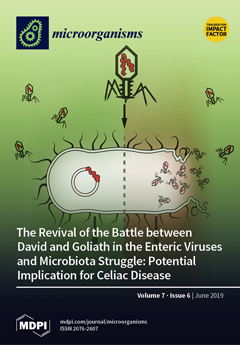
Cover Story: The human gut is inhabited by overcrowded prokaryotic communities, a major component of which is the virome, comprising viruses, bacteriophages, archaea, eukaryotes, and bacteria. The phageome is required for luminal homeostasis and, by their lytic or synergic capacities, can regulate the microbial community structure and activity. Dysbiosis is associated with numerous chronic human diseases, and enteric viral abnormal prints are just starting to emerge. Because the virome can impact microbial genetics and behavior, understanding its biology, composition, cellular cycle, regulation, mode of action, and potential beneficial or hostile activities can change the present paradigm of cross-talks in the luminal gut compartment. Celiac disease is a common autoimmune disease in which viruses are suggested to play a role in disease development. View this paper.
  • Issues are regarded as officially published after their release is announced to the table of contents alert mailing list .
  • You may sign up for email alerts to receive table of contents of newly released issues.
  • PDF is the official format for papers published in both, html and pdf forms. To view the papers in pdf format, click on the "PDF Full-text" link, and use the free Adobe Reader to open them.

Articles (31)

  • Article
  • Open Access
12 Citations
5,314 Views
13 Pages

The Influence of Modernization and Disease on the Gastric Microbiome of Orang Asli, Myanmars and Modern Malaysians

  • Eng Guan Chua,
  • Mun Fai Loke,
  • Selva Perumal Gunaletchumy,
  • Han Ming Gan,
  • Kavitha Thevakumar,
  • Chin Yen Tay,
  • Sylvia Young,
  • Than Than Aye,
  • Win Win Maw and
  • Mya Mya Aye
  • + 6 authors

The present study explored the differences in gastric microbiome between three distinct populations of Southeast Asia. These include the isolated Orang Asli population and modern Malaysians, as well as patients from Myanmar, the least developed count...

  • Article
  • Open Access
27 Citations
5,875 Views
13 Pages

Pectobacterium carotovorum is a gram-negative bacterium that, together with other soft rot Enterobacteriaceae causes soft rot disease in vegetables, fruits, and ornamental plants through the action of exoproteins including plant cell wall-degrading e...

  • Article
  • Open Access
3 Citations
4,405 Views
9 Pages

Fugacium Spliced Leader Genes Identified from Stranded RNA-Seq Datasets

  • Yue Song,
  • Bahareh Zaheri,
  • Min Liu,
  • Sunil Kumar Sahu,
  • Huan Liu,
  • Wenbin Chen,
  • Bo Song and
  • David Morse

Trans-splicing mechanisms have been documented in many lineages that are widely distributed phylogenetically, including dinoflagellates. The spliced leader (SL) sequence itself is conserved in dinoflagellates, although its gene sequences and arrangem...

  • Article
  • Open Access
9 Citations
5,559 Views
12 Pages

Characterization of Sinomonas gamaensis sp. nov., a Novel Soil Bacterium with Antifungal Activity against Exserohilum turcicum

  • Yansong Fu,
  • Rui Yan,
  • Dongli Liu,
  • Junwei Zhao,
  • Jia Song,
  • Xiangjing Wang,
  • Lin Cui,
  • Ji Zhang and
  • Wensheng Xiang

A novel Gram staining positive, aerobic bacterium NEAU-HV1T that exhibits antifungal activity against Exserohilum turcicum was isolated from a soil collected from Gama, Hadjer lamis, Chad. It was grown at 10–45 °C (optimum 30 °C), pH 5&...

  • Article
  • Open Access
14 Citations
5,968 Views
10 Pages

Pine mushroom (Tricholoma matsutake) is one of the most valued ectomycorrhizal fungi in Asia because of its unique pine-like aroma; however, due to exceptionally slow growth of its mycelia in artificial conditions, its cultivation has been largely de...

  • Article
  • Open Access
42 Citations
5,099 Views
23 Pages

The goal of this study is to assess to what extent non-Saccharomyces yeasts can introduce aromatic changes of industrial interest in fermentative, varietal and aged aromas of wine. Aroma precursors from Riesling and Garnacha grapes were extracted and...

  • Article
  • Open Access
11 Citations
4,909 Views
12 Pages

Modeling the Reduction of Salmonella spp. on Chicken Breasts and Wingettes during Scalding for QMRA of the Poultry Supply Chain in China

  • Xingning Xiao,
  • Wen Wang,
  • Xibin Zhang,
  • Jianmin Zhang,
  • Ming Liao,
  • Hua Yang,
  • Qiaoyan Zhang,
  • Chase Rainwater and
  • Yanbin Li

The objective of this study was to develop predictive models for describing the inoculated Salmonella reductions on chicken during the scalding process in China. Salmonella reductions on chicken breasts at a 100 s treatment were 1.12 ± 0.07, 1...

  • Article
  • Open Access
21 Citations
6,404 Views
17 Pages

Isolation and Immunocharacterization of Lactobacillus salivarius from the Intestine of Wakame-Fed Pigs to Develop Novel “Immunosynbiotics”

  • Yuki Masumizu,
  • Binghui Zhou,
  • A.K.M. Humayun Kober,
  • Md. Aminul Islam,
  • Hikaru Iida,
  • Wakako Ikeda-Ohtsubo,
  • Yoshihito Suda,
  • Leonardo Albarracin,
  • Tomonori Nochi and
  • Hisashi Aso
  • + 3 authors

Emerging threats of antimicrobial resistance necessitate the exploration of effective alternatives for healthy livestock growth strategies. ‘Immunosynbiotics’, a combination of immunoregulatory probiotics and prebiotics with synergistic e...

  • Article
  • Open Access
35 Citations
7,830 Views
15 Pages

Different Secondary Metabolite Profiles of Phylogenetically almost Identical Streptomyces griseus Strains Originating from Geographically Remote Locations

  • Ignacio Sottorff,
  • Jutta Wiese,
  • Matthias Lipfert,
  • Nils Preußke,
  • Frank D. Sönnichsen and
  • Johannes F. Imhoff

As Streptomyces have shown an outstanding capacity for drug production, different campaigns in geographically distant locations currently aim to isolate new antibiotic producers. However, many of these newly isolated Streptomyces strains are classifi...

of 4

Get Alerted

Add your email address to receive forthcoming issues of this journal.

XFacebookLinkedIn
Microorganisms - ISSN 2076-2607