


You are currently viewing a new version of our website. To view the old version click .

Insects, Volume 14, Issue 9

September 2023 - 61 articles

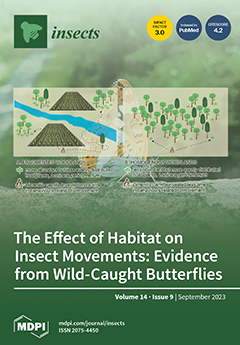
Cover Story: Habitat loss shapes animal behaviour, impacting the long-term survival of species. In our study, we explored the connection between the flight abilities of the woodland-specialist butterfly Limenitis camilla and the spatial–temporal connectivity of its primary habitat: broadleaved forests. We assessed shifts in forest functional connectivity in Wallonia, Belgium, over recent decades using land-cover data. Furthermore, we selectively captured L. camilla females in areas representing opposite ends of habitat connectivity and monitored their behaviours within outdoor arenas designed to replicate the species' natural habitat. Our findings reveal that butterflies from fragmented forests exhibit an increase in departure-related behaviour, potentially indicating an evolutionary adaptation for locating suitable egg-laying sites in shrinking, isolated habitats. View this paper
  • Issues are regarded as officially published after their release is announced to the table of contents alert mailing list .
  • You may sign up for email alerts to receive table of contents of newly released issues.
  • PDF is the official format for papers published in both, html and pdf forms. To view the papers in pdf format, click on the "PDF Full-text" link, and use the free Adobe Reader to open them.

Articles (61)

  • Article
  • Open Access
3 Citations
3,126 Views
21 Pages

Comparing Different Sticky Traps to Monitor the Occurrence of Philaenus spumarius and Neophilaenus campestris, Vectors of Xylella fastidiosa, in Different Crops

  • Crescenza Dongiovanni,
  • Michele Di Carolo,
  • Giulio Fumarola,
  • Daniele Tauro,
  • Biagio Tedone,
  • Simona Ancona,
  • Valentina Palmisano,
  • Mauro Carrieri and
  • Vincenzo Cavalieri

21 September 2023

Following the detection of the quarantine bacterium Xylella fastidiosa (Wells et al.) in the Apulia region (southern Italy) and the identification of spittlebugs as the main vector species that contributes to its epidemic spread, monitoring activitie...

  • Article
  • Open Access
6 Citations
6,175 Views
13 Pages

Optimization of Production Methods for Black Soldier Fly Larvae (Hermetia illucens L.) in Burkina Faso

  • Florence Sankara,
  • Fernand Sankara,
  • Salimata Pousga,
  • Kalifa Coulibaly,
  • Jacques Philippe Nacoulma,
  • Zakaria Ilboudo,
  • Issoufou Ouédraogo,
  • Irénée Somda and
  • Marc Kenis

21 September 2023

Larvae of Hermetia illucens are a valuable source of protein for animal feed that can be produced by exposing animal and agro-industrial wastes to naturally occurring flies. The objective of this study was to improve techniques for obtaining H. illuc...

  • Article
  • Open Access
2 Citations
3,440 Views
14 Pages

20 September 2023

The subfamily Eumeninae is a large group of fierce predatory insects that prey mainly on the larvae of Lepidoptera pests. Because of the highly similar morphologies of the genus Rhynchium and its related genera in the subfamily, including Rhynchium S...

  • Article
  • Open Access
4 Citations
1,976 Views
17 Pages

20 September 2023

Expanding on previous efforts to survey the visual opsin repertoires of the Hemiptera, this study confirms that homologs of the UV- and LW-opsin subfamilies are conserved in all Hemiptera, while the B-opsin subfamily is missing from the Heteroptera a...

  • Article
  • Open Access
8 Citations
2,719 Views
15 Pages

Synergistic Repellent and Irritant Effects of a Mixture of β-Caryophyllene Oxide and Vetiver Oil against Mosquito Vectors

  • Jirod Nararak,
  • Unchalee Sanguanpong,
  • Chutipong Sukkanon,
  • Sylvie Manguin and
  • Theeraphap Chareonviriyaphap

20 September 2023

Repellents play a major role in reducing the risk of mosquito-borne diseases by preventing mosquito bites. The present study evaluated the mosquito-repellent activity of β-caryophyllene oxide 1% (BCO), vetiver oil 2.5% (VO), and their binary mix...

  • Article
  • Open Access
7 Citations
1,854 Views
17 Pages

Differential Spreading of Microsatellites in Holocentric Chromosomes of Chagas Disease Vectors: Genomic and Evolutionary Implications

  • Francisco Panzera,
  • Ángeles Cuadrado,
  • Pablo Mora,
  • Teresa Palomeque,
  • Pedro Lorite and
  • Sebastián Pita

19 September 2023

This study focused on analyzing the distribution of microsatellites in holocentric chromosomes of the Triatominae subfamily, insect vectors of Chagas disease. We employed a non-denaturing FISH technique to determine the chromosomal distribution of si...

  • Article
  • Open Access
14 Citations
3,937 Views
14 Pages

17 September 2023

Crimean–Congo haemorrhagic fever (CCHF) is considered to be spreading across the globe, with many countries reporting new human CCHF cases in recent decades including Georgia, Türkiye, Albania, and, most recently, Spain. We update a human...

  • Article
  • Open Access
5 Citations
4,457 Views
12 Pages

Molecular Characterization of Serratia marcescens Strain Isolated from Yellow Mealworms, Tenebrio molitor, in The Netherlands

  • Teresita d. J. Bello Gonzalez,
  • Betty van Gelderen,
  • Frank Harders,
  • Rianka Vloet,
  • Michal Voorbergen-Laarman,
  • Bart de Ruiter and
  • Olga L. M. Haenen

16 September 2023

Insect culture has developed rapidly worldwide; it faces important security and safety control issues, including animal infections and disease development. In the Netherlands, in 2021, a ~30% mortality of mealworms, Tenebrio molitor, occurred at one...

  • Article
  • Open Access
8 Citations
3,449 Views
17 Pages

15 September 2023

The need for multi-gene analysis in evolutionary and taxonomic studies is generally accepted. However, the sequencing of multiple genes is not always possible. For various reasons, short mitochondrial DNA barcodes are the only source of molecular inf...

  • Article
  • Open Access
5 Citations
3,492 Views
10 Pages

14 September 2023

Cockroaches of the subfamily Panesthiinae (family Blaberidae) are among the few major groups of insects feeding on decayed wood. Despite having independently evolved the ability to thrive on this recalcitrant and nitrogen-limited resource, they are a...

of 7

Get Alerted

Add your email address to receive forthcoming issues of this journal.

XFacebookLinkedIn
Insects - ISSN 2075-4450