You are currently viewing a new version of our website. To view the old version click .

Insects, Volume 10, Issue 4

April 2019 - 35 articles

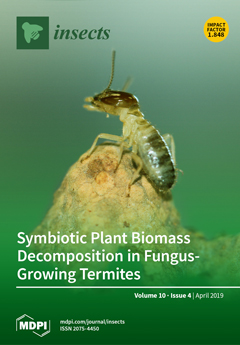
Cover Story: Plant biomass breakdown by fungus-growing termites is a tripartite cooperation that involves synergistic enzyme contributions from the mutualistic fungus Termitomyces, diversified gut microbial communities, and the insect hosts, enabling the decomposition of nearly any plant component. While numerous studies have explored the use and processing of plant biomass by these termites, we lack a comprehensive understanding of this complex process, particularly in comparisons across the evolutionary history of the association. We propose that a combination of omics tools, enzyme assays, laboratory experimentation, and field observations is a promising avenue to improve our understanding of how traits have established and evolved over the 30 million years of evolutionary history of the symbiosis, leading it to become a dominant decomposers in the Old World (sub)tropics. View this paper
  • Issues are regarded as officially published after their release is announced to the table of contents alert mailing list .
  • You may sign up for email alerts to receive table of contents of newly released issues.
  • PDF is the official format for papers published in both, html and pdf forms. To view the papers in pdf format, click on the "PDF Full-text" link, and use the free Adobe Reader to open them.

Articles (35)

  • Article
  • Open Access
16 Citations
5,040 Views
11 Pages

25 April 2019

To solve the issue of insufficient pollinating of insects for the oil tree peony ‘Feng Dan’ (Paeonia ostii T. Hong et J.X. Zhang) and improve its seed set and yield, we conducted observations from 2017 to 2018 to investigate the relations...

  • Communication
  • Open Access
13 Citations
5,167 Views
11 Pages

25 April 2019

Cacosceles newmannii (Coleoptera: Cerambycidae) is an emerging pest of sugarcane in South Africa. The larvae of this cerambycid beetle live within the sugarcane stalk and drill galleries that considerably reduce sugar production. To provide an altern...

  • Article
  • Open Access
7 Citations
4,012 Views
15 Pages

Volatiles from Different Instars of Honeybee Worker Larvae and Their Food

  • Haohao Zhang,
  • Chunsheng Hou,
  • Pingli Dai,
  • Yongjun Liu,
  • Yanyan Wu,
  • Yonggang Pang and
  • Qingyun Diao

25 April 2019

(E)-β-Ocimene was the only volatile chemical found to be emitted by whole, live worker larvae of Apis mellifera L. when sampling in the vapor phase. In addition to (E)-β-ocimene, there is evidence for the existence of other volatiles, but t...

  • Article
  • Open Access
12 Citations
4,989 Views
12 Pages

22 April 2019

The effect of bacterial sepsis on animal behavior and physiology is complex due to direct and indirect actions. The most common form of bacterial sepsis in humans is from gram-negative bacterial strains. The endotoxin (lipopolysaccharide, LPS) and/or...

  • Article
  • Open Access
43 Citations
5,666 Views
12 Pages

Sensory Quality of Essential Oils and Their Synergistic Effect with Diatomaceous Earth, for the Control of Stored Grain Insects

  • Erika Carla Pierattini,
  • Stefano Bedini,
  • Francesca Venturi,
  • Roberta Ascrizzi,
  • Guido Flamini,
  • Rossella Bocchino,
  • Jessica Girardi,
  • Paolo Giannotti,
  • Giuseppe Ferroni and
  • Barbara Conti

20 April 2019

Essential oils (EOs) have gained increasing interest as a low-toxic, eco-friendly alternative to synthetic repellents and insecticides against insect pests. However, they have scarce practical application in the protection of stored grain because of...

  • Article
  • Open Access
27 Citations
5,493 Views
12 Pages

Exposure to Insecticides Reduces Populations of Rhynchophorus palmarum in Oil Palm Plantations with Bud Rot Disease

  • Luis Carlos Martínez,
  • Angelica Plata-Rueda,
  • Francisco Andrés Rodríguez-Dimaté,
  • Juliana Mendonça Campos,
  • Valdeir Celestino dos Santos Júnior,
  • Gabriela Da Silva Rolim,
  • Flavio Lemes Fernandes,
  • Wiane Meloni Silva,
  • Carlos Frederico Wilcken and
  • José Cola Zanuncio
  • + 1 author

19 April 2019

The South American palm weevil (SAPW), Rhynchophorus palmarum Linnaeus (Coleoptera: Curculionidae) is the main pest of Elaeis guineensis and damages palm trees with bud rot disease in the Americas. The effects of six neurotoxic insecticides (abamecti...

  • Article
  • Open Access
35 Citations
5,862 Views
14 Pages

Local and Landscape Drivers of Carabid Activity, Species Richness, and Traits in Urban Gardens in Coastal California

  • Stacy M. Philpott,
  • Simone Albuquerque,
  • Peter Bichier,
  • Hamutahl Cohen,
  • Monika H. Egerer,
  • Claire Kirk and
  • Kipling W. Will

19 April 2019

Urban ecosystems, as mosaics of residential, industrial, commercial, and agricultural land, present challenges for species survival due to impervious surface, degradation, fragmentation, and modification of natural habitat, pollution, and introduced...

  • Article
  • Open Access
4 Citations
4,242 Views
13 Pages

Exploring an Odor-Baited “Trap Bush” Approach to Aggregate Plum Curculio (Coleoptera: Curculionidae) Injury in Blueberries

  • Cesar Rodriguez-Saona,
  • Anne Nielsen,
  • David Shapiro-Ilan,
  • Sunil Tewari,
  • Vera Kyryczenko-Roth,
  • Nicolas Firbas and
  • Tracy Leskey

19 April 2019

This 2-year study (2013–2014) assessed the efficacy of an odor-baited “trap bush” approach to aggregate plum curculio, Conotrachelus nenuphar, adult injury, i.e., number of oviposition-scared fruit, in four commercial highbush blueb...

  • Communication
  • Open Access
76 Citations
6,720 Views
9 Pages

Endophytic Effects of Beauveria bassiana on Corn (Zea mays) and Its Herbivore, Rachiplusia nu (Lepidoptera: Noctuidae)

  • María Leticia Russo,
  • Ana Clara Scorsetti,
  • María Florencia Vianna,
  • Marta Cabello,
  • Natalia Ferreri and
  • Sebastian Pelizza

18 April 2019

Entomopathogenic fungi are widely recognized as agents of biological control worldwide. Their use in agriculture for the regulation of pest populations is a promising alternative to conventional insecticides. Furthermore, recent studies have shown th...

  • Article
  • Open Access
11 Citations
4,371 Views
12 Pages

Hymenoptera Complex Associated with Myzus persicae and Hyalopterus spp. in Peach Orchards in Northeastern Spain and Prospects for Biological Control of Aphids

  • Yahana Aparicio,
  • Rosa Gabarra,
  • Jordi Riudavets,
  • Petr Starý,
  • Željko Tomanović,
  • Korana Kocić,
  • Juli Pujade Villar,
  • Mar Ferrer Suay,
  • Victor Cuesta Porta and
  • Judit Arnó

16 April 2019

Aphids are a serious pest for peach crops. They have traditionally been managed with insecticides, but there is increasing concern about the risk that insecticides pose to both humans and the environment. As a first step to use biological control in...

of 4

Get Alerted

Add your email address to receive forthcoming issues of this journal.

XFacebookLinkedIn
Insects - ISSN 2075-4450