You are currently on the new version of our website. Access the old version .

Galaxies, Volume 11, Issue 4

August 2023 - 12 articles

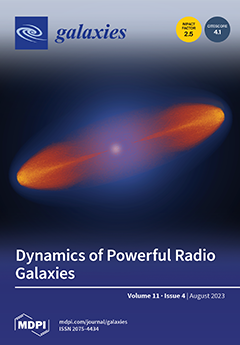
Cover Story: Analytical models of powerful radio galaxies are essential for the interpretation of synchrotron emission and feedback on the surrounding gas from the tens of millions of radio sources that will be observed by the SKA and pathfinder instruments. In this review, we group such models into two classes, with the forward expansion of the radio source being driven by either the jet momentum flux or lobe internal pressure. We extend the mathematical formalism of historical models to describe source expansion in non-uniform environments, consistent with the current generation of analytical models, e.g., radio and X-ray images from the RAiSE code are shown in the cover image. This approach enables direct comparison of different model classes with each other and with hydrodynamic simulations. View this paper
  • Issues are regarded as officially published after their release is announced to the table of contents alert mailing list .
  • You may sign up for email alerts to receive table of contents of newly released issues.
  • PDF is the official format for papers published in both, html and pdf forms. To view the papers in pdf format, click on the "PDF Full-text" link, and use the free Adobe Reader to open them.

Articles (12)

  • Review
  • Open Access
2 Citations
2,663 Views
18 Pages

Gamma Ray Pulsars and Opportunities for the MACE Telescope

  • Atul Pathania,
  • Krishna Kumar Singh and
  • Kuldeep Kumar Yadav

17 August 2023

Rapidly rotating neutron stars with very strong surface magnetic fields are observed to emit pulsed emission in the whole range of electromagnetic spectrum from radio to high-energy gamma rays. These so-called pulsars are known for their exceptional...

  • Article
  • Open Access
5 Citations
2,114 Views
17 Pages

Infrared Spectroscopy of Be Stars: Influence of the Envelope Parameters on Brackett-Series Behaviour

  • Yanina Roxana Cochetti,
  • Anahi Granada,
  • María Laura Arias,
  • Andrea Fabiana Torres and
  • Catalina Arcos

17 August 2023

The IR spectra of Be stars display numerous hydrogen recombination lines, constituting a great resource for obtaining information on the physical and dynamic structures of different regions within the circumstellar envelope. Nevertheless, this spectr...

  • Review
  • Open Access
11 Citations
3,127 Views
31 Pages

Multidimensional Simulations of Core Convection

  • Daniel Lecoanet and
  • Philipp V. F. Edelmann

The cores of main sequence intermediate- and high-mass stars are convective. Mixing at the radiative–convective boundary, waves excited by the convection, and magnetic fields generated by convective dynamos all influence the main sequence and p...

  • Article
  • Open Access
1 Citations
1,758 Views
10 Pages

Searching for Short-Timescale Transients in Gamma-ray Telescope Data

  • Annanay Jaitly,
  • Dmitriy Kostunin and
  • Karin Cescon

Astrophysical sources show variability in their emissions over a range of timescales, with transients such as fast radio bursts (FRBs) and magnetar giant flares (MGFs) showing variability on timescales as short as a few milliseconds. Recent advances...

  • Review
  • Open Access
9 Citations
2,685 Views
25 Pages

Dynamics of Powerful Radio Galaxies

  • Ross J. Turner and
  • Stanislav S. Shabala

Analytical models describing the dynamics of lobed radio sources are essential for interpretation of the tens of millions of radio sources that will be observed by the Square Kilometre Array and pathfinder instruments. We propose that historical mode...

  • Review
  • Open Access
22 Citations
8,673 Views
70 Pages

Cosmic Ray Processes in Galactic Ecosystems

  • Ellis R. Owen,
  • Kinwah Wu,
  • Yoshiyuki Inoue,
  • H.-Y. Karen Yang and
  • Alison M. W. Mitchell

Galaxy evolution is an important topic, and our physical understanding must be complete to establish a correct picture. This includes a thorough treatment of feedback. The effects of thermal–mechanical and radiative feedback have been widely co...

  • Review
  • Open Access
7 Citations
4,133 Views
22 Pages

What Drives the Ionized Gas Outflows in Radio-Quiet AGN?

  • Mainak Singha,
  • Christopher P. O’Dea and
  • Stefi A. Baum

We review the mechanisms driving the ionized gas outflows in radio-quiet (RQ) AGN. Although it constitutes ∼90% of the AGN population, what drives these outflows in these AGNs remains an open question. High-resolution imaging and integral field u...

  • Communication
  • Open Access
7 Citations
2,424 Views
8 Pages

Probing Neutrino Production in Blazars by Millimeter VLBI

  • Yuri Y. Kovalev,
  • Alexander V. Plavin,
  • Alexander B. Pushkarev and
  • Sergey V. Troitsky

The advancement of neutrino observatories has sparked a surge in multi-messenger astronomy. Multiple neutrino associations among blazars are reported while neutrino production sites are located within their central (sub)parsecs. Yet, many questions r...

  • Article
  • Open Access
15 Citations
3,579 Views
27 Pages

Searching for Phase-Locked Variations of the Emission-Line Profiles in Binary Be Stars

  • Anatoly S. Miroshnichenko,
  • Raghav Chari,
  • Stephen Danford,
  • Peter Prendergast,
  • Alicia N. Aarnio,
  • Ivan L. Andronov,
  • Lidiia L. Chinarova,
  • Aidan Lytle,
  • Ainash Amantayeva and
  • Serik A. Khokhlov
  • + 2 authors

There is growing evidence that many Be stars are parts of binary systems. As the B-type primaries are very fast rotators and their spectral lines may be distorted by the circumstellar material, it is not easy to measure their radial velocity directly...

  • Article
  • Open Access
7 Citations
2,535 Views
22 Pages

Observational Implications of OJ 287’s Predicted 2022 Disk Impact in the Black Hole Binary Model

  • Mauri J. Valtonen,
  • Lankeswar Dey,
  • Achamveedu Gopakumar,
  • Staszek Zola,
  • Anne Lähteenmäki,
  • Merja Tornikoski,
  • Alok C. Gupta,
  • Tapio Pursimo,
  • Emil Knudstrup and
  • Makoto Uemura
  • + 16 authors

We present a summary of the results of the OJ 287 observational campaign, which was carried out during the 2021/2022 observational season. This season is special in the binary model because the major axis of the precessing binary happens to lie almos...

of 2

Get Alerted

Add your email address to receive forthcoming issues of this journal.

XFacebookLinkedIn
Galaxies - ISSN 2075-4434