Skip to Content

Cancers, Volume 10, Issue 1

2018 January - 27 articles

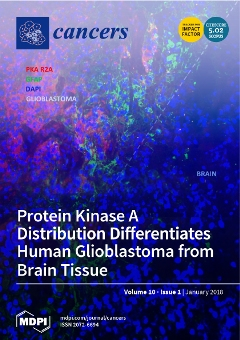
Cover Story: In cancer, not only mutated proteins may appear, but also normal proteins may change in quantity and localization, being involved in the pathogenesis of the disease. After having described the normal distribution of protein kinase A (PKA) regulatory subunits in the brain of various species, and modifications during development and aging, we showed a hotspot of PKA R2A in the Golgi apparatus of glioblastoma cells. Now, we report the same finding, which appears specific to glioblastoma, in a series of human glioblastoma samples, compared to other tumors and normal brain. We therefore conclude, R2A may be a diagnostic or therapeutic target exploitable for glioblastoma. View this paper
  • Issues are regarded as officially published after their release is announced to the table of contents alert mailing list .
  • You may sign up for email alerts to receive table of contents of newly released issues.
  • PDF is the official format for papers published in both, html and pdf forms. To view the papers in pdf format, click on the "PDF Full-text" link, and use the free Adobe Reader to open them.

Articles (27)

  • Article
  • Open Access
13 Citations
5,871 Views
14 Pages

Analysis of Site-Specific Methylation of Tumor-Related Genes in Head and Neck Cancer: Potential Utility as Biomarkers for Prognosis

  • Kiyoshi Misawa,
  • Daiki Mochizuki,
  • Atsushi Imai,
  • Masato Mima,
  • Yuki Misawa and
  • Hiroyuki Mineta

22 January 2018

Clarifying the epigenetic regulation of tumor-related genes (TRGs) can provide insights into the mechanisms of tumorigenesis and the risk for disease recurrence in HPV-negative head and neck cancers, originating in the hypopharynx, larynx, and oral c...

  • Article
  • Open Access
29 Citations
7,174 Views
15 Pages

Localization Microscopy Analyses of MRE11 Clusters in 3D-Conserved Cell Nuclei of Different Cell Lines

  • Marion Eryilmaz,
  • Eberhard Schmitt,
  • Matthias Krufczik,
  • Franziska Theda,
  • Jin-Ho Lee,
  • Christoph Cremer,
  • Felix Bestvater,
  • Wladimir Schaufler,
  • Michael Hausmann and
  • Georg Hildenbrand

22 January 2018

In radiation biophysics, it is a subject of nowadays research to investigate DNA strand break repair in detail after damage induction by ionizing radiation. It is a subject of debate as to what makes up the cell’s decision to use a certain repair pat...

  • Review
  • Open Access
148 Citations
26,081 Views
18 Pages

20 January 2018

Colorectal cancers (CRCs) are the third leading cause of cancer-related mortality worldwide. Rather than being a single, uniform disease type, accumulating evidence suggests that CRCs comprise a group of molecularly heterogeneous diseases that are ch...

  • Review
  • Open Access
80 Citations
6,675 Views
15 Pages

Contemporary Management of Localized Resectable Pancreatic Cancer

  • Anuhya Kommalapati,
  • Sri Harsha Tella,
  • Gaurav Goyal,
  • Wen Wee Ma and
  • Amit Mahipal

20 January 2018

Pancreatic cancer is the third most common cause of cancer deaths in the United States. Surgical resection with negative margins still constitutes the cornerstone of potentially curative therapy, but is possible only in 15–20% of patients at the time...

  • Review
  • Open Access
126 Citations
15,182 Views
30 Pages

mTOR Cross-Talk in Cancer and Potential for Combination Therapy

  • Fabiana Conciatori,
  • Ludovica Ciuffreda,
  • Chiara Bazzichetto,
  • Italia Falcone,
  • Sara Pilotto,
  • Emilio Bria,
  • Francesco Cognetti and
  • Michele Milella

19 January 2018

The mammalian Target of Rapamycin (mTOR) pathway plays an essential role in sensing and integrating a variety of exogenous cues to regulate cellular growth and metabolism, in both physiological and pathological conditions. mTOR functions through two...

  • Article
  • Open Access
30 Citations
8,500 Views
19 Pages

IRF4 Mediates the Oncogenic Effects of STAT3 in Anaplastic Large Cell Lymphomas

  • Cecilia Bandini,
  • Aldi Pupuleku,
  • Elisa Spaccarotella,
  • Elisa Pellegrino,
  • Rui Wang,
  • Nicoletta Vitale,
  • Carlotta Duval,
  • Daniela Cantarella,
  • Andrea Rinaldi and
  • Roberto Piva
  • + 5 authors

18 January 2018

Systemic anaplastic large cell lymphomas (ALCL) are a category of T-cell non-Hodgkin’s lymphomas which can be divided into anaplastic lymphoma kinase (ALK) positive and ALK negative subgroups, based on ALK gene rearrangements. Among several pathways...

  • Editorial
  • Open Access
19 Citations
5,364 Views
3 Pages

18 January 2018

The notion that androgens and androgen receptor (AR) signaling are the hallmarks of prostate cancer oncogenesis and disease progression is generally well accepted. What is more poorly understood is the role of AR signaling in other human malignancies...

  • Review
  • Open Access
86 Citations
19,641 Views
27 Pages

Alcohol-Derived Acetaldehyde Exposure in the Oral Cavity

  • Alessia Stornetta,
  • Valeria Guidolin and
  • Silvia Balbo

14 January 2018

Alcohol is classified by the International Agency for Research on Cancer (IARC) as a human carcinogen and its consumption has been associated to an increased risk of liver, breast, colorectum, and upper aerodigestive tract (UADT) cancers. Its mechani...

  • Review
  • Open Access
54 Citations
14,170 Views
13 Pages

EpCAM Immunotherapy versus Specific Targeted Delivery of Drugs

  • Joanna Macdonald,
  • Justin Henri,
  • Kislay Roy,
  • Emma Hays,
  • Michelle Bauer,
  • Rakesh Naduvile Veedu,
  • Normand Pouliot and
  • Sarah Shigdar

12 January 2018

The epithelial cell adhesion molecule (EpCAM), or CD326, was one of the first cancer associated biomarkers to be discovered. In the last forty years, this biomarker has been investigated for use in personalized cancer therapy, with the first monoclon...

  • Review
  • Open Access
25 Citations
6,675 Views
17 Pages

12 January 2018

Pancreatic ductal adenocarcinoma (PDAC) continues to be a disease with poor outcomes and short-lived treatment responses. New information is emerging from genome sequencing identifying potential subgroups based on somatic and germline mutations. A va...

  • Review
  • Open Access
262 Citations
27,966 Views
15 Pages

mTOR Pathways in Cancer and Autophagy

  • Mathieu Paquette,
  • Leeanna El-Houjeiri and
  • Arnim Pause

12 January 2018

TOR (target of rapamycin), an evolutionarily-conserved serine/threonine kinase, acts as a central regulator of cell growth, proliferation and survival in response to nutritional status, growth factor, and stress signals. It plays a crucial role in co...

  • Review
  • Open Access
73 Citations
8,282 Views
18 Pages

Locally Advanced Pancreatic Cancer: A Review of Local Ablative Therapies

  • Alette Ruarus,
  • Laurien Vroomen,
  • Robbert Puijk,
  • Hester Scheffer and
  • Martijn Meijerink

10 January 2018

Pancreatic cancer is typically characterized by its aggressive tumor growth and dismal prognosis. Approximately 30% of patients with pancreatic cancer present with locally advanced disease, broadly defined as having a tumor-to-artery interface >18...

  • Review
  • Open Access
28 Citations
7,403 Views
16 Pages

Targeting Pancreatic Cancer Cell Plasticity: The Latest in Therapeutics

  • Jacob M. Smigiel,
  • Neetha Parameswaran and
  • Mark W. Jackson

10 January 2018

Mortality remains alarmingly high for patients diagnosed with pancreatic ductal adenocarcinoma (PDAC), with 93% succumbing to the disease within five years. The vast majority of PDAC cases are driven by activating mutations in the proto-oncogene KRAS...

  • Article
  • Open Access
17 Citations
7,587 Views
19 Pages

Translocation Breakpoints Preferentially Occur in Euchromatin and Acrocentric Chromosomes

  • Cheng-Yu Lin,
  • Ankit Shukla,
  • John P. Grady,
  • J. Lynn Fink,
  • Eloise Dray and
  • Pascal H.G. Duijf

8 January 2018

Chromosomal translocations drive the development of many hematological and some solid cancers. Several factors have been identified to explain the non-random occurrence of translocation breakpoints in the genome. These include chromatin density, gene...

  • Article
  • Open Access
6 Citations
5,559 Views
14 Pages

New Interactors of the Truncated EBNA-LP Protein Identified by Mass Spectrometry in P3HR1 Burkitt’s Lymphoma Cells

  • Sonia Chelouah,
  • Emilie Cochet,
  • Sophie Couvé,
  • Sandy Balkaran,
  • Aude Robert,
  • Evelyne May,
  • Vasily Ogryzko and
  • Joëlle Wiels

5 January 2018

The Epstein-Barr virus nuclear antigen leader protein (EBNA-LP) acts as a co-activator of EBNA-2, a transcriptional activator essential for Epstein-Barr virus (EBV)-induced B-cell transformation. Burkitt’s lymphoma (BL) cells harboring a mutant EBV s...

  • Feature Paper
  • Review
  • Open Access
71 Citations
13,677 Views
23 Pages

5 January 2018

The resident microbiome plays a key role in exposure of the upper gastrointestinal (GI) tract mucosa to acetaldehyde (ACH), a carcinogenic metabolite of ethanol. Poor oral health is a significant risk factor for oral and esophageal carcinogenesis and...

  • Article
  • Open Access
38 Citations
6,101 Views
12 Pages

Mutations in EMT-Related Genes in ALK Positive Crizotinib Resistant Non-Small Cell Lung Cancers

  • Jiacong Wei,
  • Anthonie J. Van der Wekken,
  • Ali Saber,
  • Miente M. Terpstra,
  • Ed Schuuring,
  • Wim Timens,
  • T. Jeroen N. Hiltermann,
  • Harry J. M. Groen,
  • Anke Van den Berg and
  • Klaas Kok

4 January 2018

Crizotinib is an effective drug for patients with anaplastic lymphoma kinase (ALK)-positive non-small-cell lung cancer (NSCLC), but upon treatment, the tumors inevitably become crizotinib resistant in time. The resistance mechanisms are only partly u...

  • Review
  • Open Access
56 Citations
11,131 Views
17 Pages

3 January 2018

Throughout the years, research into signalling pathways involved in cancer progression has led to many discoveries of which mechanistic target of rapamycin (mTOR) is a key player. mTOR is a master regulator of cell growth control. mTOR is historicall...

  • Technical Note
  • Open Access
12 Citations
5,369 Views
7 Pages

Clinical Implementation of Robust Optimization for Craniospinal Irradiation

  • Alexandria Tasson,
  • Nadia N. Laack and
  • Chris Beltran

3 January 2018

With robust optimization for spot scanning proton therapy now commercially available, the ability exists to account for setup, range, and interfield uncertainties during optimization. Robust optimization is particularly beneficial for craniospinal ir...

  • Review
  • Open Access
41 Citations
7,780 Views
13 Pages

3 January 2018

Cells respond to various environmental factors such as nutrients, food intake, and drugs or toxins by undergoing dynamic epigenetic changes. An imbalance in dynamic epigenetic changes is one of the major causes of disease, oncogenic activities, and i...

  • Feature Paper
  • Review
  • Open Access
157 Citations
15,583 Views
33 Pages

Current Advances in Aptamers for Cancer Diagnosis and Therapy

  • Shin-ichiro Hori,
  • Alberto Herrera,
  • John J. Rossi and
  • Jiehua Zhou

3 January 2018

Nucleic acid aptamers are single-stranded oligonucleotides that interact with target molecules with high affinity and specificity in unique three-dimensional structures. Aptamers are generally isolated by a simple selection process called systematic...

  • Review
  • Open Access
176 Citations
14,313 Views
16 Pages

Immune Evasion in Pancreatic Cancer: From Mechanisms to Therapy

  • Neus Martinez-Bosch,
  • Judith Vinaixa and
  • Pilar Navarro

3 January 2018

Pancreatic ductal adenocarcinoma (PDA), the most frequent type of pancreatic cancer, remains one of the most challenging problems for the biomedical and clinical fields, with abysmal survival rates and poor therapy efficiency. Desmoplasia, which is a...

  • Review
  • Open Access
138 Citations
17,539 Views
21 Pages

The Role of Chromosomal Instability in Cancer and Therapeutic Responses

  • Natalia Vargas-Rondón,
  • Victoria E. Villegas and
  • Milena Rondón-Lagos

28 December 2017

Cancer is one of the leading causes of death, and despite increased research in recent years, control of advanced-stage disease and optimal therapeutic responses remain elusive. Recent technological improvements have increased our understanding of hu...

  • Review
  • Open Access
119 Citations
15,299 Views
20 Pages

23 December 2017

Pancreatic ductal adenocarcinoma (PDAC) is projected to become the second deadliest cancer by 2030, and the overall 5-year survival rate is currently less than 7%. Cancer cells frequently exhibit reprogramming of their metabolic activity. It is incre...

  • Editorial
  • Open Access
86 Citations
16,139 Views
12 Pages

JNK, p38, ERK, and SGK1 Inhibitors in Cancer

  • Jonas Cicenas,
  • Egle Zalyte,
  • Arnas Rimkus,
  • Dalius Dapkus,
  • Remigijus Noreika and
  • Sigitas Urbonavicius

21 December 2017

Mitogen-activated protein kinases (MAP kinases) are a family of kinases that regulates a range of biological processes implicated in the response to growth factors like latelet-derived growth factor (PDGF), epidermal growth factor (EGF), vascular end...

  • Feature Paper
  • Article
  • Open Access
9 Citations
5,448 Views
14 Pages

Protein Kinase A Distribution Differentiates Human Glioblastoma from Brain Tissue

  • Carla Mucignat-Caretta,
  • Luca Denaro,
  • Domenico D’Avella and
  • Antonio Caretta

21 December 2017

Brain tumor glioblastoma has no clear molecular signature and there is no effective therapy. In rodents, the intracellular distribution of the cyclic AMP (cAMP)-dependent protein kinase (Protein kinase A, PKA) R2Alpha subunit was previously shown to...

XFacebookLinkedIn
Cancers - ISSN 2072-6694