


You are currently viewing a new version of our website. To view the old version click .

Neurology International, Volume 14, Issue 2

June 2022 - 19 articles

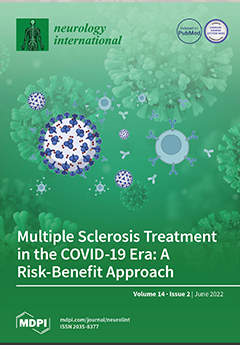
Cover Story:

In MS patients, risk factors for severe evolution of COVID-19 are older age, male gender, an EDSS score of >3, comorbidities, methylprednisolone administered in the month before infection, anti-CD20 therapy, and progressive MS course. A reduced vaccine humoral response has been described in patients on ocrelizumab and fingolimod, and a low antibody titer has been associated with the risk of SARS-CoV-2 breakthrough infection.

We suggest evaluating single patient risk factors for COVID-19 severe evolution and anti-SARS-CoV-2 antibodies titer in order to better identify those MS persons at risk of developing severe COVID-19 and to discuss with them the opportunity to administer a prophylactic therapy (i.e., tixagevimag/cilgavimab) or to treat SARS-CoV-2 infection with antivirals and/or anti-spike protein monoclonal antibodies. View this paper

  • Issues are regarded as officially published after their release is announced to the table of contents alert mailing list .
  • You may sign up for email alerts to receive table of contents of newly released issues.
  • PDF is the official format for papers published in both, html and pdf forms. To view the papers in pdf format, click on the "PDF Full-text" link, and use the free Adobe Reader to open them.

Articles (19)

  • Case Report
  • Open Access
1 Citations
2,994 Views
11 Pages

Rehabilitation Program for Gait Training Using UAN.GO, a Powered Exoskeleton: A Case Report

  • Gianfranco Lamberti,
  • Gianluca Sesenna,
  • Qamil Paja and
  • Gianluca Ciardi

16 June 2022

Background: Spinal cord injury is characterized by the interruption of neural pathways of the spinal cord, with alteration of sensory, motor, and autonomic functions. Robotic-assisted gait training offers many possibilities, including the capability...

  • Systematic Review
  • Open Access
24 Citations
6,280 Views
30 Pages

Brain Structural and Functional Alterations in Multiple Sclerosis-Related Fatigue: A Systematic Review

  • Chiara Barbi,
  • Francesca Benedetta Pizzini,
  • Stefano Tamburin,
  • Alice Martini,
  • Anna Pedrinolla,
  • Fabio Giuseppe Laginestra,
  • Gaia Giuriato,
  • Camilla Martignon,
  • Federico Schena and
  • Massimo Venturelli

Fatigue is one of the most disabling symptoms of multiple sclerosis (MS); it influences patients’ quality of life. The etiology of fatigue is complex, and its pathogenesis is still unclear and debated. The objective of this review was to descri...

  • Systematic Review
  • Open Access
7 Citations
4,152 Views
9 Pages

Pulvinar Sign, Stroke and Their Relationship with Fabry Disease: A Systematic Review and Metanalysis

  • Juan Fernando Ortíz,
  • María Belén Solís,
  • Syed Saad Ali,
  • Mahika Khurana,
  • Juan Andrés Moncayo,
  • Nishel Yogesh Kothari,
  • Mateo Alzamora,
  • Ahmed Eissa-Garces,
  • Ghanshyam Patel and
  • Gustavo Andrés Monteros
  • + 2 authors

Background: Fabry disease (FD) is the second most common lysosomal storage disorder. This disorder affects multiple systems that include the cardiac, renal, and nervous system. The pulvinar sign (PS) is a relatively common sign seen in patients with...

  • Systematic Review
  • Open Access
17 Citations
4,827 Views
9 Pages

Reversible Cerebral Vasoconstriction Syndrome in the Postpartum Period: A Systematic Review and Meta-Analysis

  • Kimberly Pacheco,
  • Juan Fernando Ortiz,
  • Jashank Parwani,
  • Claudio Cruz,
  • Mario Yépez,
  • Maja Buj,
  • Mahika Khurana,
  • Diego Ojeda,
  • Alisson Iturburu and
  • Alex S. Aguirre
  • + 2 authors

(1) Background: Reversible cerebral vasoconstriction syndrome (RCVS) encompasses a clinical and radiological diagnosis characterized by recurrent thunderclap headache, with or without focal deficits due to multifocal arterial vasoconstriction and dil...

  • Article
  • Open Access
11 Citations
4,751 Views
17 Pages

Hesperetin, a Citrus Flavonoid, Ameliorates Inflammatory Cytokine-Mediated Inhibition of Oligodendroglial Cell Morphological Differentiation

  • Satoshi Nishino,
  • Yoko Fujiki,
  • Takanari Sato,
  • Yukino Kato,
  • Remina Shirai,
  • Hiroaki Oizumi,
  • Masahiro Yamamoto,
  • Katsuya Ohbuchi,
  • Yuki Miyamoto and
  • Kazushige Mizoguchi
  • + 1 author

Oligodendrocytes (oligodendroglial cells) are glial cells that wrap neuronal axons with their differentiated plasma membranes called myelin membranes. In the pathogenesis of inflammatory cytokine-related oligodendroglial cell and myelin diseases such...

  • Review
  • Open Access
36 Citations
19,830 Views
18 Pages

Mild-to-Moderate Traumatic Brain Injury: A Review with Focus on the Visual System

  • Steven H. Rauchman,
  • Jacqueline Albert,
  • Aaron Pinkhasov and
  • Allison B. Reiss

Traumatic Brain Injury (TBI) is a major global public health problem. Neurological damage from TBI may be mild, moderate, or severe and occurs both immediately at the time of impact (primary injury) and continues to evolve afterwards (secondary injur...

  • Article
  • Open Access
24 Citations
17,209 Views
12 Pages

RETRACTED: Effect Comparison of E-Cigarette and Traditional Smoking and Association with Stroke—A Cross-Sectional Study of NHANES

  • Urvish Patel,
  • Neel Patel,
  • Mahika Khurana,
  • Akshada Parulekar,
  • Amrapali Patel,
  • Juan Fernando Ortiz,
  • Rutul Patel,
  • Eseosa Urhoghide,
  • Anuja Mistry and
  • Arpita Bhriguvanshi
  • + 4 authors

Introduction: Tobacco use is one of the most significant risk factors for stroke. Besides traditional cigarettes and combustible products, the use of e-cigarettes and electronic nicotine delivery products has been widespread among young adults in the...

  • Case Report
  • Open Access
4 Citations
7,226 Views
4 Pages

Trigeminal Herpes Zoster Transited to Ipsilateral Occipital Neuralgia

  • Keita Takizawa,
  • Zhimin Yan,
  • Jumi Nakata,
  • Andrew Young,
  • Junad Khan,
  • Mythili Kalladka and
  • Noboru Noma

The pain of occipital neuralgia (ON) is thought to be secondary to trauma or injury to the occipital nerve at any point along the course of the nerve. ON may also be caused by an infectious process (herpes zoster) or compression of the nerve. The pat...

  • Review
  • Open Access
10 Citations
8,714 Views
14 Pages

Alternative Options for Complex, Recurrent Pain States Using Cannabinoids, Psilocybin, and Ketamine: A Narrative Review of Clinical Evidence

  • Amber N. Edinoff,
  • Juliana M. Fort,
  • Christina Singh,
  • Sarah E. Wagner,
  • Jessica R. Rodriguez,
  • Catherine A. Johnson,
  • Elyse M. Cornett,
  • Kevin S. Murnane,
  • Adam M. Kaye and
  • Alan D. Kaye

With emerging information about the potential for morbidity and reduced life expectancy with long-term use of opioids, it is logical to evaluate nonopioid analgesic treatments to manage pain states. Combinations of drugs can provide additive and/or s...

  • Case Report
  • Open Access
4 Citations
2,714 Views
6 Pages

Italian Case Report with a Double Mutation in PSEN1 (K311R and E318G)

  • Paola Bisceglia,
  • Filomena Lo Vecchio,
  • Raffaela Rita Latino,
  • Carolina Gravina,
  • Maria Urbano,
  • Annamaria la Torre,
  • Gaetano Desina,
  • Antonio Greco,
  • Maurizio Leone and
  • Annibale Antonioni

Alzheimer’s disease (AD) is the most common cause of dementia worldwide. The clinical spectrum of suspected AD has been extended from mild cognitive impairment (MCI) to preclinical AD which includes people who have typical cognitive function bu...

of 2

Get Alerted

Add your email address to receive forthcoming issues of this journal.

XFacebookLinkedIn
Neurol. Int. - ISSN 2035-8377