

Skip to Content

Marine Drugs, Volume 18, Issue 12

2020 December - 78 articles

Cover Story: The extract of a Pseudosuberites sp. sponge provided three new aryl alkaloids named suberitamides A–C. Assignment of the relative configuration of the four contiguous stereogenic centers in the conformationally flexible oxolane ring in suberitamide A was accomplished using a variety of contemporary NMR techniques. These included J-based methodologies that employed new NMR experiments for the accurate determination of heteronuclear coupling constants between protons and nonprotonated carbons. The ubiquitin ligase Cbl-b is an attractive potential target for immune system modulation, and suberitamides A and B inhibited autoubiquitination of Cbl-b at low micromolar concentrations. View this paper.
  • Issues are regarded as officially published after their release is announced to the table of contents alert mailing list .
  • You may sign up for email alerts to receive table of contents of newly released issues.
  • PDF is the official format for papers published in both, html and pdf forms. To view the papers in pdf format, click on the "PDF Full-text" link, and use the free Adobe Reader to open them.

Articles (78)

  • Article
  • Open Access
19 Citations
5,705 Views
18 Pages

Proteomic Analysis of the Venom of Jellyfishes Rhopilema esculentum and Sanderia malayensis

  • Thomas C. N. Leung,
  • Zhe Qu,
  • Wenyan Nong,
  • Jerome H. L. Hui and
  • Sai Ming Ngai

21 December 2020

Venomics, the study of biological venoms, could potentially provide a new source of therapeutic compounds, yet information on the venoms from marine organisms, including cnidarians (sea anemones, corals, and jellyfish), is limited. This study identif...

  • Review
  • Open Access
36 Citations
12,967 Views
123 Pages

Bioactive Compounds from Marine Heterobranchs

  • Conxita Avila and
  • Carlos Angulo-Preckler

21 December 2020

The natural products of heterobranch molluscs display a huge variability both in structure and in their bioactivity. Despite the considerable lack of information, it can be observed from the recent literature that this group of animals possesses an a...

  • Review
  • Open Access
117 Citations
11,339 Views
18 Pages

The Structural Characteristics of Seaweed Polysaccharides and Their Application in Gel Drug Delivery Systems

  • Haowei Zhong,
  • Xiaoran Gao,
  • Cui Cheng,
  • Chun Liu,
  • Qiaowen Wang and
  • Xiao Han

21 December 2020

In recent years, researchers across various fields have shown a keen interest in the exploitation of biocompatible natural polymer materials, especially the development and application of seaweed polysaccharides. Seaweed polysaccharides are a multi-c...

  • Article
  • Open Access
85 Citations
9,683 Views
26 Pages

21 December 2020

In recent years, research on natural products has gained considerable attention, particularly in the cosmetic industry, which is looking for new bio-active and biodegradable molecules. In this study, cosmetic properties of cyanobacteria and red macro...

  • Article
  • Open Access
27 Citations
3,914 Views
22 Pages

21 December 2020

In recent years, due to an expansion of antibiotic-resistant microorganisms, there has been growing interest in biodegradable and antibacterial polymers that can be used in selected biomedical applications. The present work describes the synthesis of...

  • Article
  • Open Access
9 Citations
4,768 Views
21 Pages

21 December 2020

The discovery of new secondary metabolites from natural origins has become more challenging in natural products research. Different approaches have been applied to target the isolation of new bioactive metabolites from plant extracts. In this study,...

  • Article
  • Open Access
11 Citations
4,715 Views
9 Pages

Inhibition of Biofilm Formation by Modified Oxylipins from the Shipworm Symbiont Teredinibacter turnerae

  • Noel M. Lacerna,
  • Cydee Marie V. Ramones,
  • Jose Miguel D. Robes,
  • Myra Ruth D. Picart,
  • Jortan O. Tun,
  • Bailey W. Miller,
  • Margo G. Haygood,
  • Eric W. Schmidt,
  • Lilibeth A. Salvador-Reyes and
  • Gisela P. Concepcion

20 December 2020

The bioactivity-guided purification of the culture broth of the shipworm endosymbiont Teredinibacter turnerae strain 991H.S.0a.06 yielded a new fatty acid, turneroic acid (1), and two previously described oxylipins (23). Turneroic acid (1) is...

  • Article
  • Open Access
12 Citations
5,458 Views
18 Pages

Heteroexpression of Aspergillus nidulans laeA in Marine-Derived Fungi Triggers Upregulation of Secondary Metabolite Biosynthetic Genes

  • Ishrat Khan,
  • Wan-Lin Xie,
  • Yu-Chao Yu,
  • Huan Sheng,
  • Yan Xu,
  • Jia-Qi Wang,
  • Sanjit Chandra Debnath,
  • Jin-Zhong Xu,
  • Dao-Qiong Zheng and
  • Pin-Mei Wang
  • + 1 author

18 December 2020

Fungi are a prospective resource of bioactive compounds, but conventional methods of drug discovery are not effective enough to fully explore their metabolic potential. This study aimed to develop an easily attainable method to elicit the metabolic p...

  • Article
  • Open Access
11 Citations
3,751 Views
23 Pages

Extraction Improvement of the Bioactive Blue-Green Pigment “Marennine” from Diatom Haslea ostrearia’s Blue Water: A Solid-Phase Method Based on Graphitic Matrices

  • William Bélanger,
  • Alexandre A. Arnold,
  • François Turcotte,
  • Richard Saint-Louis,
  • Jean-Sébastien Deschênes,
  • Bertrand Genard,
  • Isabelle Marcotte and
  • Réjean Tremblay

18 December 2020

The compound “marennine” is a blue–green pigment produced by the benthic microalgae Haslea ostrearia, with pathogenicity reduction activities against some bacteria and promising potential as a natural pigment in seafood industries....

  • Review
  • Open Access
25 Citations
5,918 Views
20 Pages

18 December 2020

Globally, the burden of neurodegenerative disorders continues to rise, and their multifactorial etiology has been regarded as among the most challenging medical issues. Bioprospecting for seaweed-derived multimodal acting products has earned increasi...

  • Article
  • Open Access
13 Citations
4,449 Views
15 Pages

Sustainable Low-Volume Analysis of Environmental Samples by Semi-Automated Prioritization of Extracts for Natural Product Research (SeaPEPR)

  • Riyanti,
  • Michael Marner,
  • Christoph Hartwig,
  • Maria A. Patras,
  • Stevy I. M. Wodi,
  • Frets J. Rieuwpassa,
  • Frans G. Ijong,
  • Walter Balansa and
  • Till F. Schäberle

17 December 2020

The discovery of novel natural products (NPs) that will serve as lead structures has to be an ongoing effort to fill the respective development pipelines. However, identification of NPs, which possess a potential for application in e.g., the pharma o...

  • Article
  • Open Access
27 Citations
4,166 Views
21 Pages

Improved Stability and Activity of a Marine Peptide-N6NH2 against Edwardsiella tarda and Its Preliminary Application in Fish

  • Huihui Han,
  • Ting Li,
  • Zhenlong Wang,
  • Da Teng,
  • Ruoyu Mao,
  • Ya Hao,
  • Na Yang,
  • Xiumin Wang and
  • Jianhua Wang

17 December 2020

Edwardsiella tarda can cause fatal gastro-/extraintestinal diseases in fish and humans. Overuse of antibiotics has led to antibiotic resistance and contamination in the environment, which highlights the need to find new antimicrobial agents. In this...

  • Review
  • Open Access
25 Citations
13,590 Views
20 Pages

Are There Any Beneficial Effects of Spirulina Supplementation for Metabolic Syndrome Components in Postmenopausal Women?

  • Elena Bobescu,
  • Andreea Bălan,
  • Marius Alexandru Moga,
  • Andreea Teodorescu,
  • Maria Mitrică and
  • Lorena Dima

17 December 2020

Spirulina is a phytosynthetic filamentous cyanobacterium with microscopic dimensions, which naturally grows in the highly-salted alkaline lakes of Africa, Mexico, America, and Asia. Several bioactive peptides extracted from Spirulina were demonstrate...

  • Review
  • Open Access
42 Citations
7,219 Views
27 Pages

Bioactivity Potential of Marine Natural Products from Scleractinia-Associated Microbes and In Silico Anti-SARS-COV-2 Evaluation

  • Eman Maher Zahran,
  • Amgad Albohy,
  • Amira Khalil,
  • Alyaa Hatem Ibrahim,
  • Heba Ali Ahmed,
  • Ebaa M. El-Hossary,
  • Gerhard Bringmann and
  • Usama Ramadan Abdelmohsen

16 December 2020

Marine organisms and their associated microbes are rich in diverse chemical leads. With the development of marine biotechnology, a considerable number of research activities are focused on marine bacteria and fungi-derived bioactive compounds. Marine...

  • Article
  • Open Access
10 Citations
3,462 Views
13 Pages

16 December 2020

Tobacco smoking has become a prominent health problem faced around the world. The α3β4 nicotinic acetylcholine receptor (nAChR) is strongly associated with nicotine reward and withdrawal symptom. α-Conotoxin TxID, cloned from Conus t...

  • Article
  • Open Access
13 Citations
3,821 Views
14 Pages

Improved Isolation Procedures for Okadaic Acid Group Toxins from Shellfish (Mytilus edulis) and Microalgae (Prorocentrum lima)

  • Jane Kilcoyne,
  • Stephen Burrell,
  • Cíara Nulty,
  • Rafael Salas,
  • Elliott J. Wright,
  • Isabelle Rajotte and
  • Christopher O. Miles

16 December 2020

Okadaic acid (OA) group toxins may accumulate in shellfish and can result in diarrhetic shellfish poisoning when consumed by humans, and are therefore regulated. Purified toxins are required for the production of certified reference materials used to...

  • Article
  • Open Access
33 Citations
4,266 Views
15 Pages

16 December 2020

In hyperlipidemia, pyroptosis in endothelial cells (ECs) induces atherosclerosis via the toll-like receptor 4 (TLR4) pathway. We evaluated the effects of Ecklonia cava extract (ECE) and pyrogallol-phloroglucinol-6,6-bieckol (PPB) on pyroptosis of ECs...

  • Article
  • Open Access
101 Citations
6,158 Views
16 Pages

15 December 2020

High-fat diet (HFD) usually induces oxidative stress and astaxanthin is regarded as an excellent anti-oxidant. An 8-week feeding trial was conducted to investigate the effects of dietary astaxanthin supplementation on growth performance, lipid metabo...

  • Review
  • Open Access
159 Citations
16,738 Views
44 Pages

15 December 2020

Microalgae are microorganisms with a singular biochemical composition, including several biologically active compounds with proven pharmacological activities, such as anticancer, antioxidant and anti-inflammatory activities, among others. These prope...

  • Review
  • Open Access
87 Citations
12,029 Views
25 Pages

Ecological and Industrial Implications of Dynamic Seaweed-Associated Microbiota Interactions

  • Farid Menaa,
  • P. A. U. I. Wijesinghe,
  • Gobika Thiripuranathar,
  • Bushra Uzair,
  • Haroon Iqbal,
  • Barkat Ali Khan and
  • Bouzid Menaa

14 December 2020

Seaweeds are broadly distributed and represent an important source of secondary metabolites (e.g., halogenated compounds, polyphenols) eliciting various pharmacological activities and playing a relevant ecological role in the anti-epibiosis. Importan...

  • Article
  • Open Access
33 Citations
4,916 Views
21 Pages

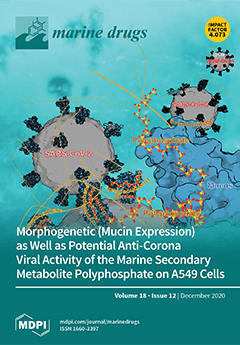
Morphogenetic (Mucin Expression) as Well as Potential Anti-Corona Viral Activity of the Marine Secondary Metabolite Polyphosphate on A549 Cells

  • Werner E. G. Müller,
  • Meik Neufurth,
  • Shunfeng Wang,
  • Rongwei Tan,
  • Heinz C. Schröder and
  • Xiaohong Wang

14 December 2020

The mucus layer of the nasopharynx and bronchial epithelium has a barrier function against inhaled pathogens such as the coronavirus SARS-CoV-2. We recently found that inorganic polyphosphate (polyP), a physiological, metabolic energy (ATP)-providing...

  • Communication
  • Open Access
6 Citations
3,830 Views
11 Pages

13 December 2020

Ice-binding proteins (IBPs) have ice recrystallization inhibition (IRI) activity. IRI property has been extensively utilized for the cryopreservation of different types of cells and tissues. Recent reports demonstrated that IRI can also play a signif...

  • Review
  • Open Access
65 Citations
9,096 Views
20 Pages

Advances in Studies on the Pharmacological Activities of Fucoxanthin

  • Han Xiao,
  • Jiarui Zhao,
  • Chang Fang,
  • Qi Cao,
  • Maochen Xing,
  • Xia Li,
  • Junfeng Hou,
  • Aiguo Ji and
  • Shuliang Song

11 December 2020

Fucoxanthin is a natural carotenoid derived mostly from many species of marine brown algae. It is characterized by small molecular weight, is chemically active, can be easily oxidized, and has diverse biological activities, thus protecting cell compo...

  • Article
  • Open Access
16 Citations
3,900 Views
21 Pages

11 December 2020

Although genetic predisposition influences the onset and progression of insulin resistance and diabetes, dietary nutrients are critical. In general, protein is beneficial relative to carbohydrate and fat but dependent on protein source. Our recent st...

  • Article
  • Open Access
35 Citations
4,432 Views
11 Pages

Antimicrobial and Antioxidant Polyketides from a Deep-Sea-Derived Fungus Aspergillus versicolor SH0105

  • Lu-Jia Yang,
  • Xiao-Yue Peng,
  • Ya-Hui Zhang,
  • Zhi-Qing Liu,
  • Xin Li,
  • Yu-Cheng Gu,
  • Chang-Lun Shao,
  • Zhuang Han and
  • Chang-Yun Wang

11 December 2020

Fifteen polyketides, including four new compounds, isoversiol F (1), decumbenone D (2), palitantin B (7), and 1,3-di-O-methyl-norsolorinic acid (8), along with 11 known compounds (36 and 915), were isolated from the deep-sea-derived fun...

  • Article
  • Open Access
6 Citations
5,345 Views
21 Pages

Identification and Characterization of a New Type III Polyketide Synthase from a Marine Yeast, Naganishia uzbekistanensis

  • Laure Martinelli,
  • Vanessa Redou,
  • Bastien Cochereau,
  • Ludovic Delage,
  • Nolwenn Hymery,
  • Elisabeth Poirier,
  • Christophe Le Meur,
  • Gaetan Le Foch,
  • Lionel Cladiere and
  • Laurence Meslet-Cladiere
  • + 2 authors

11 December 2020

A putative Type III Polyketide synthase (PKSIII) encoding gene was identified from a marine yeast, Naganishia uzbekistanensis strain Mo29 (UBOCC-A-208024) (formerly named as Cryptococcus sp.) isolated from deep-sea hydrothermal vents. This gene is pa...

  • Article
  • Open Access
25 Citations
4,883 Views
17 Pages

Mycotoxin Identification and In Silico Toxicity Assessment Prediction in Atlantic Salmon

  • Josefa Tolosa,
  • Francisco J. Barba,
  • Noelia Pallarés and
  • Emilia Ferrer

10 December 2020

The present study aimed to identify mycotoxins in edible tissues of Atlantic salmon (Salmo salar) using liquid chromatography coupled to hybrid quadrupole time-of-flight mass spectrometry (LC-Q-TOF-MS). After using a non-targeted screening approach a...

  • Article
  • Open Access
26 Citations
4,305 Views
16 Pages

Alterins Produced by Oyster-Associated Pseudoalteromonas Are Antibacterial Cyclolipopeptides with LPS-Binding Activity

  • Florie Desriac,
  • Abderrafek El Harras,
  • Matthieu Simon,
  • Arnaud Bondon,
  • Benjamin Brillet,
  • Patrick Le Chevalier,
  • Martine Pugnière,
  • Patrice Got,
  • Delphine Destoumieux-Garzón and
  • Yannick Fleury

10 December 2020

Discovery after discovery, host-associated microbiota reveal a growing list of positive effects on host homeostasis by contributing to host nutrition, improving hosts’ immune systems and protecting hosts against pathogens. In that context, a co...

  • Article
  • Open Access
16 Citations
4,174 Views
13 Pages

Antimicrobial Peptide Arenicin-1 Derivative Ar-1-(C/A) as Complement System Modulator

  • Ilia A. Krenev,
  • Ekaterina S. Umnyakova,
  • Igor E. Eliseev,
  • Yaroslav A. Dubrovskii,
  • Nikolay P. Gorbunov,
  • Vladislav A. Pozolotin,
  • Alexei S. Komlev,
  • Pavel V. Panteleev,
  • Sergey V. Balandin and
  • Mikhail N. Berlov
  • + 2 authors

10 December 2020

Antimicrobial peptides (AMPs) are not only cytotoxic towards host pathogens or cancer cells but also are able to act as immunomodulators. It was shown that some human and non-human AMPs can interact with complement proteins and thereby modulate compl...

  • Article
  • Open Access
27 Citations
5,093 Views
16 Pages

Bioactive Steroids from the Red Sea Soft Coral Sinularia polydactyla

  • Mohamed A. Tammam,
  • Lucie Rárová,
  • Marie Kvasnicová,
  • Gabriel Gonzalez,
  • Ahmed M. Emam,
  • Aldoushy Mahdy,
  • Miroslav Strnad,
  • Efstathia Ioannou and
  • Vassilios Roussis

10 December 2020

Six new (1, 2, 6, 8, 13, and 20) and twenty previously isolated (35, 7, 912, 1419, and 2126) steroids featuring thirteen different carbocycle motifs were isolated from the organic extract of the soft coral Sinularia polyda...

  • Article
  • Open Access
29 Citations
5,304 Views
17 Pages

10 December 2020

The investigation of marine natural products (MNPs) as key resources for the discovery of drugs to mitigate the COVID-19 pandemic is a developing field. In this work, computer-aided drug design (CADD) approaches comprising ligand- and structure-based...

  • Review
  • Open Access
124 Citations
11,992 Views
40 Pages

Recent Advances in Marine-Based Nutraceuticals and Their Health Benefits

  • Vida Šimat,
  • Nariman Elabed,
  • Piotr Kulawik,
  • Zafer Ceylan,
  • Ewelina Jamroz,
  • Hatice Yazgan,
  • Martina Čagalj,
  • Joe M. Regenstein and
  • Fatih Özogul

9 December 2020

The oceans have been the Earth’s most valuable source of food. They have now also become a valuable and versatile source of bioactive compounds. The significance of marine organisms as a natural source of new substances that may contribute to t...

  • Article
  • Open Access
41 Citations
4,828 Views
16 Pages

Particulate Matter-Induced Inflammation/Oxidative Stress in Macrophages: Fucosterol from Padina boryana as a Potent Protector, Activated via NF-κB/MAPK Pathways and Nrf2/HO-1 Involvement

  • Thilina U. Jayawardena,
  • K. K. Asanka Sanjeewa,
  • Hyo-Geun Lee,
  • D. P. Nagahawatta,
  • Hye-Won Yang,
  • Min-Cheol Kang and
  • You-Jin Jeon

9 December 2020

Fucosterol is a phytosterol that is abundant in marine brown algae and is a renowned secondary metabolite. However, its ability to protect macrophages against particulate matter (PM) has not been clarified with regard to inflammation; thus, this stud...

  • Article
  • Open Access
6 Citations
3,327 Views
14 Pages

Evaluation of a Brown Seaweed Extract from Dictyosiphon foeniculaceus as a Potential Therapeutic Agent for the Treatment of Glioblastoma and Uveal Melanoma

  • Philipp Dörschmann,
  • Christina Schmitt,
  • Kaya Saskia Bittkau,
  • Sandesh Neupane,
  • Michael Synowitz,
  • Johann Roider,
  • Susanne Alban,
  • Janka Held-Feindt and
  • Alexa Klettner

8 December 2020

Ingredients of brown seaweed like fucoidans are often described for their beneficial biological effects, that might be interesting for a medical application. In this study, we tested an extract from Dictyosiphon foeniculaceus (DF) to evaluate the eff...

  • Article
  • Open Access
38 Citations
4,514 Views
12 Pages

Polysaccharide from Codium fragile Induces Anti-Cancer Immunity by Activating Natural Killer Cells

  • Hae-Bin Park,
  • Juyoung Hwang,
  • Wei Zhang,
  • Seulgi Go,
  • Jihoe Kim,
  • Inho Choi,
  • SangGuan You and
  • Jun-O Jin

8 December 2020

Natural polysaccharides exhibit beneficial immune modulatory effects, including immune stimulatory and anti-cancer activities. In this study, we examined the effect of Codium fragile polysaccharide (CFP) on natural killer (NK) cell activation, and it...

  • Review
  • Open Access
189 Citations
17,945 Views
30 Pages

7 December 2020

The search for new biological sources of commercial value is a major goal for the sustainable management of natural resources. The huge amount of fishery by-catch or processing by-products continuously produced needs to be managed to avoid environmen...

  • Article
  • Open Access
29 Citations
5,502 Views
21 Pages

Fish Bone Derived Bi-Phasic Calcium Phosphate Coatings Fabricated by Pulsed Laser Deposition for Biomedical Applications

  • Gianina Popescu-Pelin,
  • Carmen Ristoscu,
  • Liviu Duta,
  • Iuliana Pasuk,
  • George E. Stan,
  • Miruna Silvia Stan,
  • Marcela Popa,
  • Mariana C. Chifiriuc,
  • Claudiu Hapenciuc and
  • Ion N. Mihailescu
  • + 2 authors

7 December 2020

We report on new biomaterials with promising bone and cartilage regeneration potential, from sustainable, cheap resources of fish origin. Thin films were fabricated from fish bone-derived bi-phasic calcium phosphate targets via pulsed laser depositio...

  • Article
  • Open Access
7 Citations
3,869 Views
16 Pages

Amentadione from the Alga Cystoseira usneoides as a Novel Osteoarthritis Protective Agent in an Ex Vivo Co-Culture OA Model

  • Nuna Araújo,
  • Carla S. B. Viegas,
  • Eva Zubía,
  • Joana Magalhães,
  • Acácio Ramos,
  • Maria M. Carvalho,
  • Henrique Cruz,
  • João Paulo Sousa,
  • Francisco J. Blanco and
  • Dina C. Simes
  • + 1 author

7 December 2020

Osteoarthritis (OA) remains a prevalent chronic disease without effective prevention and treatment. Amentadione (YP), a meroditerpenoid purified from the alga Cystoseira usneoides, has demonstrated anti-inflammatory activity. Here, we investigated th...

  • Article
  • Open Access
50 Citations
8,246 Views
18 Pages

4 December 2020

With the worldwide increase of fisheries, fish wastes have had a similar increase, alternatively they can be seen as a source of novel substances for the improvement of society’s wellbeing. Elasmobranchs are a subclass fished in high amounts, w...

  • Article
  • Open Access
75 Citations
6,104 Views
14 Pages

4 December 2020

R-phycoerythrin (R-PE), a marine bioactive protein, is abundant in Porphyra yezoensis with high protein content. In this study, R-PE was purified using a deep eutectic solvents aqueous two-phase system (DES-ATPS), combined with ammonium sulphate prec...

  • Review
  • Open Access
135 Citations
17,955 Views
28 Pages

Marine Anticancer Agents: An Overview with a Particular Focus on Their Chemical Classes

  • Marilia Barreca,
  • Virginia Spanò,
  • Alessandra Montalbano,
  • Mercedes Cueto,
  • Ana R. Díaz Marrero,
  • Irem Deniz,
  • Ayşegül Erdoğan,
  • Lada Lukić Bilela,
  • Corentin Moulin and
  • Francesco Bertoni
  • + 8 authors

4 December 2020

The marine environment is a rich source of biologically active molecules for the treatment of human diseases, especially cancer. The adaptation to unique environmental conditions led marine organisms to evolve different pathways than their terrestria...

  • Article
  • Open Access
30 Citations
4,476 Views
20 Pages

Structure Elucidation and Functional Studies of a Novel β-hairpin Antimicrobial Peptide from the Marine Polychaeta Capitella teleta

  • Pavel V. Panteleev,
  • Andrey V. Tsarev,
  • Victoria N. Safronova,
  • Olesia V. Reznikova,
  • Ilia A. Bolosov,
  • Sergei V. Sychev,
  • Zakhar O. Shenkarev and
  • Tatiana V. Ovchinnikova

4 December 2020

Endogenous antimicrobial peptides (AMPs) are evolutionary ancient molecular factors of innate immunity that play a key role in host defense. Among the most active and stable under physiological conditions AMPs are the peptides of animal origin that a...

  • Article
  • Open Access
7 Citations
4,252 Views
14 Pages

Influence of Low Salt Concentration on Growth Behavior and General Biomass Composition in Lyngbya purpurem (Cyanobacteria)

  • Itzel Y. López-Pacheco,
  • Susana Fuentes-Tristan,
  • Laura Isabel Rodas-Zuluaga,
  • Carlos Castillo-Zacarías,
  • Itzel Pedro-Carrillo,
  • María Adriana Martínez-Prado,
  • Hafiz M. N. Iqbal and
  • Roberto Parra-Saldívar

4 December 2020

Cyanobacteria are essential for the vast number of compounds they produce and the possible applications in the pharmaceutical, cosmetical, and food industries. As Lyngbya species’ characterization is limited in the literature, we characterize t...

  • Article
  • Open Access
21 Citations
4,705 Views
30 Pages

Application of Six Detection Methods for Analysis of Paralytic Shellfish Toxins in Shellfish from Four Regions within Latin America

  • Andrew D. Turner,
  • Sophie Tarnovius,
  • Robert G. Hatfield,
  • Mickael Teixeira Alves,
  • Maggie Broadwater,
  • Frances Van Dolah,
  • Ernesto Garcia-Mendoza,
  • Dinorah Medina,
  • Maria Salhi and
  • Benjamin A. Suarez-Isla
  • + 4 authors

3 December 2020

With the move away from use of mouse bioassay (MBA) to test bivalve mollusc shellfish for paralytic shellfish poisoning (PSP) toxins, countries around the world are having to adopt non-animal-based alternatives that fulfil ethical and legal requireme...

  • Review
  • Open Access
49 Citations
5,714 Views
34 Pages

Chemical Diversity of Soft Coral Steroids and Their Pharmacological Activities

  • Ekaterina V. Ermolenko,
  • Andrey B. Imbs,
  • Tatyana A. Gloriozova,
  • Vladimir V. Poroikov,
  • Tatyana V. Sikorskaya and
  • Valery M. Dembitsky

2 December 2020

The review is devoted to the chemical diversity of steroids produced by soft corals and their determined and potential activities. There are about 200 steroids that belong to different types of steroids such as secosteroids, spirosteroids, epoxy- and...

  • Review
  • Open Access
72 Citations
7,615 Views
26 Pages

2 December 2020

Deep sea has an extreme environment which leads to biodiversity of microorganisms and their unique physical and biochemical mechanisms. Deep-sea derived microorganisms are more likely to produce novel bioactive substances with special mechanism of ac...

  • Article
  • Open Access
22 Citations
8,856 Views
17 Pages

Efficacy and Mechanism of Action of Marine Alkaloid 3,10-Dibromofascaplysin in Drug-Resistant Prostate Cancer Cells

  • Sergey A. Dyshlovoy,
  • Moritz Kaune,
  • Jessica Hauschild,
  • Malte Kriegs,
  • Konstantin Hoffer,
  • Tobias Busenbender,
  • Polina A. Smirnova,
  • Maxim E. Zhidkov,
  • Ekaterina V. Poverennaya and
  • Gunhild von Amsberg
  • + 6 authors

1 December 2020

Efficacy and mechanism of action of marine alkaloid 3,10-dibromofascaplysin (DBF) were investigated in human prostate cancer (PCa) cells harboring different levels of drug resistance. Anticancer activity was observed across all cell lines examined wi...

of 2

Get Alerted

Add your email address to receive forthcoming issues of this journal.

XFacebookLinkedIn
Mar. Drugs - ISSN 1660-3397