You are currently viewing a new version of our website. To view the old version click .

Molecules, Volume 22, Issue 10

October 2017 - 225 articles

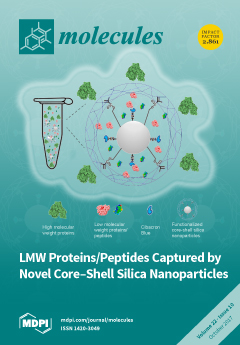
Cover Story: Isolation and purification of low molecular weight proteins and peptides (potential biomarkers) from biological fluids is a challenging task, since these are in very low concentration, susceptible to protease degradation and often masked by abundant proteins. Herein, novel core–shell silica nanoparticles were synthesized, and evaluated with both high and low molecular weight (LMW) model proteins/peptides. Nanoparticles hindered the entrance of high molecular weight proteins due to restrictive pores in the polymeric shell, while LMW proteins/peptides were captured by interaction with the molecular bait immobilized in the core. View this paper
  • Issues are regarded as officially published after their release is announced to the table of contents alert mailing list .
  • You may sign up for email alerts to receive table of contents of newly released issues.
  • PDF is the official format for papers published in both, html and pdf forms. To view the papers in pdf format, click on the "PDF Full-text" link, and use the free Adobe Reader to open them.

Articles (225)

  • Article
  • Open Access
5 Citations
4,044 Views
15 Pages

Association, Distribution, Liberation, and Rheological Balances of Alkyldimethylbenzylammonium Chlorides (C12–C16)

  • Zuzana Vitková,
  • Jarmila Oremusová,
  • Petra Herdová,
  • Oľga Ivánková and
  • Anton Vitko

24 October 2017

It is known that cationic surfactants have an antimicrobial effect and act as enhancers. This paper studies three cationic surfactants from the group of alkyldimethylbenzylammonium chlorides (dodecyl-, tetradecyl-, and hexadecyl). Interest is focused...

  • Article
  • Open Access
61 Citations
9,371 Views
14 Pages

23 October 2017

This study investigated the volatile flavor compounds and antioxidant properties of the essential oil of chrysanthemums that was extracted from the fresh flowers of 10 taxa of Chrysanthemum morifolium from three species; namely Dendranthema morifoli...

  • Review
  • Open Access
106 Citations
12,772 Views
13 Pages

Cyclodipeptides: An Overview of Their Biosynthesis and Biological Activity

  • Awdhesh Kumar Mishra,
  • Jaehyuk Choi,
  • Seong-Jin Choi and
  • Kwang-Hyun Baek

23 October 2017

Cyclodipeptides (CDP) represent a diverse family of small, highly stable, cyclic peptides that are produced as secondary functional metabolites or side products of protein metabolism by bacteria, fungi, and animals. They are widespread in nature, and...

  • Article
  • Open Access
7 Citations
5,457 Views
16 Pages

Ureidopyrazine Derivatives: Synthesis and Biological Evaluation as Anti-Infectives and Abiotic Elicitors

  • Ghada Bouz,
  • Martin Juhás,
  • Pavlína Niklová,
  • Ondřej Janďourek,
  • Pavla Paterová,
  • Jiří Janoušek,
  • Lenka Tůmová,
  • Zuzana Kovalíková,
  • Petr Kastner and
  • Martin Doležal
  • + 1 author

23 October 2017

Tuberculosis (TB) caused by Mycobacterium tuberculosis (Mtb) has become a frequently deadly infection due to increasing antimicrobial resistance. This serious issue has driven efforts worldwide to discover new drugs effective against Mtb. One researc...

  • Article
  • Open Access
9 Citations
6,484 Views
13 Pages

The Regulatory Mechanism of MLT/MT1 Signaling on the Growth of Antler Mesenchymal Cells

  • Feifei Yang,
  • Changjiu He,
  • Xuyang Sun,
  • Jing Wang,
  • Can Luo,
  • Guoshi Liu,
  • Liguo Yang,
  • Jiajun Xiong and
  • Lijun Huo

23 October 2017

Melatonin (MLT) plays an important role in regulating the physiological cycle of seasonal breeding animals. Melatonin receptor I (MT1) is effectively expressed in the cambium layer of deer antler. However, the function and metabolic mechanism of MLT/...

  • Article
  • Open Access
7 Citations
6,084 Views
14 Pages

23 October 2017

Bombesin-like peptides, which were identified from a diversity of amphibian skin secretions, have been demonstrated to possess several biological functions such as stimulation of smooth muscle contraction and regulation of food intake. Here, we repor...

  • Article
  • Open Access
42 Citations
6,284 Views
14 Pages

23 October 2017

It is shown that the dissociation energy D e for the process B⋯A = B + A for 250 complexes B⋯A composed of 11 Lewis bases B (N2, CO, HC≡CH, CH2=CH2, C3H6, PH3, H2S, HCN, H2O, H2CO and NH3) and 23 Lewis acids (HF, HCl, HBr, HC≡CH, HCN, H2O,...

  • Article
  • Open Access
28 Citations
6,543 Views
11 Pages

Phenolic Compounds Present Schinus terebinthifolius Raddi Influence the Lowering of Blood Pressure in Rats

  • Lorena De Lima Glória,
  • Mariana Barreto de Souza Arantes,
  • Silvia Menezes de Faria Pereira,
  • Guilherme De Souza Vieira,
  • Camilla Xavier Martins,
  • Almir Ribeiro de Carvalho Junior,
  • Fernanda Antunes,
  • Raimundo Braz-Filho,
  • Ivo José Curcino Vieira and
  • Larissa Leandro da Cruz
  • + 3 authors

23 October 2017

This study identified two phenolic compounds in Schinus terebinthifolius Raddi fruits: naringenin (first report in this species) and gallic acid. Their structures were elucidated by nuclear magnetic resonance (NMR) data (1H-, 13C-NMR) and a high-perf...

  • Communication
  • Open Access
46 Citations
6,441 Views
7 Pages

23 October 2017

Cadmium is a well-known elicitor of melatonin synthesis in plants, including rice. However, the mechanisms by which cadmium induces melatonin induction remain elusive. To investigate whether cadmium influences physical integrities in subcellular orga...

  • Review
  • Open Access
33 Citations
9,097 Views
12 Pages

Synthesis and Properties of MQ Copolymers: Current State of Knowledge

  • Elena Tatarinova,
  • Nataliya Vasilenko and
  • Aziz Muzafarov

23 October 2017

In this review, we discuss currently available studies on the synthesis and properties of MQ copolymers. The data on methods of producing hydrolytic and heterofunctional polycondensation of functional organosilanes as well as the obtaining MQ copolym...

of 23

Get Alerted

Add your email address to receive forthcoming issues of this journal.

XFacebookLinkedIn
Molecules - ISSN 1420-3049