


Wireless Sensor Networks, Communications, and Security for IoT Systems
This special issue belongs to the section "Information and Communication Technologies".
Special Issue Information
Dear Colleagues,
IoT deployments keep growing in scale and in the variety of settings that they serve, from smart cities and precision agriculture to healthcare and industrial monitoring. That growth puts pressure on the networks underneath them, which have to stay reliable, energy efficient, and secure while running on constrained hardware, often unattended and for years at a time.
Many of the hardest problems only show up in the field. Link quality shifts with weather, people, and neighboring radios; batteries drain faster than models predict; and low-cost nodes are exposed to jamming, spoofing, and intrusion that simulations rarely capture. At the same time, edge computing and lightweight machine learning now make it possible to detect anomalies and adapt the network close to where the data is generated. Bringing communication, security, and on-device intelligence together is what will move IoT from pilot projects to dependable infrastructure.
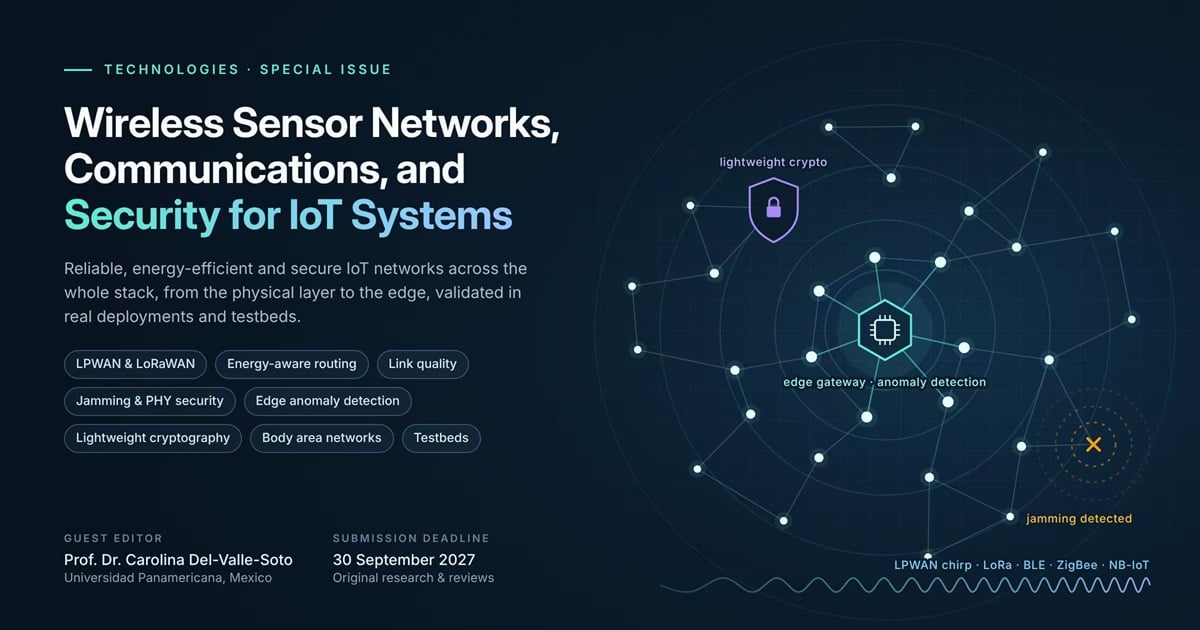
This Special Issue aims to gather recent advances in wireless sensor networks and IoT communications, with an emphasis on reliability, energy efficiency, and security across the whole stack, from the physical layer to the application layer. We invite original research and review articles, and we are particularly interested in work validated through real deployments, testbeds, or realistic experimental setups.
Topics of interest include, but are not limited to:
- Low-power wireless protocols for IoT (LoRa/LoRaWAN, BLE, ZigBee, NB-IoT, and other LPWAN technologies);
- Energy-aware routing, MAC design, and network lifetime optimization in WSNs;
- Link quality estimation and network performance monitoring;
- Physical layer security, jamming detection, and resilience against interference;
- Intrusion and anomaly detection for IoT networks, including edge-based inference;
- Lightweight cryptography and secure communication for constrained devices;
- Edge and fog computing architectures for IoT data processing;
- Application-layer protocols and middleware (MQTT, CoAP) and their security;
- Wearable and body area sensor networks;
- Real-world IoT deployments, testbeds, and lessons learned.
We look forward to receiving your contributions.
Prof. Dr. Carolina Del-Valle-Soto
Guest Editor
Manuscript Submission Information
Manuscripts should be submitted online at www.mdpi.com by registering and logging in to this website. Once you are registered, click here to go to the submission form. Manuscripts can be submitted until the deadline. All submissions that pass pre-check are peer-reviewed. Accepted papers will be published continuously in the journal (as soon as accepted) and will be listed together on the Special Issue website. Research articles, review articles as well as short communications are invited. For planned papers, a title and short abstract (about 250 words) can be sent to the Editorial Office for assessment.
Submitted manuscripts should not have been published previously, nor be under consideration for publication elsewhere (except conference proceedings papers). All manuscripts are thoroughly refereed through a single-anonymized peer-review process. A guide for authors and other relevant information for submission of manuscripts is available on the Instructions for Authors page. Technologies is an international peer-reviewed open access monthly journal published by MDPI.
Please visit the Instructions for Authors page before submitting a manuscript. The Article Processing Charge (APC) for publication in this open access journal is 1800 CHF (Swiss Francs). Submitted papers should be well formatted and use good English. Authors may use MDPI's English editing service prior to publication or during author revisions.
Keywords
- wireless sensor networks
- internet of things
- LPWAN
- low-power communication
- IoT security
- jamming detection
- anomaly detection
- edge computing
- link quality
Benefits of Publishing in a Special Issue
- Ease of navigation: Grouping papers by topic helps scholars navigate broad scope journals more efficiently.
- Greater discoverability: Special Issues support the reach and impact of scientific research. Articles in Special Issues are more discoverable and cited more frequently.
- Expansion of research network: Special Issues facilitate connections among authors, fostering scientific collaborations.
- External promotion: Articles in Special Issues are often promoted through the journal's social media, increasing their visibility.
- Reprint: MDPI Books provides the opportunity to republish successful Special Issues in book format, both online and in print.
Published Papers


Technologies - ISSN 2227-7080