
Skip to Content
  • 2.2
    Impact Factor
  • 5.2
    CiteScore
  • 17 days
    Submission to First Decision
  • 3 days
    Acceptance to Publication

Symmetry

Symmetry is an international, peer-reviewed, open access journal covering research on symmetry/asymmetry phenomena wherever they occur in all aspects of natural sciences, and is published monthly online by MDPI.  

Get Alerted

Add your email address to receive forthcoming issues of this journal.

All Articles (18,467)

  • Article
  • Open Access

Catalyst activity variation during operation of a commercial catalytic naphtha reformer is a parameter that defines cycle length. The proper determination of the cycle length is vital for adequate planning in refinery operations and for optimizing the process of catalyst regeneration and turn-around scheduling. Using the symmetry between catalyst activity and the octane number of the reformate, one may model and predict catalyst deactivation over time by simulating the octane number with a two-stage recurrent neural network (RNN). In this study, data from the operation of an industrial hybrid catalytic reforming unit over a five-year period were used to develop a model based on an RNN for predicting the octane number of the reformate, as well as for simulating—based on symmetry—changes in catalyst activity and catalyst deactivation. The model allows the cycle length to be defined based on the target reformate octane number. The RNN data were separated as follows: 70% for training, 15% for validation, and 15% for testing. The first and second stages of the RNN model each had one hidden layer with seven neurons. The proposed modeling method is characterized by very high accuracy in calculating the octane number of the reformate, with a coefficient of determination (R2) of 0.978 for the test data from Cycle I and 0.988 for those from Cycle II. Deactivation of the fresh catalyst was found to be much lower than that of the regenerated catalyst, and, according to the RNN model, the regenerated-catalyst cycle length is 32% shorter than that of the fresh catalyst if the same average reformate motor octane number (MON) of 88.3 is the target. However, if the same cycle length is pursued with the regenerated catalyst, then the average reformate MON should be reduced by 1.4 points.

Symmetry

24 November 2026

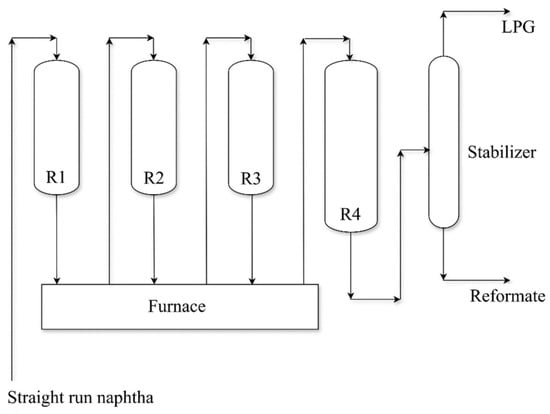
Simplified process-flow diagram of the studied hybrid industrial catalytic reforming plant.
  • Article
  • Open Access

Policy Improvement for Learning-Based UAV Control with Delay Time

  • Jiaxiu Shang,
  • Yufeng Tian and
  • Zhenghong Jin
  • + 1 author

Learning-based UAV control needs a stability property that accounts jointly for actuator limits, delayed information, and policy updates. This paper first builds an auditable local certificate, then cuts its conservatism by exploiting the geometry of the delayed-state history. A generalized saturation representation and a common quadratic metric give an invariant history ellipsoid under arbitrary gain switching and bounded learned residuals. The main extension is an exact robust one-step action envelope: completing the quadratic form separates deterministic history energy from the uncertainty that enters the newly appended state. This yields a convex applied-input filter, keeps every action of the original certified controller, and, under explicit conditions, gives a strict radius improvement over an isotropic norm bound. Trusted set-membership refinement is then shown to expand the action envelope monotonically while preserving the invariant region. A further theorem guarantees robust policy improvement over a certified backup using a verified Bellman-residual bound, without assuming an accurate optimal critic. The detailed proofs distinguish sampled-state safety, uniform value bounds, and the extra assumptions needed for parameter learning. Reproducible experiments certify packet ages up to 100 ms and input-effectiveness variation of ±15%, exhibit a strict action-admission witness, and verify nested parameter refinement. An exactly solvable scalar problem validates the policy-improvement test. The original UAV-learning benchmark does not establish consistent performance superiority, and the six-degree-of-freedom stress study remains empirical until the flight-model interface is independently verified.

Symmetry

23 November 2026

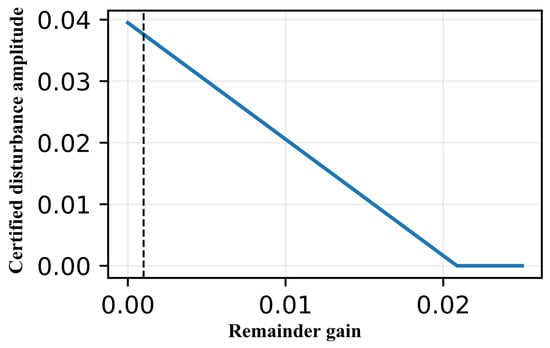
Sufficient disturbance amplitude as the certified nonlinear remainder gain increases, with the other certificate quantities fixed. The vertical line marks the actual drag bound in (77). This is a certificate boundary, not an experimentally identified stability boundary.
  • Article
  • Open Access

In this work, statistical inference for the Inverse Power Half Logistic (IPHL) distribution is considered under adaptive Type-II progressive censoring (ATIIPC). The IPHL distribution provides a flexible lifetime model for positive data, while the ATIIPC scheme offers a practical censoring mechanism by incorporating a pre-specified test time into progressive Type-II censoring. Maximum likelihood estimators of the unknown parameters, as well as the survival and hazard rate functions, are obtained, and the corresponding approximate confidence intervals are constructed using the observed Fisher information matrix and the delta method. Bootstrap confidence intervals are also considered. Since the posterior distributions are not available in closed form, Bayesian estimates and credible intervals are obtained using an MCMC procedure based on the Metropolis–Hastings algorithm under squared error and LINEX loss functions. A Monte Carlo simulation study is carried out to compare the proposed estimation methods under different parameter values. Finally, two real data sets from different fields are considered to illustrate the applicability of the proposed methods.

Symmetry

21 November 2026

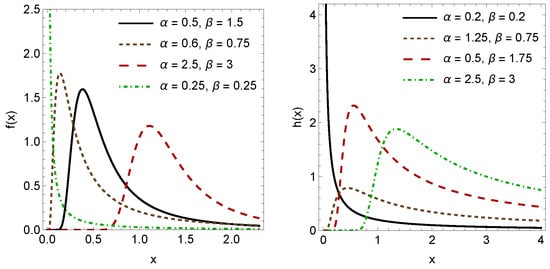
PDF and HF of the IPHL distribution for selected parameter values.
  • Article
  • Open Access

To guide grouting and lining design for deep shafts under high water pressure, we derive a semi-analytical elastoplastic ground reaction curve assuming axisymmetric plane strain, a homogeneous grouted annulus, steady-state non-Darcy seepage, and a drained shaft wall. The Vlachopoulos–Diederichs longitudinal displacement relation for an unlined reference state is used to determine excavation-induced convergence. The equilibrium response is obtained by combining the ground reaction curve with the support characteristic curve of a linear-elastic shaft lining, and a parameter-matching method is established for a prescribed equilibrium convergence. The results show that increasing the grouting extent reduces equilibrium shaft wall convergence and lining contact pressure, with diminishing benefits from increasing grouted-zone thickness. Increasing the Young’s modulus or cohesion of the grouted zone primarily reduces convergence before lining activation and has a relatively small effect on lining contact pressure. Increasing the lining activation distance reduces lining contact pressure but increases equilibrium convergence and weakens the convergence-control effect of increasing lining thickness. At a prescribed equilibrium convergence of 30.80 mm and a lining thickness of 0.60 m, increasing the grouted-zone outer radius from 7 to 9 m increases the matching lining activation distance by 49.6% and reduces lining contact pressure by 46.3%.

Symmetry

20 November 2026

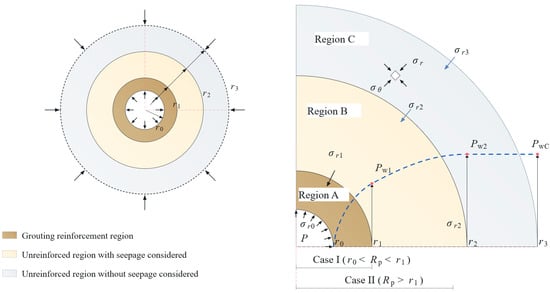
Mechanical model and pore pressure distribution around a pre-grouted shaft. The boundary arrows indicate radial loading. The black dashed circle marks the outer boundary at r3, the blue dashed curve shows the pore pressure profile, and the small square shows the radial and circumferential stresses on a rock element.

Highly Accessed Articles

News & Conferences

Latest Issues

Open for Submission

Journal Sections

XFacebookLinkedIn
Symmetry - ISSN 2073-8994